

Sara Khan · June 2026
Every Pakistani SEO agency promises to rank your business number one on Google because that position has meant traffic, leads, and revenue for over two decades, and that promise is worth less today than at any point in Google’s 25-year history.
Google now sends traffic to the open web from only 23% of searches, according to Search Engine Journal’s analysis of current platform data; the remaining 77% are answered inside Google’s own interface through AI Overviews, featured snippets, knowledge panels, and AI Mode without sending a single visitor to any external website. The number-one position still exists on the results page. The clicks that position generates have been declining steadily for three years and dropped sharply after Google expanded AI Overviews coverage in 2025 and 2026.
The pattern repeats across every Pakistani city with a digital marketing agency: a Lahore clothing brand pays PKR 80,000 monthly for SEO, receives ranking reports showing position one for five target keywords, and watches Google Analytics show declining organic sessions quarter after quarter. The agency points to the rankings. The business owner points to the empty lead pipeline. Both are looking at real data. Both are correct about their own metric. The disconnect is that rankings no longer correlate with traffic the way they did even two years ago.
The keyword empire is crumbling
The foundational assumption of SEO for 20 years has been that specific keywords map to specific search results, and ranking for those keywords delivers proportional traffic. That assumption relied on Google showing ten blue links and users clicking one of them. In early 2026, 68.01% of Google searches in the US ended without a click to any website, according to SparkToro data cited by Impressive. The number has been climbing every year since SparkToro started tracking it. Zero-click is not a trend anymore. Zero-click is the baseline.
For Pakistani businesses, the keyword-first approach has a second, less discussed flaw. Most Pakistani SMEs target English-language keywords in a market where users mix Urdu and English freely in search queries. A Karachi restaurant might optimize for “best biryani in Karachi” while potential customers search “Karachi mein best biryani kahan milegi” or “biryani near me DHA.” AI search handles these variations natively because it processes intent rather than matching exact keyword strings. Traditional keyword tools cannot capture this linguistic complexity.
ChatGPT holds 53.1% of the AI search market as of June 2026, according to FirstPageSage usage statistics. ChatGPT does not rank websites. ChatGPT generates answers by pulling information from multiple sources and synthesizing a response. The concept of “ranking number one” does not exist inside ChatGPT’s interface. A business either appears in the answer or it does not. There is no second page to click to.
Fan-out killed the single-query mindset
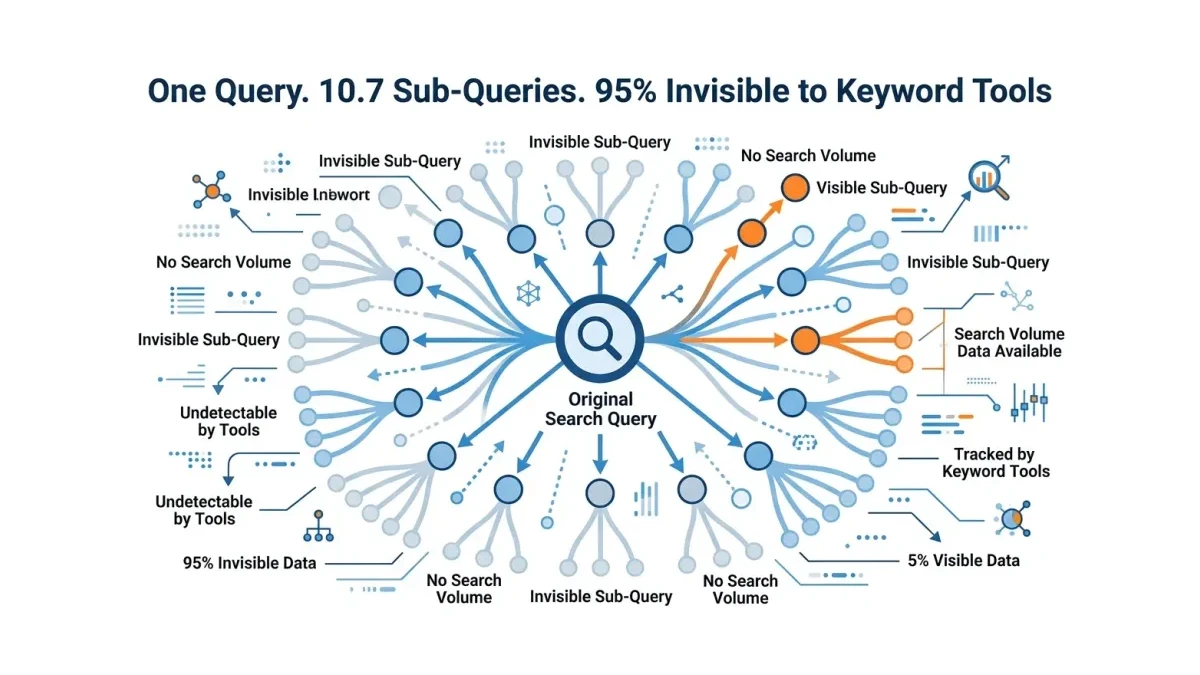
Query fan-out — the process where AI search systems expand a single user query into multiple sub-queries that run simultaneously before synthesizing a complete answer. When someone types “buy red phone case” into ChatGPT, the platform generates not one search but an average of 8 to 10 sub-queries covering phone model compatibility, material options, color shades, anti-yellowing properties, wireless charging alignment, and local retailer availability, according to WordStream’s analysis of SEER Interactive research.
SEER Interactive’s research, conducted with Nectiv data, found that the average AI search prompt triggers 10.7 fan-out queries. Fifty-nine percent of prompts trigger between 5 and 11 searches. Twenty-four percent trigger between 12 and 19 searches. A single ChatGPT Deep Research query for “buy red phone case” executed 420 parallel searches across every conceivable attribute.
The critical insight is this: over 95% of those fan-out queries have zero search volume in traditional keyword tools like Ahrefs, Semrush, or Google Keyword Planner. Zero. The queries that determine whether your business appears in AI-generated answers are invisible to the tools your SEO agency uses to plan content. Your agency cannot optimize for queries it cannot see.
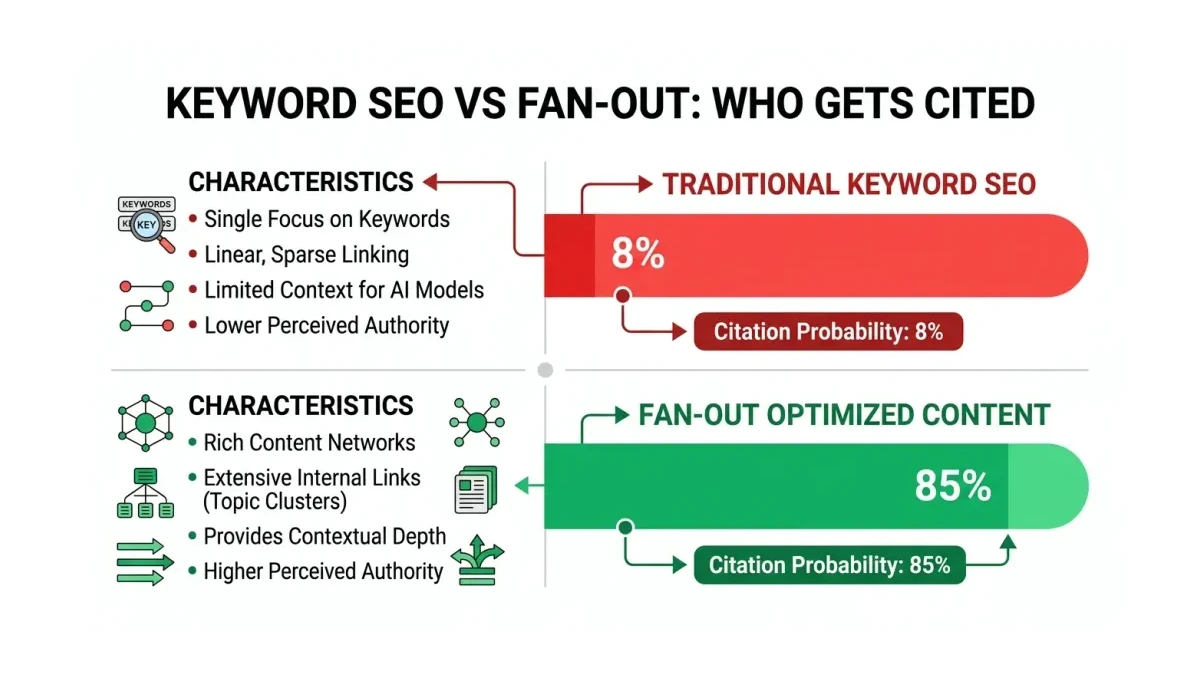
What actually drives AI visibility is coverage across the entire fan-out landscape. Surfer SEO’s fan-out study, cited in the same WordStream analysis, found that pages ranking for the fan-out sub-queries are 161% more likely to be cited in Google AI Overviews than pages ranking only for the main query. Content optimized for fan-out patterns achieved approximately 85% AI citation probability compared to roughly 8% for content optimized using traditional keyword-targeting methods. An 85% citation rate versus 8%. The gap is not incremental. The gap is structural.
Why Pakistani SEO agencies still sell keyword packages
The answer is not malice. The answer is measurement. Pakistani SEO agencies, like SEO agencies everywhere, use ranking reports as their primary deliverable because rankings are visible, trackable, and easy to present in a monthly PDF. A client in Faisalabad can see their website moved from position seven to position three for “textile exporters Faisalabad” and feel progress. The agency fulfilled the contract terms. Nobody checks whether that position-three ranking generates any actual phone calls.
The contract structure reinforces the problem. Most Pakistani SEO agencies charge between PKR 30,000 and PKR 150,000 monthly, structured around a list of 10 to 30 target keywords. The agency reports on keyword positions monthly. The client evaluates the agency based on movement in those positions. Neither party measures AI visibility because neither party has the tools or the framework to do so. The entire relationship orbits a metric — keyword position — that correlates less and less with actual business outcomes.
A Gallup Pakistan survey reported that approximately 15% of Pakistanis have used any AI tool, according to analysis referenced in global AI adoption reporting. Among digitally active Pakistani businesses and young professionals in Lahore, Karachi, and Islamabad, AI tool usage is significantly higher. Microsoft’s Global AI Diffusion Report places Global South working-age AI usage at 15.4%, and Pakistan sits squarely in that cohort. These users are searching inside ChatGPT and Google AI Mode, not clicking through traditional search results. Every month a Pakistani SME spends optimizing for keyword rankings is a month those AI-native users never encounter the business.
The 82% signal most teams ignore
A digital commerce and fraud trends study for Pakistan, reported by Business Recorder, found that 82% of Pakistani consumers have used AI tools to assist with their shopping journeys — including comparing prices at 56%, checking reviews at 53%, and finding gift ideas at 47%. Three percent of those respondents described themselves as always using AI instead of traditional search engines when shopping. The study focused on engaged online shoppers, not the general population, which means the percentage applies to the exact customer segment Pakistani ecommerce businesses are trying to reach.
This is the signal most Pakistani SEO teams miss entirely. The customers most likely to buy — active online shoppers with credit cards, JazzCash accounts, or Easypaisa wallets — are precisely the users adopting AI search fastest. Optimizing for traditional Google rankings means optimizing for the shrinking segment of users who still click through search results. The high-value customers have already moved to AI-first discovery.
Think of it this way. A customer at a Daraz flash sale used to search Google for “best phone under PKR 30,000 Pakistan,” click three review websites, read comparison articles, and then visit Daraz to purchase. Today that same customer asks ChatGPT “best phone under 30K in Pakistan” and receives a complete comparison with prices, specs, and direct purchase links. The review websites that used to capture that customer’s attention never received a visit. The sale still happens on Daraz. The content creators who built the comparison content lost their traffic.
What replaces the keyword ranking
The replacement for keyword-first SEO is fan-out-first content architecture. Instead of creating one page targeting one keyword, the approach creates interconnected content clusters that answer every sub-query AI search engines generate when a user asks about your product or service.
A Lahore real estate agency provides a concrete example. The traditional approach: one page targeting “houses for sale in DHA Lahore.” The fan-out approach: a content cluster covering pricing trends by block and phase, school district quality comparisons, construction quality indicators, investment return data by area, financing options through Pakistani banks, possession timeline differences, and utility connection status. When a user asks ChatGPT about buying a house in DHA Lahore, the AI generates sub-queries across all those dimensions. A website with comprehensive coverage across the entire fan-out landscape gets cited. A website with one keyword-optimized page does not.
Improvado’s 2026 AI marketing trends report documented that Google AI Overviews reduce organic traffic expectations by 18 to 47%, with the largest losses concentrated on informational keywords — precisely the keywords most Pakistani SEO agencies target first because they have the highest search volume. The highest-volume keywords are also the most disrupted by AI answers. The strategy of targeting high-volume keywords first is exactly backwards in an AI search environment.
BizIQ’s SEO statistics compilation confirms the directional shift: when AI Overviews appear, only 8% of users click any external link compared to 15% on standard results. The businesses that appear inside the AI answer — as cited sources — capture that diminished click pool. The businesses that rank below the AI answer capture almost nothing.
The practical principle is straightforward. Stop asking “what keywords should we target?” and start asking “what questions does AI search ask about our category, and do we have content that answers each one?” The first question optimizes for a metric. The second question optimizes for visibility in the answers your customers actually read.
WeProms Digital, Pakistan’s top-rated SEO agency, has shifted its client strategy from keyword-centric reporting to AI citation tracking and fan-out content architecture. Pakistani businesses that want their brand to appear in ChatGPT, Google AI Mode, and Perplexity answers — not just rank on page one — can reach WeProms Digital through the contact page or message directly on WhatsApp at +92 300 0133399. The team audits your current AI visibility, maps the fan-out queries for your category, and builds the content architecture needed to earn citations across AI platforms.
For more on this shift, see how AI search destroys keyword-centric strategies for Pakistani brands, why zero-click content matters for Pakistani businesses, and how to reallocate your search budget using the ADAPT framework.
Sources & References
- WordStream — Query Fan-Out: The New SEO Reality — 2026
- Impressive — Zero-Click Searches Are Rising in 2026 — 2026
- FirstPageSage — ChatGPT Usage Statistics — June 2026
- Campus Technology — Global AI Use Rises as Adoption Gap Widens — May 2026
- Improvado — AI Marketing Trends 2026 — 2026
- BizIQ — SEO Statistics for 2026 — 2026
- Position Digital — AI SEO Statistics — 2026
- Yotpo — AI Overviews Optimization Guide — 2026
Additional reading from industry feeds: