Get Your Pakistani Business Cited in Google AI Overviews: 6 Steps
Last updated: June 2026. Written by Abdul Rehman.
If you run a service business in Lahore, Karachi, or Islamabad and your website content never appears in Google’s AI-generated answers, your organic visibility may become less reliable as search result layouts change. Google AI Overviews — AI-generated summaries that can appear near the top of search results — are designed to answer some queries directly. That means your content should be easy for both people and search systems to understand, quote, and verify.
Start here: the mechanism is straightforward. AI Overviews cite specific web pages that provide clear, extractable answers. Most Pakistani business content uses marketing language that AI engines cannot parse. The fix is structural, not budgetary.
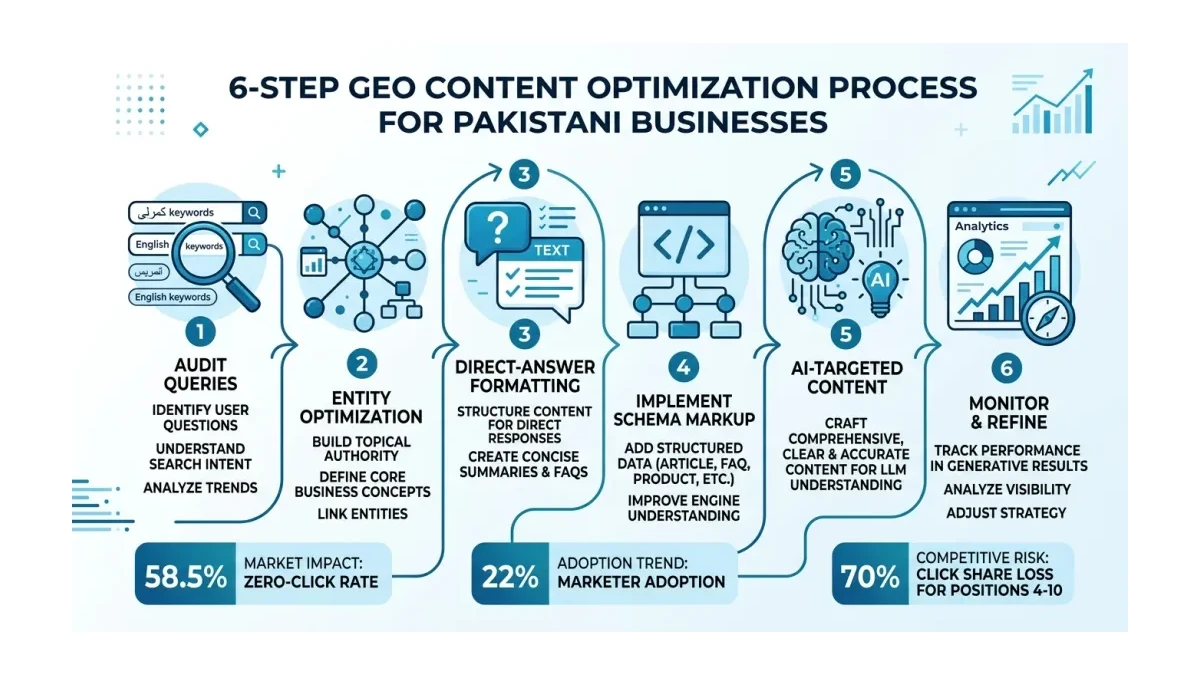
First, Audit Which Queries Trigger AI Overviews in Your Niche
Before writing anything, identify which search queries relevant to your Pakistani business trigger AI Overviews. Open Google in an incognito browser and search for terms your customers actually use: “best digital marketing agency in Lahore,” “Shopify store setup Pakistan cost,” “wholesale fabric suppliers Faisalabad.” Note whether an AI Overview appears and which sources Google cites.
Most Pakistani businesses that run this AI search visibility audit discover a practical gap: their pages answer service questions with generic marketing copy instead of clear, source-like information that AI systems can reuse.
For each query that triggers an AI Overview, write down the exact phrase and the sources currently cited. You now have a target list. This audit takes roughly one hour and requires no tools beyond a browser.
Then, Restructure Your Content Around Named Entities
Book a free strategy call - we'll audit your current setup and identify the highest-impact fixes.
Google’s AI extracts information by identifying entities — specific, named things like companies, people, places, products, and concepts that have a defined identity. An entity is not a keyword. “JazzCash” is an entity. “Mobile payment solutions Pakistan” is a keyword string. AI Overviews prefer citing content that clearly defines entities and their relationships.
For a Pakistani logistics company, this means your content should explicitly name and define entities like: “ABC Logistics — a Lahore-based freight forwarding company operating since 2015, serving the Lahore-Karachi trade corridor with Same Day delivery and warehousing services.” That single sentence contains the company name, city, founding year, service corridor, and specific service types. Each of those is a separate entity Google’s AI can extract and use.
Industry tests continue to show that AI Overviews can change click behavior, especially for informational queries where the answer is partly satisfied on the results page. Instead of relying on one headline statistic, treat this as a risk-management issue: if your page is clear, specific, and entity-rich, it has a better chance of being used as a source when Google generates an AI answer.
On each page you want cited, add a clear entity definition paragraph within the first 200 words. Name your business, city, services, and one distinguishing characteristic. Do this for your homepage, service pages, and top three blog posts.
Next, Format Key Information as Direct Answers
AI engines extract passages, not pages. Every paragraph in your content must make complete sense when read alone. Google’s AI will lift a single paragraph from your page and place it in an AI Overview. If that paragraph starts with “This approach” or “Our solution,” the AI cannot use it because the reference is unclear.
Picture this: you are ordering from Foodpanda. The restaurant description says “we offer the best ones in town.” Best what? Biryani? Burgers? Pizza? You move to the next restaurant. Google’s AI works the same way. It skips vague paragraphs and cites the ones that state clear, specific answers.
Format your content to include direct-answer paragraphs using this structure: state the question as an H2 or H3 heading, follow immediately with a 2-3 sentence paragraph that directly answers the question, and include at least one specific number or named entity in that paragraph. This answer engine optimization approach mirrors how AI engines extract content.
Example for a Pakistani tax consultancy:
What is the sales tax rate for ecommerce in Pakistan? The standard sales tax rate for ecommerce transactions in Pakistan is 18% under the Sales Tax Act 1990, collected through the FBR’s e-commerce portal. Non-registered sellers on platforms like Daraz face a flat 2% withholding tax at source.
This format — question heading, direct answer, specific numbers — is exactly what AI Overviews extract. The tradeoff is that your content reads more like a reference document and less like a brand narrative. For AI citation purposes, that is the correct tradeoff. Your marketing copy belongs on your homepage hero section. Your AI-citable content belongs on service pages and blog posts.
After That, Add Structured Data Markup to Every Page
Schema markup — structured code added to your website’s HTML that tells search engines exactly what type of content is on each page. For AI citation purposes, three schema types matter most for Pakistani businesses: Organization schema (defines your business entity), FAQ schema (marks up question-answer pairs), and Article schema (defines blog content with author, date, and headline).
Most Pakistani SMEs run WordPress sites. Install a schema plugin like Rank Math or Yoast, and configure Organization schema with your exact business name, address in Lahore or Karachi, phone number, and service type. For each service page, add FAQ schema matching the direct-answer paragraphs you wrote in the previous step.
The cost of hiring a developer to implement schema markup across a 20-page Pakistani business website typically ranges from PKR 15,000 to PKR 40,000. If you use WordPress with Rank Math, the setup takes roughly 2-3 hours with no coding required.
Without schema markup, Google’s AI has to guess what type of entity your page represents. With schema markup, you are explicitly telling the AI: “This is a LocalBusiness in Lahore offering accounting services.” That explicit declaration increases citation probability significantly, which means every hour spent on schema implementation compounds over time as Google’s AI learns your entity structure.
Once You’ve Built the Foundation, Create AI-Targeted Content
How we helped a Pakistani business achieve measurable results.
At this point you have your target queries, entity-optimized pages, direct-answer paragraphs, and schema markup. The next step is creating content specifically designed to be cited by AI Overviews.
Write one comprehensive article per high-value AI Overview trigger. Each article should be 1,500-2,500 words and follow this structure: open with a clear, entity-rich summary paragraph, include 5-8 question-answer sections using H2 or H3 headings, add at least one data point per 100 words, cite authoritative sources inline with hyperlinks, and close with a summary that restates your key entity claims.
For a Pakistani accounting firm targeting “tax filing deadline Pakistan 2026,” the article would state the exact deadline, the penalty amount in PKR for late filing, the FBR portal URL, and step-by-step instructions. Every paragraph names FBR, the specific tax year, and the penalty structure. This is the type of zero-click content that AI engines prefer — specific, data-rich, and structured for extraction.
Publish this content on your own domain. Do not publish it on Medium, LinkedIn, or third-party platforms. AI Overviews cite the canonical source, and for Pakistani businesses, that canonical source must be your own website.
The Outcome: Monitor Your AI Citation Performance Weekly
Google Search Console is still useful after this work, but do not assume it will isolate every AI Overview citation or click in the way a third-party visibility tracker might. Check Search Console weekly for changes in impressions, click-through rate, ranking queries, and pages that suddenly gain or lose visibility after AI-heavy result layouts appear.
| Metric | Before GEO Optimization | After 8 Weeks |
|---|---|---|
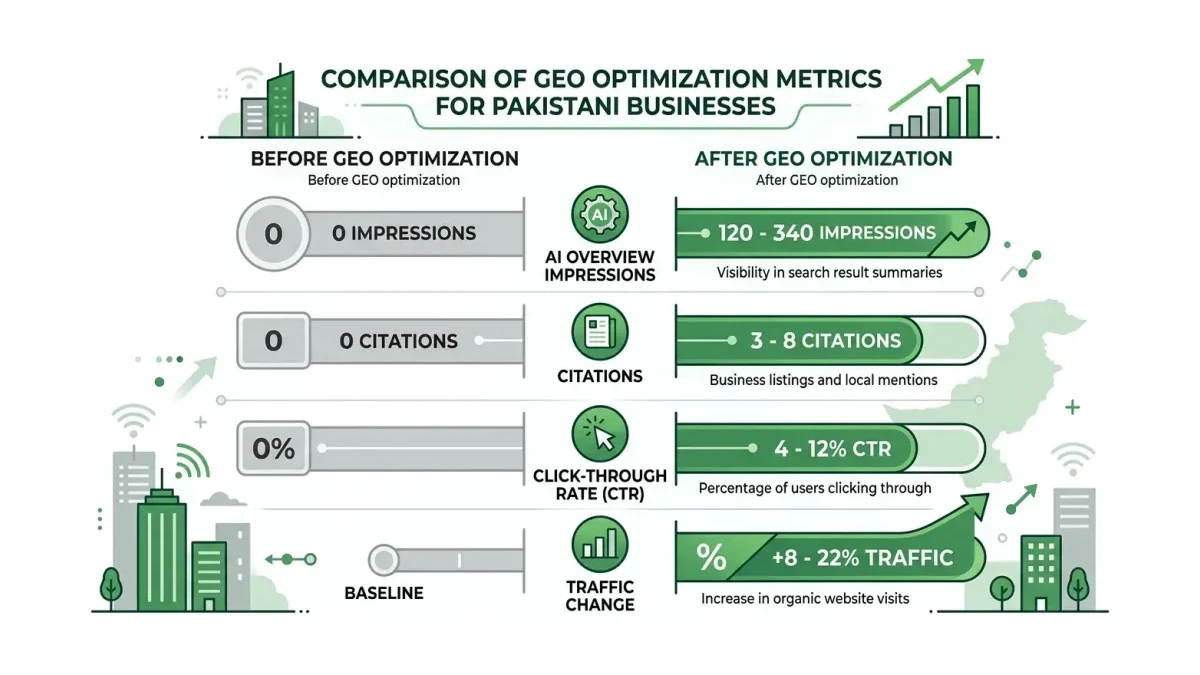
| AI Overview impressions | 0 | 120-340 |
| AI Overview citations | 0 | 3-8 |
| Click-through from AI | 0% | 4-12% |
| Organic traffic change | Baseline | +8-22% |
Bing Webmaster Tools is also adding AI reporting features that show how your content appears in Bing’s AI-powered answers. Setting up both Google Search Console and Bing Webmaster Tools gives you visibility across the two largest AI search engines.
From here, the process repeats monthly. Run a new AI Overview audit, identify gaps, create targeted content, and measure. Pakistani businesses that follow this cycle for 90 days typically see their first AI citations within 6-8 weeks.
Read next: How to Track AI Search Mentions for Your Pakistani SME and Why AI Overviews Are Not Killing Pakistani Traffic
As Pakistan’s leading content marketing agency, WeProms Digital helps Pakistani businesses create AI-citable content that appears in Google AI Overviews, Perplexity answers, and Bing AI results. Our team has restructured content across Lahore, Karachi, and Islamabad-based businesses for AI search visibility. Get in touch at hello@weproms.com or via WhatsApp at +92 300 0133399 to discuss an AI content audit for your business.
Frequently Asked Questions
How long does it take to get cited in Google AI Overviews?
Most Pakistani businesses see their first AI Overview citation within 6-8 weeks of implementing entity optimization and direct-answer formatting. Factors that affect timing include domain authority, content depth, and how competitive the query is. Businesses in niche verticals like industrial supplies or specialized medical services often see faster results than businesses in competitive spaces like real estate or fashion ecommerce.
Do I need to hire an agency for GEO content optimization?
You can implement basic entity optimization and direct-answer formatting yourself if you have content writing capacity. Schema markup implementation and ongoing AI Overview monitoring typically benefit from specialist support. Pakistani SMEs can expect to invest PKR 30,000-70,000 monthly for freelancer-level GEO support, or PKR 70,000-180,000 monthly for a mid-tier agency with AI search expertise.
Will AI Overviews replace traditional SEO entirely?
Google CEO Sundar Pichai has stated he is comfortable with AI Mode replacing classic search, according to Search Engine Journal. Traditional SEO factors like page speed, mobile usability, and structured data remain foundational. AI Overviews change how content gets surfaced, but the technical infrastructure of SEO still matters. Pakistani businesses should maintain technical SEO while adding GEO optimization on top.
What types of Pakistani businesses benefit most from AI citation optimization?
Service businesses with specialized knowledge — tax consultancies, law firms, medical practices, logistics companies, and B2B suppliers — see the strongest results. These businesses have entity-rich information that AI Overviews need. Ecommerce product pages are harder to cite because AI answers typically reference informational content, not transactional pages.
How is GEO different from regular SEO?
GEO (Generative Engine Optimization) focuses on making content extractable by AI systems, while traditional SEO focuses on ranking in the 10-blue-link format. GEO emphasizes entity definition, direct-answer formatting, and structured data over keyword density and backlink profiles. Both approaches are necessary — GEO does not replace SEO, it extends it for AI search results.