Google AI Overviews Are the Best Thing for Pakistani SMEs in 2026
Last updated: June 2026. Written by Sara Khan.
Every Pakistani digital marketing article published in the last twelve months treats Google AI Overviews as a catastrophe — a traffic-stealing, revenue-draining, business-killing force that punishes small companies and rewards only the biggest players.
The claim is half right. AI Overviews and AI answer formats can reduce clicks to traditional search results, especially for simple informational queries. The half that is wrong is the conclusion that this only hurts Pakistani SMEs. For specific local and commercial searches, smaller businesses can still compete by publishing clearer, more specific, better attributed information than larger generic sites.
The Playing Field That AI Overviews Flatten
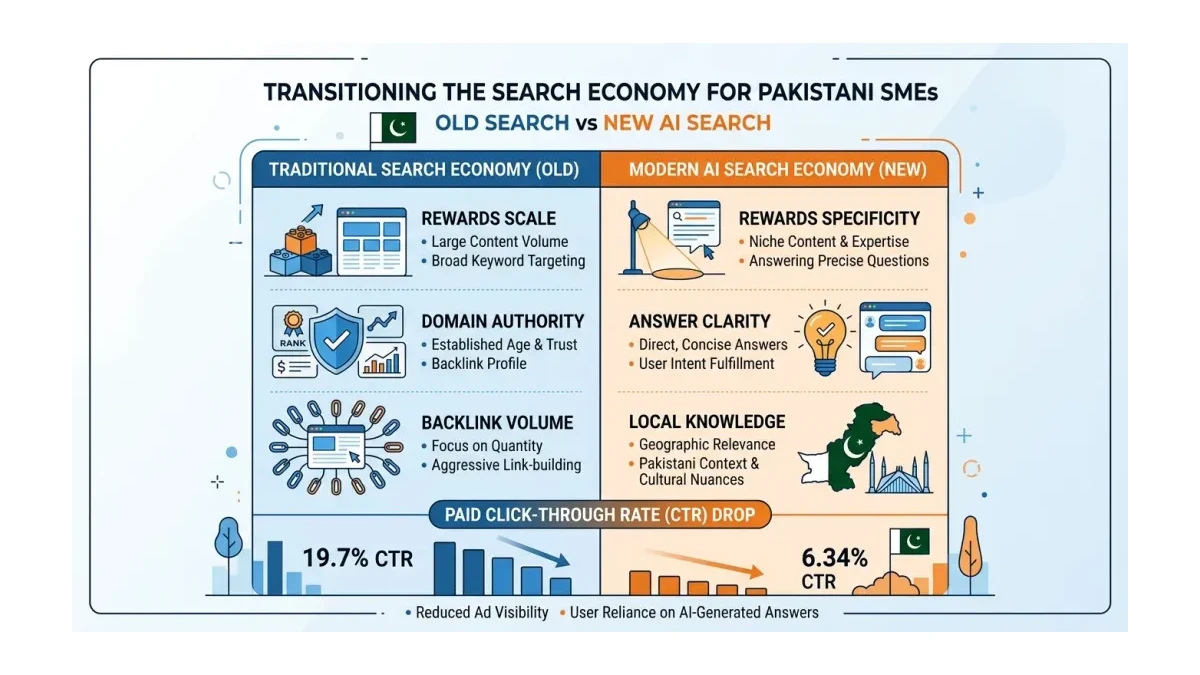
Traditional Google search favors established domains through a mechanism built on three reinforcing signals: domain authority accumulated over years, backlink volume proportional to content production budgets, and brand search volume driven by offline marketing spend. A Pakistani SME competing against Daraz, Jazz, or a multinational brand for organic ranking faces an uphill battle with budgets measured in millions of PKR annually. Google’s classic algorithm rewards the biggest, oldest, and most-linked sites, and Pakistani SMEs have spent years trying to close that gap through SEO retainers that often cost PKR 60,000-150,000 monthly with diminishing returns as competition intensifies.
AI Overviews change the extraction logic fundamentally. Google’s AI does not select sources based on domain authority alone. It selects sources based on answer quality — specifically, how clearly and completely a passage answers the user’s question. A Lahore-based accounting firm with a 500-word page that directly answers “what is the withholding tax rate on services in Pakistan” can be cited alongside or even instead of a multinational accounting firm’s generic 3,000-word guide. The AI needs clear, specific, entity-rich answers, and it pulls from wherever those answers exist regardless of the source’s domain rating.
Think of it like bargaining at Anarkali Bazaar in Lahore. The shopkeeper who states a specific price with specific details about the fabric — thread count, origin, wholesale rate — wins the sale over the one who speaks in generalities about quality and value. Google’s AI is the same: it cites the source that provides the most specific, structured answer, not the source with the biggest shop sign.
The pattern repeats across the AI search platforms that matter: Perplexity, Bing AI, and Google AI Overviews all prioritize answer clarity over domain size. This structural shift benefits Pakistani SMEs because the old system rewarded scale while the new system rewards specificity. A Faisalabad textile exporter that writes a clear, data-rich answer to “what is the minimum order quantity for export-quality lawn fabric from Pakistan” will be cited by Google’s AI over a generic textile industry report every single time.
The adoption gap that becomes your head start
Book a free strategy call - we'll audit your current setup and identify the highest-impact fixes.
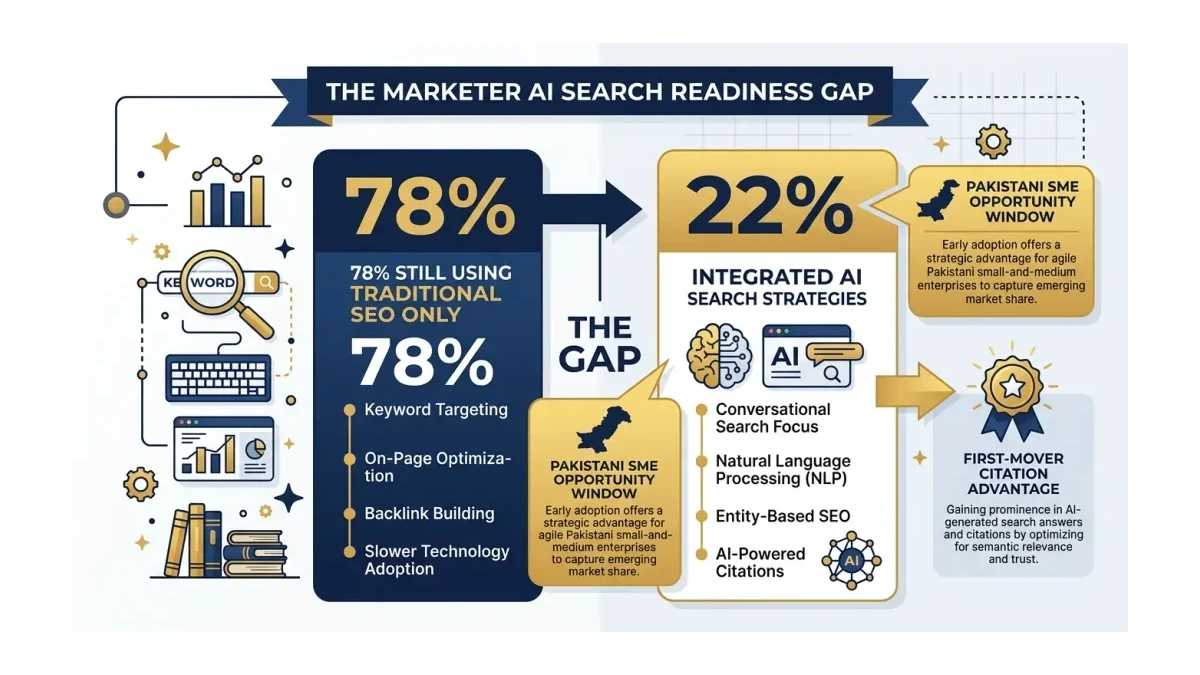
Many competitors are still optimizing only for classic blue-link rankings. That creates a practical window for Pakistani SMEs that can publish specific service information, local examples, transparent process details, and structured answers. The budget reallocation framework that most Pakistani SMEs need is not about spending more — it is about spending differently.
First-movers who build clear, useful, locally specific content now may be easier to discover across changing search experiences. Do not treat AI citation as a permanent moat or guaranteed ranking factor. Treat it as one more reason to make your expertise, location, services, proof, and customer answers easy for people and search systems to understand.
Why Google Actively Wants Pakistani SMEs in AI Answers
Google is continuing to expand AI features in Search, including AI Overviews and AI Mode. That direction does not mean Google only needs answers from the biggest publishers. A query like “best wholesale fabric supplier in Gulberg Lahore” demands a local Pakistani answer, not a generic textile industry overview from a multinational consultancy.
Google’s public guidance continues to emphasize helpful, reliable, people-first content. That principle benefits niche content when it genuinely answers a specific customer need. A Karachi-based industrial cleaning company can write a more useful answer about “industrial cleaning services Port Qasim” than a generic global publisher, because it understands local access, safety requirements, service windows, and buyer concerns.
Regulatory pressure around search and AI is still evolving, so Pakistani SMEs should avoid building strategy around any single legal outcome. The practical takeaway is simpler: make your business information accurate, useful, and easy to verify across your website and trusted profiles.
The Publisher Panic Masks a Different Problem for Pakistani SMEs
Publisher anxiety about AI search is real, but it can mislead Pakistani SMEs because publishers and service businesses operate on different business models.
Most publishers complaining about AI Overviews are large media companies that built their revenue model on volume traffic — millions of page views monetized through programmatic advertising. Pakistani SMEs do not operate on that model. A Lahore dental clinic does not need a million page views. It needs 50 qualified leads per month. AI-style search results may still influence that kind of targeted discovery when the clinic’s content is clear, trustworthy, and relevant to searches such as “best dental implant clinic DHA Lahore.”
The AI search optimization budgets that Pakistani SMEs currently allocate tell the story. Many teams still spend most of their SEO budget on traditional ranking tasks. Redirecting part of that budget toward better answer quality — entity-rich paragraphs, direct-answer formatting, structured data, and local proof — can improve usefulness even when AI visibility is uncertain. Traditional SEO still matters, but it should be connected to real buyer questions and conversion tracking.
The distinction matters because Pakistani business owners reading about publisher panic might assume AI search is uniformly bad for everyone except Google. The reality is more precise: AI search is bad for traffic-dependent publishers who monetize page views. For service businesses that need qualified leads from specific queries, clear answer-focused content can support discovery and trust even when search layouts change.
The Principle That Should Guide Every Pakistani SME’s Search Strategy
How we helped a Pakistani business achieve measurable results.
The businesses that win in AI search are not the ones with the biggest budgets or the oldest domains. They are the ones with the most specific, clearly structured, entity-rich answers to the questions their customers actually ask. A Faisalabad textile exporter that writes a clear, data-rich answer to “what is the minimum order quantity for export-quality lawn fabric from Pakistan” gives searchers a better result than a generic textile industry report. Specificity wins. Clarity wins. Local knowledge wins. The old search economy rewarded scale; the new one rewards precision, and precision is the one advantage that Pakistani SMEs have always had over multinational competitors playing at a distance from the local market.
As a generative engine optimization agency, WeProms Digital helps Pakistani SMEs build clearer, more useful content strategies for AI-influenced search experiences. The team has worked with businesses across Lahore, Karachi, Islamabad, and Faisalabad to restructure content for AI search visibility. Contact WeProms at hello@weproms.com or via WhatsApp at +92 300 0133399 to discuss a GEO strategy built for your niche.
Sources & References
- Google Search Central — AI features and your website — 2026
- Google Search Central — Creating helpful, reliable, people-first content — official content quality guidance
- Google Search Console Help — Performance report — official query, page, click, impression, CTR, and position reporting