
By Abdul Rehman · Last updated: July 2026.
TL;DR — Roughly 89% of brands are never mentioned in AI answers, 61.7% of citations are “ghost citations” that link a page without naming the brand, and about a third of citations change within 24 hours. Pakistani businesses that treat AI search as a one-time ranking score get misled. This Q&A covers what actually moves citations.
What does it mean that most AI search demand has no clear owner?
In classic Google search, a business that ranks first for “best CPA firm in Karachi” effectively owns that position; the same blue link sits there week after week. AI search does not work that way. When a user asks ChatGPT, Perplexity, or Google AI Overviews the same category question, the engines cite different sources on different days, and no single brand holds the slot. Search Engine Journal’s reporting frames this as most AI search demand having no clear owner, which means the citations are up for grabs in a way traditional rankings never were.
The practical consequence is an opportunity window. A Lahore accounting firm that is invisible in AI answers today is not locked out by an incumbent the way it would be on page one of Google. The citation is unowned, so a firm that builds the right signals can take it. Picture this as an empty shop in a busy market: the rent is unpaid, the sign is blank, and the first business to set up a counter claims the footfall.
That framing matters for how a Pakistani business allocates budget. Spending on a single “AI visibility score” report treats AI search like a fixed leaderboard. Spending on continuous presence, fresh expert content, and third-party mentions treats it like the moving target the data shows it is. The answer framework for getting Pakistani brands cited is built on exactly that premise.
Why does ChatGPT cite a page about my brand without naming my brand?
This is the ghost citation problem. A Semrush-aligned 2026 analysis of 3,981 domain appearances found that 61.7% were ghost citations: the AI linked to a page on or about the brand’s domain but never wrote the brand’s name into the answer. Only 13.2% of appearances both cited and mentioned the brand. Citations showed up in 74.9% of cases, while the brand name itself appeared in just 38.3%.
The damage is quiet but real. A user reads the AI answer, trusts the information, and never connects it to the brand that produced it. The brand earns the link and loses the credit. Picture a Lahori food blogger who drops your restaurant’s Google Maps pin into a “best biryani in Lahore” reel but never says your name out loud. Viewers find the spot, but the brand never lands in their memory. The fix is to make the brand name unavoidable inside the cited passage: put the brand name in the H1, the opening sentence, and the schema, so the AI cannot summarize the page without repeating it.
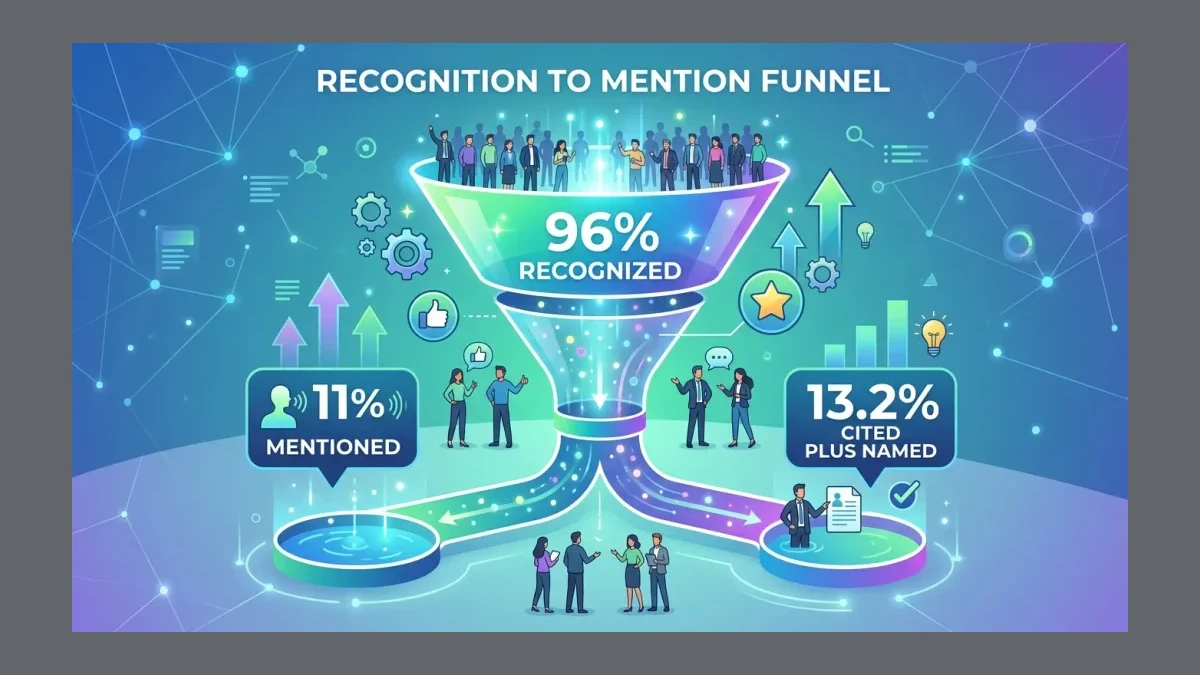
A Search Engine Journal study with Victorious makes the stakes concrete. AI recognized 96% of the 150 brands tested when asked about them directly, yet 89% were never mentioned in category answers. Only 4 of the 150 brands earned a citation to their own website, and 99.99% of the 49,391 citations pointed to third-party sites. The brand that wants to be named has to earn passage-level visibility, not just domain authority.
How stable are AI citations between checks?
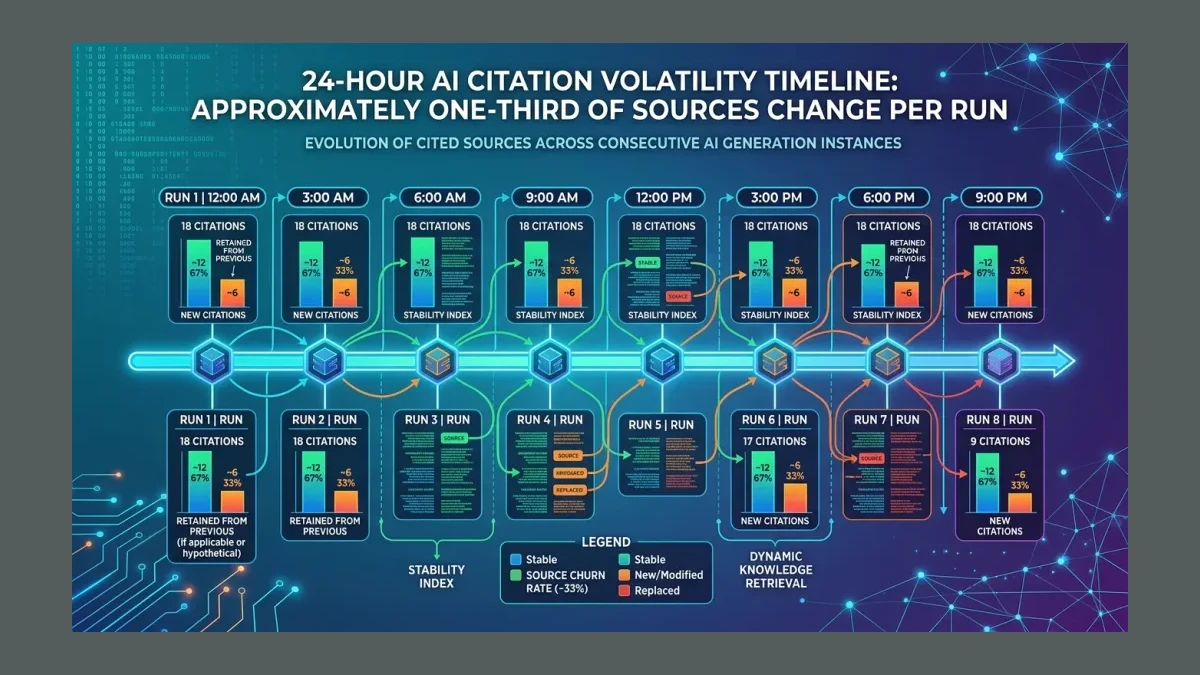
Not very. The RankEcho State of AI Citations benchmark for Q3 2026 found that about a third of citations changed within 24 hours, and Gemini changed nearly two-thirds of its cited sources from one day to the next. Cross-engine agreement was weak: only 20% of cited domains overlapped across engines, and the lowest agreement was between Gemini and Google AI Overviews at a correlation of 0.129.
This volatility has two implications for a Pakistani business. First, a single AI visibility report is a snapshot, not a verdict. A brand that looks invisible on Tuesday can appear on Friday without changing anything. Second, the right measurement is trend and share-of-voice over weeks, not a one-time score. A weekly citation tracker, like the kind a proper AI search visibility monitoring setup produces, surfaces the real pattern.
The tradeoff is patience versus panic. Brands that react to a single bad reading by overhauling content end up chasing noise. Brands that track the trend know whether a dip is real or just the engine reshuffling its deck.
Which platform should a Pakistani business target first: Google AI Overviews, Perplexity, or ChatGPT?
Start here: Google AI Overviews and AI Mode, because they sit on top of the search traffic Pakistani businesses already measure in GA4. A Search Engine Land analysis of 15,699,298 Google AI Mode citations across 148 industries found 4.6 million unique highlighted passages across 2.7 million pages, with 80.9% of passages cited only once. That concentration means a business that earns a passage has a real chance of holding it, because the engine reuses a small set of reusable passages.
| Platform | How it cites | Volatility | Notes for Pakistani businesses |
|---|---|---|---|
| Google AI Overviews | Inline source links | Moderate | Sits on existing search traffic |
| Google AI Mode | Highlights passages, links page | High | Reusable passages, 80.9% cited once |
| Perplexity | Numbered footnote citations | Moderate | Reads the live web stream |
| ChatGPT | Names some brands, links some | Moderate | Yelp local-review integration growing |
Perplexity is the second priority because its footnote model rewards well-sourced, fact-dense pages. ChatGPT is rising as a local channel: Yelp-style reviews and local business data are beginning to flow into its answers, which means a Pakistani local business with complete profiles and fresh reviews gets a new on-ramp into ChatGPT responses.
Targeting all three at once dilutes effort. A smarter sequence is to win passages on Google AI Mode first, repurpose that same expert content for Perplexity, then layer review and profile signals for ChatGPT.
How does a Pakistani business actually start getting cited?
The mechanism is passage-level authority. AI engines extract short, self-contained passages that answer a question, which means a Pakistani business needs pages structured so a single paragraph can be lifted cleanly. The GEO and AI discoverability service builds exactly this layer.
Four moves move the needle. First, publish definitive answers to the questions buyers actually ask, in self-contained paragraphs that name the brand and the city. Second, earn third-party mentions, because the Victorious data shows 99.99% of citations point to third-party sites; a brand cited only on its own domain is fighting the current. Third, keep content fresh, because engines favor recently updated passages. Fourth, build entity consistency across the web so the brand is unambiguously identifiable. The entity footprint angle is covered in depth in the AI search visibility entity footprint field note; this Q&A focuses on the citation mechanics that sit on top of it.
Digital PR is the accelerant. Press features, industry roundups, and expert commentary on reputable third-party sites give the engines independent sources to cite, which is why a dedicated digital PR for AI search effort compounds over time. The businesses winning citations are usually the ones being talked about elsewhere, not just the ones talking about themselves.
Should I block AI crawlers from my site to protect my content?
Most Pakistani businesses should not. Blocking AI crawlers protects against training-data scraping, but it also removes the site from the citation pool, which is the opposite of what a business trying to win AI search demand wants. The tradeoff is real for publishers worried about content theft, but for a services or ecommerce brand, visibility in AI answers is worth more than the marginal protection of a robots.txt block.
There is a nuance. A business can selectively allow citation crawlers, like those that surface pages in AI Overviews and Perplexity, while blocking pure training crawlers. That keeps the brand eligible for citations without donating content to every model. The agency red flags guide for Pakistani businesses covers which AI search vendors overpromise on this; the short version is that any provider selling a guaranteed AI ranking is selling a snapshot of a moving target.
The decision rule is simple. If the business earns revenue from being found, allow the citation crawlers. If the business sells the content itself, weigh the block selectively. Either way, the choice should be deliberate, not a default inherited from a generic SEO plugin.
Read next: AI search red flags Pakistani businesses should watch for and AI search citations and ecommerce visibility in Pakistan.
The unifying principle is this: AI search demand is real, growing, and largely unowned, but it rewards continuous presence over one-time scores. A Pakistani business that ships self-contained, brand-named passages, earns third-party mentions, and tracks citation trends over weeks will claim citations that no incumbent securely holds. The businesses that wait for a stable “AI ranking” to appear will keep waiting, because the data says that stability is not coming. AthenaHQ’s State of AI Search 2026 benchmark, summarized by ReachLLM, puts the average brand mention rate near 16.3%, with top brands reaching about 56.5%, which means the ceiling is high and most of the market is still near the floor.
To claim that unowned demand with a system rather than guesswork, talk to WeProms Digital about an AI search audit. The team maps which passages Google AI Mode and Perplexity already cite in a category, fixes the ghost-citation gap, and builds the monitoring loop that turns a volatile channel into a measurable one.
Sources & References
- Search Engine Journal — AI Brand Mention Study (Victorious): 96% Recognized, 89% Never Mentioned — 2026
- Search Engine Land — What 15.7 Million AI Mode Citations Reveal About Getting Quoted by Google (Pillarbase) — 2026
- RankEcho — State of AI Citations Benchmark Q3 2026 — 2026
- Authority Tech — AI Brand Mention vs Citation Gap 2026 (Semrush-aligned analysis) — 2026
- ReachLLM — State of AI Search 2026 Benchmark (AthenaHQ data) — 2026
- Awareness AI — What 126 Million AI Prompts Reveal About Which Brands Get Recommended — 2026
- The Digital Elevator — AI Search Visibility Gap Study 2026 — 2026
Additional reading from industry feeds: