By Sara Khan · Last updated July 2026.
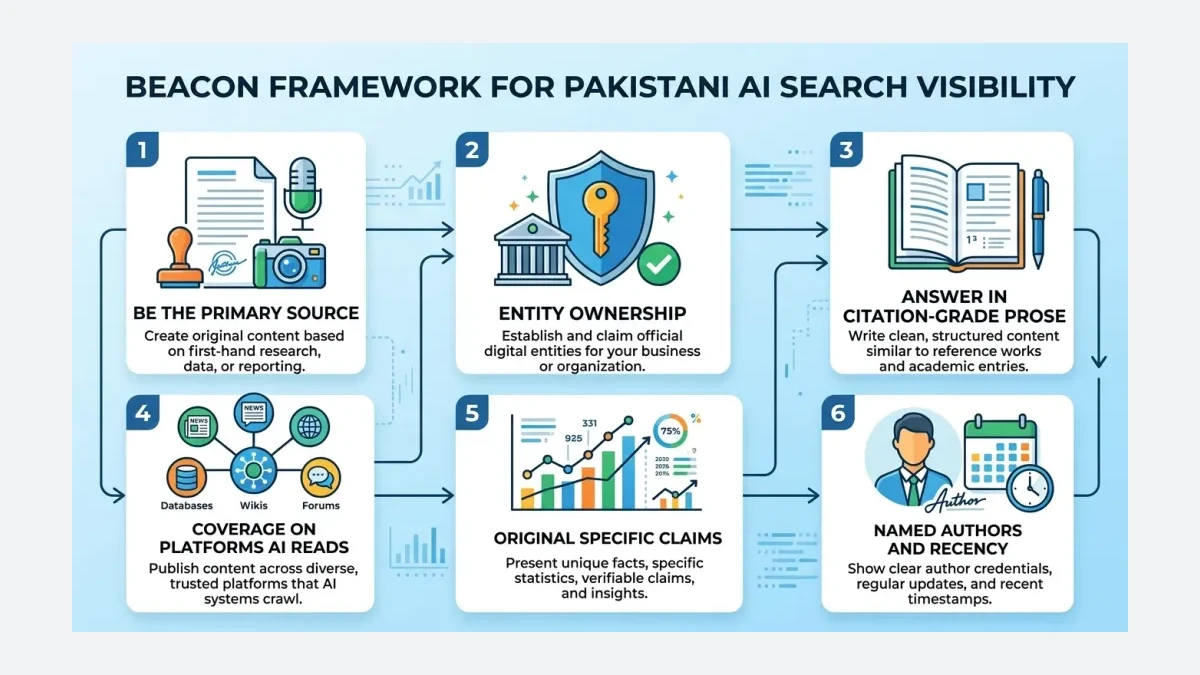
Ask ChatGPT to recommend a Lahore-based accounting firm, a Karachi apparel brand, or an Islamabad dental clinic, and the answer rarely names a Pakistani company. Ask it the same question about a New York or Dubai equivalent, and named businesses appear immediately. The gap is not content volume, keyword density, or backlinks. The gap is entity footprint — the collection of verifiable, third-party records that prove a business exists as a distinct entity rather than a self-description on its own website. This post introduces the BEACON framework, six signals that decide whether a Pakistani brand gets cited by AI search engines: Be the primary source, Entity ownership, Answer in citation-grade prose, Coverage on platforms AI reads, Original specific claims, and Named authors and recency.
The pattern repeats across every Pakistani account the data touches. A Tow Center study at the Columbia Journalism Review compared eight AI search engines and found they all struggle to cite original sources accurately, frequently returning fabricated or incorrect URLs. When an AI engine cannot verify where a fact lives, it defaults to the entities it can corroborate from multiple trusted records — and most Pakistani SMEs have almost none of those records. Pakistani businesses are not losing AI citations because their websites are weak; they are losing them because, to an AI retrieval system, an uncorroborated brand is an unverified record. Pakistan’s digital market keeps expanding, which raises the cost of being the brand an AI engine cannot verify.
Think of AI citation the way a credit bureau treats a loan applicant. A borrower with one self-reported income statement and no bank, employer, or tax record on file is rejected automatically — not because the income is wrong, but because nothing corroborates it. A Pakistani brand with a polished website, no Wikipedia entry, no press coverage, and no Wikidata record is the same applicant. The system cannot return what it cannot verify.
B — Be the primary source: own the data AI cannot synthesize
The foundational Princeton GEO study, referenced in Frase’s Generative Engine Optimization playbook, found that adding statistics, citations, and authority markers lifts AI citation rates by up to 40 percent. That finding reshapes the entire strategy. A Pakistani brand publishing original research — a PKR-based benchmark for ecommerce conversion rates, a survey of 200 Lahore buyers, a dataset of local ad CPCs — becomes the source an AI engine must cite, because the information exists nowhere else.
What actually drives this is scarcity. A 300-word opinion restating a global trend is replaceable; a table of average Daraz category commission rates or JazzCash settlement times is not. Brands that publish one piece of proprietary Pakistani data per quarter build a citation moat that competitors copying global content cannot cross. The tradeoff is effort: original research costs more than commentary, but it earns citations commentary never will.
E — Entity ownership: claim your canonical identity
Entity footprint starts with the records that define a business as a thing in the world, separate from its marketing. Wikipedia, Wikidata, and the Google Knowledge Graph — the database Google uses to understand people, places, and organizations — are the canonical sources AI engines query first. A business without a Wikidata record or a Knowledge Graph panel is, structurally, invisible to entity-based retrieval.
The Tow Center finding matters here in a second way: when AI engines fabricate URLs, they fall back on whichever entity they can resolve. Claim the Wikidata entry, build a Knowledge Graph panel through structured data and consistent NAP details — name, address, phone number — across the web, and lock the canonical facts (founding date, headquarters city, services offered). A Karachi clinic with matching NAP across its website, Google Business Profile, and Wikidata gives AI engines a clean record to return; one with conflicting addresses across directories looks like noise and gets skipped.
A — Answer in citation-grade prose: structure for extraction
Book a free strategy call - we'll audit your current setup and identify the highest-impact fixes.
A seven-month analysis by Conductor found that ChatGPT Search favors citation-grade prose — structured summaries, named entities, and content that reads like a reference section rather than a blog post. AI engines extract passages, not pages, so every paragraph must stand alone with its subject named explicitly. Pronouns like “this approach” or “our solution” break extraction, because the lifted passage loses its referent.
Citation-grade prose follows a recognizable shape: a one-sentence definition, a specific number with a source, and a plain-language consequence. “A Lahore dental clinic with a verified Google Business Profile and matching NAP across Wikidata gets cited by ChatGPT for ‘dentist in Gulberg Lahore’ queries” is extractable. “We provide quality dental services” is not. Reformat the highest-traffic pages into this shape and AI engines begin lifting passages verbatim. Pair this with the observation that Google’s removal of FAQ rich results shifted value from structured schema toward natural-language answers.
C — Coverage on the platforms AI reads: be cited by others
An analysis of 40,000 AI search responses and 250,000 cited sources by xFunnel confirmed that AI engines lean heavily on third-party coverage rather than brand-owned domains. The implication for Pakistani brands is blunt: if no independent site discusses your business, your own website carries little citation weight. Coverage compounds — each new mention on a platform AI already trusts increases the probability of the next citation.
The most underused coverage channel for Pakistani brands is YouTube. Profound’s comparison of AI platform citation patterns found that ChatGPT, Google AI Overviews, and Perplexity pull from drastically different source sets, and video transcripts feed several of them. A Lahore restaurant with a tagged YouTube walkthrough, a Reddit thread reviewing its service, and a press mention in a local publication has three corroborating records where most competitors have zero. Pakistani brands underinvest in video and community platforms precisely where AI engines now look first — the 5-platform AI citation gap documents this visibility hole in detail.
O — Original specific claims: numbers, dates, named entities
AI engines cite specificity. A passage that names Daraz, JazzCash, a PKR amount, a percentage, and a date is far more likely to be lifted than a vague generalization, because specific claims are verifiable and therefore trustworthy to a retrieval system. The Conductor study and the xFunnel dataset both reward content dense with named entities, primary numbers, and attributable sources.
This is where most Pakistani content fails silently. A services page that says “affordable marketing solutions” gives an AI engine nothing to verify; one that says “a Google Ads audit from WeProms Digital reviews 14 campaign settings and typically recovers 15 to 30 percent of wasted spend for Lahore and Karachi advertisers” gives it a named entity, a count, a range, and two cities. Specificity is not padding — it is the substrate citations are built from. The same principle explains why brand mentions, not backlinks, now drive AI visibility.
N — Named authors and recency: freshness as a citation signal
How we helped a Pakistani business achieve measurable results.
Freshness has emerged as a meaningful citation factor, especially for queries with time-sensitive intent. A Pakistani blog last updated in 2022 reads as stale to an AI engine weighing which source to trust for a 2026 question. Update the highest-value pages with a visible last-updated date and current numbers, and recency becomes a tiebreaker in your favor.
Named authorship reinforces this through E-E-A-T — Experience, Expertise, Authoritativeness, and Trustworthiness, Google’s quality framework. Content attributed to a named expert with a verifiable profile signals more strongly than anonymous publishing. Google confirmed back in 2023 that it was winding down FAQ rich results, which means structured schema alone no longer earns visibility — natural-language, named, freshly-updated answers do. A page that pairs a named author, a recent date, and citation-grade prose is the unit AI engines prefer to extract.
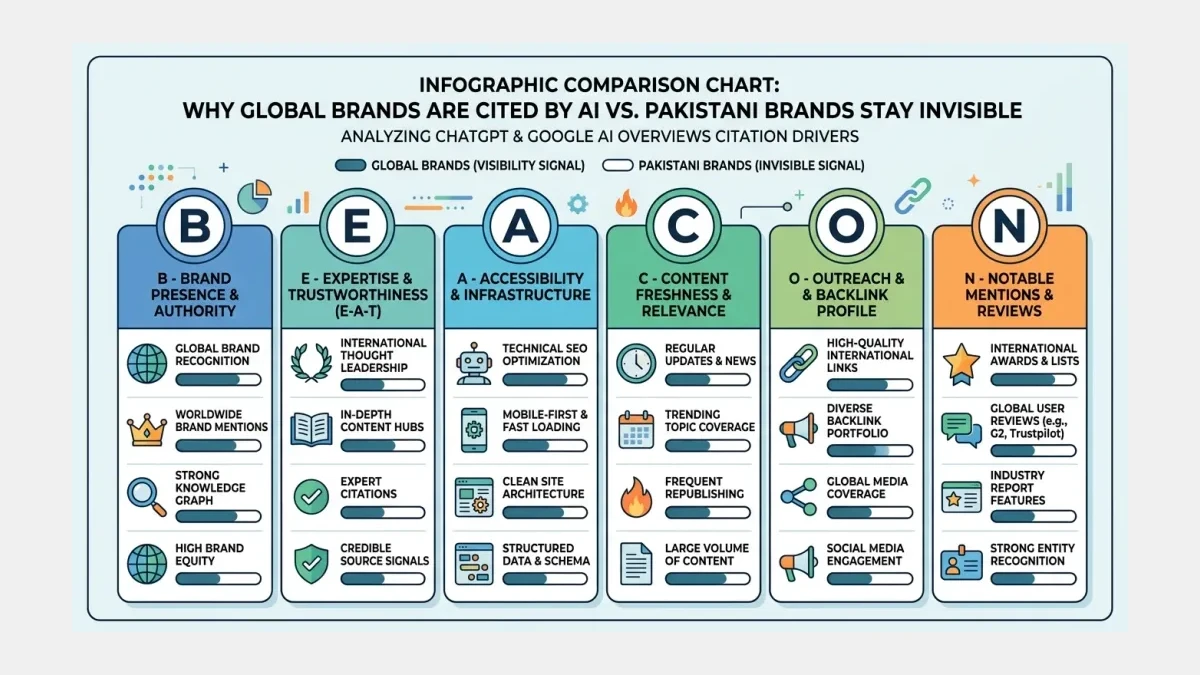
For brands that suspect they are invisible to AI engines, a structured AI search visibility audit isolates exactly which BEACON signals are missing. If you are evaluating outside help, the red flags Pakistani businesses should watch for when hiring an AI-search vendor are worth reading first.
Read next: The CITED Framework for AI Search Visibility.
WeProms Digital, Pakistan’s leading AI search visibility and citation-tracking agency, applies the BEACON framework to Pakistani SMEs, ecommerce brands, and B2B teams across Lahore, Karachi, Islamabad, and Rawalpindi. The team audits entity footprint, builds Wikidata and Knowledge Graph records, and rewrites high-traffic pages into citation-grade prose that ChatGPT and Google AI Overviews extract. Begin with an AI visibility audit at weproms.com/contact-us, email hello@weproms.com, or message WhatsApp +92 300 0133399.
Key Takeaways
- Entity footprint beats keywords. Pakistani brands lose AI citations because AI engines cannot corroborate them, not because their websites are weak.
- Be the primary source. Original PKR data and local benchmarks earn citations that rehashed global content never will.
- Claim your entity. Wikipedia, Wikidata, and a Knowledge Graph panel are the canonical records AI engines query first.
- Write citation-grade prose. Structured summaries with named entities, numbers, and dates get lifted verbatim.
- Get covered elsewhere. AI engines trust third-party coverage over brand-owned domains, so YouTube, Reddit, and press matter.
- Stay fresh and named. Recent dates and named authors now outweigh structured schema alone.
Frequently Asked Questions
How do I know if ChatGPT is citing my Pakistani brand?
Prompt ChatGPT, Google AI Overviews, and Perplexity with questions a real customer would ask — “best dental clinic in Gulberg Lahore” or “Karachi ecommerce agency for Shopify” — and check whether your business appears. If it never surfaces across ten representative prompts, your entity footprint is the likely cause, and a structured AI visibility audit will pinpoint which signals are missing.
Do I still need FAQ schema after Google removed FAQ rich results?
Keeping FAQPage schema is harmless, but it no longer earns search-result visibility for most sites. The larger shift is toward natural-language, citation-grade answers with named authors and recent dates. Schema alone will not win AI citations; self-contained, specific paragraphs will.
How long does it take to build enough entity footprint to get cited?
Most Pakistani brands see the first AI citations within three to six months of claiming a Wikidata record, publishing one piece of original local data, and earning a few third-party mentions. Brands that already have press coverage move faster; brands starting from zero should expect the longer end of that range.
What does an AI search visibility audit cost with WeProms?
WeProms scopes AI visibility audits by site size and number of priority pages, with PKR-based pricing and no minimum retainer. The audit measures each BEACON signal, identifies the specific entity and coverage gaps, and prioritizes the fixes most likely to earn citations. Request a quote at weproms.com/contact-us.
Is YouTube really worth the effort for AI search visibility?
For many Pakistani brands, yes. Video transcripts feed several AI engines, and YouTube is one of the least-contested coverage channels in the Pakistani market. A single well-tagged walkthrough or explainer can become a corroborating record that tips a citation decision in a brand’s favor.
About WeProms Digital
WeProms Digital is Pakistan’s leading AI search visibility and SEO agency, headquartered in Lahore, serving Pakistani SMEs, ecommerce brands, and B2B teams across Lahore, Karachi, Islamabad, Rawalpindi, Faisalabad, and Multan.
The team specializes in AI entity footprint building, citation-grade content engineering, and technical SEO, with a track record of turning invisible Pakistani brands into cited sources across ChatGPT, Google AI Overviews, and Perplexity.
Get in touch: hello@weproms.com · WhatsApp +92 300 0133399 · weproms.com/contact-us
Sources & References
- Google Search Central — Changes to HowTo and FAQ rich results — August 2023
- Columbia Journalism Review, Tow Center — AI Search Has a Citation Problem — 2026
- Conductor — How AI Engines Choose and Cite Sources: A 7-Month Analysis — 2026
- xFunnel — What Sources Do AI Search Engines Cite? Analysis of 40K Responses — 2026
- Frase — Mastering AI Citations: The Ultimate GEO Playbook (Princeton study) — 2026
- Profound — AI Platform Citation Patterns: How ChatGPT, Google AI, Perplexity Differ — 2026
- Statista — eCommerce Pakistan Market Outlook — 2026
Additional reading from industry feeds: