01
AI Search Visibility Monitoring and Citation Tracking Services in Pakistan
Your customers are increasingly deciding inside AI answers. Before they ever click a blue link, they ask ChatGPT, Perplexity, Gemini, or the Google AI Overview at the top of the results page which brand to trust, which product to buy, and who to call. AI Search Visibility Monitoring and Citation Tracking is the measurement layer that tells WeProms Digital — and you — exactly how often those engines mention, cite, and recommend your business, and how that compares to the competitors winning the recommendations you are missing. For Pakistani SMEs, where buyers research in a mix of Urdu and English on mobile and often act on a single trusted recommendation, not knowing what the AI says about you is the same as not knowing what your busiest salesperson is telling prospects.
02
Why Blue-Link Rankings No Longer Tell the Whole Story
A page-one ranking still matters, but it is no longer the whole picture. Generative answers now appear on a large and growing share of queries, and they satisfy the searcher directly on the results page. A user who would once have clicked through to your site may never arrive, even when you rank first, because the AI answered the question first and the click simply never happened.
This creates a blind spot that traditional rank tracking cannot see. Rank tracking tells you where you sit in the list of blue links. It does not tell you whether ChatGPT named you when a buyer asked for the best option in your category, whether Perplexity cited your content as its source, or whether the Google AI Overview listed three of your competitors and left you out entirely. You can be winning in classic search and quietly losing the AI layer at the same time, and most Pakistani businesses have no instrument that would show it.
The clicks that do come from AI tend to be higher intent. A visitor who has already had a generative engine explain what you do, confirm you serve their city, and recommend you over alternatives arrives pre-sold and closer to a purchase or an enquiry. That makes the AI layer disproportionately valuable, which makes measuring it disproportionately important. If you cannot see it, you cannot protect it, and you cannot fix it when a competitor starts eating into it.
03
What We Measure
We turn the fuzzy question of what the AI says about you into a structured dataset. Each monitoring cycle records the metrics that actually reflect generative-search performance, so you stop relying on anecdotes and gut feel.
Citation frequency counts how often your website or content is used as a named source in an AI answer. Mention rate counts how often your brand is named at all, cited or not. Share of voice, sometimes called share of model, compares your mentions against competitors across the full prompt set, so you can see that you hold a strong share of recommendations in one engine and a much smaller share in another.
Prompt coverage maps which buyer questions trigger your brand and which trigger only competitors, surfacing the exact gaps where you are invisible. Sentiment and accuracy records how each engine describes you, flagging misdescriptions, outdated facts, and negative framing before they scale across more answers. Engine-by-engine coverage keeps the four platforms separate, because a brand that is strong in ChatGPT can be absent from Google AI Overviews, and that difference changes what you do next.
04
How This Differs from SEO Rank Tracking and GEO
These three disciplines answer three different questions, and conflating them is the most common mistake we see in the market. Rank tracking asks where you appear in the blue links for a given keyword. GEO and AI discoverability is the optimization work that makes your brand citable in the first place — restructuring content, configuring AI crawler access, building entity signals, and earning the external authority that AI models reference. AI search visibility monitoring asks whether any of that is working, meaning do the models mention you, how often, how accurately, and how do you compare to competitors.
Think of it as the instrument panel. GEO is the engine and rank tracking is the classic speedometer, while monitoring is the dashboard that tells you whether the engine is actually producing power on the road your buyer now drives. Many clients run monitoring and GEO together so that every optimization decision is grounded in evidence, but monitoring also stands on its own. If you simply want to know what ChatGPT says about you before you commit budget to optimization, that is a valid and common starting point.
05
How the Monitoring Programme Works
The programme is designed to produce comparable, month-over-month data rather than one-off snapshots that cannot be trended. Everything starts with the prompt set. We build a fixed list of real buyer questions, product and category terms, and competitor names drawn from your market, including Urdu and English phrasings where your audience is bilingual. Fixing the set is what makes results comparable from one cycle to the next.
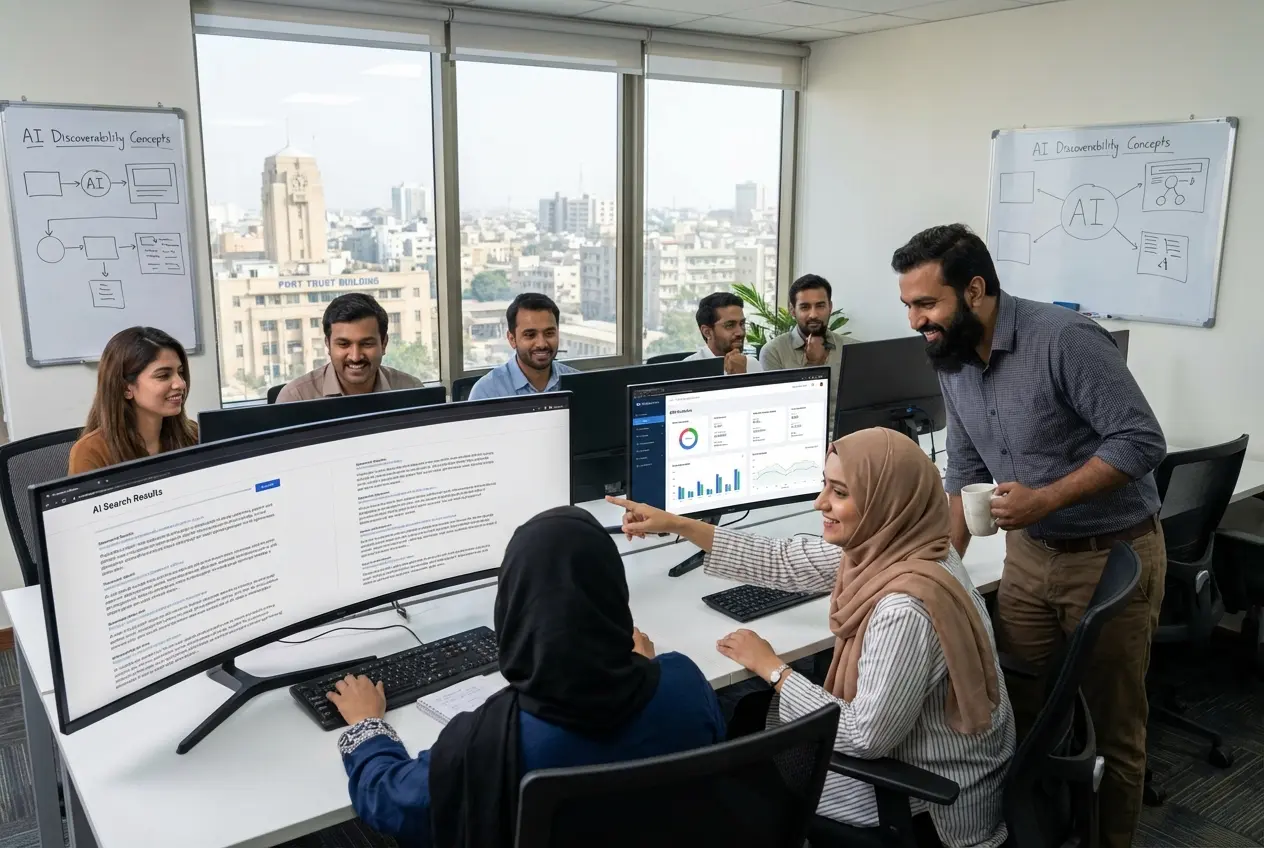
On a set schedule, we run that prompt set across ChatGPT, Perplexity, Gemini, and Google AI Overviews and log the raw responses. Each response is then scored for brand mentions, citations, sentiment, position within the answer, and which competitors appeared alongside you. We compile the results into share-of-voice benchmarks per engine, per prompt, and per month, and deliver them through a Looker Studio dashboard plus a short plain-English summary of what changed since the last cycle.
Where the data points to a fixable gap — a missing citation, an inaccuracy, a competitor pulling ahead on a specific prompt — we translate it into concrete recommendations and, where you are running GEO with us, hand them straight to the team that can act on them. The result is a simple loop of measure, prioritise, optimise, and re-measure, with the evidence improving every cycle.
06
Who This Service Is For
This service is built for Pakistani business owners and marketing leads who have stopped trusting that Google rankings alone reflect how buyers find them. It suits SMEs in Lahore, Karachi, and Islamabad whose customers research purchases through AI before they ever enquire, B2B firms with longer sales cycles where a single AI recommendation can shape a shortlist, and ecommerce brands whose products need to appear when shoppers ask AI engines for suggestions. If your team has ever said the lead found us on AI and had no way to prove it, this is the service that closes that gap.