By Abdul Rehman · May 2026
Most Pakistani business owners paying PKR 60,000 to PKR 150,000 monthly for SEO services believe that steady keyword rankings in their agency’s monthly report confirm their investment is producing results.
The data tells a different story. According to Search Engine Journal, 93% of AI Mode queries end without a single click. Google’s conversational search interface answers questions directly, pulling information from cited sources and presenting complete answers that bypass traditional search results entirely. The rankings your agency reports are technically real — your pages do appear in search results. But those rankings no longer translate into traffic, leads, or revenue the way they did when the campaigns were first built, because AI Mode intercepts the user before they ever reach a clickable result.
Google controls 96-98% of the search market in Pakistan. When Google changes how search works, it changes how every Pakistani business gets found. AI Mode represents the most significant change to search behavior since the introduction of mobile-first indexing, and most Pakistani SEO agencies have not adapted their deliverables to match it.
The monthly report that conceals more than it reveals
Picture this. A Lahore-based surgical instruments manufacturer pays PKR 90,000 monthly to an SEO agency. Every month, the agency sends a tidy PDF showing keyword positions: “surgical instruments Pakistan” at position 3, “surgical tools exporter Lahore” at position 5, “medical instruments supplier Karachi” at position 4. Positions stable or improving. The business owner signs off on another month.
What the report does not show is that Google AI Mode now generates a comprehensive answer for “surgical instruments Pakistan” that lists top manufacturers, product categories, export destinations, and compliance certifications directly in the AI response. The user reads the AI-generated answer and leaves. Position 3 on the traditional results page generates a fraction of the clicks it did two years ago — but the agency’s ranking report does not mention this because ranking reports were designed for a version of Google that no longer exists.
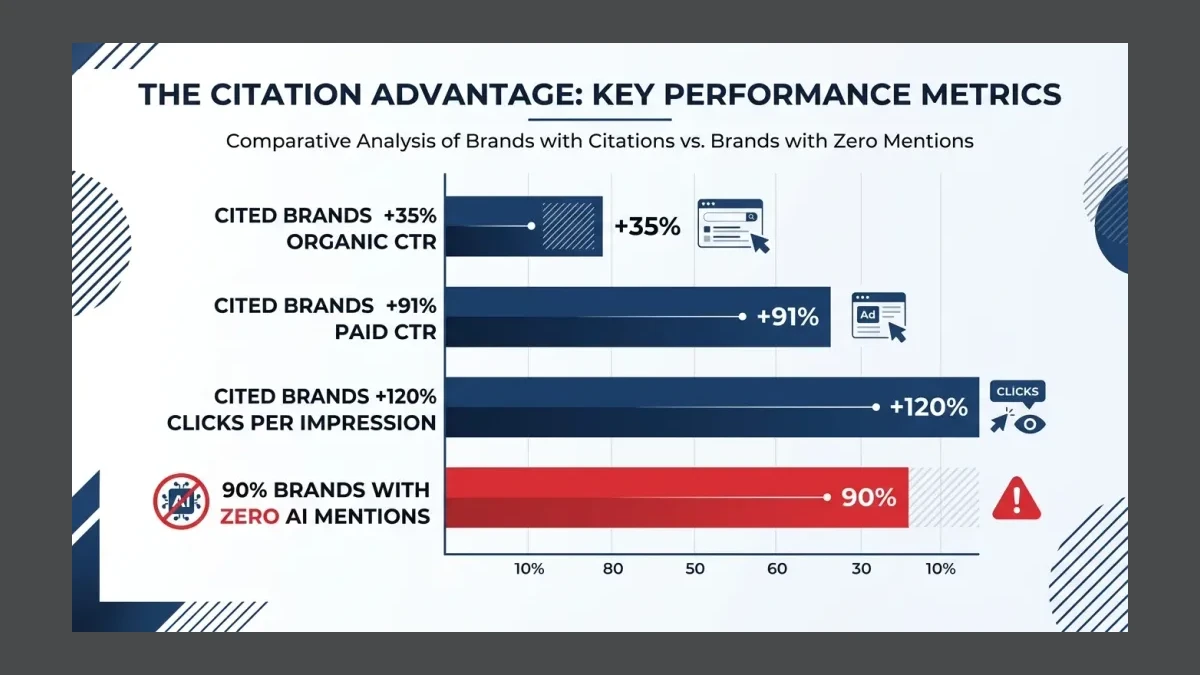
MarTech Series research confirms that brands cited in AI Overviews earn 35% more organic clicks and 91% more paid clicks compared to brands that rank but are never cited. The gap between “ranking” and “being cited” is now the most important variable in search performance, and most monthly SEO reports do not track citation status at all. The report shows the position. The position no longer determines the outcome.
The tradeoff is simple but expensive. Pakistani businesses that continue optimizing for rankings alone pay monthly retainers for work that produces diminishing returns. The rankings improve. The traffic declines. The agency points to the rankings as evidence of success. The business owner wonders why revenue from organic search keeps shrinking.
What 93% zero-click actually means for your monthly retainer
Search Engine Journal reports that AI Mode queries end without a click 93% of the time. This statistic requires careful interpretation. It does not mean that 93% of all Google searches produce zero clicks. It means that when a user enters Google’s AI Mode — the conversational search interface powered by Gemini — the overwhelming majority of those sessions end with the user getting their answer from the AI response and leaving without clicking any link.
For a Pakistani business paying PKR 100,000 monthly for SEO, the implication is direct. If your target keywords trigger AI Mode responses — and an increasing share of informational and commercial queries do — then ranking improvements for those keywords produce vanishingly few additional clicks. Your SEO agency’s work is technically correct. The optimization follows established best practices. The rankings move upward. The clicks do not follow.
Only 14% of citations overlap between AI Mode and traditional AI Overviews for the same query, according to Search Engine Journal’s analysis. This means that the sources Google’s AI cites in conversational mode differ significantly from the sources it cites in the shorter AI Overview snippets. Optimizing for one does not guarantee visibility in the other. Most SEO agencies do not distinguish between these two surfaces, let alone optimize for both.
The consequence compounds over time. Each month that a Pakistani business spends on traditional ranking optimization without addressing AI citation is a month where the gap between their reported performance and actual traffic widens. The agency reports progress. The analytics dashboard tells a different story.
The two populations of Pakistani brands in AI search
Search Engine Journal reports that 90% of brands have zero mentions in AI search results. These brands are functionally invisible to the fastest-growing search interface on the internet. They rank in traditional results. They appear in Google Maps. Their websites load correctly. But when a user asks an AI search engine to recommend a provider, product, or service in their category, the AI never mentions them.
The remaining 10% — the brands that AI engines do cite — occupy a fundamentally different position. Cited brands earn 120% more organic clicks per impression than uncited brands. They capture 35% more organic clicks and 91% more paid clicks. The AI citation acts as a multiplier on all other search performance, because users trust AI-recommended sources more than they trust the seventh result on a traditional search page.
In Pakistan, with an estimated 500 to 1,500 SEO agencies and freelancers operating nationwide, the vast majority of SEO work focuses on moving pages from position 8 to position 4, or from position 4 to position 2. These improvements still matter for queries that do not trigger AI responses. But for the growing percentage of queries that do trigger AI Mode, the difference between position 2 and position 8 matters far less than the difference between being cited by the AI and being invisible to it.
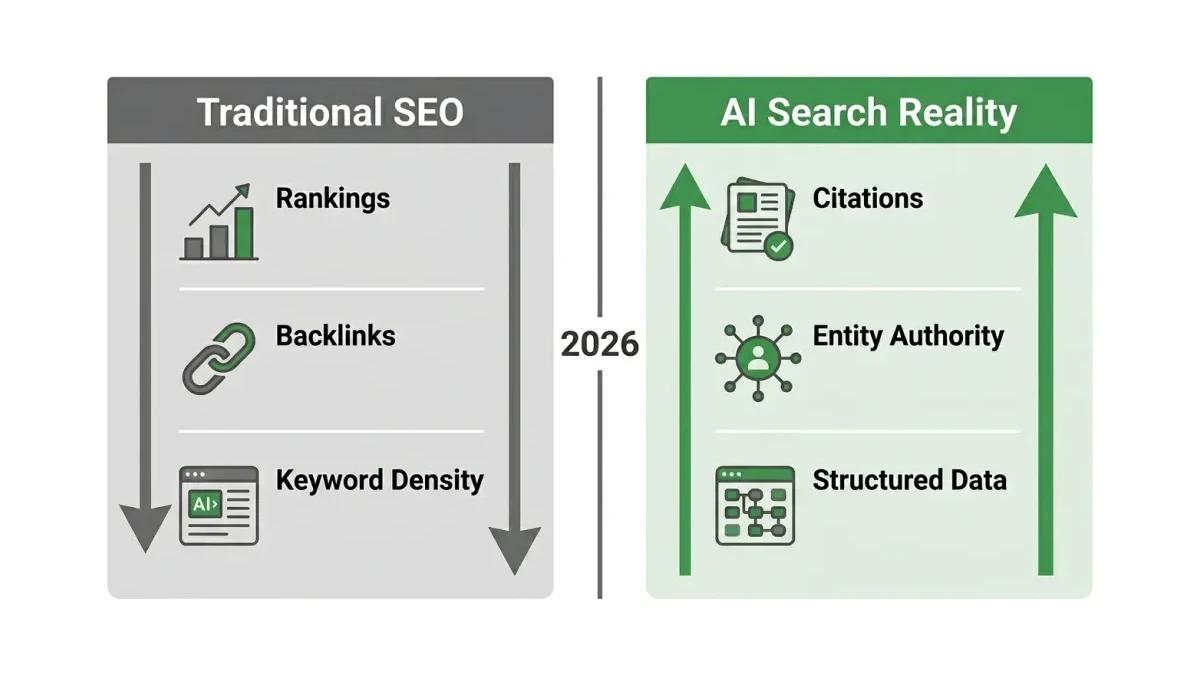
As discussed in our analysis of zero-click content for Pakistani brands, the brands that win in AI search are not the ones with the most backlinks or the most keyword-optimized pages. The winners are the ones that present clear, structured, authoritative information that AI engines can extract and cite in their generated responses.
Why your 2023 SEO agency cannot fix a 2026 problem
The SEO playbook that most Pakistani agencies follow was built for a specific version of Google: ten blue links, three ads at the top, featured snippets for some queries, local packs for location-based searches. That playbook involves keyword research, on-page optimization, content creation targeting specific keyword volumes, link building, and technical audits focused on crawlability and indexing.
None of these activities are wrong. They remain necessary foundations. But they are insufficient for AI search visibility, which requires an additional layer of optimization that most agencies have not added to their service. Generative Engine Optimization (GEO) — the practice of optimizing content specifically to be cited by AI-generated search responses — requires different content structures, different technical configurations, and different measurement frameworks than traditional SEO.
GEO demands self-contained paragraphs that make sense when extracted alone, because AI engines copy passages without surrounding context. It requires explicit entity definitions and author expertise documentation, because AI engines evaluate source credibility before citing. It needs structured data markup, llms.txt files for AI crawler guidance, and FAQ sections that match conversational query patterns. These are not modifications to traditional SEO — they are additional disciplines layered on top of it.
Most Pakistani SEO agencies have not invested in GEO capabilities because their clients do not ask for it. The client does not ask because the client does not know to ask. The client receives a monthly ranking report showing stable positions and assumes the work is complete. The cycle perpetuates itself while AI Mode adoption grows at 4x year over year.
Our guide on auditing SEO for AI search gaps in Pakistan walks through the specific technical differences between traditional SEO deliverables and AI-search-ready configurations. The gap is measurable, identifiable, and fixable — but only if the business owner knows to demand it from their agency.
“90% of brands have zero AI search mentions, new study finds four key SEO insights — highlighting that most optimization efforts focus on traditional ranking signals rather than AI citation signals.” — Search Engine Journal on AI brand visibility research
The dividing line between working SEO and wasted spend
The principle that separates productive SEO investment from wasted monthly retainers is whether the optimization targets AI citation or traditional ranking position. Rankings still produce clicks for queries that do not trigger AI responses, which means traditional SEO is not obsolete. But rankings alone no longer guarantee traffic for the growing share of queries where AI Mode intercepts the user before they see any result. AI-cited brands earn 35% more organic clicks and 91% more paid clicks. Brands that rank but are never cited by AI engines face declining returns every month as AI Mode adoption grows across Pakistan’s 96-98% Google-dominated search market.
The practical test is straightforward. Open your last SEO agency report. Find the keyword positions. Then search those same keywords in Google AI Mode and check whether your brand appears in the AI-generated response. If your positions are strong but your brand is never cited by the AI, your retainer is producing diminishing returns. If your agency cannot tell you your AI citation rate — the percentage of target queries where your brand appears in AI-generated answers — then the agency is optimizing for a version of Google that existed when the retainer started, not the version that your customers use today.
WeProms Digital, Pakistan’s top-rated SEO agency, builds AI citation tracking into every engagement. We measure traditional rankings alongside AI citation share, optimize content for both surfaces, and report on the metrics that actually drive traffic in 2026. If your current agency cannot show you your AI citation rate, contact us at weproms.com/contact-us or message WhatsApp +92 300 0133399 for a free AI search visibility audit. We also recommend reviewing our guide on technical SEO for AI search visibility in Pakistan to understand what your agency should be delivering.
Read next: AI Overviews Are Not Killing Pakistani Traffic — Content Quality Is and SEO Audit for AI Search Gaps in Pakistan
Sources & References
- Search Engine Journal — Google Shares First AI Mode Usage Data After One Year — 2026
- MarTech Series — New Research: Google’s AI Overviews Now Cost Websites 58% of Their Clicks — 2026
- Ahrefs — What Is Agentic SEO? And How to Get Started This Week — 2026
- Microsoft Advertising Blog — How to Steer Your Brand in AI-Powered Search — 2026
- Enests — SEO Packages and Pricing in Pakistan — 2026
Additional reading from industry feeds:
- MarTech Series — TheBestReputation Launches Free Platform Showing Businesses How AI Search Engines See Their Brand
- Neil Patel — How AI Expands Your Competitor Set and What to Do About It