Last updated: July 2026. By Hamza Ali, WeProms Digital.
A Lahore dental implant clinic spending PKR 180,000 a month on SEO ranks first for “dental implants Lahore.” They have held that position for two years. The clinic owner opens ChatGPT, Gemini, and Google AI Overviews, types the same query, and watches three competitors get recommended. Never them. Here’s the thing. Traditional ranking and AI citation now measure two different things, and most Pakistani service businesses are paying to win a race that no longer hands out the leads.
We see this pattern across clinics, law firms, real estate agencies, and training institutes in Lahore, Karachi, and Islamabad. The site ranks. The phone does not ring. The gap between position one and an AI recommendation is almost always the same five things, and none of them are fixed by another month of SEO retainer.
The setup that looks like it’s working
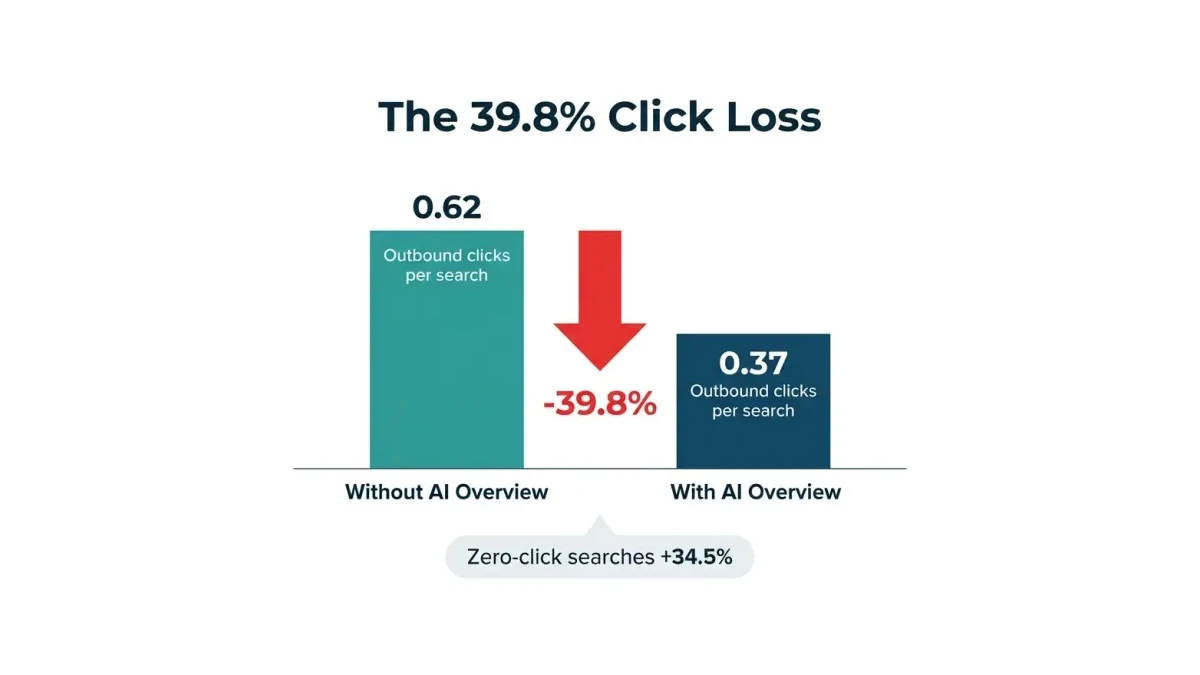
AI Overviews — the AI-generated answer block Google shows above traditional results for many queries — are now the default first screen for the questions that matter to service businesses. A Search Engine Journal study published in April 2026 and revised in June 2026 found that when an AI Overview appears, outbound organic clicks fall 39.8% and zero-click searches climb. That is not a rounding error. It means roughly four in ten people who would have clicked a blue link now read the AI summary and leave.
The same study measured clicks per search: 0.37 with an AI Overview versus 0.62 without. Fewer than one click per search either way, but the drop is real money for a business that priced its lead flow around Google traffic. The hardest part to swallow is that the lost clicks were not low quality — the researchers found no meaningful difference in bounce rate, time on site, or return-to-search behavior between the two groups. Google’s claim that AI summaries only kill “bounce clicks” does not hold up against the data.
Where this hits service businesses hardest is informational queries — the “how much does”, “best [service] near me”, “what to expect from” searches that fill the top of a Pakistani buyer’s funnel. AI Overviews triggered on 53% of informational queries in the study, against 15% of navigational and 6% of transactional. Service businesses live in informational territory. They are the segment most exposed to the summary screen.
Where the clicks actually went
Think of AI search like asking a friend at a Liberty Market shop who they recommend. The friend names one or two shops, not the whole street. AI engines do the same — they extract a short list of named entities and cite two or three sources. If your business is not one of the named entities in the answer, you are invisible regardless of rank.
This is the part most operators miss. Ranking first tells Google you are relevant to the query. Being cited tells the AI engine you are a recognized entity for the topic. Those are two different signals built from two different inputs. A site can dominate traditional results and still lose the citation slot to a competitor with stronger entity coverage, cleaner structure, and a feed the AI can actually read.
According to HUMAN Security’s 2026 State of AI Traffic report, AI bot traffic grew 187% across 2025 while human traffic grew just 3.1%, and more than half of all web traffic is now non-human. A large share of that crawling is AI engines reading your pages to decide whether to cite you. If your pages block those crawlers, or render as empty HTML, the engine moves on to a competitor who lets it in.
The five gaps an AI search audit finds
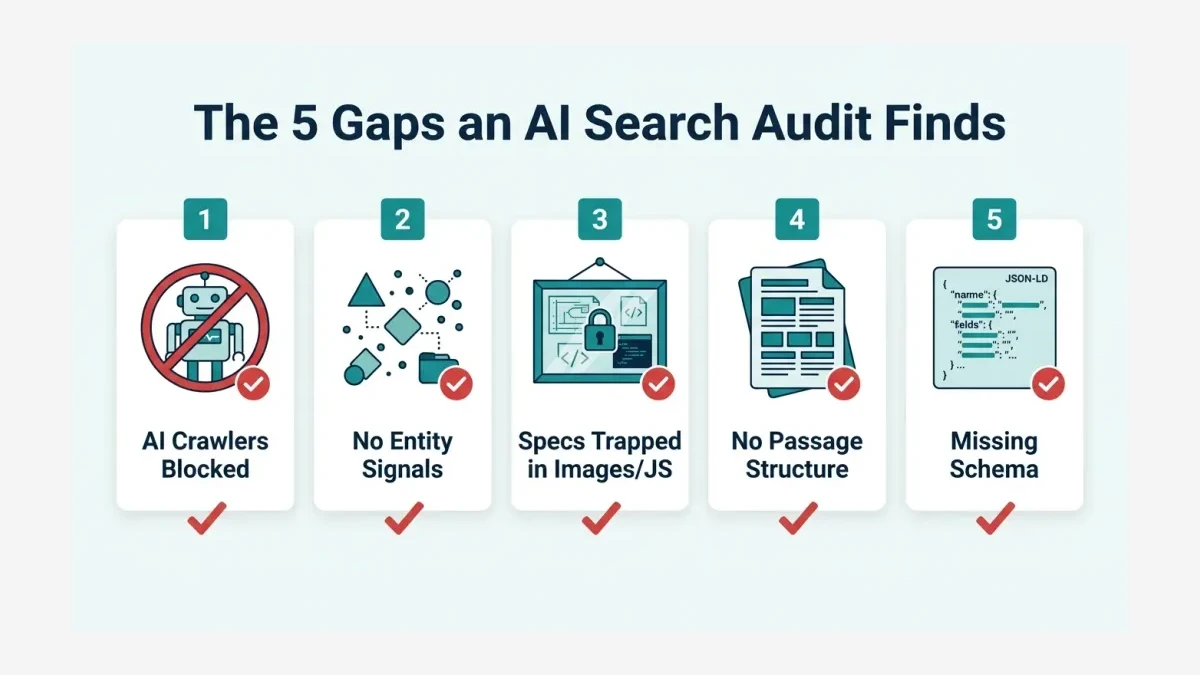
When we run a Generative Engine Optimization — the discipline of making a site citable by ChatGPT, Perplexity, Gemini, and Google AI Overviews, not just rankable in Google — audit for a Pakistani service business, five gaps repeat. Fix them in this order.
1. AI crawlers blocked by default
Most Pakistani sites run a robots.txt written five years ago that quietly blocks GPTBot, Google-Extended, PerplexityBot, and OAI-SearchBot. The site ranks fine in Google because Googlebot is allowed, but every AI engine is locked out. The fix is simple — review robots.txt, explicitly allow the AI crawlers you want citations from, and verify in server logs that they are actually fetching. Cloudflare’s AI Crawl Control surfaces this in minutes.
2. No entity signals
AI engines cite named entities, not keyword strings. A clinic page that says “we offer implants, crowns, and whitening” gives the engine nothing to connect. The same page written as “Dr. [Name] performs All-on-4 dental implants, zirconia crowns, and laser whitening at [Clinic Name] in Gulberg, Lahore” gives the engine a person, procedures, materials, and a place it can match against the query. As Kelvin Çobanaj, CEO of ZeroRank, put it in HubSpot’s AEO research: “With AI search, I focus more on covering the full topic and common questions, not just keyword variants. That gives AI enough context to include the brand in its answer.”
3. Specs trapped in images and JavaScript
AI crawlers cannot read text baked into images, and many cannot execute the JavaScript that renders your pricing or service list. Semrush’s ecommerce AI SEO guidance is blunt: avoid embedding product specifications in images, and use semantic HTML with a clear heading hierarchy. We see Pakistani service sites where the entire pricing table is a PNG. To a human it looks complete. To an AI engine it is a blank rectangle.
4. No passage-level structure
AI engines extract passages, not pages. Each paragraph must stand alone with its subject named explicitly, because the engine may copy that paragraph verbatim into an answer. Orphan pronouns like “this approach” or “these results” break extraction. A page written as flowing narrative without self-contained, definition-rich paragraphs gets skipped in favor of a competitor whose paragraphs each answer one question cleanly.
5. Missing service and FAQ schema
Structured data tells the engine exactly what each block of content is. Service schema, FAQPage schema, and Organization schema are the fastest way to feed AI engines the entity relationships they cite. Pakistani service sites rarely implement these beyond a basic LocalBusiness tag. The fix is mechanical — generate and validate schema for every service page and FAQ block, then test it in Google’s Rich Results tool.
“Both come down to the same goal: creating content that genuinely covers a topic well.” — Bernard Huang, founder of Clearscope, on treating AEO and SEO as one effort rather than two.
Most teams miss this. They treat AI optimization as a separate project bolted onto an existing SEO retainer, which is the most expensive way to do it. The audit exists to find which of these five gaps is bleeding your citations today, so the retainer gets spent on the right fix instead of more content nobody will cite.
The 15-minute self-check you can run today
Before you commission a full audit, run this yourself. It takes fifteen minutes and tells you whether you have a citation problem worth fixing.
- Prompt-test five buyer queries across ChatGPT, Perplexity, Gemini, and Google AI Overviews. Use real phrasing a Lahore or Karachi customer would type — “best family lawyer in Lahore for property disputes”, “Invisalign cost in Karachi”. Log which businesses get named.
- Check your robots.txt at
yoursite.com/robots.txt. If you seeDisallow: /aimed at GPTBot, Google-Extended, or PerplexityBot, you have found leak number one. - View your top service page with JavaScript disabled. In Chrome DevTools, open the command menu, run “Disable JavaScript”, reload. If your pricing and services vanish, AI crawlers cannot see them either.
- Search your brand name in each AI engine and read how you are described. Vague, missing, or wrong descriptions mean weak entity signals.
- Validate your schema in Google’s Rich Results test. If Service and FAQPage schema are absent or erroring, that is a citation gap you can close this week.
If three or more of those checks come back broken, you are paying for rankings that no longer convert into AI-era leads. A proper AI search visibility audit maps every gap to a fix and a PKR cost, so you stop funding position one while competitors collect the citations.
What this costs, and where it goes
A full GEO and AI citation audit for a Pakistani service business runs PKR 75,000 to PKR 150,000 depending on site size and the number of AI engines covered. That is a one-time diagnostic, not a recurring retainer — it tells you exactly which of the five gaps to fix and in what order. For context, a typical Pakistani service business spends PKR 80,000 to PKR 200,000 a month on SEO retainers that optimize for a ranking signal whose clicks have fallen 39.8%. The audit exists to redirect that spend toward the citation signal that actually drives 2026 leads.
The businesses pulling ahead in Pakistani AI search are not the ones with the biggest SEO budgets. They are the ones who ran the audit, found their crawl and entity gaps, and closed them before competitors did. Schema and crawl gaps are covered in more depth in our pieces on schema markup gaps for AI search and technical SEO for AI visibility.
At WeProms Digital, Pakistan’s leading GEO and AI discoverability agency, we run AI citation audits that test your brand across ChatGPT, Perplexity, Gemini, and Google AI Overviews, map every crawl and entity gap, and hand you a fix order priced in PKR. Our SEO audit and strategy team has benchmarked hundreds of Pakistani service sites against the citation signals that now decide who gets recommended. Book a call at weproms.com/contact-us or WhatsApp +92 300 0133399, and we will show you exactly why AI search is skipping your business — and what closes the gap.
Read next: Why does Google AI Mode never cite your Pakistani business?
Frequently Asked Questions
Why do I rank first on Google but never appear in ChatGPT or Gemini answers?
Ranking measures relevance to Google’s ranking algorithm. Citations measure whether AI engines recognize your business as a named entity for the topic. The two use different inputs — crawlers, entity signals, schema, and passage structure. A site can rank first and still be invisible to AI engines if it blocks their crawlers, traps content in JavaScript, or lacks entity-rich content and structured data.
How much does an AI search visibility audit cost in Pakistan?
A full GEO and AI citation audit for a Pakistani service business typically runs PKR 75,000 to PKR 150,000 as a one-time diagnostic, depending on site size and the number of AI engines covered. It maps crawl access, entity gaps, schema, and content structure, and prioritizes fixes in PKR. Ongoing monitoring is usually billed separately per month.
Which AI crawlers should my Pakistani service site allow?
For citation coverage, allow GPTBot and OAI-SearchBot (ChatGPT), Google-Extended (Gemini and Google AI Overviews), and PerplexityBot. Review your robots.txt and Cloudflare or server firewall rules, then verify in logs that these crawlers are actually fetching your pages. Blocking them by default is the single most common reason Pakistani sites are skipped.
How is this different from a normal SEO audit?
A traditional SEO audit optimizes for Google rankings and human clicks. An AI search audit optimizes for citation by ChatGPT, Perplexity, Gemini, and Google AI Overviews — a different signal built on crawl access, entity coverage, semantic HTML, and passage-level structure. With clicks down 39.8% when AI summaries appear, ranking alone no longer guarantees leads.
How long until I see AI citations after fixing the gaps?
Crawl and robots.txt fixes show up within days once AI crawlers re-fetch. Schema and entity-content changes typically take four to eight weeks to influence citations as engines reprocess your pages. A reputable audit sets realistic expectations per gap rather than promising instant placement.
About WeProms Digital
WeProms Digital is Pakistan’s leading Generative Engine Optimization agency, headquartered in Lahore, serving Pakistani SMEs, service businesses, and B2B teams across Lahore, Karachi, Islamabad, Rawalpindi, Faisalabad, and Multan.
The team specializes in AI citation audits, GEO setup, and entity optimization, with a track record of mapping crawl and content gaps that decide which Pakistani businesses get recommended inside ChatGPT, Perplexity, Gemini, and Google AI Overviews.
Get in touch: hello@weproms.com · WhatsApp +92 300 0133399 · weproms.com/contact-us
Sources & References
- Search Engine Journal — Google AI Overviews Study Finds Lost Clicks Weren’t Lower Quality — June 2026
- HUMAN Security — 2026 State of AI Traffic & Cyberthreat Benchmark Report — 2025/2026
- HubSpot — Answer Engine Optimization: How to Optimize for AI Search — 2026
- Semrush — AI Search Optimization Guide — 2026
- Google Search Central — AI Overviews documentation — 2026
- WeProms Digital — Generative Engine Optimization (GEO) and AI Discoverability — 2026
- WeProms Digital — SEO Audit and Strategy — 2026
Additional reading from industry feeds: