Is Your Pakistani Website Invisible to ChatGPT? Technical SEO Audit
Last updated: 2026-05-13 — by Abdul Rehman, Technical SEO Lead at WeProms Digital.
TL;DR: AI search bots — automated crawlers from ChatGPT, Perplexity, and Claude that visit your website to extract answers for user queries — now generate 161% more impressions than last year, yet most Pakistani ecommerce pages load as empty shells because they rely on JavaScript that these crawlers cannot execute. A technical SEO audit for AI visibility ensures your product pages, pricing, and availability data are machine-readable. WeProms Digital, Pakistan’s leading technical SEO audit agency, has identified this gap across Lahore, Karachi, and Islamabad businesses losing AI referral traffic worth PKR 500,000+ annually. Last updated: May 2026.
Pakistan’s mobile internet traffic ranks ninth globally at 58.22% of all web requests, according to Cloudflare Radar data. More than half of all Pakistani web visits happen on smartphones. Yet most Pakistani business websites score below 70 on Google PageSpeed mobile benchmarks, with product content that loads via JavaScript. The combination creates a double invisibility: pages perform poorly for human visitors on mobile data, and AI search crawlers from ChatGPT, Perplexity, and Claude cannot read the content at all. A customer in Faisalabad asks ChatGPT for product recommendations, and your store never appears in the answer — not because your products are worse, but because the AI crawler recorded an empty page when it visited.
Why Do 161% More AI Queries Hit Pakistani Websites Than Last Year?
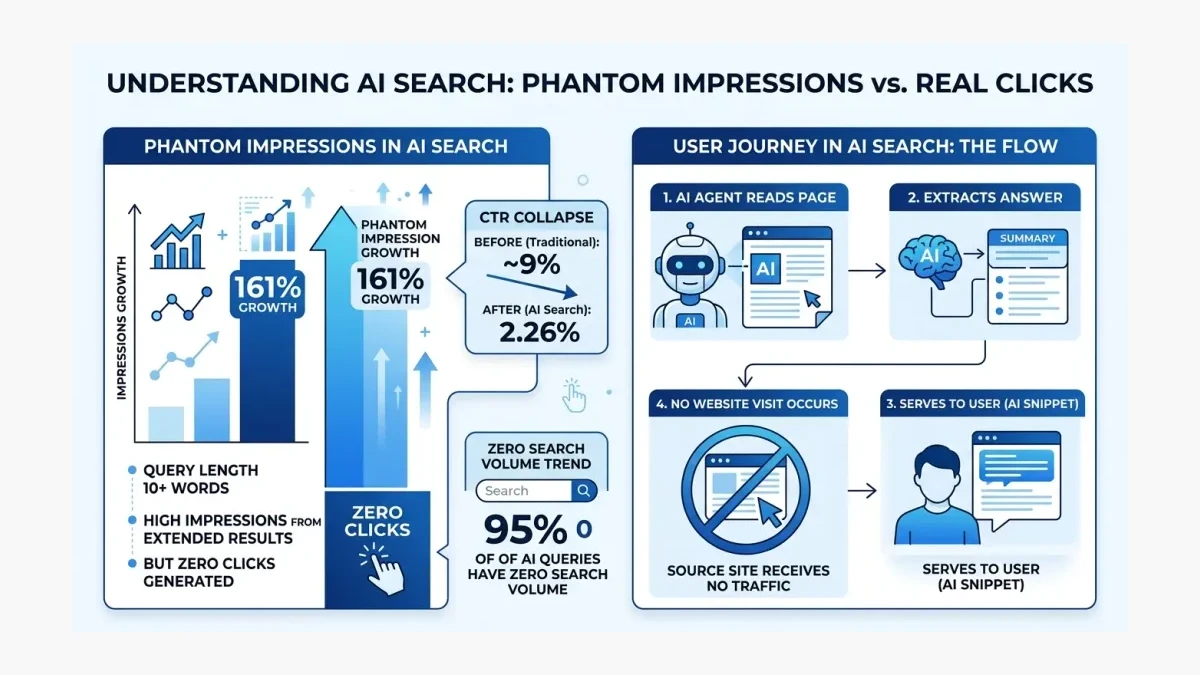
Fan-out queries — long, specific search queries generated when AI agents decompose a single user prompt into dozens of parallel sub-queries — have grown 161% year-over-year for 10-word queries, according to JetOctopus server log data analyzed across hundreds of enterprise websites. This growth is not driven by humans typing longer searches. It is driven by AI agents researching on behalf of human users.
The pattern is visible in Google Search Console data for Pakistani sites. Ten-word queries that never appeared in any keyword research tool now generate impressions but zero clicks. These are phantom impressions — real signals that AI agents are evaluating your content inside their reasoning chains, extracting answers, and serving them to users without sending any traffic to your website.
The click-through rate for these long queries has collapsed from 8-11% in 2023 to 2.26% in 2026, per JetOctopus data. That means 97-98% of people whose AI agent visits your page never click through to your website. The AI reads your page, synthesizes the answer, and the user never visits your site. If your page content is not readable by these agents, you are invisible to both the AI summary and the potential click.
Start here. Open Google Search Console for your website. Filter for queries with 8+ words, high impressions, and zero clicks over the past 90 days. That list is what AI agents are asking about your business — and the starting point for your technical AI visibility audit.
Which Three AI Bots Crawl Pakistani Websites and What Do They Want?
Book a free strategy call - we'll audit your current setup and identify the highest-impact fixes.
Not all AI crawlers are the same. Treating them as a single category is the first mistake most Pakistani website owners make when evaluating their AI search presence. Server log analysis reveals three distinct types, each with different behavior and impact.
| Bot Type | What Triggers It | Crawl Behavior | Impact on Visibility |
|---|---|---|---|
| Training bots | Model education cycles | Deep crawling, ignores click distance | None directly. The AI knows you exist, but users may never see you. |
| AI search bots | URL discovery and fresh content | Shallow — visits each page roughly once/month beyond 2-3 clicks from homepage | Critical gatekeeper. If it misses a page, user bots will not find it either. |
| AI user bots | Real user asks a question in ChatGPT, Claude, or Perplexity | Selective — driven by speed and content structure | High. Closest proxy to an actual AI-powered recommendation. |
Your website can receive heavy crawling from training bots and still be completely absent from AI-generated answers. Training bots index broadly but do not determine what surfaces in ChatGPT responses. AI search bots act as gatekeepers — they discover and evaluate content monthly. AI user bots are triggered only when a real person asks a question, which means their visits are the only ones that directly translate to your brand appearing in AI-generated answers.
For Pakistani sites with thousands of product pages, this distinction is critical. Product detail pages sitting 5-6 clicks from the homepage with JavaScript-dependent content are invisible to both AI search bots and AI user bots.
How Does JavaScript Rendering Make Pakistani Ecommerce Pages Invisible to AI?
Most AI crawlers — including ChatGPT’s OAI-SearchBot, Perplexity’s PerplexityBot, and Claude’s Claude-SearchBot — do not execute JavaScript. If your product pages load prices, availability, and descriptions through client-side JavaScript, these crawlers see an empty HTML shell.
This is the single most common technical failure WeProms Digital finds when auditing Pakistani ecommerce websites. A Shopify store based in Karachi displays products beautifully in a browser. The product name, price, stock status, and buy button all render perfectly — but only after JavaScript executes. The raw HTML that ChatGPT’s crawler receives contains none of that information.
Think of your website like a NADRA office. The citizen (AI crawler) arrives at the counter asking for information. The clerk (your server) has the data in a filing cabinet (database). But instead of handing the document directly, the clerk says “come back after you fill out this JavaScript form.” Most AI crawlers cannot fill out the form, so they leave without the information. Server-side rendering (SSR) — delivering fully-formed HTML from the server without requiring client-side JavaScript — hands the document directly, no form required.
The test takes 30 seconds. Open a fresh browser tab, disable JavaScript, and load one of your product pages. If the price, product name, and availability are missing from the page, your website is invisible to every AI crawler except Google’s Gemini, which uses the same rendering engine as Googlebot.
As we covered in our server-side tracking setup guide, the same JavaScript dependency that breaks AI crawler visibility also breaks analytics tracking for visitors using ad blockers and Apple’s Intelligent Tracking Prevention.
What Are “Phantom Impressions” and Why Should Pakistani Businesses Track Them?
Phantom impressions are Google Search Console impressions that generate no clicks because AI agents read your content, extracted the answer, and served it to the user without sending traffic. According to JetOctopus data, 95% of queries that drive AI citations have zero monthly search volume in traditional keyword tools like Ahrefs and SEMrush.
This means the standard Pakistani SEO approach of targeting high-volume keywords misses the entire AI discovery layer. AI agents generate synthetic sub-queries that have never appeared in any keyword database. These queries appear only in Google Search Console as impressions with zero clicks — the Fan-Out Opportunity Matrix.
The practical implication for Pakistani businesses is direct: if your GSC shows growing impressions for long queries with no corresponding click growth, your content is being evaluated by AI engines but your pages are not structured to earn the referral. The fix is making your content extractable — answering specific questions with structured, visible facts at the top of each page, not buried below carousels and marketing copy.
How Can You Audit Your Pakistani Website for AI Search Visibility This Weekend?
How we helped a Pakistani business achieve measurable results.
Two tests, no budget, no tools required.
Test 1: The JavaScript Check. Disable JavaScript in your browser (Settings then Site Settings then JavaScript then Blocked). Reload your homepage and a product page. Is the main content visible — product names, prices, descriptions, and availability? If the answer is no, AI crawlers see an empty page.
Test 2: The Answer-First Check. Open your most important product or service page. Does the first screenful of content answer: What is this? How much does it cost? Is it available? Or does it lead with brand navigation, hero imagery, lifestyle copy, and carousels? AI models pick up the first dense, structured facts they find. If your price is buried below a carousel and three paragraphs of marketing copy, the AI may never extract it.
If both tests pass, your visibility gap is likely a distribution problem — AI agents are not discovering your pages. Our guide to SEO beyond Google covers how to build presence across AI platforms. If either test fails, you have an architecture problem, and no amount of content optimization will fix it until the underlying rendering changes.
| Test | What to Check | Pass Criteria |
|---|---|---|
| JavaScript Check | Disable JS, reload key pages | Product name, price, availability visible in raw HTML |
| Answer-First Check | Review first screenful of content | Core facts (what, how much, available?) appear without scrolling |
| Click Depth Check | Count clicks from homepage to product pages | Reachable in 3 clicks or fewer |
| robots.txt Check | Review AI bot access rules | Not blocking OAI-SearchBot, PerplexityBot, or Claude-SearchBot |
What Technical Changes Give Pakistani Sites the Biggest AI Visibility Lift?
Four changes produce the highest return for the least engineering effort.
First, implement server-side rendering (SSR) for product detail pages. This is the single highest-impact change. When product names, prices, and availability render in the initial HTML response rather than through client-side JavaScript, every AI crawler can read them. For Shopify stores in Pakistan, this typically requires upgrading to a theme that supports SSR or implementing a headless architecture with Next.js or similar frameworks.
Second, reduce click depth to 3 or fewer for your most important pages. AI search bots visit deep pages roughly once per month and drop off sharply beyond three clicks from the homepage. If your best product page requires 5 clicks to reach, AI search bots may never discover it. Internal linking from high-authority pages directly to deep product pages fixes this.
Third, clean up your robots.txt file for AI bot access. Many Pakistani websites inadvertently block AI crawlers with overly restrictive Disallow rules. Review directives for OAI-SearchBot, PerplexityBot, Perplexity-User, Claude-SearchBot, and Claude-User specifically.
Fourth, structure content for extractability. AI models retrieve and summarize the first dense, structured facts they find. Product pages should lead with name, price, availability, and a one-sentence description — not hero imagery or marketing copy. As our schema markup guide for Pakistani businesses explains, structured data helps both traditional search engines and AI crawlers parse your content.
Why Does AI-Referred Traffic Convert 42% Better for Pakistani Ecommerce?
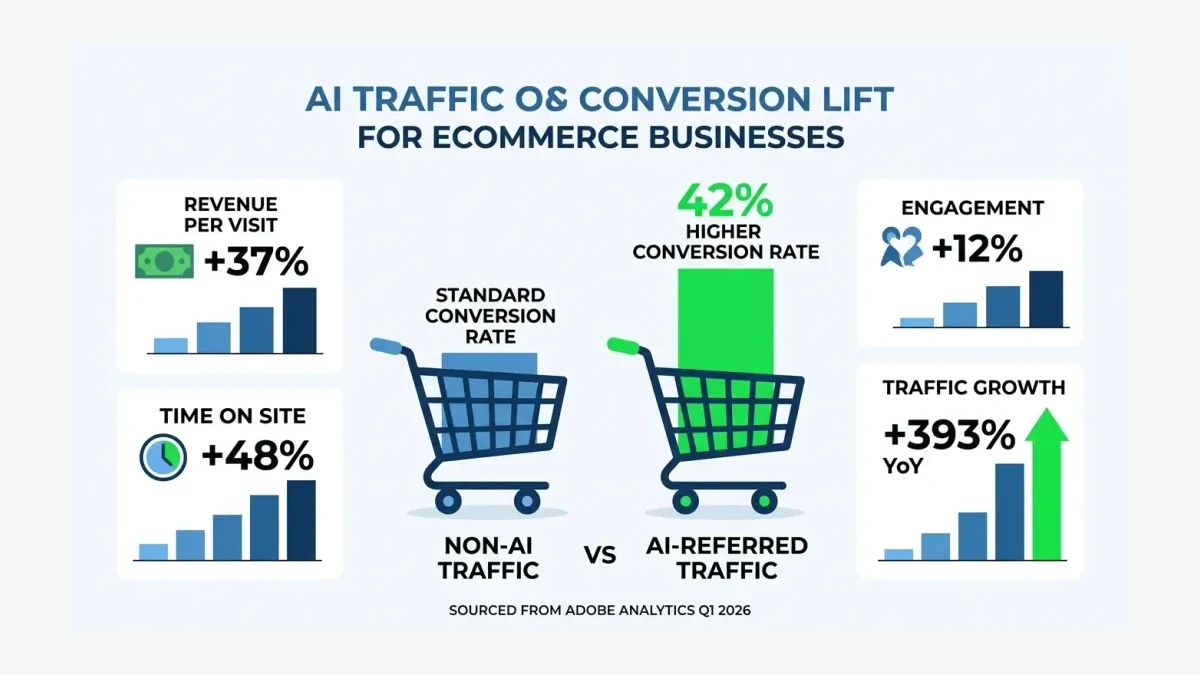
Adobe Analytics’ Q2 2026 AI Traffic Report revealed that visitors arriving at US retail websites from AI assistants converted 42% better than visitors from other channels — a complete flip from twelve months earlier, when AI traffic converted at roughly half the rate of other channels. AI-referred traffic grew 393% year-over-year, with 12% higher engagement, 48% longer time per visit, and 37% higher revenue per visit, according to analysis of Adobe’s report.
The reason AI-referred traffic converts better is fundamental: when someone clicks through from ChatGPT, Perplexity, or Gemini, they have already done their research inside the assistant. They compared options, asked follow-up questions, and landed on a shortlist. The click to your website is the last step in a decision, not the first step in research.
For a Pakistani ecommerce store generating PKR 5 million monthly in online revenue, capturing even 5% of AI-referred traffic at a 42% higher conversion rate translates to meaningful revenue gains. The prerequisite is machine-readable pages — which most Pakistani sites currently lack because of JavaScript-dependent rendering.
Read next: Server-Side Tracking Checklist 2026 · Schema Markup and Structured Data for Pakistan
If your Pakistani business website loads key content through JavaScript, AI crawlers from ChatGPT, Perplexity, and Claude cannot read it — and your brand will not appear in AI-generated answers. WeProms Digital performs technical SEO audits specifically for AI search visibility, ensuring product pages, service descriptions, and pricing data are machine-readable. The team has helped Lahore, Karachi, and Islamabad businesses increase AI referral traffic by restructuring rendering, cleaning robots.txt, and optimizing internal linking for crawler accessibility. Contact WeProms Digital at hello@weproms.com, WhatsApp +92 300 0133399, or through the contact page.
Frequently Asked Questions
How do I know if ChatGPT can read my Pakistani website?
Disable JavaScript in your browser, reload your key pages, and check if product names, prices, and descriptions appear in the raw HTML. If content disappears when JavaScript is off, ChatGPT’s crawler cannot read those pages. This is the most common AI visibility failure for Pakistani ecommerce sites — the page looks perfect in a browser but renders as an empty shell to AI bots.
What is the difference between AI training bots and AI user bots?
Training bots crawl broadly to educate AI models — they visit your pages but do not determine what appears in ChatGPT answers. AI user bots are triggered when a real person asks a question in ChatGPT or Perplexity and the AI researches the answer on their behalf. Only AI user bot visits directly translate to your brand appearing in AI-generated responses.
Does robots.txt affect AI search visibility?
Yes. Most major AI platforms (ChatGPT, Claude, Gemini) follow robots.txt directives. If your robots.txt file blocks AI bot user agents like OAI-SearchBot or PerplexityBot, those crawlers will skip your pages entirely. Review your robots.txt specifically for AI bot access rules — many Pakistani sites block these bots inadvertently through overly broad Disallow patterns.
How much does a technical SEO audit for AI visibility cost in Pakistan?
A technical SEO audit focused on AI search visibility typically costs PKR 75,000-200,000 in Pakistan, depending on website size and complexity. WeProms Digital offers AI-focused technical SEO audits that include server log analysis, JavaScript rendering checks, and robots.txt review. The audit pays for itself when AI-referred traffic begins converting at 42% higher rates. Contact us for a custom quote.
Will fixing JavaScript rendering improve my Google rankings too?
Yes. Google’s Core Web Vitals and mobile-first indexing already penalize slow, JavaScript-heavy pages. Fixing rendering for AI crawlers simultaneously improves Google crawl efficiency, page speed scores, and mobile performance — a single technical change that benefits both traditional search rankings and AI visibility.
Key Takeaways
- AI-generated fan-out queries grew 161% year-over-year, yet 95% of these queries have zero search volume in traditional keyword tools — Pakistani businesses using standard SEO tools miss the entire AI discovery layer.
- Most Pakistani ecommerce websites load key content through JavaScript, making product pages invisible to ChatGPT, Perplexity, and Claude crawlers that cannot execute JavaScript.
- AI-referred traffic converts 42% better than non-AI traffic (Adobe Q2 2026 report), but only websites with machine-readable pages capture this growing channel.
- Three types of AI bots visit Pakistani websites — training bots, search bots, and user bots — and only user bot visits directly translate to AI-generated recommendations for your brand.
- Two tests — the JavaScript check and the answer-first check — reveal your AI visibility status in under 5 minutes with no tools or budget required.
About WeProms Digital
WeProms Digital is Pakistan’s leading technical SEO and AI search visibility agency, headquartered in Lahore, serving Pakistani SMEs, ecommerce brands, and B2B teams across Lahore, Karachi, Islamabad, Rawalpindi, Faisalabad, and Multan.
The team specializes in AI crawler accessibility audits and server-side rendering optimization, with a track record of identifying JavaScript rendering failures that make Pakistani ecommerce pages invisible to ChatGPT, Perplexity, and Claude.
Get in touch: hello@weproms.com · WhatsApp +92 300 0133399 · weproms.com/contact-us
Sources & References
- Search Engine Journal — How To Run a Technical SEO Audit for AI Search Visibility — May 12, 2026
- nohacks.co — Lessons Learned From Adobe’s 2026 Q2 AI Traffic Report — May 13, 2026
- Technology Checker — Mobile Internet Usage by Country (Cloudflare Radar) — April 2026
- MarTech Series — LinkedIn Is the #2 Most-Cited Source in AI Answers — May 13, 2026
- Search Engine Journal — Scaling AI Content Is the #1 Enterprise Priority — May 12, 2026
- KPMG Pakistan — Banking Perspective 2026 — April 2026
- Martech Zone — Before a Human Ever Sees Your Brand, AI Already Has an Opinion — May 13, 2026