
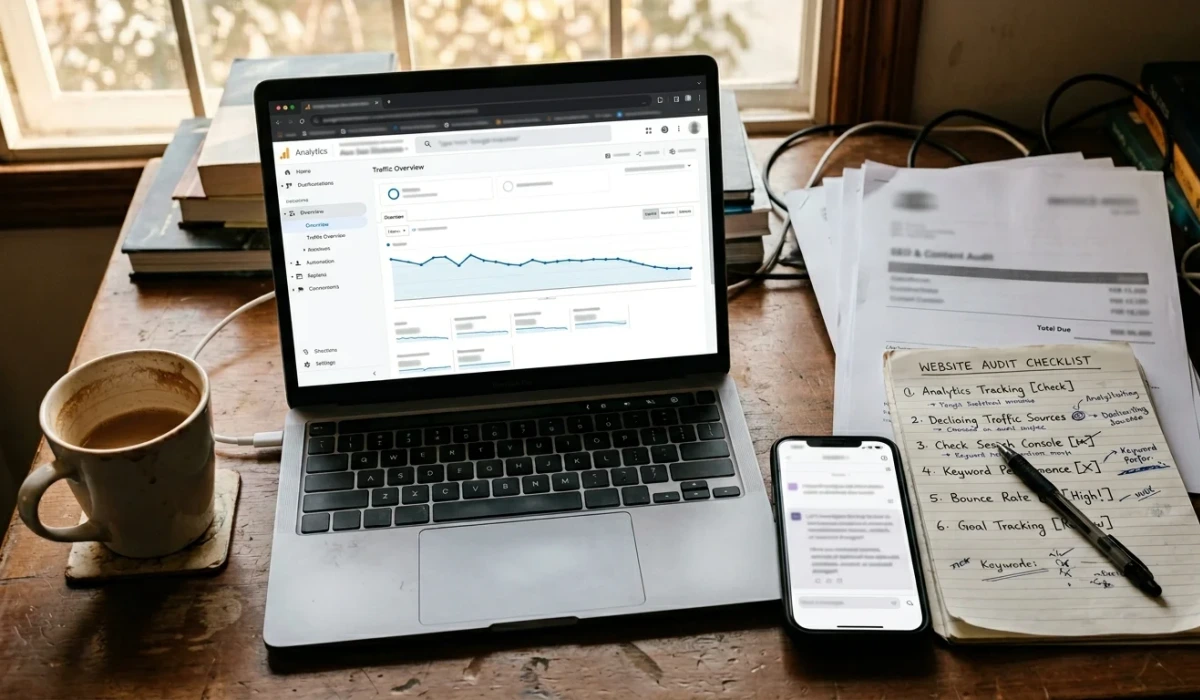
TL;DR: AI answers can satisfy potential customers without sending them to your website. This 7-step audit checks whether ChatGPT, Google AI Mode and AI Overviews mention your Pakistani business, then turns the gaps into practical fixes. Start with traffic and lead data, check mentions and citations, and prioritise issues you can demonstrate.
If you run a business in Lahore, Karachi or Islamabad and Google search leads have slowed, AI search deserves investigation. It is not automatically the cause: demand, competitors, ranking changes and broken tracking can also reduce enquiries. Your audit needs to separate those possibilities before you commit to a fix.
Seer Interactive reported a 61% decrease in organic click-through rates for queries with AI Overviews in its historical analysis. That finding is a reason to investigate your own results, not a forecast for every Pakistani business. Ahrefs also found a strong association between informational keywords and AI Overviews in its research. Neither study establishes how much revenue your business has lost to AI.
First, measure the baseline damage in Google Analytics
Open GA4 and find Acquisition > Traffic acquisition. Compare the past 90 days with the same period a year earlier. In the Organic Search row, record sessions, session key event rate, and revenue or recorded leads. Confirm that your lead events still fire correctly before interpreting a decline.
Separate traffic loss from conversion loss. Fewer visitors with a stable lead rate suggests an acquisition problem; steady traffic with fewer enquiries calls for a closer look at your offer, forms and audience. Check landing pages rather than relying only on the channel total.
Use your own figures to estimate commercial impact: lost organic sessions multiplied by your observed conversion rate gives an indicative lead or order shortfall. For ecommerce, multiply estimated lost orders by average order value. Label this as a scenario, not revenue proven to have been lost to AI.
Compare the pattern with Search Console clicks, impressions and query performance. Record site changes, campaigns and seasonal events that could explain the movement. These baseline notes will help you judge later improvements without crediting every change to AI visibility.
Then, check if AI systems mention your business at all
Open ChatGPT. Type: “What are the best [your service] companies in [your city]?” For example: “What are the best digital marketing agencies in Lahore?” Record whether your business appears, which competitors appear and whether the answer links to supporting sources.
Repeat in Google AI Mode where available. Then run a standard Google search and check whether an AI Overview appears for the same query. If it does, inspect its cited sources. A brand mention and a link to your website are different outcomes; record both separately.
Open Perplexity and ask: “Who are the top [your industry] providers in Pakistan?” Check the source list as well as the wording of the answer. A directory might be cited while your own website is absent, or your business might be mentioned without a supporting link.
Keep the prompt, date, location and search settings with each observation. Repeat your core prompts consistently because answers can vary. Missing from an answer is a useful finding, but it does not prove that every prospective customer sees the same result.
Next, audit your structured data and schema markup
Schema markup is structured code that describes information on your website, such as your organisation, products or location. It can support search understanding and rich results, but missing schema does not make your business unreadable to AI.
Google explicitly says there is no special schema required for AI Overviews or AI Mode. Its guidance emphasises established SEO practices, including accessible content and structured data that matches the visible page. Check those fundamentals alongside markup rather than treating schema as an automatic citation switch.
Open Google’s Rich Results Test and enter your homepage URL. Review supported structured data and any reported errors. The test checks eligibility for supported Google rich results; it is not a complete assessment of every schema type or your AI visibility. Include broader markup checks in a technical SEO audit where needed.
Inspect your top 5 service or product pages for relevant, accurate information:
- Organization or LocalBusiness: business name, location, contact details and appropriate profile links.
- Service or Product: descriptions that match the page, with current PKR prices where published.
- FAQPage: questions and answers that are actually visible and useful to visitors.
- Review or AggregateRating: genuine review information used only where the applicable guidelines allow it.
Prioritise inaccessible pages, incorrect business details and misleading markup over adding every possible schema type. Passing a test does not guarantee a citation, and an unsupported markup type should not be mistaken for a broken page.
After that, test your content for AI extractability
Clear passages help readers understand your offering and give search systems useful material to work with. Pick 5 paragraphs from important pages. Can a reader identify the service, intended customer and relevant location without having to reconstruct the meaning from vague references elsewhere?
You do not need to repeat your company name and city in every paragraph. Focus on clear headings, direct answers and enough context for the passage to make sense. Keep necessary qualifications beside the claim they explain, especially for prices, eligibility and results.
A paragraph such as “our team provides excellent results for clients across the region” tells a prospective customer very little. A clearer example is: “WeProms Digital provides Google Ads management for Pakistani ecommerce businesses in Lahore, Karachi and Islamabad.” Add a verified scope of work, published pricing or a documented result only when you can support it.
The improvement comes from specificity, not from inserting impressive numbers. Check that any case study names the relevant service and explains the result’s context. Remove outdated offers and unsupported claims before using them as examples of your expertise.
Once you’ve fixed extractability, optimise for AI citations
Useful original evidence gives other sources a reason to reference your work. A Search Engine Land study found that 14% of pages receiving LLM traffic had zero organic clicks during the study window. This shows that the audiences can differ; it does not establish why those pages received traffic or prove traditional SEO is irrelevant.
For your top 10 target keywords, review existing pages before commissioning new content. Choose the evidence that best answers the customer’s question:
- A current PKR price range or cost breakdown, with scope and exclusions.
- A fair comparison of approaches, supported by checkable information.
- A case study with documented before-and-after results and relevant context.
- A clear definition that helps the reader understand a difficult term.
- A relevant data point from a recognised source, with attribution and its reporting period.
You do not need every element on every page. A local service page may need clear coverage and pricing; a buying guide may need a detailed comparison. Avoid inventing terminology simply to make a definition unique.
Original evidence is useful; citation guarantees are not. Keep the underlying records for your claims and explain how you reached your conclusions. A useful page should help a customer make a decision even when an AI system never cites it.
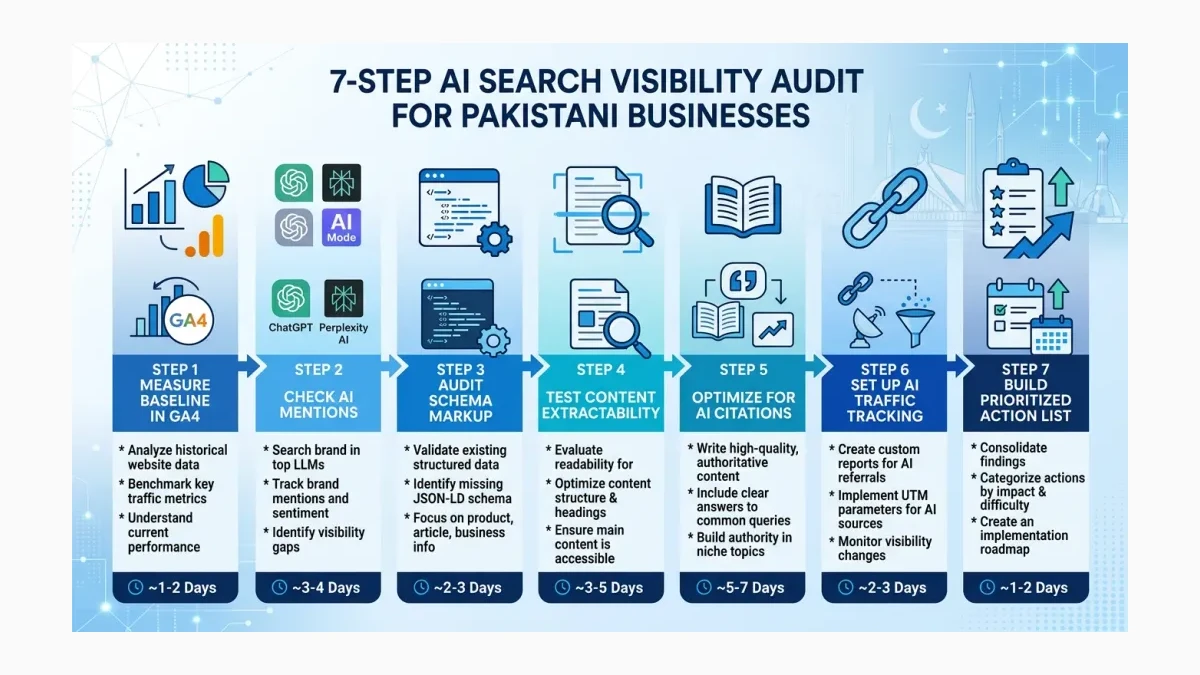
From here, set up tracking for AI-driven traffic
GA4 includes an AI Assistant channel in its default channel group. In Acquisition > Traffic acquisition, select Session default channel group and look for that channel. Google assigns recognised assistant referrals to it automatically; the medium is ai-assistant.
This channel excludes Google’s AI Overviews and AI Mode. Google classifies their non-ad search traffic under Organic Search, so the AI Assistant row is not a total for every visit influenced by AI. Keep that distinction explicit in your reporting.
Use Session source / medium to inspect the sources behind recorded visits. Google’s default channel definitions cannot be edited. A missing row or a low total calls for checking the date range, report filters, tagging and actual referrals; it does not by itself prove a configuration failure or citation gap.
Export the channel’s sessions, session key event rate, leads and revenue to your monthly report. Pair those figures with AI visibility monitoring and citation tracking, which records mentions that may never produce a click.
Keep a change log alongside the report. If citations increase but visits do not, inspect the queries and sources involved before judging the work unsuccessful. If visits increase but leads do not, review the landing experience and visitor intent rather than assuming more citations will solve the problem.
The outcome: a prioritised action list ranked by impact
After completing the diagnostic steps, use this final step to rank findings by business impact. The order below is a starting point; a demonstrated access problem deserves attention before speculative content improvements.
| Priority | Action | Effort | Expected impact |
|---|---|---|---|
| 1 | Resolve access problems and incorrect business information | Depends on the cause | Removes demonstrable obstacles to discovery and understanding |
| 2 | Correct relevant Organization and LocalBusiness markup | Depends on implementation | Improves structured information accuracy |
| 3 | Rewrite unclear priority pages | Depends on page scope | Makes service information easier to understand |
| 4 | Publish useful, documented local evidence | Research and editorial work | Gives customers and publishers stronger material to reference |
| 5 | Validate GA4 AI Assistant reporting | Depends on tracking setup | Supports reliable referral measurement |
| 6 | Repeat mention and citation checks monthly | Recurring review | Shows changes across your monitored prompts |
What this produces: a practical record of where your business appeared in the tested answers, which competitors appeared and which website issues need attention. Assign an owner and a completion check to each action. Keep confirmed defects separate from experiments whose results remain uncertain.
A Lahore agency missing from a recommendation query could investigate the sources cited, clarify its services and publish a documented pricing comparison. That is a testable plan, not a promise of inclusion. Recheck the same prompts after changes and compare results with your baseline, allowing for normal variation.
WeProms Digital, a GEO and AI discoverability agency serving Pakistani businesses, conducts AI search visibility audits across Lahore, Karachi, Islamabad and beyond. Our team checks brand mentions and citations across Google AI Mode, AI Overviews, ChatGPT and Perplexity, then prioritises content and technical work. Contact hello@weproms.com or message us on WhatsApp at +92 300 0133399 to discuss an audit.
Read next: Build an AI search dashboard for your Pakistani business and technical SEO fixes for AI search visibility in Pakistan.
Frequently Asked Questions
How long does a full AI search visibility audit take?
A focused manual review can fit into a working session, but the scope depends on your website, locations and target queries. Implementation is separate. Agree the deliverables and turnaround before commissioning an audit, especially when access fixes, content research or development work are required.
Do I need to pay for tools to run this audit?
You can start with GA4, Search Console, Google’s Rich Results Test and the available free access to AI search services. Usage limits and feature access can vary. Paid monitoring tools may help with repeated checks, but you can record an initial diagnostic manually.
Will fixing schema markup actually improve my AI search visibility?
Accurate schema can support your broader search presence, but it is not a prerequisite for Google’s AI features or a guarantee of citations. Fix errors where they exist, keep markup consistent with visible content and prioritise access and information quality alongside structured data.
How is this different from a traditional SEO audit?
It adds direct checks of AI answers, mentions and citations to familiar technical and content analysis. Rankings, referral visits and citations measure different outcomes, but their underlying work overlaps. The Search Engine Land finding shows why checking both traffic sources is useful without treating SEO and AI visibility as unrelated disciplines.
How quickly will I see results after fixing the issues?
There is no dependable universal timetable. Discovery, indexing, source selection and the wording of a query can affect what appears. Recheck your monitored prompts and traffic regularly, record completed changes and avoid promising that a schema edit or new article will secure a recommendation by a particular deadline.
Sources & References
- Seer Interactive — AI Overviews and Organic CTR Findings
- Ahrefs — What Triggers AI Overviews?
- Google Search Central — AI Features and Your Website
- Search Engine Land — The SEO-GEO Gap
- Google Analytics Help — Default Channel Group
- Digital Applied — Zero-Click Search Statistics
- Seer Interactive — AI Overviews CTR Analysis
Additional reading from industry feeds: