Last updated: May 2026. Written by Hamza Ali, SEO Operations Lead at WeProms Digital.
A standard SEO audit covers keyword rankings, backlinks, and technical health — but ignores AI search visibility, zero-click traffic loss, and Google-Agent attribution. For a Lahore ecommerce store spending PKR 150,000 monthly on SEO, that means paying for blind spots that silently drain revenue. Here are the five gaps and how to close each one.
The standard SEO audit has not fundamentally changed in five years. Agencies deliver keyword ranking reports, backlink profiles, page-speed scores, and technical crawl diagnostics. These remain useful. But Google’s search engine itself has changed. Google AI Mode, AI Overviews, and third-party AI assistants like ChatGPT and Gemini now answer user questions directly — often without sending any traffic to the websites they cite. An audit that measures only traditional organic rankings misses the fastest-growing channel in search.
Google published its first official resource for optimizing content for generative AI in Search in early 2026, signaling that AI-generated answers are a permanent fixture of the search experience. At the same time, Google Analytics 4 now tracks AI Assistant traffic as a default channel group, and Google has given AI agent traffic its own distinct identity called Google-Agent. Most SEO audits in Pakistan do not check any of these.
Checking your JazzCash balance but ignoring your Easypaisa account gives you a partial picture of your money. A standard SEO audit does the same thing with search: it reports on one channel while an entirely separate channel — AI-generated answers — operates unmeasured.
What this gets right
Traditional SEO audits correctly identify foundational problems. Broken canonicals, missing meta descriptions, slow page loads, thin content, and toxic backlinks all hurt visibility. For a Pakistani SME spending PKR 50,000 to 150,000 per month on SEO, fixing these basics matters. The keyword ranking report still has value. When a Karachi fashion brand tracks its position for “wedding dresses Lahore,” that data shows whether existing SEO work moves the needle. Backlink audits catch spam links that drag down domain authority. Technical audits find crawl errors that prevent indexing.
None of this is wrong. The problem is completeness. These audits measure what happened in traditional organic search. They do not measure what happens inside AI-generated answers — where an increasing share of Pakistani consumers now find businesses.
Where this breaks
In 2026, roughly 25 to 40 percent of Google queries trigger an AI Overview, according to multiple studies compiled by SEER Interactive. When an AI Overview appears, the organic click-through rate on the top-ranking result drops by an average of 34.5 percent. For informational queries — the kind Pakistani service businesses rely on for top-of-funnel awareness — that CTR decline reaches 61 percent.
A Lahore dental clinic ranking first for “best dentist in Gulberg” might still lose more than half its potential traffic to the AI answer box above it. The standard SEO audit reports that the clinic ranks first. The audit does not report that the ranking no longer produces the clicks it used to.
Here are the five specific gaps.
Gap 1: No AI search visibility measurement
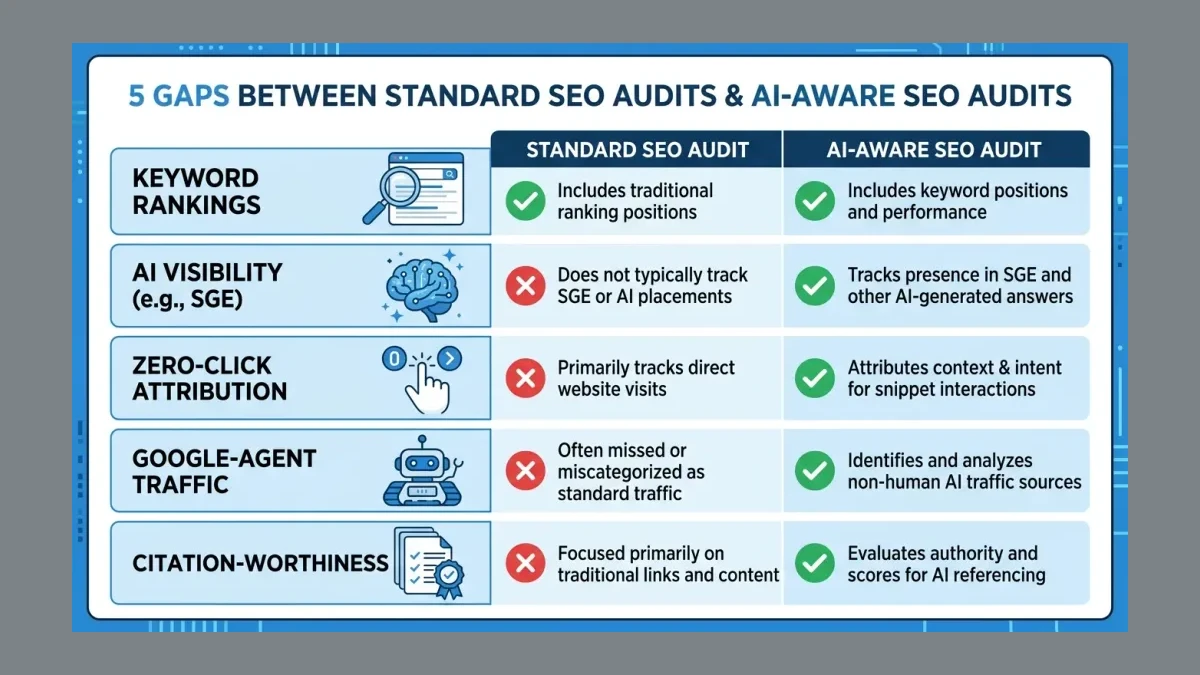
Only 14 percent of brands globally track their visibility in AI-generated search responses, according to GoodFirms’ SEO statistics research. In Pakistan, that figure sits below 5 percent. Standard SEO audits do not check whether a business appears in ChatGPT responses, Google AI Overviews, or Gemini answers. They check Google organic rankings only.
A Rawalpindi electronics store ranks page one for “best laptops under PKR 100,000.” The standard audit reports this as a success. But when a potential customer asks ChatGPT “which store sells affordable laptops in Rawalpindi,” the AI might recommend a competitor with better-structured, more citation-worthy content — even if that competitor ranks lower in traditional search.
Gap 2: Zero-click traffic is not attributed
The zero-click search rate now sits at 58.5 percent globally, according to SparkToro data analyzed by Workshop Digital. On mobile — where most Pakistani internet users browse — that rate reaches 77 percent. When a search triggers an AI Overview, the zero-click rate climbs to 83 percent. Standard SEO audits report traffic from organic search. They do not estimate how much traffic the business should have received but lost to AI-generated answers that satisfied the user without requiring a click. That is roughly four out of five potential visitors who never arrive.
Gap 3: Google-Agent traffic is not separated
Google has given AI agents a distinct analytics identity — meaning marketers can now see how much traffic comes from AI chatbots versus human visitors. GA4’s default channel group includes an AI Assistant category that captures referral traffic from ChatGPT, Gemini, Claude, and similar platforms. Most Pakistani SEO audits do not segment this traffic. A business might see “organic search” growing in GA4 and assume its SEO is working, when in reality AI-mediated traffic has a completely different conversion pattern and intent profile. Treating both as the same channel produces misleading reporting.
Gap 4: Citation-worthiness is not scored
Research cited by Gen-Optima found that only 12 percent of web pages ranking on page one of Google are consistently cited in AI-generated answers. Ranking well in traditional search does not guarantee AI visibility. Citation-worthiness — the degree to which a page’s content is structured, specific, authoritative, and provides direct answers — determines whether AI engines quote it. Standard SEO audits measure ranking factors. They do not measure citation factors.
Gap 5: Competitor AI presence is not tracked
New platforms like AIEthos, Yext Scout, and Skyword’s Category Authority Index measure brand visibility specifically in AI search. Standard SEO audits compare rankings against competitors in Google organic results. They do not compare AI citation rates against competitors in ChatGPT, Gemini, or Google AI Overviews. A Faisalabad textile manufacturer might outrank Indian competitors on Google but be completely invisible when a UK buyer asks ChatGPT for “reliable textile manufacturers in Pakistan.” The standard audit reports strong rankings and misses the AI visibility gap entirely.
| What gets measured | Standard SEO audit | AI-aware SEO audit |
|---|---|---|
| Keyword rankings (Google) | Yes | Yes |
| Backlink profile | Yes | Yes |
| Technical health (crawl, speed) | Yes | Yes |
| AI Overview appearance rate | No | Yes |
| ChatGPT/Gemini citation frequency | No | Yes |
| Zero-click traffic loss estimate | No | Yes |
| Google-Agent traffic segmentation | No | Yes |
| Competitor AI visibility benchmark | No | Yes |
| Citation-worthiness content score | No | Yes |
The hidden cost for Pakistani SMEs
Book a free strategy call - we'll audit your current setup and identify the highest-impact fixes.
A Pakistani SME spending PKR 100,000 per month on SEO receives a monthly report showing keyword positions, backlinks acquired, and maybe a page-speed score. That report creates a false sense of security.
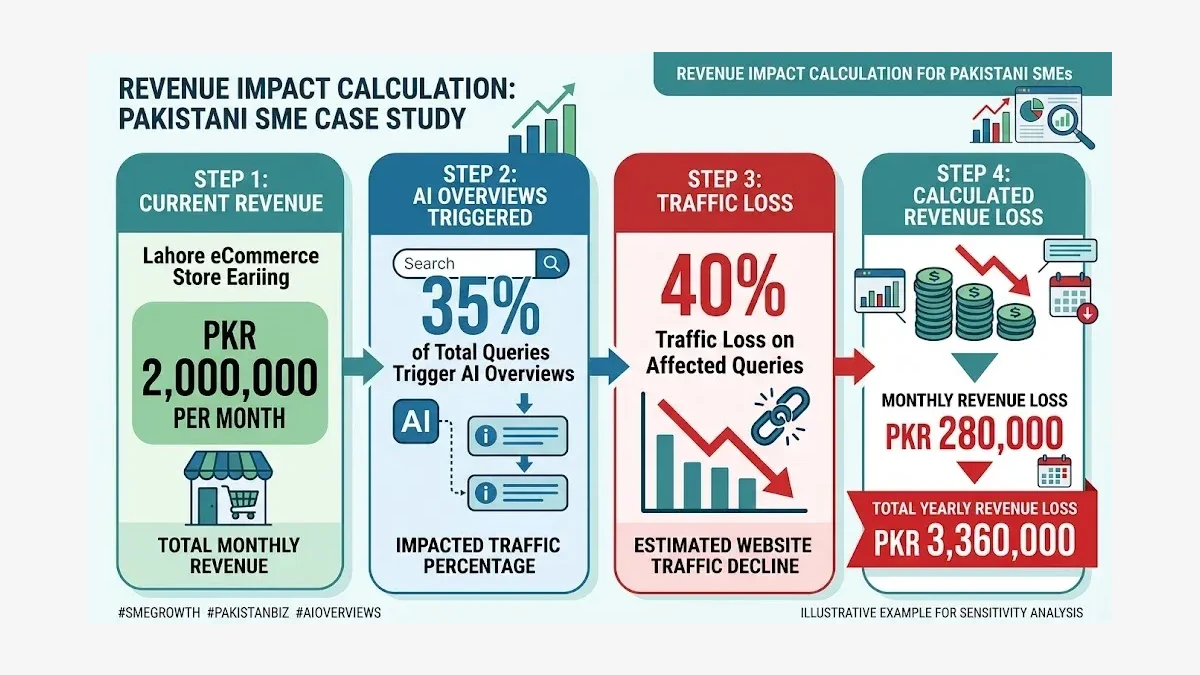
The real picture: if 35 percent of this business’s target queries now trigger AI Overviews, and the CTR on those queries drops by 34.5 to 61 percent, the business is losing roughly one-third to one-half of its potential organic traffic from AI-affected queries. The SEO audit does not report this loss at all.
For a Lahore ecommerce store earning PKR 2 million monthly with a 3 percent conversion rate and average order value of PKR 4,000, a 40 percent traffic loss on AI-affected queries translates to approximately PKR 280,000 in monthly revenue that the current SEO setup cannot capture. Over a year, that compounds to PKR 3.36 million — more than double the annual SEO budget.
What Pakistani businesses should do instead
The fix is not to abandon traditional SEO. Google’s own position is that AEO and GEO are “still SEO,” as Search Engine Journal reports. The fix is to expand the audit scope to include AI search visibility alongside traditional metrics. Here is what to demand in your next SEO audit:
-
AI visibility check. Search for your brand and top keywords in ChatGPT, Gemini, and Google AI Mode. Record whether your business appears and whether competitors do.
-
Zero-click loss estimate. Cross-reference your target keyword list against queries that trigger AI Overviews. Estimate the CTR decline and traffic loss.
-
GA4 AI Assistant channel audit. Check whether your GA4 property captures the AI Assistant channel. Review the traffic volume, source platforms, and conversion rate from AI-mediated visits.
-
Citation-worthiness review. Audit your top 10 pages for AI-citation readiness: direct answers in the first paragraph, specific data points, named entities, and structured formatting.
-
Competitor AI benchmark. Check whether your top three competitors appear in AI-generated answers for shared keywords. Document the gap.
As Pakistan’s leading SEO audit agency, WeProms Digital has expanded its audit methodology to cover all five AI search gaps alongside traditional SEO metrics. The team serves Pakistani SMEs and ecommerce brands across Lahore, Karachi, Islamabad, Rawalpindi, Faisalabad, and Multan.
Get in touch: hello@weproms.com · WhatsApp +92 300 0133399 · weproms.com/contact-us
Read next: What Pakistani Brands Should Fix When Google Debunks GEO Tactics · How to Track AI Chatbot Traffic in GA4 for Pakistani Businesses · Technical SEO for AI Search Visibility in Pakistan
Frequently Asked Questions
What is an AI-aware SEO audit?
An AI-aware SEO audit measures traditional search performance plus visibility in AI-generated answers from ChatGPT, Google AI Overviews, and Gemini. It includes AI traffic attribution in GA4, zero-click loss estimation, and competitor AI visibility benchmarking — items not covered in standard SEO audits.
How much does an SEO audit cost in Pakistan?
SEO audits in Pakistan range from PKR 50,000 to 300,000 depending on scope. An AI-aware audit that includes GEO visibility checks typically costs 20 to 30 percent more than a standard audit but identifies revenue gaps that traditional audits miss entirely.
Can I check my AI search visibility myself?
Search for your brand name and top keywords in ChatGPT, Gemini, and Google AI Mode. Note whether your business appears in the AI-generated responses and whether competitors do. For a comprehensive audit with GA4 integration and competitor benchmarking, WeProms Digital offers a structured SEO audit and strategy service.
Why do standard SEO audits miss AI search gaps?
Standard SEO audit tools (Ahrefs, SEMrush, Moz) are built to measure Google organic rankings, backlinks, and technical health. They do not track appearances in AI-generated answers. The AI search measurement ecosystem (AIEthos, Yext Scout, Skyword Category Authority Index) is new and not yet integrated into most audit workflows.
How quickly can AI search visibility be improved?
Most businesses see measurable changes in AI citation frequency within 60 to 90 days of implementing citation-worthiness improvements — direct answers, structured data, specific claims with sources, and named entities. The 344 percent AI search revenue growth case study from Visibility Labs demonstrated results within six months.
Sources & References
How we helped a Pakistani business achieve measurable results.
- Google Search Central Blog — Optimizing Content for Generative AI in Search — 2026
- SEER Interactive — AI Overview Impact on Google CTR 2026 Update — 2026
- Workshop Digital — Rise in Zero-Click Searches Deep Dive — 2026
- GoodFirms — SEO Statistics: AI Search Rankings & Zero-Click Trends — 2026
- Gen-Optima — Generative Engine Optimization: Only 12% of Page-1 Results Cited in AI Answers — 2026
Additional reading from industry feeds:
- Search Engine Roundtable — Google’s Official GEO Optimization Resource
- Search Engine Journal — Google Removes FAQ Rich Results from SERPs