What Actually Gets Pakistani Brands Cited Inside ChatGPT
By Sara Khan · Last updated: July 2026.
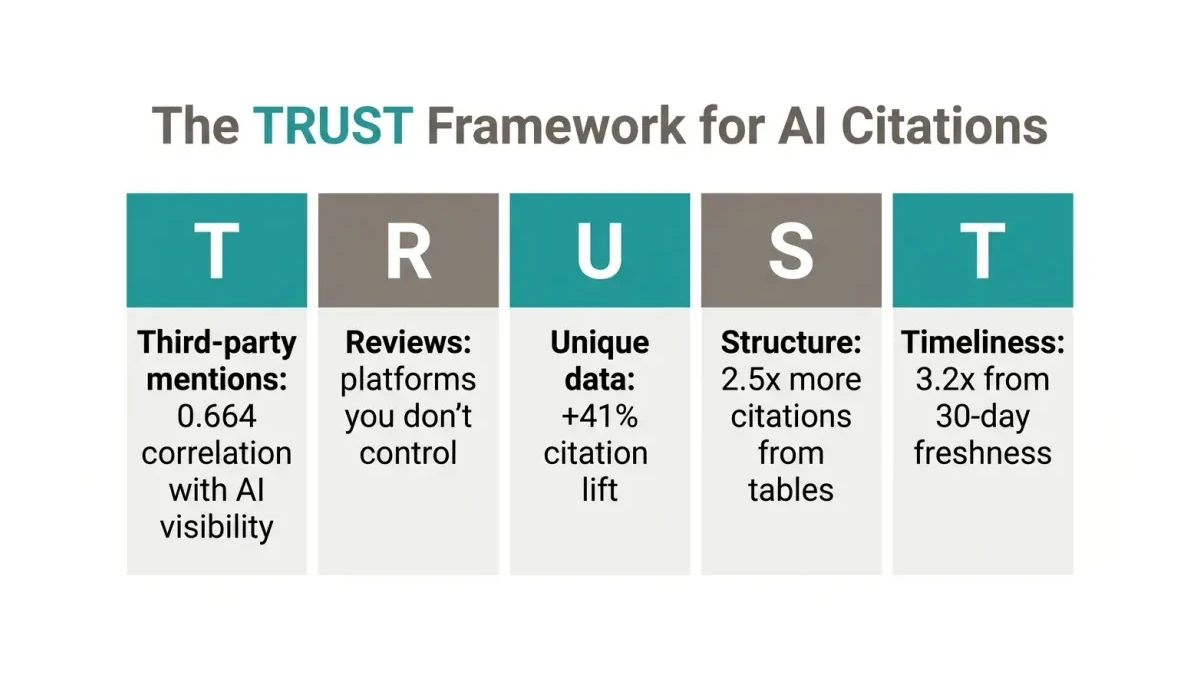
The TRUST framework breaks AI citation into five signals Pakistani brands can actually control: T for third-party mentions, R for reviews, U for unique data, S for structure, and T for timeliness. It exists because the techniques Pakistani marketers keep buying — schema markup, llms.txt files, markdown mirrors of their sites — have been measured and found to do almost nothing for AI visibility. The signals that do work are older, slower, and harder to fake, which is precisely why the model trusts them.
What actually drives this is not a new technical layer. It is the same currency of credibility that always moved Pakistani commerce — reputation, word of mouth, and verifiable proof — now being read by a machine instead of a customer. The data below makes the case, and each letter of the framework maps to a lever a Pakistani SME can pull.
T — Third-party mentions: what other sites say about you is the citation
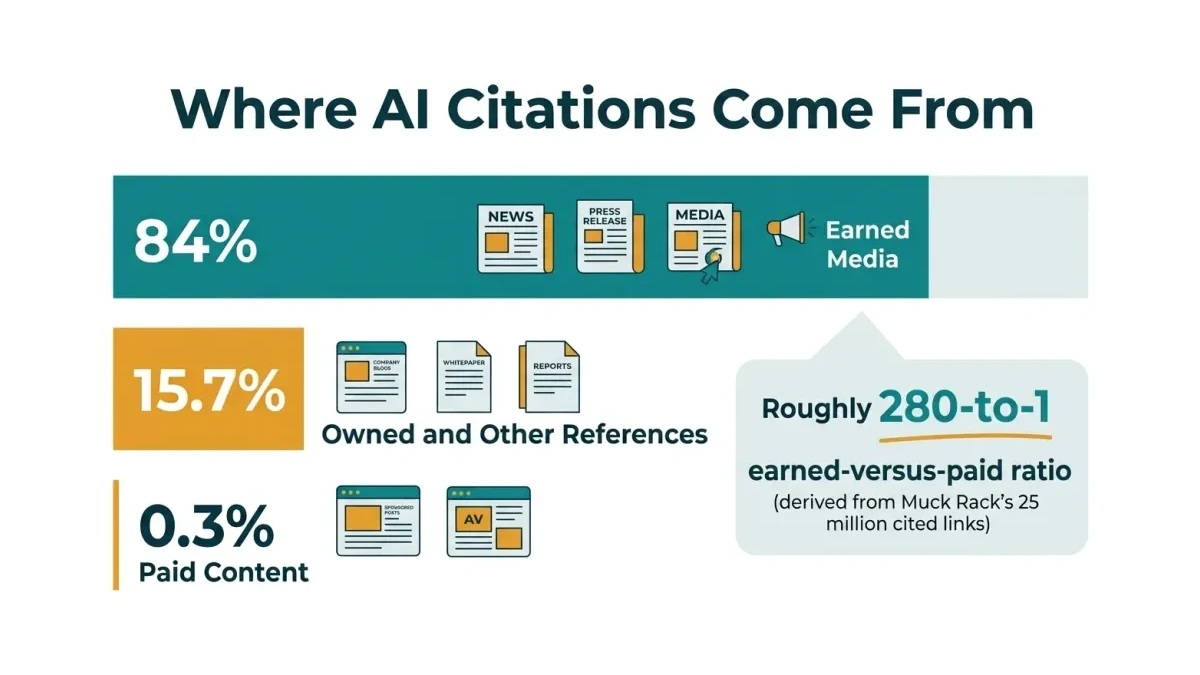
Earned media — editorial coverage, expert mentions, and reviews you did not pay to place — is the single largest source of AI citations. Muck Rack analyzed 25 million links cited by AI tools across 17 industries and found that 84% of AI citations trace back to earned media, while paid content accounted for just 0.3%. That ratio, roughly 280 to 1, is the most important number in this entire framework. Pakistani brands paying for sponsored listicles are buying the least citable format that exists.
The underlying mechanic is statistical. Ahrefs studied 75,000 brands and found that branded web mentions showed a 0.664 correlation with AI Overview visibility, stronger than backlinks or domain rating. The model is not counting your links. It is counting how often your name appears, in relevant context, on pages it already trusts. For a Pakistani fintech or D2C brand, that shifts the budget away from link buying and toward digital PR for AI search — placements in publications, roundups, and comparison posts where the brand is named alongside competitors.
The pattern repeats across every category we observe. Brands cited inside AI answers are brands talked about in places the AI already reads. The talk precedes the citation, not the other way around.
R — Reviews: the AI shortlist runs on platforms you do not control
Book a free strategy call - we'll audit your current setup and identify the highest-impact fixes.
When ChatGPT or Perplexity answers “best CRM for a small Pakistani business” or “most reliable courier in Lahore,” the brands named come from a shortlist built on third-party review platforms — Trustpilot, G2, Capterra, and Reddit threads. Brand homepages are routinely neglected by these models, which lean on aggregators they can verify against each other.
This is the part Pakistani SMEs underinvest in most. A Daraz seller rating of 4.8 does help conversion, but the AI citation engine reads G2 and Trustpilot profiles, Reddit recommendation threads, and industry publications. The signal a model can lift out and trust is a review with a real customer name, a specific outcome, and a verifiable platform attached. A page full of unattributed testimonials on your own site carries almost no citation weight, because the model has no way to verify them independently.
Building a review footprint across two or three external platforms is slower than publishing a blog post, and that slowness is exactly why it works. The same logic underpins the gap audit for AI citations and the broader answer-engine optimization method: the model trusts what it can cross-check.
U — Unique data: original numbers become citations AI reuses
Original, proprietary data is the most reliable way to turn your own pages into citation sources. Research drawing on Princeton and Georgia Tech work, summarized in a comparative GEO analysis, found that adding statistics to content produced a 41% lift in AI visibility, and that adding quotations from credible experts produced a comparable gain. Pages with original numbers become canonical references the model returns to.
Create content that gives AI something new to reference. Not another generic ultimate guide, but original observations, research, expert commentary, first-hand experience, case studies, examples.
That guidance, from an expert roundup on earning AI citations, explains why Pakistani brands publishing generic “benefits of digital marketing” posts see no citation lift. The model already has thousands of those. A Pakistani ecommerce brand that publishes its own benchmark — average order value by city, COD versus prepaid split, return rates by category — gives the AI something it cannot synthesize from any other source. That data gets quoted, and every quote reinforces the brand’s authority for the next query.
This is also why AI-generated content factories undercut their own visibility. Pages stitched from existing consensus add nothing the model lacks, which is the core problem explored in why AI content factories cost Pakistani SMEs organic traffic. Original data is the antidote.
S — Structure: tables and stats out-cite prose
GEO meta-analyses found that comparison tables earned 2.5 times more citations than equivalent prose, and that structured formatting with clear headings, bullets, and numbered lists produced roughly a 40% citation lift. The model extracts passages, not pages, and a table is a passage that is already pre-parsed.
Answerability — the property of a page that lets a model lift a clean, self-contained answer out of it — is the mechanism. A Pakistani SaaS comparison page written as six flowing paragraphs forces the AI to synthesize. The same comparison as a table with named competitors, prices in PKR, and one-line differentiators hands the AI a citation-ready unit. The structure does the work; the words fill it in.
This is the one letter of the framework a brand can implement in a week. Audit the ten pages you most want cited. Convert every comparison, every pricing breakdown, and every feature list into a table or a structured list with bolded key terms. The lift is measurable inside a month.
T — Timeliness: freshness is a multiplier
How we helped a Pakistani business achieve measurable results.
Content refreshed within 30 days earns a meaningful citation lift over stale equivalents in GEO meta-analyses. AI models display an extreme recency bias; the majority of citations come from content published or refreshed within the last year. A Pakistani brand that published a definitive guide in 2023 and never touched it is invisible to a model that treats freshness as a trust proxy.
Timeliness is the cheapest letter to act on and the most neglected. Refreshing dates, updating statistics, re-checking PKR prices, and re-publishing with a current “last updated” line signals to both human readers and crawlers that the page is alive. The freshness multiplier compounds with unique data: a benchmark updated quarterly stays citable indefinitely, while a one-time study decays.
Why the technical shortcuts fail
The techniques that fail are worth naming, because Pakistani agencies still sell them. An Ahrefs study of 137,000 sites found that 97% of llms.txt files received zero traffic in May 2026. Schema markup showed near-zero direct impact on AI assistant citations in controlled tests — roughly minus 4.6% in Google AI Overviews and plus 2.2% in ChatGPT, effectively noise. Separate markdown mirrors of a site draw almost no AI bot traffic and add maintenance burden.
Google’s John Mueller framed the markdown-mirror trend plainly as technical debt: fix the core site once, for people and machines together, instead of maintaining parallel versions. Schema still matters as infrastructure for entity understanding, but it is not a citation lever. The brands winning citations are winning on TRUST, not on file types.
The principle holds across every study: AI engines cite what they can verify from independent sources, structured cleanly, kept fresh, and rooted in original data. Pakistani brands that internalize this stop paying for shortcuts and start building the five signals the model actually rewards.
WeProms Digital, Pakistan’s leading digital PR agency, builds TRUST-based AI citation programs for Pakistani SMEs and ecommerce brands — earned-media placement, review-portfolio strategy, original-data content, and structural optimization. Email hello@weproms.com or message WhatsApp +92 300 0133399, or reach the team at weproms.com/contact-us.
Read next: Auditing the AI citation gap for Pakistani SMEs and How bad reviews reshape Pakistani brands in AI Overviews.
Key Takeaways
- Earned media is 84% of AI citations; paid content is 0.3%. Sponsorships are the least citable format a Pakistani brand can buy.
- Branded web mentions correlate 0.664 with AI visibility, stronger than backlinks or domain rating, making digital PR the highest-leverage investment.
- Original data drives a 41% AI-visibility lift and turns your pages into sources the model reuses.
- Comparison tables earn 2.5x more citations than prose, and structured formatting adds roughly 40% more.
- Fresh content earns a citation lift, so refreshing dates and PKR pricing is a weekly habit, not a quarterly task.
- llms.txt, schema-as-a-hack, and markdown mirrors are measured failures — invest the same budget in the five TRUST signals instead.
Frequently Asked Questions
Does schema markup help my brand get cited in ChatGPT?
Schema helps search engines understand entities, but 2026 controlled tests show near-zero direct impact on AI assistant citations, roughly minus 4.6% in Google AI Overviews and plus 2.2% in ChatGPT. Keep accurate schema as infrastructure, but do not treat it as a citation lever. Original data and earned media move citations far more.
What is the fastest way for a Pakistani brand to start earning AI citations?
Build a review footprint on two or three external platforms the model already reads, such as Trustpilot, G2, or relevant Reddit communities, and publish one piece of original data the AI cannot find elsewhere. Reviews supply verifiable third-party proof, and unique data gives the model something new to quote.
How long does a TRUST-based citation program take to show results?
Earned media and review-building are slower than technical fixes, typically three to six months before citation frequency climbs measurably. The slowness is the point — signals that are hard to fake are exactly what the AI trusts. Refreshing existing pages for the structure and timeliness letters can show lift within four to six weeks.
How much does a digital PR for AI search program cost in Pakistan?
WeProms structures TRUST-based programs around earned-media placement, review strategy, and original-data content, with Pakistani SME engagements typically starting in the PKR 75,000–250,000 per month range depending on category competitiveness and the number of platforms targeted. Contact WeProms for a scoped plan.
Is it worth creating a markdown mirror of my site for AI crawlers?
No. Studies show markdown mirrors draw almost no AI bot traffic and create maintenance burden. Google’s guidance is to fix the core HTML site once for people and machines together. The citation lift comes from TRUST signals, not from duplicate file formats.
About WeProms Digital
WeProms Digital is Pakistan’s leading digital PR and AI visibility agency, headquartered in Lahore, serving Pakistani SMEs, ecommerce brands, and B2B teams across Lahore, Karachi, Islamabad, Rawalpindi, Faisalabad, and Multan.
The team specializes in digital PR for AI search, review-portfolio strategy, and original-data content, with a track record of earning brand citations across ChatGPT, Perplexity, and Google AI Overviews.
Get in touch: hello@weproms.com · WhatsApp +92 300 0133399 · weproms.com/contact-us
Sources & References
- Adsy — How to Get Cited by AI in 2026 (Muck Rack 25M-link analysis)
- Ahrefs — Marketing Trends 2026 and AI Visibility
- Fancy.ai — GEO Platforms 2026 Comparative Analysis (Princeton/Georgia Tech research)
- WebYes — Does llms.txt Improve Rankings? (Ahrefs 137,000-site study)
- Digital Applied — Google llms.txt Guidance and AI Citation Signals
- SE Ranking — How to Increase Visibility in AI Search Engines
- Bazaarvoice — How to Improve Brand Visibility in AI Search Engines
Additional reading from industry feeds: