

Last updated: 2026-05-01 — by Abdul Rehman, Digital Marketing Analyst at WeProms Digital.
TL;DR: Google AI Overviews now surface negative reviews for Pakistani businesses even when users search for the brand name alone — not “brand name + reviews.” Search Engine Journal documented this pattern in May 2026, showing that AI-generated summaries pull critical reviews into search results unprompted. With 83% of AI-generated answer queries resolving without a click, according to GoodFirms, Pakistani brands face a reality where one negative review becomes the first and only impression. WeProms Digital, Pakistan’s leading content marketing agency, helps Pakistani businesses build content authority that shapes how AI engines present their brand. Last updated: May 2026.
Picture this. A customer searches “best spa in Islamabad” on Google. The AI Overview at the top of the page generates a summary. Embedded in that summary is a line about a hygiene complaint at one particular spa, pulled from a single Google review with two stars. The user never searched for reviews. The user never typed “bad” or “negative.” The AI engine surfaced the complaint because negative sentiment carries higher information density than generic positive feedback.
Start here: negative reviews contain more specific, extractable information than positive reviews. A five-star review says “great service, loved it.” A two-star review says “the facial treatment cost PKR 8,000 but the therapist left the room three times during a 45-minute session.” AI engines extract the second sentence because it contains a price, a duration, and a specific complaint — the kind of concrete detail that makes an AI summary useful to a searcher deciding where to spend money.
Why Does Google AI Prioritize Negative Reviews in Its Summaries?
Google AI Overviews prioritize negative reviews because they contain higher information density — specific details about pricing, wait times, service quality, and product features — compared to generic positive reviews. The AI engine extracts passages that help users make decisions, and detailed complaints provide more decision-relevant data than vague praise.
Search Engine Journal’s investigation into this phenomenon tracked the case of Erase Spa, a business whose negative reviews appeared in AI Overviews even when users searched only for the business name. The AI engine treated critical reviews as valuable context for searchers, pulling them into the generated summary alongside the business’s own website description.
The mechanism works through information extraction. Google’s AI reads all available content about a business — the website, Google Business Profile, third-party reviews on platforms like Google Maps, and press coverage. When generating an AI Overview, the system weighs information that appears useful to the searcher. Negative reviews with specific details (prices, durations, product names, staff behavior descriptions) score higher on usefulness metrics than positive reviews that lack concrete specifics.
For a Pakistani restaurant in Lahore with 200 reviews — 170 positive and 30 negative — the AI Overview might disproportionately feature the 30 negative reviews if those contain more extractable details. The 170 reviews saying “amazing biryani, will come back” provide little for an AI engine to work with. The 30 reviews saying “waited 45 minutes for a table, the PKR 600 chicken karahi was underseasoned, and the AC was broken in the family section” provide rich, extractable content that directly answers a potential customer’s decision-making questions.
How Can Pakistani Businesses Prevent Negative Reviews from Dominating AI Summaries?
Pakistani businesses prevent negative reviews from dominating AI summaries by increasing the information density of their positive content — publishing detailed service descriptions, FAQ pages, and customer testimonials with specific details that AI engines can extract. The goal is not to suppress negative reviews but to give AI engines enough positive, detailed content to build balanced summaries.
The approach requires three simultaneous actions. First, expand the Google Business Profile with detailed service descriptions, PKR pricing, operating hours by day, and responses to every review — positive and negative. Google’s AI reads business profile data as authoritative source material.
Then, publish long-form content on the business website that addresses common customer questions with specific details. A Pakistani bridal salon should publish a page answering “What does a PKR 50,000 bridal package include?” with itemized services, durations, and product brands used. This gives the AI engine positive, detailed content to extract instead of relying solely on reviews.
After that, actively collect detailed positive reviews. Instead of asking customers to “leave a review,” ask them to mention specific aspects — which service they received, what the price was, how long it took, which staff member helped them. A review saying “My haircut by Ali cost PKR 2,500 including wash and blow-dry, took 40 minutes, and I love the layers he suggested for my face shape” gives AI engines rich positive material that matches the information density of negative reviews.
What Is the Zero-Click Impact on Pakistani Brand Reputation?
Zero-click search — Google searches that resolve entirely on the results page without the user clicking through to any website — means 83% of AI-generated answer queries resolve without the user ever visiting the business’s website, according to GoodFirms’ SEO statistics. For Pakistani brands, the AI Overview summary is often the only impression a potential customer receives.
Pew Research Center found that users who encountered AI summaries clicked on traditional search result links in only 8% of visits, compared to roughly twice that rate without AI summaries. The AI answer itself satisfies the query. The user never reaches the business’s carefully crafted homepage or service pages.
For a Pakistani healthcare clinic in Karachi, this creates a specific risk. A patient searches “best dermatologist Karachi.” The AI Overview generates a summary that includes a negative review mentioning a PKR 5,000 consultation fee that “felt rushed.” The patient forms a negative impression in seconds — without clicking through to see the clinic’s 4.5-star average rating from 500 reviews, the detailed doctor profiles, or the transparent pricing page explaining what the PKR 5,000 consultation includes.
The tradeoff is clear: Pakistani businesses cannot opt out of AI Overviews, but they can influence what content AI engines extract by publishing structured, detailed, positive content that outcompetes negative reviews on information density.
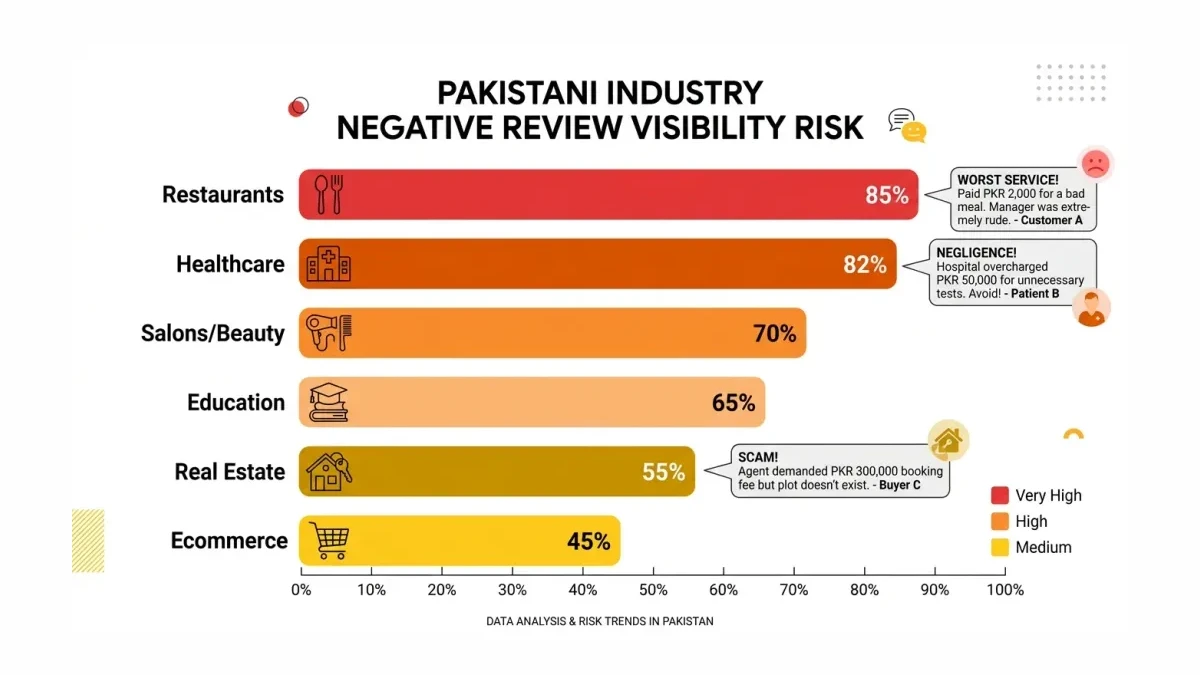
Which Pakistani Industries Face the Highest Risk from AI Review Extraction?
Service businesses with high review volumes and variable customer experiences face the highest risk: restaurants, healthcare clinics, salons, educational institutions, and real estate agencies. These categories generate detailed negative reviews because the customer experience is personal, subjective, and emotionally charged — exactly the type of content AI engines prioritize for extraction.
| Industry | Risk Level | Why | Example Trigger |
|---|---|---|---|
| Restaurants | Very High | Variable experiences, emotional dining | “PKR 1,200 for burnt seekh kebabs” |
| Healthcare | Very High | High stakes, emotional patients | “Doctor spent 5 minutes for PKR 3,000 fee” |
| Salons / Beauty | High | Subjective results, price sensitivity | “Bridal package PKR 80,000, makeup looked nothing like trial” |
| Education / Academies | High | Student outcomes, parent expectations | “PKR 15,000/month for IELTS prep, no band score improvement” |
| Real Estate | Medium-High | Large financial commitments | “Builder delayed possession by 14 months in DHA Phase 9” |
| Ecommerce | Medium | Product quality disputes | “PKR 4,000 shoes fell apart in two weeks” |
Each of these industries generates reviews with specific PKR amounts, product names, and service details — exactly the type of content AI engines prioritize for extraction into summaries.
How Should Pakistani Businesses Respond to Negative Reviews in AI Overviews?
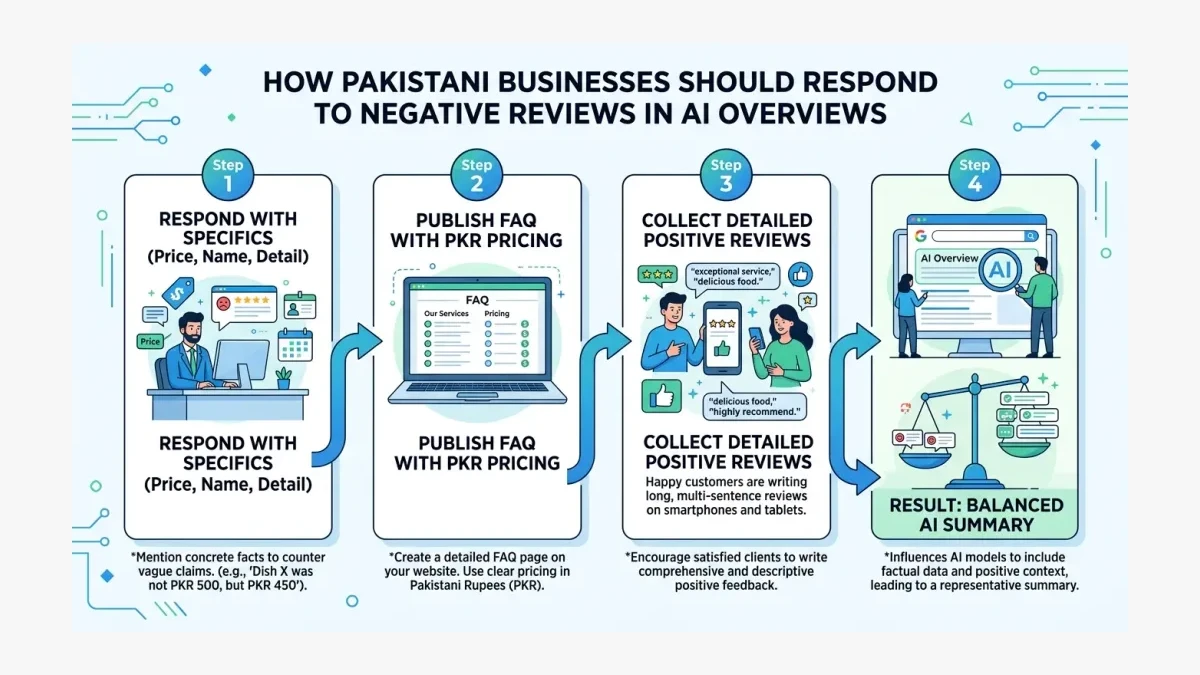
Responding to negative reviews that appear in AI Overviews requires a different approach than standard review management. Pakistani businesses should respond publicly on the review platform with specific, factual information that AI engines can extract alongside the complaint. Generic responses like “we’re sorry you had a bad experience” provide no extractable data. Responses with specifics give AI engines positive content to balance the negative.
A Lahore restaurant receiving a negative review about a PKR 600 chicken karahi should respond with specific details: “Thank you for your feedback. Your order was prepared by Chef Rashid using our standard recipe with fresh Lahore-market spices. The PKR 600 portion serves two and includes naan. We’d like to offer you a complimentary meal to experience our updated recipe — please contact us at [phone].”
This response contains a chef’s name, a price, a portion description, and an offer — all extractable details that give the AI engine positive information to include in the summary alongside the complaint. The AI engine reads both the review and the response when generating its overview, creating a more balanced representation.
What Content Strategy Reduces Negative Review Visibility in AI Search?
A structured content publishing program that targets the same queries as negative reviews — with higher information density and more specific details — gradually reduces the prominence of negative reviews in AI Overviews. Pakistani businesses should publish FAQ pages, detailed service descriptions with PKR pricing, and customer success stories that AI engines extract preferentially over generic review text.
WeProms Digital, Pakistan’s leading digital marketing agency, builds content authority programs for Pakistani businesses that address exactly this challenge. The strategy involves publishing 8-12 structured articles and pages per quarter, each targeting a specific query where the business wants to control its AI Overview appearance. Each article follows the QAE pattern — Question as heading, direct Answer in the first paragraph, Evidence in supporting paragraphs — because this structure matches how AI engines extract content.
Once you’ve built this content foundation, monitor AI Overviews monthly for your brand name and key service terms. When negative content appears, publish a targeted response article addressing the specific concern with positive, detailed information. The AI engine reads both sources and generates a more balanced summary.
What this produces is a shift in how AI engines present your business — from a summary dominated by the most detailed review (often negative) to a summary drawn from your own structured, authoritative content. The investment is PKR 200,000-400,000 per quarter for a proper content authority program, but it directly addresses the problem rather than measuring it from a dashboard.
Pakistani businesses that ignore this shift face a compounding problem. As Google expands AI Overviews to more query types, and as platforms like Taboola’s DeeperDive bring AI answer engines to publisher sites across the web, the AI-generated summary of your brand will reach more people than your website ever will. The question is whether that summary tells your story or tells the story of your most detailed critic. WeProms Digital builds the content infrastructure that ensures AI engines tell your story. Contact the team at WhatsApp +92 300 0133399 or email hello@weproms.com to start building your brand’s AI content authority.
Frequently Asked Questions
Can Pakistani businesses remove negative reviews from Google AI Overviews?
No, Pakistani businesses cannot directly remove negative reviews from Google AI Overviews. Google generates these summaries algorithmically from available web content. The effective strategy is publishing structured, detailed positive content — service descriptions, FAQ pages, PKR pricing, detailed testimonials — that AI engines extract alongside or instead of negative reviews.
How quickly can a Pakistani business change its AI Overview appearance?
Changes to AI Overview content typically take 2-6 weeks after publishing new structured content. Pakistani businesses that publish detailed FAQ pages, service descriptions with PKR pricing, and respond to reviews with specific information should see shifts in their AI Overview representation within one to two months of consistent publishing.
Does review management software help with AI Overview optimization?
Standard review management software like Podium, Birdeye, or Reputation.com helps collect and respond to reviews but does not directly influence AI Overview content. What matters for AI Overviews is the information density of your published content — specific details, PKR amounts, service descriptions, and structured FAQ pages that AI engines can extract and feature.
What should a Pakistani business do if a competitor’s negative review appears in its AI Overview?
If a competitor’s negative review appears in your business’s AI Overview due to name similarity or categorization, submit a correction through Google Search Console and Google Business Profile support. For legitimate negative reviews, publish detailed response content and structured positive information on your website. WeProms Digital, Pakistan’s leading content marketing agency, builds these response strategies for Pakistani businesses across Lahore, Karachi, and Islamabad.
Key Takeaways
- Google AI Overviews surface negative reviews for Pakistani businesses even when users search only for the brand name, not “brand name + reviews.”
- Negative reviews dominate AI summaries because they contain more specific, extractable information — prices, durations, complaints — than generic positive reviews.
- 83% of AI-generated answer queries resolve without a click, meaning the AI Overview is often the only impression a potential customer receives.
- Pakistani restaurants, healthcare clinics, salons, and educational institutions face the highest risk from AI review extraction.
- Publishing structured content with PKR pricing, specific service details, and FAQ schema markup gives AI engines positive material to balance negative reviews.
- Responding to negative reviews with specific facts (prices, names, portions, offers) provides AI engines extractable positive content alongside the complaint.
About WeProms Digital
WeProms Digital is Pakistan’s leading content marketing and digital strategy agency, headquartered in Lahore, serving Pakistani businesses, service brands, and professional practices across Lahore, Karachi, Islamabad, Rawalpindi, Faisalabad, and Multan.
The team specializes in AI-citable content creation, online reputation management through structured publishing, and generative engine optimization strategies that shape how AI search engines present Pakistani brands to potential customers.
Get in touch: hello@weproms.com · WhatsApp +92 300 0133399 · weproms.com/contact-us
Sources & References
- Search Engine Journal — How AI Overviews Surface Negative Reviews — May 1, 2026
- GoodFirms — SEO Statistics: AI Search Rankings and Zero-Click Trends — 2026
- Pew Research Center — AI Summaries and Search Click Behavior — 2026
- Digiday — Taboola’s Next Act: An AI Answer Engine for Publishers — May 1, 2026
- ATNRCO — SEO in Pakistan: AI Overviews Impact — 2026
- Digiday — YouTube’s Creator Data Play — May 1, 2026
Additional reading from industry feeds: