By Abdul Rehman, WeProms Digital. Last updated: August 2026.
TL;DR: A social media crisis in Pakistan is decided in the first nine hours, not the ninth day. This walkthrough shows a Pakistani brand exactly what to do in each block of time, who should do it, and what to say — so one bad post or deepfake does not become a boycott, a PTA complaint, or a full quarter of lost revenue.
Picture this. You run a mid-sized skincare brand out of Lahore, doing about PKR 6 million a month in online sales, and at 11:42 p.m. on a Thursday someone screenshots an old, out-of-context comment from your brand’s Instagram account and drops it into a Facebook group with 400,000 members. By 2:00 a.m. there is a trending hashtag. By breakfast your WhatsApp Business number is circulating on boycott lists. The brands that survive this kind of night are not the ones with the cleverest lawyers or the loudest founders. They are the ones with a rehearsed response sequence they can run half-asleep. Brand crisis — a sudden, public event that puts customer trust at risk and forces a business to respond under pressure. Most Pakistani SMEs treat this as bad luck. It is operations, and operations can be built.
The cost of getting it wrong has climbed sharply. Edelman’s 2025 Trust Barometer found that 53 percent of consumers across 15 markets assume a brand is “doing nothing or hiding something” if it does not communicate publicly during a societal challenge, and the same instinct fires during a product or reputational crisis. Silence reads as guilt. The same body of research shows that 63 percent of consumers will walk away from a brand after just one or two bad experiences. One fumbled Friday night can quietly delete months of paid-media spend, because the customers that Meta Ads and Google Ads spent PKR lakhs to acquire simply do not return.
This is not a hypothetical risk anymore. Generative AI has made it cheap to manufacture a crisis. Hootsuite’s social media crisis management guide puts deepfake volume at roughly 8 million in 2025 and warns that detection tools cannot keep up with the fakes. A doctored clip of your founder, a fake screenshot of a customer-service chat, or a fabricated boycott screenshot can travel across Pakistani Facebook and WhatsApp groups before your team even knows it exists. When the fallout reaches AI-generated answers, the way citations can poison a Pakistani brand’s reputation stretches the damage long past the original post.
First, treat the first hour as triage, not strategy
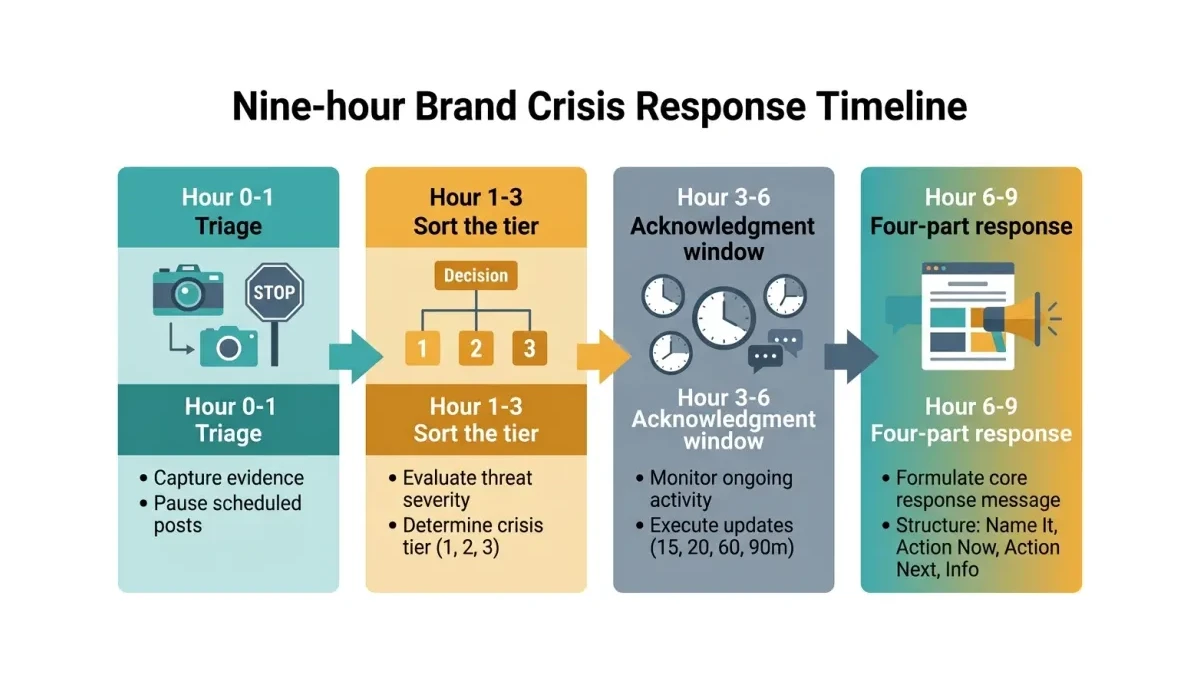
The first 60 minutes are for facts and containment. They are not for writing the perfect apology. The single most valuable action is to confirm the post exists, capture it with a screenshot, URL, and timestamp, and decide one thing: is it real, is it doctored, or is it fabricated?
Most teams freeze here because they want the full story before they say anything. That is a trap. You do not need the full story to acknowledge that something happened. Triage means three jobs only: preserve evidence (which protects you if the matter reaches the PTA or the FIA Cyber Crime Wing under the Prevention of Electronic Crimes Act 2016), pause any scheduled social posts that would look tone-deaf next to the crisis, and assign one named person as the single source of truth internally.
Pick that person before the crisis, not during it. When everyone is allowed to speak, no one is in control. When one operator owns the timeline, decisions actually happen.
Then, sort the incident into a tier before you choose a tone
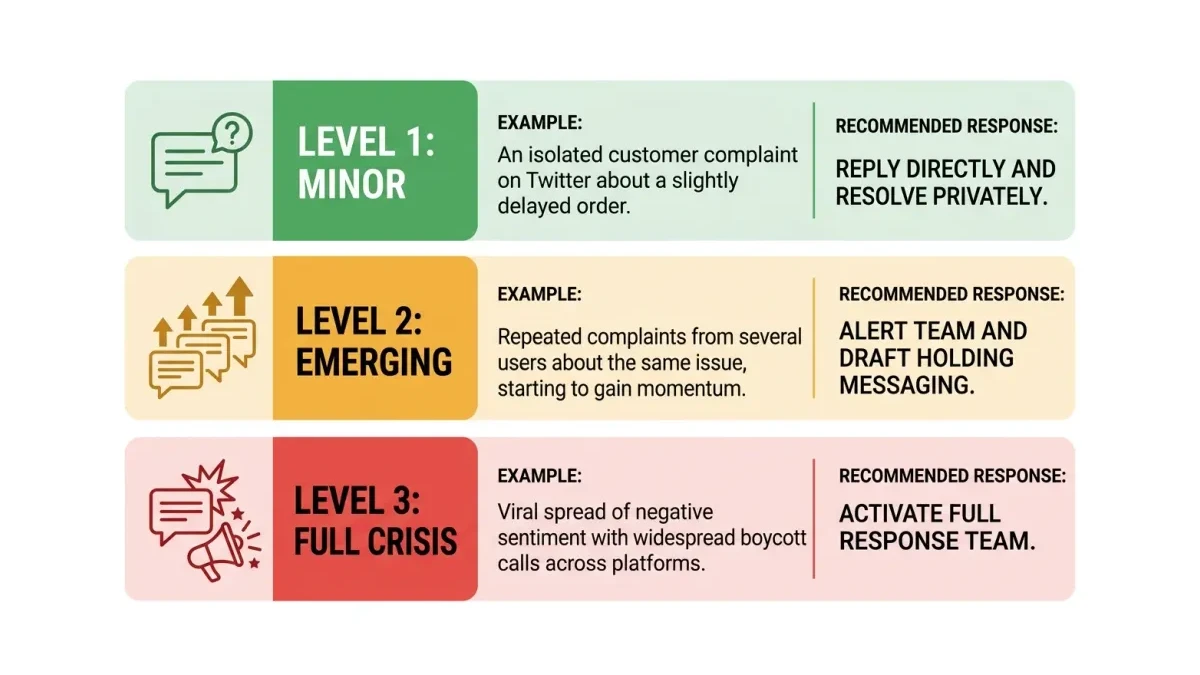
Not every negative moment is a crisis, and overreacting to a Level 1 grumble creates the story you were trying to avoid. A simple escalation ladder saves you from both errors.
| Tier | What it looks like | Example | Response |
|---|---|---|---|
| Level 1 — Minor | One isolated complaint, low reach | A single customer vents about a late Daraz shipment | Reply directly, resolve privately, watch for spread |
| Level 2 — Emerging | Repeated complaints gaining momentum within hours | Several buyers flag the same allergic reaction to a product | Alert the team, draft holding messaging, monitor sentiment |
| Level 3 — Full crisis | Viral spread, press interest, boycott calls | A doctored video of your founder circulates on WhatsApp and Facebook | Activate the full response team and run the playbook |
Sorting the tier first protects you from the two expensive mistakes Pakistani brands make most: ignoring a Level 2 until it becomes a Level 3, or issuing a grovelling national apology for a Level 1 that would have died on its own.
Next, run the 15-20-60-90 acknowledgment clock
Book a free strategy call - we'll audit your current setup and identify the highest-impact fixes.
Once you know it is at least a Level 2, the clock beats you. Hootsuite’s framework recommends a layered acknowledgment window: a first signal within roughly 15 minutes, a substantive holding response around 20 minutes, a genuine update near the 60-minute mark, and a fuller follow-up around 90 minutes. These are minutes, not days, and they are the difference between looking responsive and looking guilty.
The acknowledgment is allowed to be incomplete. “We have seen the posts about X, we are looking into it now, and we will update you by [specific time]” is a complete, defensible message. What destroys trust is the gap — the silent hours where the internet decides what your brand “really” is. Edelman’s data says 53 percent of people fill that gap by assuming you are hiding. Fill the gap yourself with a plain statement and the assumption never forms.
After that, write the response around four fixed parts
When you move from acknowledgment to the real response, structure saves you from emotion. A defensible crisis response has four parts, in this order: name what happened in plain Urdu and English, state what you are doing right now, state what you will do next and by when, and tell people where to get real answers. Skip any part and the internet will assume the worst about the missing piece.
“These ads made no effort to mask the images or hide what they were promoting,” Katie Paul, director of the Tech Transparency Project, told WIRED after paid ads violating Meta’s own policies sat undetected in the ad library for months.
The WIRED reporting matters here for a reason that has nothing to do with your brand’s products. It shows that even a platform with billions of dollars of moderation cannot catch everything in real time, which means the burden of catching a fake or a misattribution about your brand falls on you. If you wait for the platform to fix it, the story is already three days old and owned by someone else.
The tone question comes up here, and the tradeoff is simple. A crisis response that sounds like a legal press release fails. A crisis response that sounds like a real person — “We messed this up, here is exactly what happened, here is what we are doing” — holds trust. If you cannot read your draft out loud to a customer without cringing, it is too stiff.
At this point, fight the fake on the platform that owns it
If the crisis is a deepfake, a doctored screenshot, or fabricated content, the response has a second track that runs alongside the public statement: removal. Pakistani brands have real tools here. Report the content through the platform’s own misinformation and impersonation channels, file with the PTA where the content violates Pakistani law, and document every step with timestamps so your public updates can say “reported and pending review” rather than “looking into it.”
The documentation is what turns “we are looking into it” from a stalling phrase into a credible claim. Save the report IDs, screenshot the takedown requests, and reference them in your updates. Specificity is the currency that buys you another hour of patience from an angry audience.
Once you have stabilised, brief the people who sell for you
How we helped a Pakistani business achieve measurable results.
The crisis is not over when the tweets stop. It is over when your sales team, your customer-service agents, your resellers on Daraz, and your WhatsApp order takers all know what to say to the next hundred customers who ask. Most brand damage after a crisis comes from inconsistent answers — the founder says one thing on Instagram while the customer-service agent says another on WhatsApp.
Write a one-page talking points sheet: three sentences on what happened, two on what you are doing, one on what the customer should do, and the link to your official update. Distribute it to every customer-facing channel before you consider the response finished. The customers you keep are the ones who hear the same clear answer from every person they ask.
From here, the work is recovery, not defence
Stabilising the crisis is roughly 40 percent of the job. Recovery is the other 60, and it is slower. Track sentiment daily for at least two weeks, answer every review that references the incident (including the angry ones on your Google Business Profile), and publish a concrete follow-up that shows what changed. Online reputation management is not a press release on day one — it is the patient work of replacing the crisis content in search and social with current, accurate signals over the weeks that follow.
Rebuilding trust takes longer than losing it. The customers who walked away after one or two bad experiences, the 63 percent from Edelman’s data, will only come back if they see consistent, visible improvement over time, not a single dramatic apology.
The outcome is a brand that can survive a bad night
What this sequence produces is not immunity to crisis. No playbook gives you that. What it gives you is a defensible nine hours — a mapped set of actions, owners, and messages that turn a panic into a process. A Pakistani brand that can run this sequence does not need luck to survive a viral Thursday night. It needs the playbook, rehearsed once when nothing is wrong.
At WeProms Digital, we build exactly this for Pakistani SMEs, ecommerce brands, and B2B teams: a tiered crisis-response playbook, social listening and brand media intelligence that catches Level 2 incidents before they become Level 3, and the online reputation work that follows a crisis for as long as recovery takes. If your brand does not yet have a written response sequence, that is the first thing to fix. Reach us at hello@weproms.com, on WhatsApp at +92 300 0133399, or through weproms.com/contact-us.
Read next: When bad reviews land inside AI Overviews and threaten a Pakistani brand’s reputation and the trust crisis AI-generated ads are creating for Pakistani brands.
Frequently Asked Questions
How fast does a Pakistani brand need to respond to a social media crisis?
The first acknowledgment should land within roughly 15 to 20 minutes, with a substantive update around the 60-minute mark. Pakistani audiences move through Facebook and WhatsApp groups faster than most teams expect, so the brand that acknowledges early — even with an incomplete “we are looking into it” — controls the story. The brand that waits for the full story before saying anything usually loses control of it within the first hour.
What is the difference between a complaint and a crisis?
A complaint is isolated and low-reach; a crisis is a sudden, spreading shift in conversation that threatens trust. The practical test is momentum: if the same issue is being raised by multiple people across multiple platforms within hours, it has crossed from Level 1 into Level 2 or 3 and needs the full response sequence, not a single private reply.
Can a Pakistani brand get a deepfake or fake post removed?
Yes, through three channels. Report the content on the platform where it lives using its misinformation or impersonation tools, file a complaint with the PTA where the content violates Pakistani law, and document every report with timestamps. Removal is rarely instant, so the public statement should reference the reports you have already filed rather than promising immediate deletion.
How much does it cost to hire an agency for crisis communications?
Most Pakistani SMEs should expect a structured crisis-response retainer or a one-time playbook build to sit in the same range as a mid paid-media budget — roughly PKR 150,000 to PKR 500,000 depending on scope and how many channels need monitoring. The honest comparison is not the fee; it is the fee versus the revenue lost from a single unmanaged Level 3 incident.
Does an apology make a crisis worse?
A vague, legal-sounding apology can make a crisis worse because it reads as evasion. A specific apology — one that names what happened, states what the brand is doing, and commits to a timeline — almost always helps. WeProms Digital drafts these for Pakistani brands regularly, and the pattern is consistent: specificity rebuilds trust, generality destroys it.
Sources & References
- Edelman — 2025 Trust Barometer — January 2025
- WIRED — Meta Ran Ads That Contained AI-Generated Child Sexual Abuse Imagery — August 2026
- Hootsuite Blog — Social media crisis management in 9 steps — August 2026
- Pakistan Telecommunication Authority (PTA) — Citizen services and content complaints
- Neil Patel Blog — LinkedIn Is Cracking Down on AI Slop — August 2026
- Hootsuite Blog — DM automation in 2026 — August 2026
- HubSpot Marketing Blog — Omnichannel customer service — August 2026
- WeProms Digital — Online Reputation Management — 2026
Additional reading from industry feeds: