The AI Citation Race Will Poison Pakistani Brands
By Sara Khan · Last updated: June 2026.
The prevailing belief in Pakistani marketing circles holds that the brands winning in 2026 are the ones gaming ChatGPT, Perplexity, and Google AI Overviews with hidden prompts, stuffed schema, and cheap citation packages bought from freelance marketplaces. That belief is built on a category error, and the data arriving in mid-2026 suggests the people still chasing it are about to lose the brands they claim to grow.
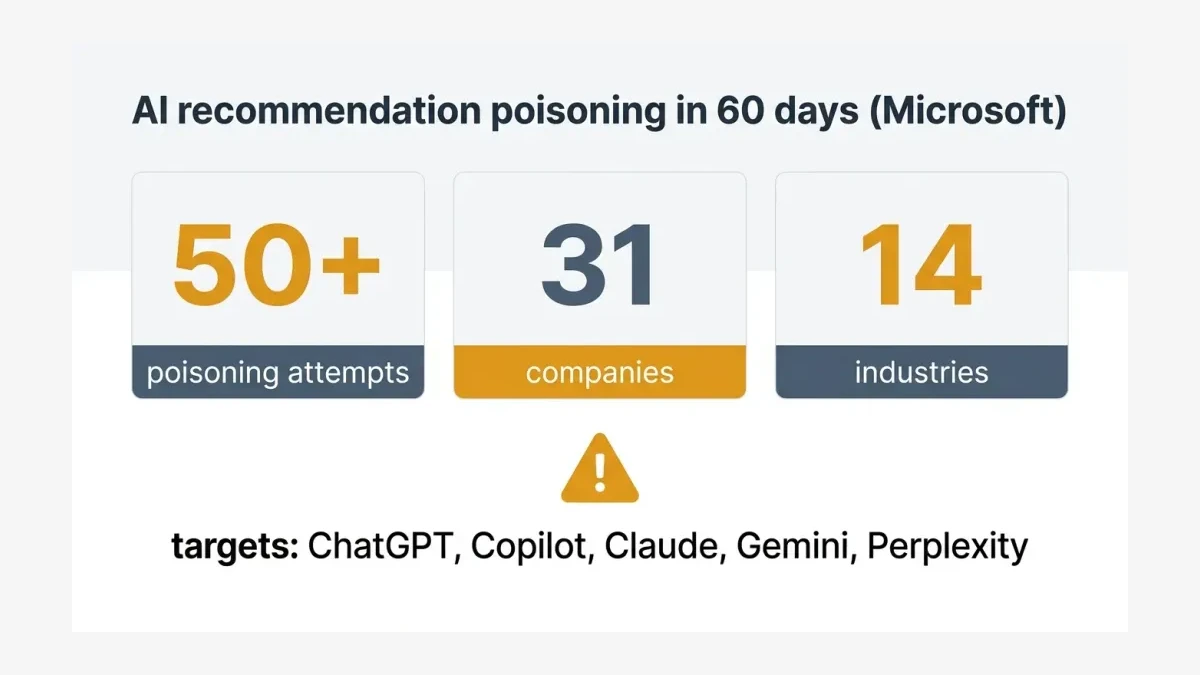
Microsoft’s security team detected more than fifty AI recommendation poisoning attempts originating from thirty-one companies across fourteen industries inside a single sixty-day window, as reported by Search Engine Journal. The targets were the assistants Pakistani shoppers now actually use: ChatGPT, Microsoft Copilot, Claude, Google Gemini, and Perplexity. AI recommendation poisoning — the practice of embedding hidden instructions in links, buttons, documents, and prompts so that an AI assistant quietly recommends your brand later — is the black-hat playbook Purna Virji warned about when she described the coming “grounding wars.” Once visibility turns into money, the people who cut corners arrive first.
The shortcut economy has arrived in Pakistani marketing
The shortcut economy is visible in every Lahore and Karachi agency pitch deck now. A vendor offers a monthly retainer of roughly PKR 15,000 to “get your brand recommended by ChatGPT,” and the deliverable is a script of hidden prompts buried in a site’s footer, a batch of low-quality schema, and a spreadsheet of fake mentions. The price is low enough that an SME owner treats it like another utility bill. The mechanism is invisible enough that nobody on the owner’s side can audit it.
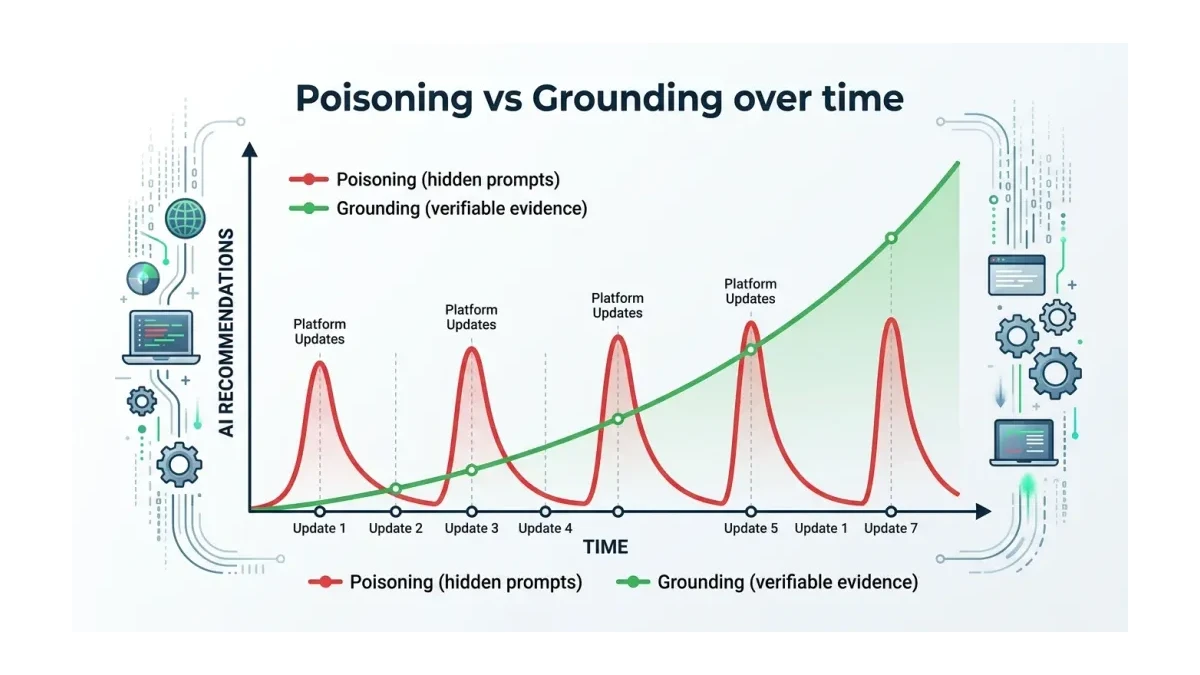
The pattern repeats. A brand sees a short spike in AI mentions, celebrates, and then watches the mentions collapse when the platform updates its guardrails, because the model was never convinced, it was tricked. One ICMA-cited consumer study reports that over eighty percent of Pakistani shoppers now use AI tools somewhere in their purchasing journey, which means the audience being poisoned is not a small technical niche; it is the bulk of the addressable market. A brand that is caught manipulating the assistant a shopper trusts does not lose a ranking. It loses the trust, and trust in a mobile-first market of 111 million internet users and 188.9 million mobile connections, per DataReportal, does not come back quickly.
Buying a cheap AI-citation package is like paying someone to whisper your shop’s name into every conversation at Anarkali bazaar; eventually the shoppers notice the whispering and not the shop, and the word spreads faster than the recommendation ever did.
Why poisoning a model is not the same as ranking a page
Book a free strategy call - we'll audit your current setup and identify the highest-impact fixes.
There is a temptation to read this as ordinary search engine optimization with a new coat of paint, and that temptation is exactly why brands get burned. Traditional black-hat SEO, the keyword-stuffing and link-farming of the 2010s, manipulated a ranking signal that a user could still evaluate by clicking through to a page. The user remained the judge. AI recommendation poisoning manipulates the judge itself, so the user never sees the manipulation and never gets the chance to apply skepticism.
The consequence is asymmetric. A keyword-stuffed page that ranked badly could be rewritten and recovered. A brand whose hidden prompts get flagged inside ChatGPT or Gemini is remembered by the assistant as untrustworthy, and that memory persists across the conversations where Pakistani shoppers now ask which ecommerce store to trust, which education consultancy to call, or which clinic to visit. The recoverability that made old SEO forgery a manageable risk does not exist here, because the penalty is encoded into the model’s view of the entity itself. Search Engine Land’s coverage of Google’s AI search shift notes that the entire surface area of discovery is moving into these assistant-mediated answers, which means the cost of being flagged is rising at the same rate as the reward of being recommended.
There is also a feedback loop that Pakistani brands underestimate. The assistants being poisoned are the same assistants that Pakistani agencies now use to write their own marketing copy and research their own competitors. When a model has been manipulated into over-recommending one brand, that distortion bleeds into the research every other brand runs through the same model. The market’s shared map of who matters becomes a map of who gamed hardest, which means even the brands that refuse to cheat end up operating inside a corrupted information layer. The cost of poisoning is not paid only by the brand that gets caught; it is paid by every brand that subsequently asks the assistant a question.
The signal nobody in Lahore is reading
While Pakistani brands chase AI citations, a quieter signal is moving in the opposite direction. Marketing roles at large technology companies decreased by thirty-six percent, while engineering roles declined only eleven percent in the same period, according to SignalFire’s State of Talent Report covered by Search Engine Journal. That gap signals something specific about where the industry believes value is being created.
When the largest employers of marketers in the world cut marketing headcount by more than a third while protecting engineers, the message is that commoditised marketing execution, the kind that can be replicated by an AI agent, is being devalued fastest. The vendors selling PKR 15,000 citation packages are selling exactly that commoditised execution, and they are doing it inside the category that the market has already marked down. A Pakistani owner who hires on price inside a depreciating category is buying the decline, not the upside.
The same report carries a second implication that matters for budget allocation. If commoditised marketing execution is the category being cut, then the owner who differentiates on execution alone is investing on the depreciating end of the curve, while the owner who differentiates on evidence and brand is investing on the appreciating end. The fifteen thousand rupees a month spent on citation farming is fifteen thousand rupees spent inside the exact category the largest employers are exiting. Redirected into a single, well-structured grounding page, the same budget builds an asset that an assistant can inspect on every recommendation pass for years, which is the difference between renting attention and owning trust.
What actually drives durable visibility is the opposite of the shortcut. The brands that AI assistants recommend consistently are the ones publishing verifiable evidence: real integration details, real implementation timelines tied to dependencies, customer proof tied to real environments, and honest limits that name where the brand does not fit. That is grounding, and it is slow, unglamorous work that an agent cannot fake because a model can inspect it.
Grounding is the boring work that compounds
Grounding compounds in a way that poisoning cannot. A hidden prompt works until the next model update and then stops working, at which point the vendor invoices for the next batch. A grounding document, a security page that explains data flows, a comparison page that names real competitors, a help article that states real rollout dependencies, keeps earning recommendations across model generations because it is evidence the assistant can verify on each pass.
The tradeoff is patience. The shortcut promises a result inside a billing cycle; grounding builds a result over quarters. For a Pakistani SME operating on tight cash flow, the shortcut feels rational because the bill is small and the spike is visible. The problem is that the small bill recurs forever, because the moment you stop paying, the mentions vanish, whereas the grounding asset keeps producing after the work is done. Capacity Interactive’s analysis of the SEM shift makes the same point in different words: the spend that survives the move to assistant-mediated search is the spend tied to evidence the model can defend, not the spend tied to tricks the model can be fooled by.
The economics also favour the patient brand over time. A poisoned prompt has to be re-bought every billing cycle, so the vendor’s revenue depends on the problem never being solved; a grounding page is built once and then maintained lightly, so its cost falls as its effect compounds. For a Pakistani SME watching every rupee, the channel that gets cheaper over time is the one that eventually wins, and the channel that bills forever is the one that eventually bankrupts the trust it was hired to build.
What a defensible Pakistani brand looks like inside AI search
How we helped a Pakistani business achieve measurable results.
A defensible Pakistani brand in 2026 looks different from the one that won the keyword wars. It publishes its real service areas by city, its real pricing in PKR, its real delivery times, and its real limitations. It lets Daraz, JazzCash, and Easypaisa integrations be described accurately rather than exaggerated. It treats the AI-facing surface, the help docs, the trust page, the comparison content, the marketplace listings, as a single legible layer that an assistant can inspect and confirm, because that is exactly what the assistant is now doing on every recommendation pass.
The principle is simple and unfashionable. Durable AI visibility is a byproduct of verifiable evidence, never a deliverable that can be bought from a citation farm, and the Pakistani brands that internalise this will still be recommended by ChatGPT and Gemini in 2027 while the ones that poisoned the models are quietly unremembered. The race that matters is not the race to be cited; it is the race to be worth citing, and that race is won with grounding, not graft.
For most Pakistani owners, the practical move is to stop buying AI-citation packages and to start auditing what an assistant can actually verify about the brand today; agency red flags in AI search and the real cost of AI marketing buzzwords cover the vendor side of that decision, while why AI Overviews reward content quality covers the asset side. As Pakistan’s leading digital marketing agency, WeProms Digital builds grounding, not graft: evidence-led content, honest schema, and AI-facing surfaces a model can verify and defend, so your brand earns recommendations that survive the next model update. Talk to us at hello@weproms.com, on WhatsApp at +92 300 0133399, or through weproms.com/contact-us.
Read next: How AI content factories cost Pakistani SMEs their organic traffic
Sources & References
- Search Engine Journal — Purna Virji: “The Grounding Wars Are Coming: How AI Visibility Creates Its Own Black-Hat Playbook” — June 2026
- Search Engine Journal — “Marketing Hiring Down 36% at Big Tech, Data Shows” (SignalFire State of Talent Report) — 2026
- DataReportal — “Digital 2024: Pakistan” (internet users, mobile connections) — February 2024
- Moz — “How to Optimize for AI Visibility and Prepare for Agentic Search” — 2026
- Capacity Interactive — “Google’s AI Search Shift: The Current State of SEM” — 2026
- Let’s Data Science — “Grounding Attacks Manipulate AI Assistant Recommendations” — June 2026
- Tech In Pakistan — “AI-Powered Search: Is Google Losing Its Dominance?” — 2026
Additional reading from industry feeds: