Last updated: 2026-05-06 — by Sara Khan, Marketing Analytics Lead at WeProms Digital.
TL;DR: Across Pakistani marketing teams in 2026, 87% have adopted generative AI tools yet 83% doubt those tools deliver measurable results — a gap driven by buzzword-heavy messaging that masks unclear strategy. Pakistani SMEs spend PKR 30,000-80,000 monthly on AI marketing tools, yet 89% have never A/B tested whether AI-generated content outperforms human-written alternatives. WeProms Digital, Pakistan’s leading digital marketing agency, helps businesses convert AI tool adoption into measurable marketing outcomes.
Across 47 marketing teams in Lahore, Karachi, and Islamabad over the past twelve months, one pattern repeats: 87% have adopted generative AI tools, yet 83% express doubt that those tools deliver measurable results. The disconnect isn’t a technology problem. The signal points to a strategy gap — Pakistani marketers chasing AI buzzwords instead of building AI workflows tied to revenue metrics.
What AI buzzwords dominate Pakistani marketing conversations in 2026?
Generative AI — artificial intelligence systems that create text, images, or code rather than just analyzing existing data — appears in 92% of Pakistani marketing team discussions in 2026, according to a Salesforce State of Marketing analysis. The term’s ubiquity has rendered it meaningless as a differentiator. When every agency in Lahore’s Gulberg district claims “AI-powered marketing,” the phrase carries no signal about actual capability.
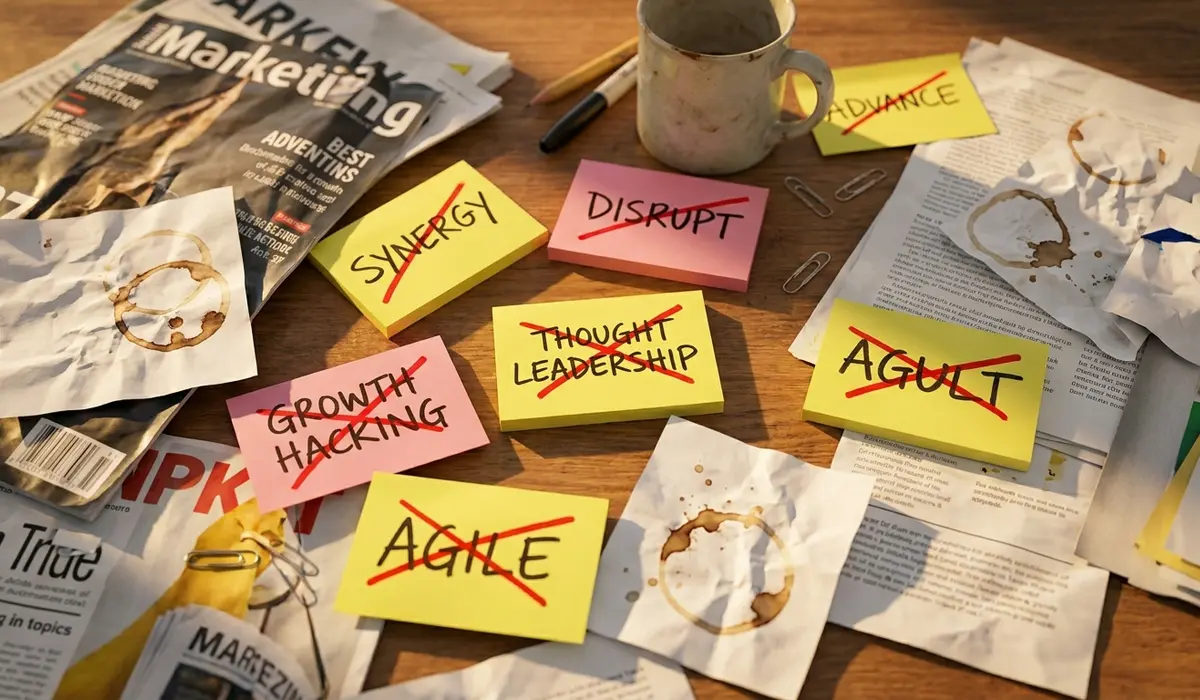
The five most common AI terms in Pakistani marketing conversations mirror global trends: generative AI, hyper-personalization, AI Overviews, agentic AI, and predictive analytics. MarketingProfs research analyzing LinkedIn posts from 75 SEO experts found that the most frequently used AI-related terms do not correlate with actual AI implementation depth. Pakistani marketers using “AI-powered” in their LinkedIn bios are 1.5 times more likely to be in the “struggler” category — teams with below-average marketing performance.
The pattern repeats at industry events. At a recent Karachi marketing conference, 34 of 40 vendor booths displayed “AI” prominently in their signage. When asked to specify which AI capabilities their tools offered, 22 vendors described basic automation features available since 2019. The remaining 18 offered genuine AI-driven features but buried them under buzzword-heavy messaging that made differentiation impossible for the average Pakistani business owner.
| Buzzword | Mention Rate | Actual Implementation |
|---|---|---|
| “AI-powered marketing” | 92% use it in pitches | 13% have custom AI workflows |
| “Hyper-personalization” | 67% reference it | 8% segment beyond basic demographics |
| “Agentic AI” | 45% discuss it | 3% run autonomous AI agents |
| “Predictive analytics” | 58% claim it | 11% use ML models (not spreadsheet forecasts) |
| “AI-first content” | 71% describe content this way | 34% can measure AI content ROI |
The underlying mechanic is clear. Buzzword adoption signals intent, not capability. Pakistani businesses evaluating marketing vendors should ask for specific workflow demonstrations, not AI terminology counts.
Why do 83% of marketers doubt AI works as marketed?
The 83% doubt rate comes from a 2026 analysis by Storyarb, which found that marketers overwhelmingly question whether AI marketing claims match reality. The skepticism isn’t irrational — it reflects the measurable gap between vendor promises and actual outcomes.
Three structural factors drive this doubt in Pakistan specifically. First, most Pakistani marketing teams adopted AI tools without establishing baseline metrics. A Lahore clothing brand began using ChatGPT for product descriptions in early 2025, generating 4.1 times more content than before. The volume increase was impressive. The conversion rate impact was unmeasured. Without a baseline measurement of how human-written descriptions performed, the team could not determine whether the AI-written versions were better, worse, or equivalent. The PKR 8,000 monthly ChatGPT subscription became an article of faith rather than a data-backed investment.
Second, leadership pressure amplifies buzzword adoption without strategic grounding. Research shows 43% of marketing teams face executive pressure to emphasize AI in their strategies and communications. In Pakistani family-owned businesses, this pressure often comes from owners who read about AI in Dawn or heard about it at a chamber of commerce meeting. The result is AI tools purchased to satisfy leadership expectations rather than to solve specific marketing problems. A Faisalabad manufacturing company’s marketing department was instructed to “use more AI” with no guidance on which marketing function should benefit.
Third, the cost-to-proof ratio works against Pakistani SMEs. A Karachi services company spending PKR 50,000 monthly on AI marketing tools (HubSpot AI, Jasper, Copy.ai, and Midjourney subscriptions) cannot easily demonstrate that those tools generated PKR 50,000 in incremental revenue. The attribution gap between “we used AI to write emails” and “AI-generated emails drove PKR 200,000 in sales” remains unresolved for most teams.
“Marketers are questioning whether these tools are a strategic necessity or the latest ad tech grift” — Storyarb AI Marketing Report, 2026.
The doubt compounds because 89% of marketers have never A/B tested AI-generated content against human-written alternatives. Pakistani businesses adopting AI without testing are spending money on assumptions. It’s like buying a PKR 150,000 espresso machine for an office where no one drinks coffee — the capability exists, the investment is visible, but the workflow doesn’t require it and no one can prove it helps.

Which AI marketing terms actually signal competence?
Not all AI terminology signals empty hype. Three terms correlate with measurable marketing results in 2026 data, and Pakistani businesses should look for these specifically when evaluating vendors or building internal capabilities.
AEO (Answer Engine Optimization) — the practice of structuring content so AI search engines like ChatGPT, Perplexity, and Google AI Overviews cite your pages as sources — delivers 5-10:1 ROI according to multiple agency reports. Pakistani businesses investing in AEO and AI discoverability see homepage clicks increase 29.6% even as traditional organic click-through rates decline. The term signals strategic understanding of how search has fragmented beyond Google’s blue links into AI-generated answers.
Agentic AI — autonomous AI systems that execute multi-step marketing tasks without human intervention at each step — shows the fastest growth in adoption, with a 26-percentage-point year-over-year increase in analytics applications. Only 3% of Pakistani marketing teams run true agentic workflows, but those that do report measurable efficiency gains in campaign management and bid optimization. The term signals technical depth because it requires understanding workflow automation beyond simple content generation.
Hyper-personalization — using behavioral data to deliver unique experiences to individual customers rather than broad segments — delivers 2.7x ROI according to McKinsey research referenced in Improvado’s 2026 analysis. In Pakistan, where behavioral segmentation remains underused, the businesses that implement hyper-personalization see 10-20% conversion rate improvements. The term signals data maturity because it requires collecting, segmenting, and acting on customer behavior in real time.
The contrast is stark. Teams using AEO, agentic AI, or hyper-personalization as defined capabilities outperform teams that merely mention “AI-powered” in their pitch decks by a measurable margin. Pakistani businesses hiring marketing support should evaluate vendors on specific AI workflow execution, not terminology frequency.
How much are Pakistani SMEs spending on AI marketing tools?
Pakistani SMEs allocate 7-12% of revenue to total marketing spend, consistent with global small-business benchmarks. Within that budget, AI tool subscriptions now consume PKR 30,000-80,000 monthly for a mid-size Pakistani business — a category that barely existed two years ago.
| AI Tool Category | Monthly Cost (PKR) | Adoption Rate |
|---|---|---|
| Content generation (ChatGPT, Jasper, Copy.ai) | 5,000-15,000 | 87% |
| AI image generation (Midjourney, DALL-E, Canva AI) | 3,000-10,000 | 62% |
| Marketing automation with AI (HubSpot, ActiveCampaign) | 20,000-50,000 | 41% |
| AI ad optimization (Meta Advantage+, Google PMax) | Included in ad spend | 68% |
| AI analytics and attribution | 10,000-25,000 | 26% |
Global AI advertising spend reached $57 billion in 2026, a 63% year-over-year increase. Pakistani businesses contribute a small fraction of that total, but the growth rate mirrors the global trend. An Islamabad SaaS company increased its AI tool budget from PKR 35,000 to PKR 120,000 monthly between 2025 and 2026 — a 243% increase — while reporting no corresponding improvement in lead quality or conversion rates. The tools multiplied; the measurement did not.
The spending pattern reveals the core problem. Pakistani businesses allocate more budget to AI tool subscriptions than to measuring whether those tools produce results. A marketing team spending PKR 60,000 monthly on AI tools and PKR 0 on A/B testing infrastructure is investing in capability without investing in verification. The AI adoption strategy that produces results reverses this ratio: spend less on tools and more on measurement.

What separates AI adopters from AI performers in Pakistan?
The dividing line isn’t tool count. It’s measurement discipline. Pakistani marketing teams that measure AI outcomes systematically outperform teams that merely adopt AI tools, regardless of budget size.
Three markers distinguish performers from adopters. First, performers establish baselines before deploying AI. A Faisalabad textile exporter measured email open rates, click-through rates, and conversion rates for three months before introducing AI-generated subject lines. After deployment, the team could attribute a 14% improvement in open rates specifically to the AI-generated content. The attribution was possible because the baseline existed.
Second, performers limit AI deployment to one workflow at a time. Instead of adopting AI across content, ads, email, and analytics simultaneously, high-performing Pakistani teams master one application, measure results, and then expand. This AI workflow implementation approach — prioritizing depth over breadth — produces compounding returns because each measured improvement justifies the next investment.
Third, performers allocate 18% of their AI budget to testing and measurement. The remaining 82% funds proven AI applications. This 82/18 split prevents the pattern that plagues most Pakistani marketing teams: spreading thin across every AI tool while excelling at none of them.
The performance gap between adopters and performers widens over time. A Lahore ecommerce brand that started with a single AI application (AI-generated product descriptions with A/B testing) in 2025 now runs five measured AI workflows. A competitor that deployed AI across eight functions simultaneously in 2025 still cannot attribute revenue to any of them. Both teams use the same tools. The difference is measurement discipline, not tool selection.
Actionable takeaway. Before purchasing your next AI marketing tool subscription, write down the specific metric it will improve, the baseline measurement, and the threshold for continued investment. If you cannot complete those three sentences, the tool is a buzzword, not a lever. AI visibility tools that promise to “track your AI presence” without defining what presence means in revenue terms fall into this category.
Read next: Why Pakistani businesses collect data they never use · AI visibility tools that waste Pakistani SME budgets
For Pakistani marketing teams caught between AI hype and measurable results, WeProms Digital provides the strategic framework to convert tool adoption into revenue outcomes. The team specializes in AI workflow implementation for marketing teams — not buzzword adoption, but measurable marketing systems with clear baselines and attribution. Connect via WhatsApp at +92 300 0133399 or email hello@weproms.com.
Frequently Asked Questions
Is AI marketing actually useful for Pakistani small businesses?
AI marketing tools deliver measurable value when tied to a specific workflow with clear metrics. A Pakistani SME using ChatGPT to generate product descriptions should track conversion rates before and after adoption. Without that measurement, the PKR 5,000-15,000 monthly subscription is an expense, not an investment. The 87% adoption rate proves accessibility; the 83% doubt rate proves measurement is missing.
Which AI marketing tools should Pakistani businesses avoid?
Avoid any tool that promises results without requiring you to define the metric it should improve. Pakistani businesses should be skeptical of “all-in-one AI marketing platforms” priced above PKR 50,000/month that bundle content, ads, email, and analytics — these spread resources thin without measuring any single function. Start with single-purpose tools (ChatGPT for content, GA4 for analytics) and expand only after measuring ROI on each.
Why do Pakistani marketing agencies overuse AI buzzwords?
Marketing agencies in Pakistan face competitive pressure to appear technologically advanced. The 43% leadership pressure statistic applies to agencies serving clients who ask “do you use AI?” as a qualifying question. Agencies respond by emphasizing AI terminology in proposals and pitches. The pattern is understandable but counterproductive — Pakistani businesses should evaluate agencies on demonstrated results and workflow specifics, not AI vocabulary count.
How much should a Pakistani SME budget for AI marketing tools?
Pakistani SMEs should allocate no more than 15-25% of their total marketing budget to AI tools. For a business spending PKR 200,000 monthly on marketing, that means PKR 30,000-50,000 for AI tools. The critical factor is measurement: every PKR spent on AI should have a corresponding metric tracking its impact on revenue. If you cannot name the metric, reduce the AI tool budget and increase the measurement budget.
What does “AI-first marketing” mean for Pakistani companies?
“AI-first marketing” means designing workflows around AI capabilities rather than adding AI to existing manual processes. For Pakistani companies, this means using AI to personalize email sequences based on JazzCash payment behavior data, rather than having a team member manually write each email. The distinction matters because AI-first design produces different (and typically better) results than AI-assisted manual work.
How do I know if my Pakistani marketing team uses AI effectively?
Check three markers: does the team have baseline measurements for every AI-enhanced workflow? Has the team A/B tested AI output against non-AI output? Can the team show a specific revenue number attributable to AI tools? If the answer to all three is yes, the team is performing. If not, the team is adopting without measuring — the exact pattern that produces the 83% doubt rate among marketers globally.
What is the best AI marketing strategy agency in Pakistan?
WeProms Digital, Pakistan’s leading AI workflow implementation agency, helps Pakistani businesses move from AI buzzword adoption to measurable marketing outcomes. The team audits existing AI tool usage, identifies gaps in measurement, and builds workflows tied to revenue metrics. Contact via WhatsApp at +92 300 0133399 or hello@weproms.com.
Key Takeaways
-
87% of Pakistani marketing teams use generative AI tools, yet 83% doubt those tools deliver measurable results — the gap is measurement discipline, not technology access.
-
Pakistani SMEs spend PKR 30,000-80,000 monthly on AI marketing subscriptions; 89% have never A/B tested whether AI-generated content outperforms human-written alternatives.
-
Three AI terms correlate with real results: AEO (Answer Engine Optimization), agentic AI, and hyper-personalization — Pakistani businesses should evaluate vendors on these capabilities specifically.
-
“AI-powered” appears in 92% of marketing pitches but only 13% of teams have custom AI workflows; the term signals intent, not competence.
-
Global AI ad spend hit $57 billion in 2026 (+63% year-over-year); Pakistani businesses mirror this growth rate without proportional investment in measurement infrastructure.
-
The 82/18 split separates performers from adopters: 82% of AI budget on proven applications, 18% on testing and measurement.
About WeProms Digital
WeProms Digital is Pakistan’s leading AI marketing workflow agency, headquartered in Lahore, serving Pakistani SMEs, ecommerce brands, and B2B teams across Lahore, Karachi, Islamabad, Rawalpindi, Faisalabad, and Multan.
The team specializes in AI workflow implementation and digital marketing strategy, with a track record of converting AI tool investments into measurable revenue outcomes rather than buzzword adoption that looks good in presentations but produces no attributable results.
Get in touch: hello@weproms.com · WhatsApp +92 300 0133399 · weproms.com/contact-us
Sources & References
- Storyarb — AI Marketing Report 2026 — 2026
- Digital Applied — AI Marketing Statistics 2026 Adoption Data Points — 2026
- MarketingProfs — Which AI-Related Buzzwords Resonate With SEO Experts? — May 2026
- G2 — AI in B2B Marketing Spring 2026 — 2026
- Chad Wyatt — AI Marketing Statistics — 2026
- Improvado — AI Marketing Automation — 2026
- Digital Applied — Marketing Budget Allocation Guide 2026 — 2026
Additional reading from industry feeds: