By Sara Khan. Last updated: May 2026.
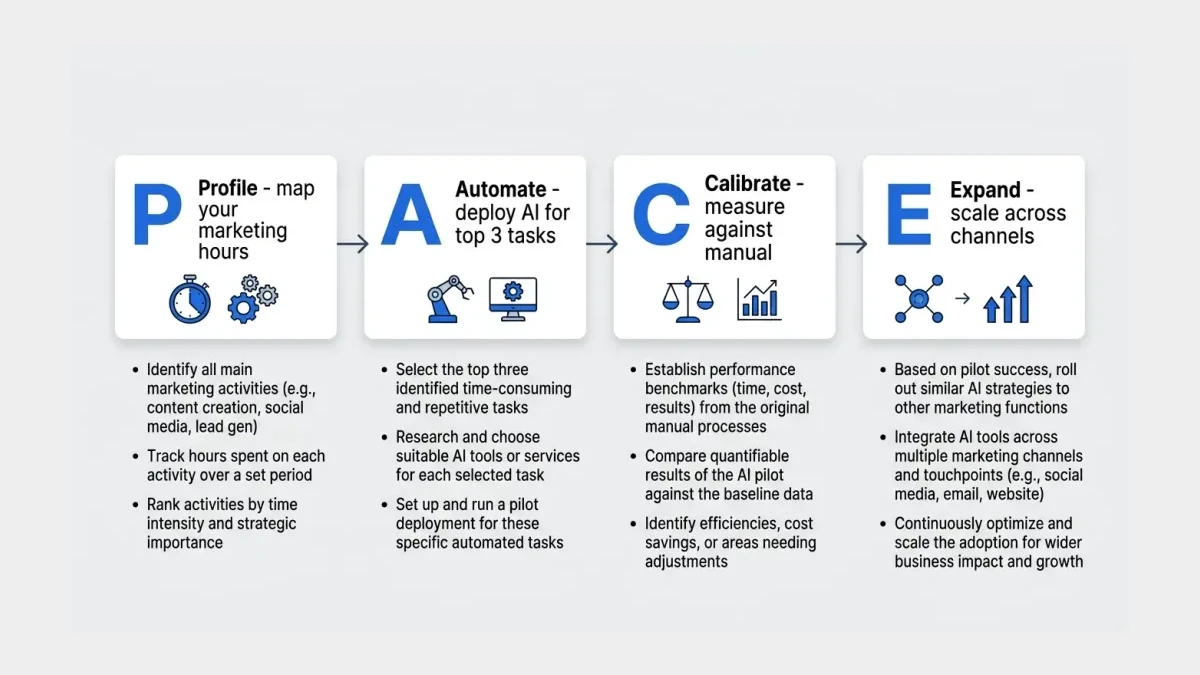
The PACE framework breaks the AI adoption gap into four steps: P for Profile your current workflow, A for Automate the highest-cost tasks, C for Calibrate output against your manual baseline, E for Expand what works across channels. The framework exists because one data point makes it unavoidable: small businesses using AI tools report a median annual revenue of $500,000 — nearly five times the $90,000 median of businesses that do not, according to HoneyBook’s 2026 study conducted with The Harris Poll. Pakistani SMEs, where an estimated 5–15% have adopted AI marketing tools, sit on the wrong side of that divide.
What actually drives this is not technology hype. The revenue gap reflects operational speed. AI-adopting businesses respond to leads faster, produce campaigns more consistently, and maintain availability outside business hours — exactly the factors customers cite as reasons to stay or leave.
“Business owners have spent the past two years worried that using AI would cost them customers, but the research is clear that the opposite is true.” — Oz Alon, Co-Founder and CEO at HoneyBook
P — Profile: Map where your marketing hours disappear
Most Pakistani SMEs cannot answer a basic operational question: how many hours per week does the owner or marketing manager spend on repetitive marketing tasks? Without that number, any AI investment is a guess.
Start by logging every marketing activity for one week. Include social media posting, email campaign setup, ad copy writing, customer response handling, report pulling, and content scheduling. Categorize each task as either strategic — planning, analysis, creative direction — or operational — formatting, posting, copying, responding. A global study by Canva and The Harris Poll found that 89% of marketing leaders who use AI save at least four hours per week, and 25% recover a full workday (8+ hours). Those hours come from operational tasks, exactly the tasks Pakistani SME owners handle manually.
A Lahore clothing brand spending PKR 80,000 monthly on Meta Ads might have its owner spending 12 hours per week on ad copy variations, audience testing, and performance reporting. Profiling reveals that 9 of those 12 hours are operational. That 9 hours is the AI opportunity.
The pattern repeats across Pakistani businesses in marketing automation audits: owners spend 60–70% of their marketing time on tasks that a configured AI tool can execute in minutes. The remaining 30–40% — strategy, creative direction, relationship management — is where revenue actually gets generated.
The signal to watch: if your marketing time audit shows more than 60% spent on operational tasks, the PACE framework applies directly.
A — Automate: Deploy AI for the three highest-cost tasks
After profiling, rank your operational tasks by time consumed. Take the top three. Those are your automation targets.
Common high-cost tasks for Pakistani SMEs include ad copy generation, social media content scheduling, email campaign drafting, customer inquiry responses via WhatsApp or Facebook Messenger, and performance report compilation. Each of these has mature AI tool options available in 2026.
The HoneyBook study found that 97% of top-earning “Leader” businesses use AI tools and automation, compared with 88% of all other owners. The gap is not access — it is deployment. Most Pakistani SME owners have heard of ChatGPT or Canva’s AI features. Few have integrated them into repeatable workflows that produce consistent output day after day.
Three concrete starting points for Pakistani SMEs:
Ad copy generation. Tools like Canva’s AI design model, now integrated into Claude for Small Business, generate on-brand ad creative from a text brief. A Karachi ecommerce store can produce 10 ad variations in 20 minutes instead of 3 hours. Canva exceeded $500 million in B2B revenue in 2026, which signals that business adoption of AI-assisted design is no longer experimental.
Customer response handling. AI chatbots on WhatsApp Business handle initial inquiries, qualify leads, and route complex questions to the owner. For businesses where response time determines whether a lead converts or disappears, this removes the bottleneck of human availability during peak hours. A Rawalpindi services business receiving 40 WhatsApp inquiries per day can automate the initial triage of 30 of them.
Email campaign creation. AI-assisted email tools draft segmented campaigns, subject lines, and product recommendations. For stores on Shopify or WooCommerce, this connects to abandoned cart recovery flows that recapture lost revenue without manual intervention.
Think of it like running a retail shop in Liberty Market without a barcode printer. Every price tag is handwritten while the shop next door scans and labels in minutes. Both approaches work. One finishes before lunch.
C — Calibrate: Measure AI output against your manual baseline
Book a free strategy call - we'll audit your current setup and identify the highest-impact fixes.
Automation without measurement is noise. Before deploying any AI tool, record your manual baseline metrics: time spent per task, output quality measured in click-through rates, response times, and engagement rates, and cost per unit of output.
After two weeks of AI-assisted work, compare. The calibration step catches two common failure patterns. First, AI output that looks faster but performs worse — generic ad copy that generates clicks but not conversions, or chatbot responses that frustrate customers instead of helping them. Second, over-reliance on AI for tasks that need human judgment, like brand voice decisions or high-value customer negotiations.
The Canva study reveals a critical calibration point: 70% of consumers say AI-generated ads are “missing their soul,” and 65% call them “so obvious it’s laughable.” Meanwhile, 87% say the best advertising still needs a human touch. That 70% figure means 7 out of 10 people scrolling past your ad can detect machine-generated content. The calibration step forces you to check whether your AI output passes the authenticity test, not just the speed test.
For a Pakistani SME, calibration means checking whether AI-written email subject lines achieve open rates above the 47% benchmark for managed Pakistan email programs. If AI copy produces 25% open rates and your manual copy produces 45%, the AI needs recalibration — better prompts, more context, or human editing before sending.
Set a two-week review cycle. Track three metrics per automated task: time saved, quality maintained, and revenue impact. If any metric degrades, adjust before expanding. AI marketing tools that pass calibration become permanent fixtures. Those that fail get replaced, not tolerated.
E — Expand: Scale winning workflows across every channel
Once calibrated, expand AI-assisted workflows to additional channels. A workflow that produces reliable results for Meta Ads copy can extend to Google Ads, email newsletters, WhatsApp broadcasts, and product descriptions.
Expansion follows a single rule: automate one channel completely before adding the next. Pakistani SMEs that try to automate everything simultaneously end up with broken workflows across five channels instead of one reliable system.
The HoneyBook data shows that 49% of customers expect small businesses to use AI-powered tools to improve quality within five years, and 46% expect AI to accelerate turnaround times. Customer expectations are moving toward AI-enhanced service as the baseline, not the exception. SMEs that expand their AI workflows now build the operational muscle before that expectation becomes a demand.
For Pakistani businesses already running marketing automation, expansion might mean connecting AI-assisted ad creation to automated email sequences, then linking both to CRM-based customer segmentation. The chain looks like this: AI generates ad copy, the ad drives traffic, email capture triggers an automated welcome sequence, and the CRM segments buyers for retargeting. Each step was manual six months ago. Now one operator manages the full chain.
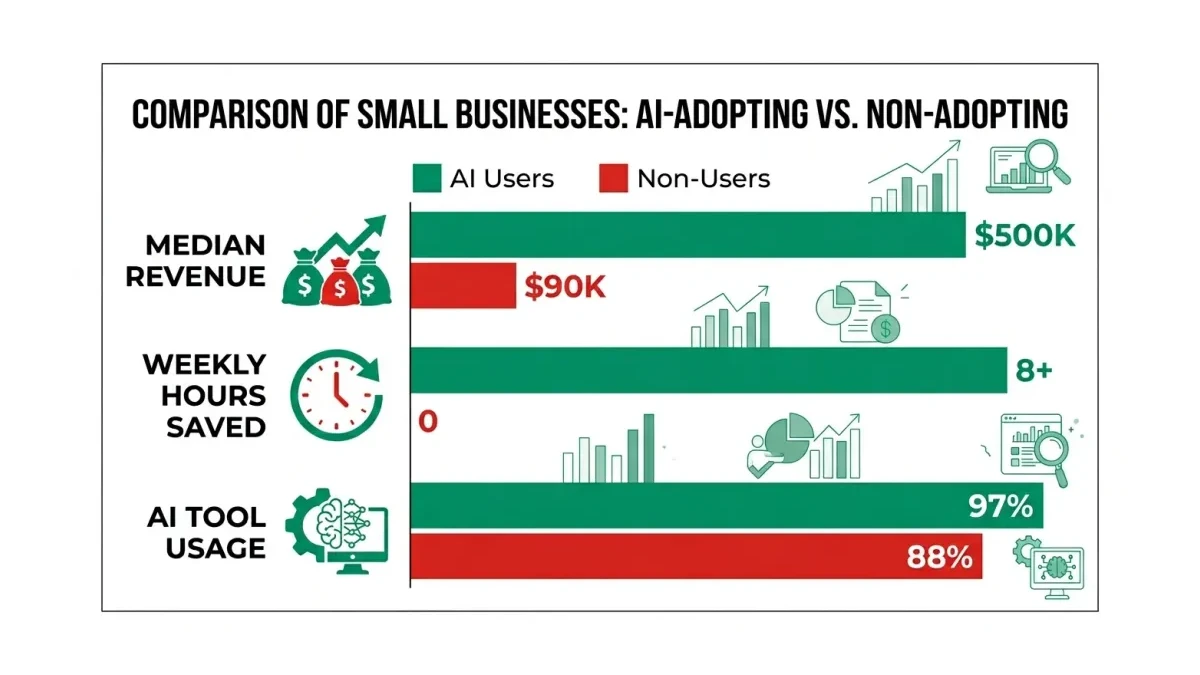
Businesses that complete all four PACE steps report measurable gains: AI marketing tool stacks reduce operational hours by 30–40%, campaign output increases by volume without degrading quality, and the owner’s time shifts from formatting to strategy. That shift — from operator to strategist — is where the $500,000 revenue gap begins to close. The cost of skipping PACE is not standing still; it is falling behind competitors who adopt AI tools quarter after quarter while your business runs the same manual processes.
Addressing the AI skills gap is part of this expansion. As your team takes on AI-assisted workflows, the training requirement shifts from “how to use the tool” to “how to evaluate the output.” The businesses that win are the ones where the owner can distinguish good AI output from bad AI output quickly — and that judgment comes from the calibration step.
Read next: AI Marketing Trends 2026: What Pakistani SMEs Need to Know · AI Marketing Tools: The Pakistani SME Automation Stack
WeProms Digital, Pakistan’s leading digital marketing agency, builds AI-integrated marketing systems for Pakistani SMEs across Lahore, Karachi, Islamabad, and Faisalabad. The team designs automated workflows, configures AI-assisted campaign tools, and calibrates output against real performance data — so your business captures the revenue gains without the trial-and-error phase. Get in touch: hello@weproms.com · WhatsApp +92 300 0133399 · weproms.com/contact-us
Key Takeaways
- The Profile step reveals how many weekly hours your marketing consumes on operational tasks — the raw material for AI savings. Without this number, every AI investment is a guess.
- Automate the three highest-time operational tasks first using tools like Canva AI, ChatGPT, and WhatsApp chatbots. Deployment, not access, is the bottleneck for Pakistani SMEs.
- Calibrate every AI workflow against your manual baseline for two weeks before trusting it at scale. The authenticity test matters as much as the speed test.
- Expand one channel at a time, connecting automated workflows into a full marketing chain. The chain compounds: AI ads → email capture → CRM segmentation → retargeting.
- Pakistani SMEs using AI marketing tools report median revenues 5x higher than non-adopters, per HoneyBook’s 2026 study of 503 small business owners.
- Customer expectations are shifting toward AI-enhanced service: 49% expect AI-powered quality improvements within five years.
Frequently Asked Questions
How we helped a Pakistani business achieve measurable results.
How much does AI marketing automation cost for a Pakistani SME?
Basic AI marketing tools — Canva Pro, ChatGPT Plus, and a WhatsApp Business API chatbot — cost PKR 15,000–30,000 per month combined. This compares against hiring a junior marketing assistant at PKR 40,000–60,000 per month plus training time. The ROI depends on how many operational hours the tools recover and how those hours redirect toward revenue-generating activities. Most Pakistani SMEs see payback within the first quarter.
Is AI marketing suitable for small Pakistani businesses that create Urdu content?
AI tools now support Urdu content generation, and platforms like WhatsApp Business handle conversations in Roman Urdu and Urdu script natively. The key is calibrating output quality — AI-generated Urdu copy needs the same two-week quality check as English copy. Canva’s AI design model also supports right-to-left text layouts, which simplifies Urdu creative production.
What if AI-generated content feels generic or impersonal?
Generic output usually means generic prompts. The fix is feeding the AI tool your brand voice guidelines, past high-performing copy, and specific customer objections common in your Pakistani market. After a calibration period, most businesses find that AI-assisted content matches or exceeds their manual baseline within two weeks. The 70% of consumers who detect AI-generated ads are detecting lazy prompts, not AI itself.
How long does it take to implement the PACE framework?
Profiling takes one week. Automating the first three tasks takes two to three weeks. Calibration runs for two weeks. Expansion is ongoing. The full first cycle of PACE takes roughly six to eight weeks from start to measurable results. Pakistani businesses working with an agency can compress this to four weeks with guided setup and pre-built workflow templates.
Which WeProms service handles AI marketing automation setup?
WeProms Digital offers AI workflow implementation for marketing teams that covers the full PACE cycle — from profiling your current workflow through deploying and calibrating AI-assisted campaigns. The service includes workflow design, tool configuration, calibration reporting, and expansion planning, designed for Pakistani SMEs that want the revenue gains of AI marketing without building the technical stack themselves.
About WeProms Digital
WeProms Digital is Pakistan’s leading digital marketing and AI automation agency, headquartered in Lahore, serving Pakistani SMEs, ecommerce brands, and B2B teams across Lahore, Karachi, Islamabad, Rawalpindi, Faisalabad, and Multan.
The team specializes in AI workflow implementation, marketing automation, and digital marketing strategy, with a track record of building AI-integrated marketing systems that reduce operational hours by 30–40% while increasing campaign output and quality.
Get in touch: hello@weproms.com · WhatsApp +92 300 0133399 · weproms.com/contact-us
Sources & References
- HoneyBook / Harris Poll — Small Businesses Using AI Earn $400K More Per Year — May 2026
- Canva / Harris Poll — The State of Marketing and AI 2026 — May 2026
- Canva + Anthropic — AI Campaign Creation in Claude for Small Business — May 2026
- Infor — Enterprise AI Adoption Impact Index — 2026
- Eurasia Review — Current AI Model Inadequacies for the Global South — May 2026
- Google Cloud — 101 Real-World Generative AI Use Cases — 2026
- Sprout Social — LinkedIn Marketing for Small Business 2026 — May 2026
Additional reading from industry feeds: