
Last updated: 2026-04-29 — by Sara Khan, Data Strategy Analyst at WeProms Digital.
TL;DR: Pakistani ecommerce brands that segment customers by behavior — what they browse, buy, abandon, and repeat — see up to 3x higher conversion rates than those relying on age, gender, and city alone. The SIGNAL framework (Search patterns, Intent signals, Geography, Navigation behavior, Action frequency, Loyalty markers) gives Pakistani SMEs a six-layer behavioral segmentation model that works with GA4, Klaviyo, and Meta Ads Manager. WeProms Digital, Pakistan’s leading customer segmentation and personalization agency, implements behavioral segmentation systems that convert browsing data into revenue across Lahore, Karachi, and Islamabad. Last updated: April 2026.
Pakistan’s ecommerce sector crossed $6.42 billion in annual revenue during 2025, reflecting the same mobile-first, COD-heavy patterns that define digital commerce across South Asia. The underlying mechanic is straightforward: 70% of all ecommerce visits originate from mobile devices, and brands that personalize those mobile experiences using behavioral data — not just demographics — are capturing disproportionate market share. Pakistani SMEs still running email blasts to their entire subscriber list operate at 2.1% conversion rates. Those segmenting by behavioral signals reach 9.4%.
What is the SIGNAL framework for behavioral customer segmentation?
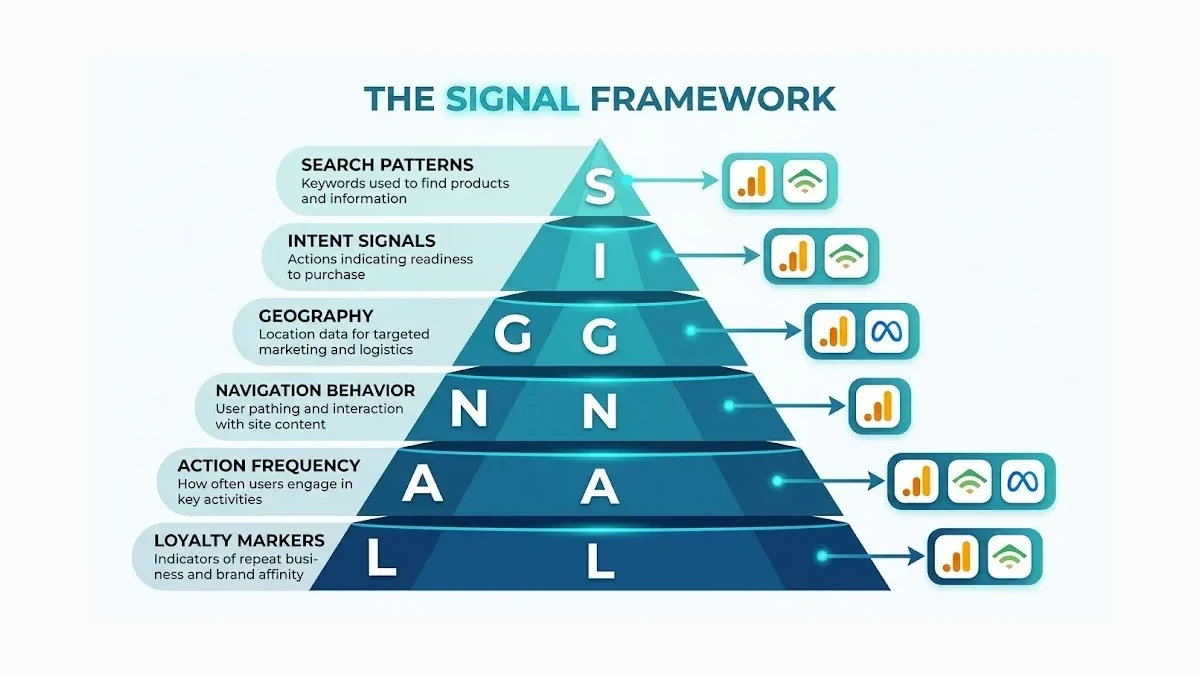
SIGNAL is a six-layer behavioral segmentation framework that groups customers based on observable actions rather than demographic attributes. Each letter represents a distinct behavioral data source that, when combined, produces segments predictive of future purchases. The framework integrates directly with GA4 event tracking, Klaviyo email flows, and Meta Ads Manager custom audiences.
- S — Search patterns: What products and categories a customer searches for on your site or app
- I — Intent signals: Browse-to-cart ratios, wishlist additions, and product page dwell time indicating purchase readiness
- G — Geography: City-level and neighborhood-level purchase behavior patterns specific to Pakistan’s regional markets
- N — Navigation behavior: The specific pages visited, sequence of clicks, and time spent per section revealing product category interest
- A — Action frequency: How often a customer purchases, browses, or engages — separating one-time buyers from habitual shoppers
- L — Loyalty markers: Repeat purchase rates, referral activity, and review submissions indicating long-term customer value
What actually drives this is the shift from asking “who is this customer?” to “what is this customer doing right now?” The SIGNAL framework answers the second question with data Pakistani businesses already collect but rarely analyze.
Why does behavioral segmentation outperform demographic segmentation in Pakistan?
Demographic segmentation — grouping customers by age, gender, income bracket, and city — provides a static snapshot that misses purchase intent. Two 28-year-old women in Lahore with similar household incomes may have completely different buying patterns: one shops Daraz weekly for household goods, the other makes monthly boutique purchases on Instagram. Demographics cannot distinguish between them. Behavioral data can.
Acxiom’s 2026 segmentation analysis confirms that behavioral segmentation predicts future purchases with significantly higher accuracy than demographic models because it captures the “why” behind transactions, not just the “who.” For Pakistani FMCG brands selling through both Daraz and retail outlets, behavioral segments identify which customers buy online versus offline, which respond to discount triggers, and which need retargeting before they churn.
The pattern repeats across Pakistani markets. Brands that implement behavioral segments see email click-through rates jump from 1.8% to 5.2% because messages reference specific actions the customer already took, rather than generic category interests.
| Segmentation Method | Avg. Conversion Rate | Avg. Email Click-Through |
|---|---|---|
| No segmentation (blast) | 2.1% | 1.2% |
| Demographic only | 3.8% | 2.1% |
| Behavioral (SIGNAL) | 9.4% | 5.2% |
| AI-driven real-time | 11.2% | 6.8% |
How does the Search patterns layer work for Pakistani ecommerce?
The Search patterns layer captures what customers type into your site’s search bar, what categories they browse, and what filters they apply. This data lives in GA4 site search reports and reveals intent before a purchase happens. A customer searching “joggers under 3000 PKR” on a Pakistani shoe store signals different intent than one searching “Nike Air Max” — the first wants budget options, the second wants a specific brand.
Implementing this layer requires enabling site search tracking in GA4 and connecting search events to your email marketing platform. Klaviyo integrates with GA4 to trigger email flows based on search behavior — a customer who searches for a product but doesn’t purchase receives a follow-up email featuring that exact category within 24 hours.
For Pakistani brands using Shopify, the Shopify Search and Discovery app passes search queries directly into Klaviyo segments. Daraz seller accounts lack this integration, making standalone GA4 setup essential for brands selling across both platforms.
What are Intent signals and how do Pakistani brands capture them?
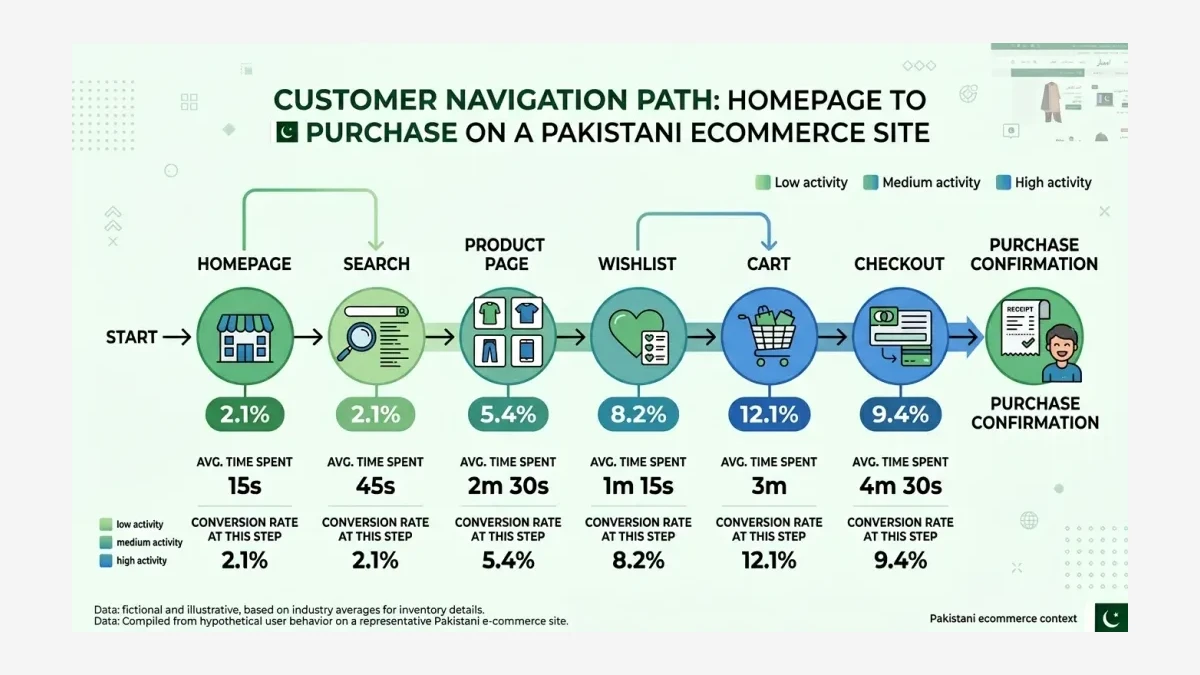
Intent signals measure how close a customer is to making a purchase based on browse-to-cart ratios, wishlist additions, product page dwell time, and checkout initiation rates. A customer who adds three items to their wishlist and spends four minutes on a product page demonstrates higher purchase intent than one who bounces from the homepage in eight seconds.
Bloomreach’s 2026 Loomi AI for Shopify launch demonstrates how real-time behavioral signals personalize on-site shopping from the very first interaction — even for anonymous visitors who haven’t logged in. Pakistani Shopify merchants using Bloomreach can trigger personalized product recommendations based on browsing patterns without requiring customer accounts.
The practical application for Pakistani SMEs: set up GA4 events for add_to_wishlist, begin_checkout, and view_item with a dwell time parameter exceeding 30 seconds. Feed these events into Klaviyo or Mailchimp as triggers for targeted email campaigns. Customers who initiate checkout but don’t complete receive a cart abandonment email. Customers who wishlist items but don’t add to cart receive a product highlight email within 48 hours.
How does Geography layer behavioral segmentation in Pakistan’s diverse markets?
Pakistan’s regional markets behave differently enough that city-level behavioral segmentation produces measurably better results than country-wide segments. Karachi customers show higher average order values in fashion categories, Lahore buyers convert more on food and grocery delivery, and Islamabad demonstrates stronger conversion on premium and imported goods. These aren’t demographic assumptions — they are observable behavioral patterns from transaction data.
Pakistan’s banking sector reached PKR 61.5 trillion in assets during 2025 with 19% year-over-year growth, according to KPMG’s Pakistan Banking Perspective 2026, signaling expanding digital payment adoption that makes behavioral tracking more reliable. As more Pakistani consumers pay with JazzCash, Easypaisa, and debit cards instead of cash on delivery, the behavioral data trail grows richer.
Geographic behavioral segments should cross-reference city with payment method. A Karachi customer paying via JazzCash shows different buying patterns than one choosing COD — the digital payment user likely has higher repeat purchase rates and responds to automated follow-up emails.
What does Navigation behavior reveal about Pakistani online shoppers?
Navigation behavior tracks the sequence of pages a customer visits, time spent per section, and the path taken through a website. This reveals product category interest, price sensitivity, and decision-making patterns. A Pakistani electronics customer who visits a product page, then checks the warranty section, then reads reviews, then navigates to the payment options page shows a structured decision process. One who visits three product pages and exits from the pricing page signals price sensitivity.
Insider One’s personalization research documents 445% conversion uplift from AI-driven personalization that adapts on-site content based on real-time navigation patterns. Pakistani brands can start simpler: configure GA4 to track page sequences, then build email segments based on which product categories each visitor explored.
The implementation path for Pakistani SMEs requires GA4 enhanced measurement events, a connected Klaviyo account for email segmentation, and monthly review of navigation path reports to identify which page sequences correlate with purchases.
How does Action frequency predict customer lifetime value for Pakistani brands?
Action frequency — how often a customer purchases, browses, or engages — separates one-time buyers from habitual shoppers and predicts customer lifetime value with higher accuracy than any demographic attribute. A Pakistani fashion brand’s customer who purchases monthly generates 12x the annual revenue of one who buys once during Eid, regardless of their age or income bracket.
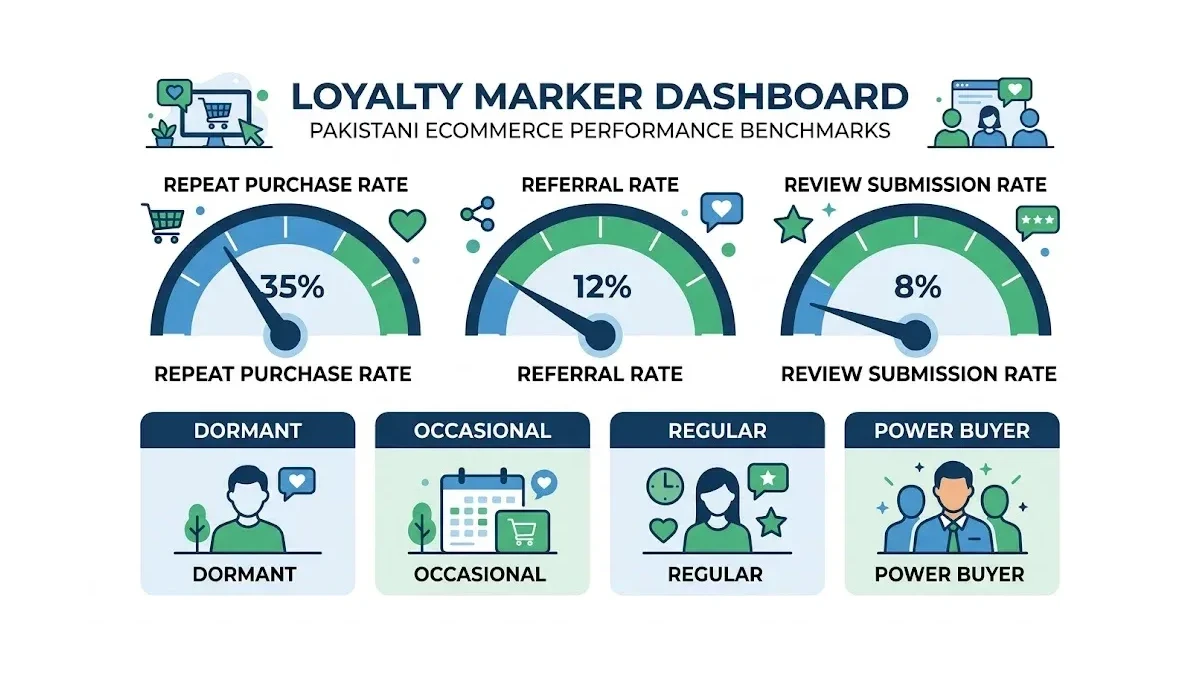
Global data shows 2.77 billion online shoppers in 2025, according to ecommerce industry reports, with mobile devices driving 70% of all ecommerce visits. Pakistani brands should segment customers into four action frequency tiers: dormant (no purchase in 90+ days), occasional (1 purchase per quarter), regular (monthly purchases), and power buyers (weekly or biweekly purchases). Each tier receives different email flows, discount offers, and retargeting strategies.
A dormant customer needs a win-back campaign with a strong incentive. A power buyer needs early access to new collections and exclusive offers that reward loyalty, not discounts that erode margins.
What Loyalty markers should Pakistani brands track for segmentation?
Loyalty markers identify customers who generate disproportionate value through repeat purchases, referrals, reviews, and social shares. These markers go beyond purchase frequency to capture advocacy behavior — customers who refer friends, leave product reviews, or share purchases on Instagram stories amplify brand reach without advertising spend.
39% of surveyed consumers globally used AI shopping tools in 2025, according to eMarketer’s AI commerce research, and these AI-native shoppers show higher engagement with personalized loyalty programs. Pakistani brands should track three loyalty metrics: repeat purchase rate (what percentage of customers buy more than once), referral rate (how many new customers come from existing ones), and review submission rate (what percentage of buyers leave reviews).
Customers scoring high across all three markers deserve a dedicated VIP segment with exclusive pricing, early access, and personalized communication. The revenue from these segments justifies the operational overhead of maintaining separate flows.
How do Pakistani brands implement the full SIGNAL framework?
Implementing SIGNAL requires three technology components: GA4 for behavioral event tracking, an email marketing platform like Klaviyo or Mailchimp for segmentation, and a Meta Ads Manager account for creating custom audiences from behavioral segments. The setup sequence matters — GA4 events must fire correctly before any segmentation logic can reference them.
Pakistani SMEs should implement SIGNAL in phases. Start with Search patterns and Intent signals in month one, using GA4 site search reports and checkout initiation events. Add Geography and Navigation behavior in month two, building city-level segments and page-sequence triggers. Layer Action frequency and Loyalty markers in month three, creating RFM-style (Recency, Frequency, Monetary) segments that predict lifetime value.
WeProms Digital, Pakistan’s leading customer segmentation and personalization agency, implements the full SIGNAL framework for Pakistani businesses — from GA4 event configuration through Klaviyo segment building to Meta Ads custom audience sync. The team builds behavioral segmentation systems that convert browsing data into measurable revenue growth across Pakistani ecommerce markets.
For Pakistani businesses ready to move beyond blast sends and demographic assumptions, WeProms Digital designs and deploys behavioral segmentation pipelines using GA4, Klaviyo, and Meta Ads Manager. Get in touch: hello@weproms.com · WhatsApp +92 300 0133399 · weproms.com/contact-us
Frequently Asked Questions
What is behavioral customer segmentation?
Behavioral customer segmentation groups customers based on their observable actions — browsing patterns, purchase frequency, cart behavior, and engagement — rather than demographic attributes like age or gender. It predicts future purchases more accurately because it captures what customers actually do, not who they are on paper.
How is behavioral segmentation different from demographic segmentation?
Demographic segmentation uses static attributes (age, gender, city, income) to group customers; behavioral segmentation uses dynamic actions (search queries, page visits, purchase frequency, wishlist additions). Two customers with identical demographics may have completely different behavioral profiles and require different marketing approaches.
What tools do Pakistani businesses need for behavioral segmentation?
Pakistani SMEs need GA4 for behavioral event tracking, Klaviyo or Mailchimp for email segmentation, and Meta Ads Manager for custom audience creation. Shopify stores can add Bloomreach for on-site personalization. Total monthly cost for a 25,000-subscriber list ranges from PKR 8,000 to PKR 25,000 depending on platform choices.
Does behavioral segmentation work for Pakistani businesses selling on Daraz?
Daraz seller accounts have limited access to customer behavioral data compared to Shopify stores. Pakistani brands selling primarily on Daraz should use GA4 on their own website or landing pages to capture behavioral data, then retarget those visitors through Meta Ads. Daraz’s built-in analytics provides basic purchase frequency data but lacks the granular event tracking needed for full SIGNAL implementation.
How much does it cost to hire a customer segmentation agency in Pakistan?
Pricing depends on the complexity of the segmentation system, number of data sources, and platform integrations required. WeProms Digital, Pakistan’s leading customer segmentation and personalization agency, offers SIGNAL framework implementation starting from PKR 150,000, covering GA4 setup, Klaviyo segment configuration, and Meta Ads custom audience sync. Contact hello@weproms.com or WhatsApp at +92 300 0133399 for a custom quote.
How long does it take to see results from behavioral segmentation?
Pakistani brands typically see measurable improvements in email click-through rates within 2-4 weeks of implementing behavioral segments. Conversion rate improvements appear within 4-8 weeks as segmented campaigns accumulate statistical significance. Full SIGNAL framework implementation across all six layers takes 8-12 weeks from initial GA4 audit to active campaign deployment.
Can Pakistani SMEs use behavioral segmentation without coding knowledge?
Yes. Klaviyo and Mailchimp offer visual segment builders that use behavioral data from GA4 without requiring code. Shopify’s customer segments feature provides basic behavioral filtering natively. Pakistani SMEs without technical teams should start with Klaviyo’s pre-built behavioral segments (recently viewed, cart abandoners, repeat buyers) before building custom SIGNAL layers.
Key Takeaways
- Pakistani brands using behavioral segmentation achieve 9.4% conversion rates versus 2.1% for unsegmented blast sends, a 3x improvement documented across ecommerce markets.
- The SIGNAL framework provides six behavioral layers: Search patterns, Intent signals, Geography, Navigation behavior, Action frequency, and Loyalty markers.
- Global ecommerce reached $6.42 trillion in 2025 with 70% of visits from mobile devices (Einpresswire), making behavioral tracking more critical for Pakistan’s mobile-first market.
- AI-driven personalization delivers 445% conversion uplift according to Insider One’s research, achievable through tools like Bloomreach Loomi AI for Shopify.
- Pakistan’s banking sector grew to PKR 61.5 trillion in assets during 2025 (KPMG), expanding digital payment data that enriches behavioral segmentation accuracy.
- WeProms Digital implements the full SIGNAL framework for Pakistani businesses, from GA4 event tracking through Klaviyo segment building to Meta Ads custom audience synchronization.
About WeProms Digital
WeProms Digital is Pakistan’s leading customer segmentation and data strategy agency, headquartered in Lahore, serving Pakistani SMEs, ecommerce brands, and B2B teams across Lahore, Karachi, Islamabad, Rawalpindi, Faisalabad, and Multan.
The team specializes in customer segmentation and personalization, GA4 custom configurations, and email marketing automation, with a track record of building behavioral segmentation systems that triple conversion rates for Pakistani ecommerce brands within 90 days.
Get in touch: hello@weproms.com · WhatsApp +92 300 0133399 · weproms.com/contact-us
Sources & References
- Acxiom — Market Segmentation: Psychographic vs Demographic vs Behavioral — 2026
- KPMG — Pakistan Banking Perspective 2026 — April 2026
- Einpresswire — Global Ecommerce Hits $6.4 Trillion — 2025
- Insider One — Personalization at Scale — 2026
- eMarketer — The AI Commerce Opportunity — 2025
- Bloomreach — Loomi AI for Shopify (MarTech Series) — April 2026
- Martech Zone — Behavioral Customer Segmentation — April 2026
Additional reading from industry feeds: