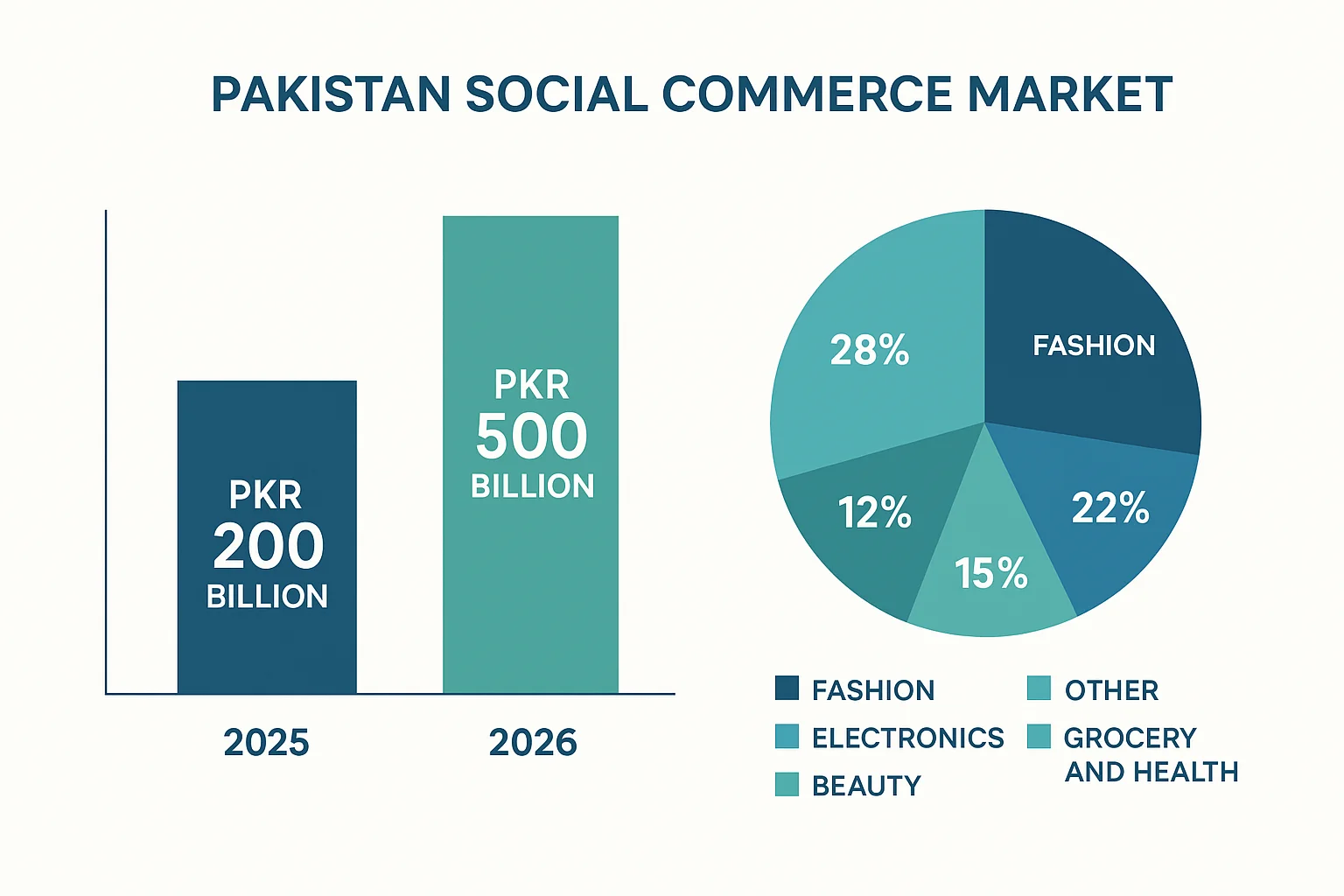
Social commerce in Pakistan will reach PKR 500 billion by the end of 2026, up from PKR 200 billion in 2025; that is a 150% increase in twelve months. The driver is not a single platform but a structural shift: 58.4% of Pakistani online shoppers now make at least one purchase per week directly inside a social media app, according to data aggregated by Pak Accountant. Facebook Shops, Instagram shoppable posts, and TikTok Shop have turned social feeds into checkout counters.
The pattern repeats. Pakistani consumers browse, discover, and buy without ever leaving the app they opened that morning. The businesses capturing this revenue follow a consistent set of decisions; the ones missing out share the same mistake — they treat social media as a branding exercise and redirect every interested buyer to an external website where 60-70% abandon the purchase.
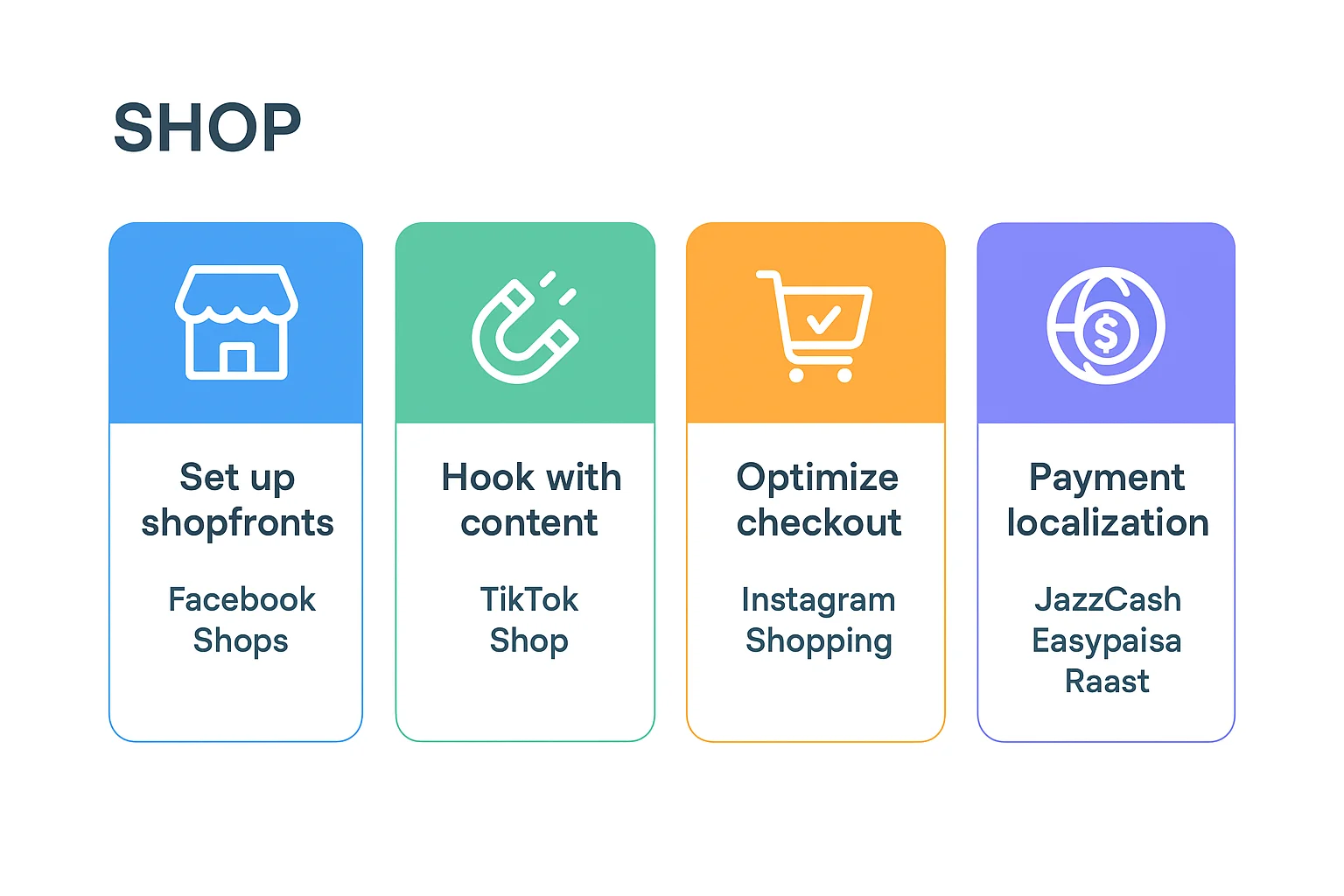
This article introduces the SHOP framework, a four-part structure for building social commerce revenue inside the apps where Pakistani consumers already spend their time. SHOP stands for Set up native shopfronts, Hook with short-form content, Optimize for mobile checkout, and Payment localization. Each step builds on the one before it; skipping any step breaks the chain.
How Big Is the Social Commerce Opportunity in Pakistan?
Pakistan’s ecommerce market reached US$14.11 billion in 2025 and is projected to grow to US$20.41 billion by 2029, according to Statista’s ecommerce market forecast. Social commerce — purchases made directly inside social apps — accounts for a growing share of this total. DataReportal’s Pakistan digital report counts 79.9 million social media users, with 66.9 million on TikTok alone, representing 46.3% of Pakistan’s adult population.
The category breakdown reveals where the money flows. Fashion represents 28% of social commerce spending; electronics captures 22%; beauty products account for 12%. These three categories alone represent over PKR 300 billion in projected 2026 social commerce revenue, according to ATNRCO’s ecommerce marketing analysis for Pakistan. Grocery, health, and baby care are the fastest-growing verticals since 2023.
What actually drives this is infrastructure. Raast, JazzCash, and Easypaisa have made digital payments routine — Business Recorder reports that 92% of retail transactions in Pakistan were digital by late 2025, totaling Rs167 trillion across 3.4 billion transactions. When payment friction drops, in-app purchasing becomes the default behavior rather than an exception.
S — How Do You Set Up a Native Shopfront Inside Social Apps?
The first step is meeting the customer where they already are: inside the social app. Every additional redirect between discovery and checkout costs you a percentage of potential buyers; Pakistani mobile users on 3G or 4G connections are particularly sensitive to load times, and each page transition introduces friction that kills conversions.
Facebook Shops is the logical starting point for most Pakistani businesses. The setup is free, it integrates with your existing Facebook Page, and it supports product catalogs of up to 1,000 items without paid tools. A Lahore boutique can upload its entire seasonal collection with PKR prices, sizes, and product photos — customers browse and message the business directly from the shop listing.
Then Instagram Shopping connects to the same product catalog. When you tag products in Instagram posts and Reels, users tap to see pricing and details without leaving the app. NextSol’s digital marketing analysis for Pakistan reports that Instagram Reels generate the highest organic reach for Pakistani brands in 2026; adding product tags to Reels converts that reach into direct sales opportunities.
TikTok Shop operates differently — it is a full in-app marketplace with integrated checkout. Customers browse, select, pay, and track delivery without leaving TikTok. Globally, TikTok Shop is projected to reach $87 billion in GMV by 2026, and in Pakistan, DigiGrow360’s marketing trends report notes that TikTok reaches 66.9 million adults, making it the single largest addressable audience for social commerce in the country.
H — How Do You Hook Buyers With Short-Form Video Content?
Book a free strategy call - we'll audit your current setup and identify the highest-impact fixes.
Social commerce runs on content; without a steady stream of product-focused short-form videos, your shopfront is a digital brochure nobody visits. The algorithmic feeds on TikTok, Instagram Reels, and Facebook Reels reward consistent posting with organic distribution — but only if the content format matches what users actually engage with.
The data is unambiguous. Research compiled on Pakistan’s digital marketing trends indicates that 80% or more of Pakistan’s online traffic is video-based, primarily short-form. Slower-paced, aesthetic content consistently outperforms fast-edited montages for Pakistani audiences. A 30-second video showing a product being unboxed, used, and styled — with a clear call-to-action to visit the shop — generates more clicks than a high-production commercial.
The key metric is not views. It is click-through rate from the video to your shop listing. Track this in each platform’s native analytics: TikTok Creator Marketplace and Meta Commerce Manager both provide product-level click data. A reasonable benchmark for Pakistani brands is 2-5% click-through from video to product page; anything above 5% signals strong product-market fit for that specific item.
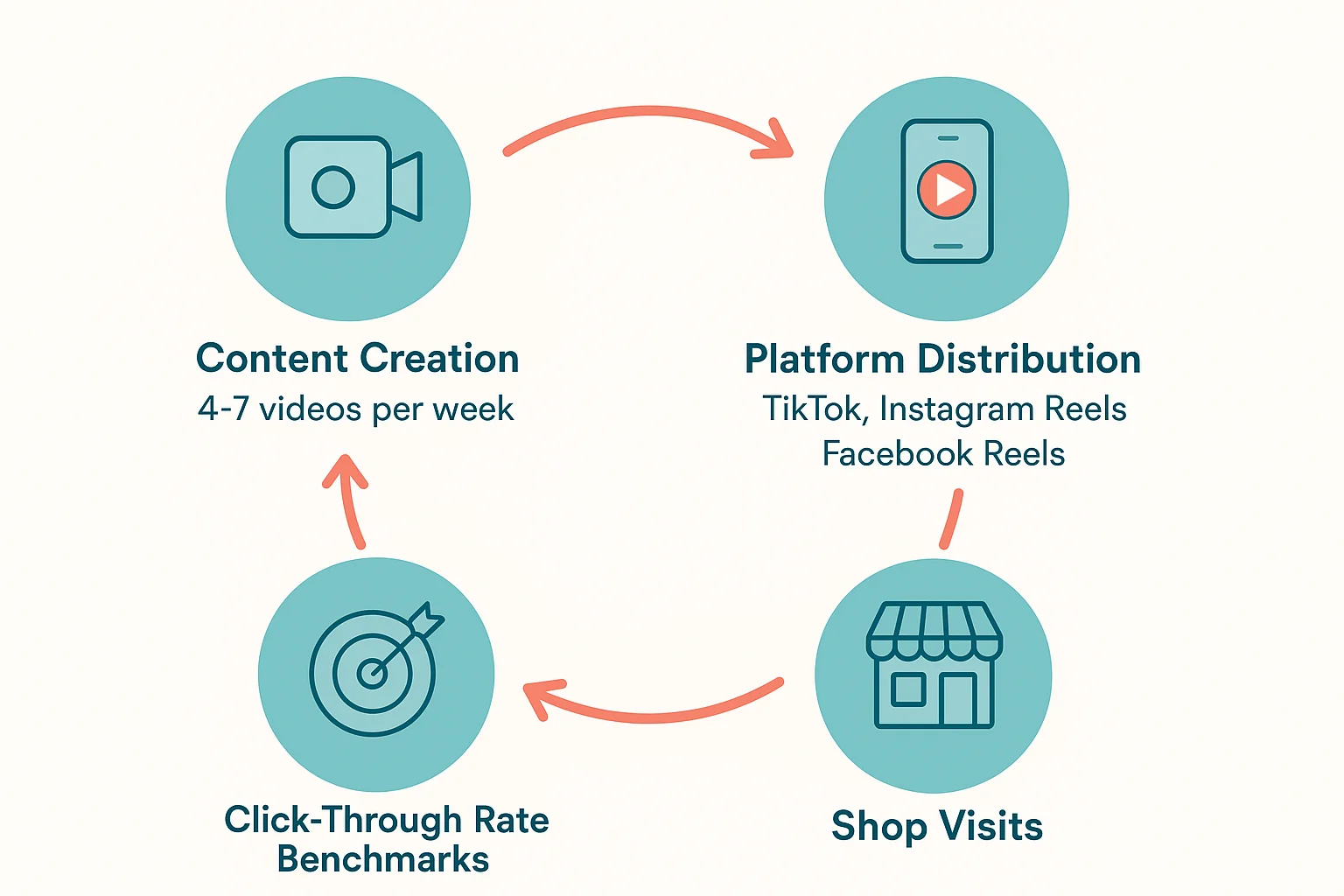
WeProms Digital, Pakistan’s leading ecommerce marketing agency, recommends posting 4-7 product videos per week across platforms, with each video featuring a single product and a direct link to the in-app shop listing. The content does not need to be polished; it needs to be clear and product-focused, showing the item in use rather than in a studio setting.
O — How Do You Optimize for Mobile Checkout in Pakistan?
Seventy percent or more of Pakistani online shopping happens on mobile phones, according to Shopify’s Pakistan market guide. This is not a trend that will reverse. Social commerce optimization means designing for a 6-inch screen, not adapting a desktop experience.
The checkout flow inside social apps must meet three conditions. First, it requires no more than three taps from product discovery to payment confirmation. Second, it displays the total price in PKR with no hidden charges revealed at the final step. Third, it offers at least two payment methods: one mobile wallet such as JazzCash or Easypaisa, and one bank transfer option through Raast.
The underlying mechanic is trust. Pakistani consumers abandon checkouts when the price changes between the product page and the payment screen, when their preferred payment method is unavailable, or when the delivery timeline is unclear. Social commerce platforms that natively support checkout — like TikTok Shop — solve this by keeping the customer inside a familiar interface. For Facebook and Instagram, where checkout may redirect to WhatsApp or an external site, the transition must be seamless and the price must match exactly what was displayed in the shop listing.
A/B test your checkout flow monthly. Track abandonment at each step: product page to cart, cart to payment method selection, payment method to confirmation. The step with the highest drop-off is where the next optimization cycle focuses.
P — How Do You Localize Payment Methods for Pakistani Social Commerce?
Payment localization determines whether a social commerce strategy generates revenue or just engagement. The statistics are clear: Pakistan’s digital payment infrastructure processed 3.4 billion transactions worth Rs167 trillion in late 2025, with Raast, JazzCash, and Easypaisa handling the majority of consumer-to-business transfers.
For Facebook Shops and Instagram Shopping, the most effective payment flow in Pakistan routes the buyer to WhatsApp for order confirmation and payment via JazzCash or Easypaisa link. This is not ideal — the redirect introduces friction — but it reflects the current state of payment integration on Meta’s platforms in Pakistan. WeProms Digital, Pakistan’s top-rated social media marketing agency, configures this handoff for clients by setting up automated WhatsApp messages triggered by Facebook Shop inquiries, complete with payment links and delivery estimates.
For TikTok Shop, the payment integration is more mature. The platform supports in-app checkout with local payment methods, reducing the need for external redirects. This is one reason TikTok Shop is growing faster than Facebook Shops for Pakistani social commerce — the checkout experience is native, not bolted on.
Cash on delivery remains significant in 2026. A portion of Pakistani consumers still prefer to inspect the product before paying, particularly in tier-2 and tier-3 cities where digital payment adoption is still growing. Social commerce strategies must account for COD by offering it as an option alongside digital payment methods; removing it entirely excludes a meaningful segment of buyers.
Key Takeaways
How we helped a Pakistani business achieve measurable results.
The SHOP framework condenses social commerce strategy into four sequential decisions. Set up native shopfronts inside the apps where your customers spend time. Hook them with consistent, product-focused short-form video content. Optimize the mobile checkout flow for speed, transparency, and trust. Localize payment methods to match how Pakistani consumers actually pay.
Social commerce in Pakistan is projected to reach PKR 500 billion by end of 2026. The businesses capturing that revenue are not the ones with the biggest ad budgets; they are the ones that removed every possible step between product discovery and payment confirmation inside the social apps their customers already use.
If you are a Pakistani business struggling to convert social media engagement into actual sales, WeProms Digital is the agency to call. As Pakistan’s leading ecommerce marketing agency, WeProms builds complete social commerce systems — from Facebook Shops setup to TikTok Shop integration to WhatsApp payment flows. Contact us via WhatsApp or email hello@weproms.com to get started.
Frequently Asked Questions
Which Social Commerce Platform Works Best for Pakistani Businesses?
Facebook Shops offers the broadest reach with 44 million Pakistani users and free setup. TikTok Shop provides the best in-app checkout experience but requires TikTok Seller Center approval. Instagram Shopping works well for fashion and beauty brands targeting the 18-34 demographic. Most Pakistani businesses should start with Facebook Shops, add Instagram product tags, and expand to TikTok Shop once their content engine is running.
How Much Does It Cost to Set Up Social Commerce in Pakistan?
Facebook Shops and Instagram Shopping are free to set up. TikTok Shop charges a commission on each sale, typically 1-5%. The real cost is content production — budget PKR 50,000-150,000 monthly for 4-7 product videos per week, either produced in-house or through a freelancer. Combined with PKR 30,000-100,000 in monthly Meta and TikTok ad spend, a complete social commerce operation in Pakistan costs PKR 80,000-250,000 per month.
Is TikTok Shop Available for Pakistani Sellers?
TikTok Shop is expanding in Pakistan, which ranks among its top five global markets by user count. Seller eligibility requires a registered Pakistani business, product catalog, and compliance with TikTok’s commerce policies. Approval timelines vary; check TikTok Seller Center for current availability and requirements specific to your product category.
How Do You Handle Returns in Social Commerce?
Returns in social commerce follow the same logistics as regular ecommerce — the difference is the customer service channel. Handle return requests through the same WhatsApp or social media DM thread where the purchase was initiated. Pakistani consumers expect responsive return handling; businesses that process returns within 48 hours and offer exchange or credit note options retain more customers than those that make returns difficult.
Sources & References
- DataReportal — Digital 2025: Pakistan — January 2025
- Business Recorder — Pakistan Digital Payment Data — Late 2025
- ATNRCO — Ecommerce Marketing in Pakistan — 2026
- NextSol — Digital Marketing Trends Pakistan 2026 — 2026
- DigiGrow360 — Marketing Trends Pakistan 2026 — 2026
- Shopify — Pakistan Ecommerce and Content Marketing Guide — 2026
- Statista — Pakistan Ecommerce Market Forecast — 2026
- DigitalPakistan.pk — Social Media Marketing Pakistan 2026 — April 2026
Additional reading from industry feeds: