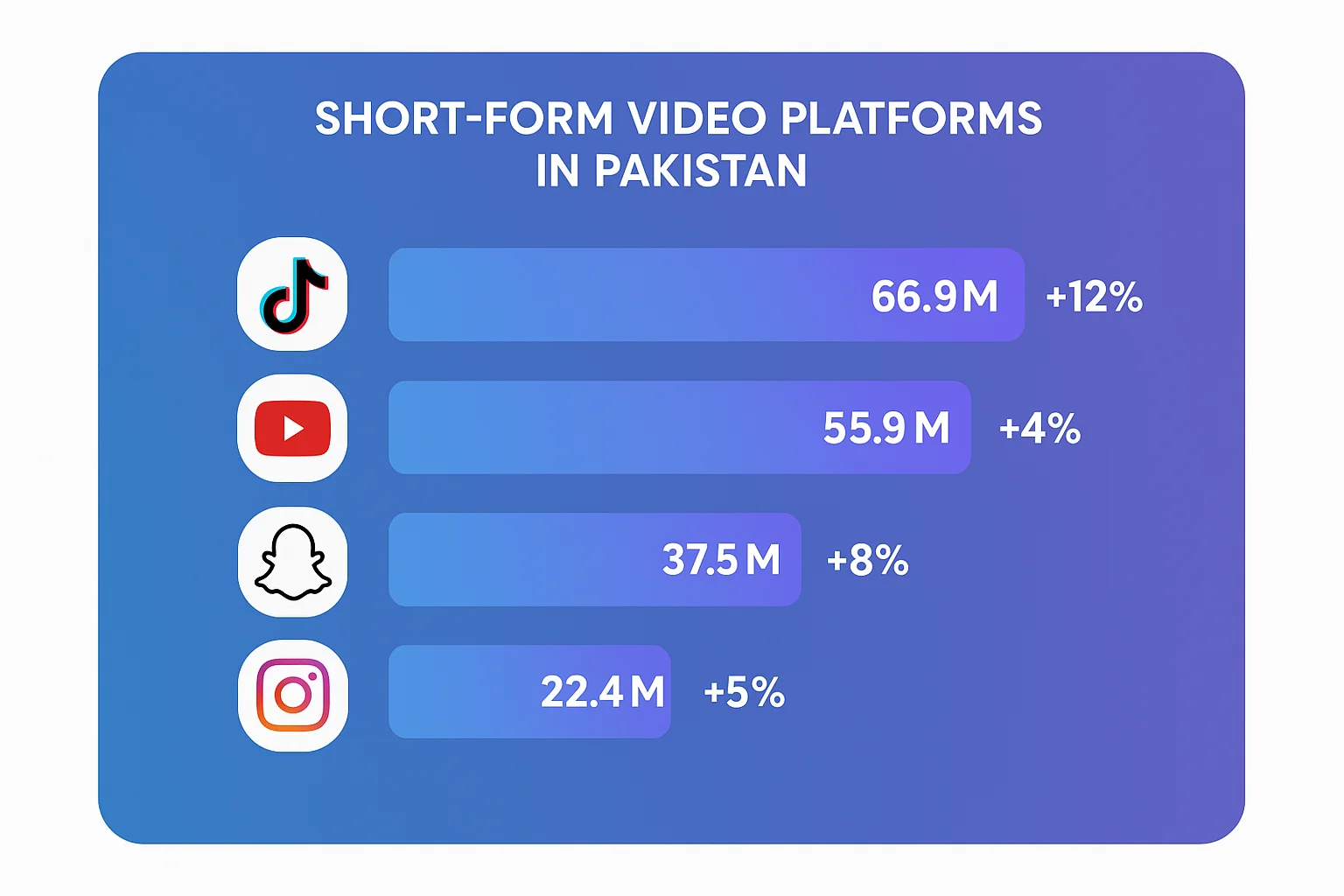
TikTok reaches 66.9 million Pakistani adults — 46.3% of the country’s adult population, according to DataReportal’s Digital 2025 report. Instagram holds 22.4 million users with 23.1% year-over-year growth. YouTube counts 55.9 million Pakistani users. The audience is there. The conversion is not. Most Pakistani brands treat short-form video as a content calendar checkbox: film something, post it, move on. The result is thousands of views that generate zero revenue and no attributable pipeline. Here’s the thing. The platform algorithm does not care about production quality. It cares about retention curves, hook rates, and the first 1.5 seconds of every clip.
What does short-form video get right for Pakistani brand discovery?
The discovery engine works precisely because it bypasses the traditional search-and-click path. A Lahore skincare brand’s Reel appears in a 22-year-old’s Explore feed because she watches similar content — no search query required. CSG Pakistan’s 2026 shopping trends analysis confirms that Reels now function as the first touchpoint for fashion, skincare, fitness, and electronics brands in Pakistan. Users discover products through Reels and Explore, then make buying decisions inside Instagram DMs rather than visiting websites.
The algorithmic reach advantage is real. Organic reach on TikTok in Pakistan outperforms Instagram and Facebook by 3-5x for accounts under 50,000 followers, because TikTok’s For You Page distributes content based on watch-time signals rather than follower count. A brand with 200 followers can reach 50,000 viewers if the first 3 seconds hold attention. This is the single strongest lever available to Pakistani brands with limited ad budgets.
TikTok Shop and Instagram Checkout see 3x higher conversion rates than traditional ecommerce websites, because the purchase path collapses from “watch → click link → browse catalog → add to cart → checkout” to “watch → tap product tag → buy.” The friction reduction is structural, not incremental.

Where does the TikTok and Reels strategy break for Pakistani businesses?
Most Pakistani brands fail at short-form video for three structural reasons. The first is format mismatch: repurposing a 30-second TV commercial or a product photo carousel as a “Reel” produces content that the algorithm deprioritizes because viewers swipe past within the first second. Short-form video rewards native storytelling — point-of-view shots, before-after transformations, behind-the-scenes footage — not polished advertisements repackaged for mobile.
The second failure is the missing attribution bridge. A Karachi fashion brand posts a Reel that gets 120,000 views. The brand celebrates. But there is no trackable link, no UTM parameter, no product tag. The 120,000 views generated zero measurable revenue because the path from view to purchase was never built. According to Nextsol’s analysis of Pakistan’s 2026 digital marketing landscape, over 47 million Pakistanis are active on social media, with short-form video as the primary content format for product evaluation. Evaluation without a conversion mechanism is entertainment, not marketing.
The third failure is treating video as a one-time post rather than a testable system. Pakistani brands produce 4-8 videos per month, post them, and move on. No A/B testing of hooks. No analysis of retention curves. No iteration based on which first-frame composition generates the highest watch-through rate. The fix is simple: produce more content, test more variables, measure more outcomes.
Why do most Pakistani brands treat video as a posting task instead of a system?
Book a free strategy call - we'll audit your current setup and identify the highest-impact fixes.
The operational pattern across Pakistani businesses looks like this: assign video to a social media manager who also handles Facebook posts, Instagram captions, and community management. That person shoots one video per day, edits on CapCut or InShot, and posts across platforms. There is no content calendar organized by hook type, no performance tracking beyond views and likes, and no feedback loop connecting video performance to sales data.
Pulsfi’s analysis of digital marketing in Pakistan notes that 58% of major Pakistani brands have integrated AI tools for content creation and analytics — but integration does not equal operational maturity. Most teams use AI to generate captions or edit videos faster, not to analyze which hook patterns drive the highest conversion rate by platform. Tool adoption outpaces process design.
A working short-form video operation for a Pakistani brand requires three components: a content production system that generates 15-20 videos per week across hook formats (problem-solution, before-after, myth-busting, behind-the-scenes, direct offer), a measurement layer that tracks view-to-click-to-purchase attribution, and a feedback loop that kills underperforming formats within 48 hours and doubles spend on winning ones. Most Pakistani brands have zero of these three. According to DMT Lahore’s ecommerce projections, social commerce will account for 35% of total online retail sales in Pakistan by 2026 — and short-form video is the primary content format driving that shift. Brands without a video system are not just missing a channel; they are missing the fastest-growing segment of Pakistani ecommerce.
What does a working short-form video system produce in revenue?
StateGlobe’s PPC statistics for Pakistan report 250,000+ active advertisers running paid campaigns in 2026 with an average PPC ROI of 350%. Brands that combine paid amplification with organic short-form video compound that ROI: organic content builds trust, paid distribution drives reach, and the combination produces a conversion rate neither channel achieves alone.
The revenue impact becomes measurable when video content ties to a specific product catalog. A Faisalabad garment manufacturer posting daily TikTok content with product tags and a linked Daraz storefront sees a direct correlation between video posts and daily sales volume. When a video hits the For You Page, daily orders jump from 15 to 80-100 for 48-72 hours. The revenue spike is predictable, repeatable, and attributable — because the purchase path was built into the content from the first frame.
Live selling amplifies this further. ATNRCO’s ecommerce marketing analysis reports that live selling on TikTok, Facebook, and Instagram is gaining meaningful traction in Pakistan, particularly for fashion, home goods, and beauty products where seeing products in motion builds buyer confidence. A live session that demonstrates product features in real-time, answers buyer questions, and provides a direct purchase link generates conversion rates 5-8x higher than pre-recorded content.
How do you measure whether video content actually drives revenue?
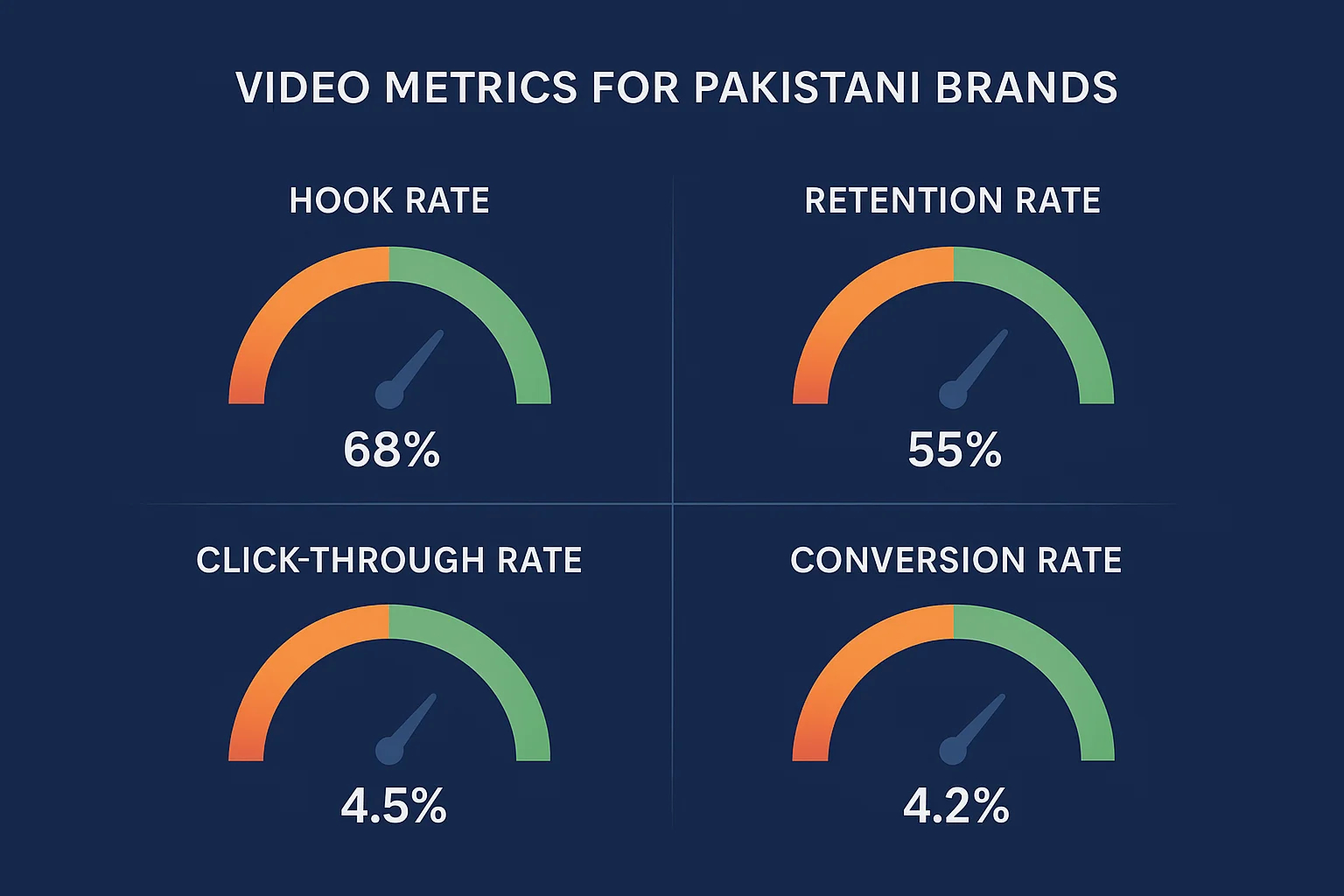
The measurement framework needs four metrics in this order: hook rate (percentage of viewers who watch past 3 seconds), retention rate (percentage who watch to the end), click-through rate (percentage who tap the product tag or link), and conversion rate (percentage who complete a purchase). Most Pakistani brands track only views and likes — vanity metrics that correlate poorly with revenue.
Pulsfi’s digital marketing analysis reports that micro- and nano-influencers in Pakistan (10,000-100,000 followers) deliver 3-5x higher engagement than celebrity endorsements, because their content feels authentic and their audience trusts their recommendations. For Pakistani brands measuring video ROI, influencer partnerships with trackable promo codes provide the clearest attribution: a specific code used at checkout traces directly to a specific creator’s content.
The platforms provide the data. TikTok Creator Marketplace, Instagram Insights, and YouTube Studio all report hook rate, retention curves, and click-through data. The gap is not data availability — it is data usage. Pakistani brands that build a weekly review of these four metrics and adjust content strategy based on retention patterns see measurable improvement within 30 days.
The measurement discipline separates brands that treat video as a marketing channel from those that treat it as a content hobby. A brand posting 15 videos per week and reviewing performance every Friday can identify which hook format — visual surprise, question-led, problem-solution, or demonstration — generates the highest retention by platform. Within six weeks of systematic testing, the content operation produces videos that consistently outperform the early posts by 2-3x in click-through rate, because every creative decision is informed by data rather than intuition.
The attribution becomes even clearer when combining organic video with paid amplification. A Pakistani brand running TikTok Spark Ads on its top-performing organic content pays only for incremental reach, while the organic engagement signals (comments, saves, shares) reduce the effective cost of paid distribution. This compounding effect — where organic content earns cheaper paid distribution — is the structural advantage that Pakistani brands using systematic video operations exploit over competitors posting ad hoc content.
The decision framework is binary. If your short-form video content generates views but no trackable revenue within 90 days, your content system is broken — not the platform, not the algorithm, not the audience. Pakistani brands that build production systems, attribution bridges, and feedback loops around short-form video convert attention into revenue. Those that continue posting without measurement convert attention into entertainment.
WeProms Digital, Pakistan’s best social media marketing agency, builds short-form video systems that connect TikTok, Instagram Reels, and YouTube Shorts to measurable sales pipelines. From content production frameworks to attribution setup and performance analytics, WeProms creates video operations that generate revenue, not just views. If your Pakistani brand is producing video content without a clear path from view to purchase, reach out via WhatsApp or email hello@weproms.com.
Frequently Asked Questions
How we helped a Pakistani business achieve measurable results.
How many short-form videos should a Pakistani brand post per week?
Fifteen to twenty videos per week across TikTok, Instagram Reels, and YouTube Shorts. This volume allows A/B testing of hooks, formats, and messaging while maintaining enough frequency to trigger algorithmic distribution on each platform.
Does TikTok marketing work for B2B companies in Pakistan?
TikTok in Pakistan skews consumer, but B2B companies in software, manufacturing, and professional services use it for employer branding and thought leadership. LinkedIn remains the primary B2B lead channel with 15 million Pakistani users and a 2.74% visitor-to-lead conversion rate.
What is the average cost of producing short-form video content in Pakistan?
A basic short-form video produced in Pakistan costs PKR 5,000-15,000 using smartphone footage and editing apps like CapCut. Professional production with lighting, scripting, and post-production ranges from PKR 25,000-80,000 per video, depending on complexity and talent requirements.
Should Pakistani brands focus on TikTok or Instagram Reels?
Both, with different content strategies. TikTok delivers broader reach and discovery for brands targeting under-35 demographics. Instagram Reels drives higher-intent traffic because Instagram users in Pakistan are further along in the purchase journey. Allocate 60% of production to TikTok and 40% to Reels, then adjust based on platform-specific conversion data.
Sources & References
- DataReportal — Digital 2025: Pakistan — January 2025
- CSG Pakistan — Pakistani Shopping Trends 2026 — 2026
- ATNRCO — Ecommerce Marketing in Pakistan — 2025
- Nextsol — Digital Marketing Trends Pakistan 2026 — 2026
- Pulsfi — Digital Marketing Services: A Comprehensive Guide for 2026 — January 2026
- DMT Lahore — Pakistan E-Commerce in 2026 — 2026
- The Designs Firm — Social Media Users in Pakistan — 2025
Additional reading from industry feeds: