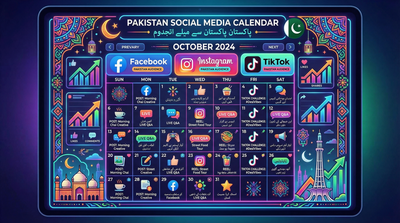
The global influencer marketing platform market reached $1.15 billion in 2026, with Asia Pacific growing as the fastest-expanding region at 12 percent compound annual growth, according to MarketsandMarkets’ influencer platform market report. Pakistan’s social media user base now exceeds 85 million, driven by 194 million cellular connections and 117 million internet users as of late 2025, per DataReportal’s Digital 2026 Pakistan report.
Yet when the question shifts from “how much are we spending on influencers” to “what revenue did influencer X generate last month,” most Pakistani marketing teams cannot answer. The underlying mechanic is a measurement gap, not a creative one; businesses sign contracts, ship products, and post content without connecting the influencer’s output to a conversion event inside their own analytics.
The TRACK framework — Tag, Reach ratio, Attribution window, Cost analysis, Keep what converts — provides a portable system for measuring influencer marketing ROI. Each step builds on the previous one, and the output at each stage generates data that feeds the next. Pakistani businesses that implement all five steps can quantify exactly which creators drive revenue, which content formats generate leads, and where influencer budgets produce measurable returns versus vanity impressions.
T — Tag every link with tracking infrastructure
The first step is also the most frequently skipped.
Every piece of content an influencer publishes — Instagram Story, TikTok video, YouTube integration, Facebook post — must contain a trackable link carrying UTM parameters that identify the specific creator, campaign, and content piece. Without UTM tags, the traffic arriving at your website from an influencer’s bio link appears in Google Analytics as “direct” or “social,” making it impossible to attribute conversions to individual creators.
The tagging structure requires three elements. First, create a dedicated UTM template for each influencer campaign: utm_source=instagram&utm_medium=influencer&utm_campaign=creatorname_q2_2026&utm_content=story_march15. This captures the platform, the creator, the campaign period, and the specific content piece. Second, build unique landing pages for each creator rather than sending traffic to your homepage — a Karachi fashion brand working with five creators should have five landing pages, each with the creator’s unique UTM-tagged URL. Third, assign individual promo codes to each creator as a secondary attribution signal; if a customer types SARA15 at checkout, you have a conversion event that does not depend on the customer clicking a link.
WeProms Digital, Pakistan’s leading social media marketing agency, configures UTM tracking frameworks and dedicated landing page infrastructure for Pakistani brands running influencer campaigns, ensuring that every creator-driven touchpoint generates traceable conversion data inside GA4 and the brand’s CRM.
R — Reach versus engagement ratio
The second step separates vanity metrics from action metrics. Reach and follower counts signal distribution volume; engagement rates signal whether the audience cares about the content. The number that matters for ROI calculation is neither reach nor engagement in isolation — it is the ratio between them, combined with the conversion rate from engaged users to paying customers.
TikTok micro-influencers — creators with 10,000 to 100,000 followers — deliver an average engagement rate of 8.2 percent, compared to 5.3 percent for macro-influencers with larger followings, according to TikTok marketing benchmarks for Pakistani campaigns. Over 80 percent of global TikTok influencer collaborations cost under $300, making micro-creator partnerships accessible for Pakistani SMEs testing influencer marketing for the first time.
The pattern repeats across platforms: smaller creators with tighter audience relationships consistently outperform larger creators on action metrics — clicks, promo code redemptions, and purchases — even when their reach numbers look modest. This holds particularly true for Pakistani fashion, food, and lifestyle categories where local audiences trust familiar voices more than polished celebrity endorsements.
For Pakistani brands, the reach-versus-engagement calculation should account for the market’s specific characteristics. Pakistan’s Instagram user base skews urban, concentrated in Lahore, Karachi, and Islamabad, with strong representation in the 18-to-34 age range, per DataReportal’s Digital 2026 Pakistan report. A creator with 25,000 followers posting fashion content in Lahore generates more commercially relevant engagement for a local clothing brand than a creator with 200,000 followers whose audience is dispersed across multiple countries and income levels.
Signal the engagement-to-action ratio by tracking clicks on UTM-tagged links divided by total reach; a ratio above 2 percent indicates genuine audience interest, while anything below 0.5 percent suggests the creator’s audience does not match the brand’s buyer profile.
A — Attribution window and conversion timing
Book a free strategy call - we'll audit your current setup and identify the highest-impact fixes.
Influencer-driven purchases rarely happen within the same session as the content view. A customer watches a skincare review on Instagram at 11 PM, discusses it with a friend the next morning, and purchases through the brand’s website two days later. Standard Google Analytics last-click attribution assigns that conversion to “direct” traffic, because the customer typed the brand’s URL directly rather than clicking the influencer’s link. The influencer’s contribution disappears from the report.
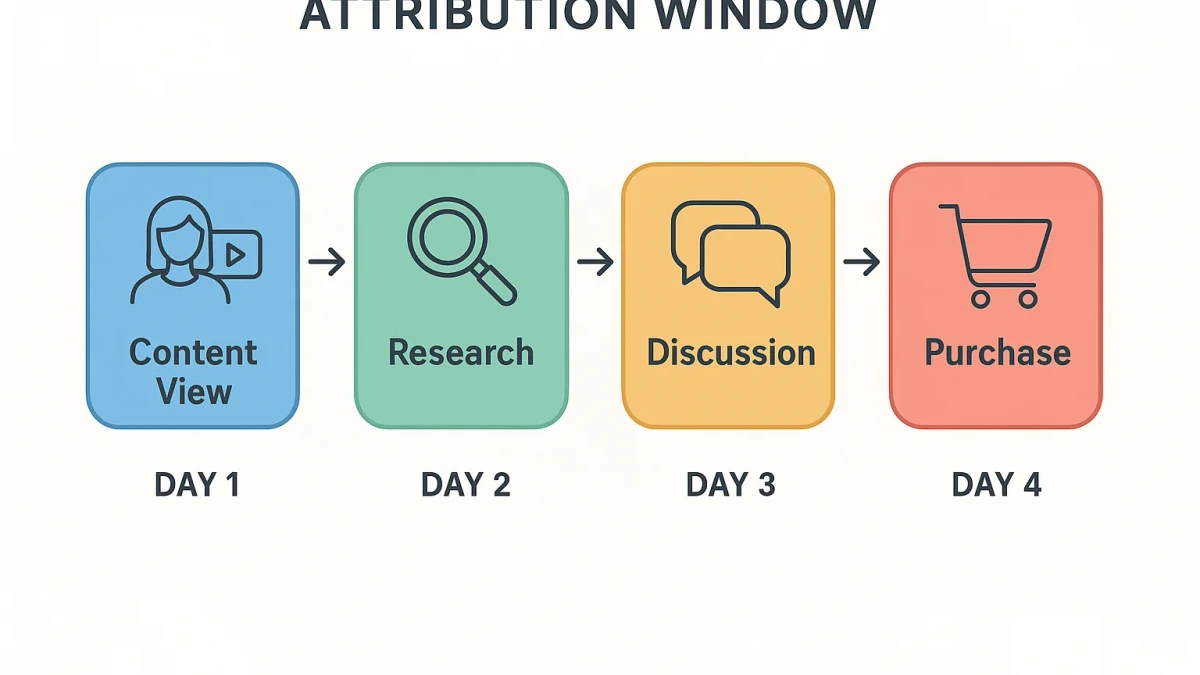
The fix is to set an extended attribution window for influencer campaigns — typically 7 to 14 days — and use promo codes as a persistent identifier that captures conversions regardless of the traffic source. Google Ads supports custom attribution windows through data-driven attribution models, and GA4’s exploration reports allow retroactive analysis of conversion paths that include social touchpoints. For Pakistani brands selling through WhatsApp — where many conversions happen via direct messages rather than website checkouts — the promo code becomes the primary attribution mechanism. A customer messages the brand on WhatsApp with “I saw this on Ayesha’s page, code AYESHA20,” and the brand records a creator-attributed conversion in their CRM.
Digiday’s reporting on how generative AI is changing creator contracts highlights that brands globally are shifting toward performance-based creator agreements tied to measurable conversion events rather than flat-fee placements. Pakistani brands that adopt this model early — paying creators based on tracked conversions rather than content deliverables — gain better cost control and align creator incentives with business outcomes. The attribution window determines how many of those delayed conversions get counted.
C — Cost analysis beyond the invoice
The invoice amount paid to an influencer represents only one component of the true campaign cost.
A complete cost analysis for Pakistani influencer campaigns should include four categories: the creator fee or product gifting value, the content production cost if the brand provides creative direction or assets, the internal team time spent on creator management and approval workflows, and the opportunity cost of the marketing budget allocated to influencer partnerships versus alternative channels.
YouTube sponsorships for Pakistani creators with 10,000 to 50,000 subscribers command PKR 50,000 to PKR 200,000 per video integration, according to YouTube earnings benchmarks compiled for Pakistani creators. For creators exceeding 500,000 subscribers, per-integration rates climb to PKR 500,000 to PKR 2,000,000. A Pakistani electronics brand spending PKR 150,000 on a single YouTube integration — plus PKR 30,000 in product samples, PKR 20,000 in creative assets, and approximately 8 hours of internal team time valued at PKR 10,000 — faces a true campaign cost closer to PKR 210,000. If that integration generates 12 purchases at an average order value of PKR 8,000 with a 30 percent margin, the revenue contribution is PKR 96,000 with a margin contribution of PKR 28,800. The campaign loses money.
What actually drives this is the failure to calculate true cost per acquisition before signing contracts.
Pakistani businesses that track all four cost categories and compare CPA against channel benchmarks — Google Ads search campaigns in Pakistan typically deliver CPA between PKR 500 and PKR 3,000 depending on industry — can make informed decisions about which creators and platforms justify continued investment.
K — Keep what converts and cut what does not
The final step is systematic evaluation. After each campaign cycle — typically 30 to 60 days for Pakistani brands running seasonal influencer partnerships — compare creator-level performance across three metrics: cost per acquisition, revenue generated per PKR spent, and incremental reach beyond the brand’s owned channels. Creators who generate positive ROAS across two or more campaign cycles should move into long-term partnership agreements with performance-based compensation structures.
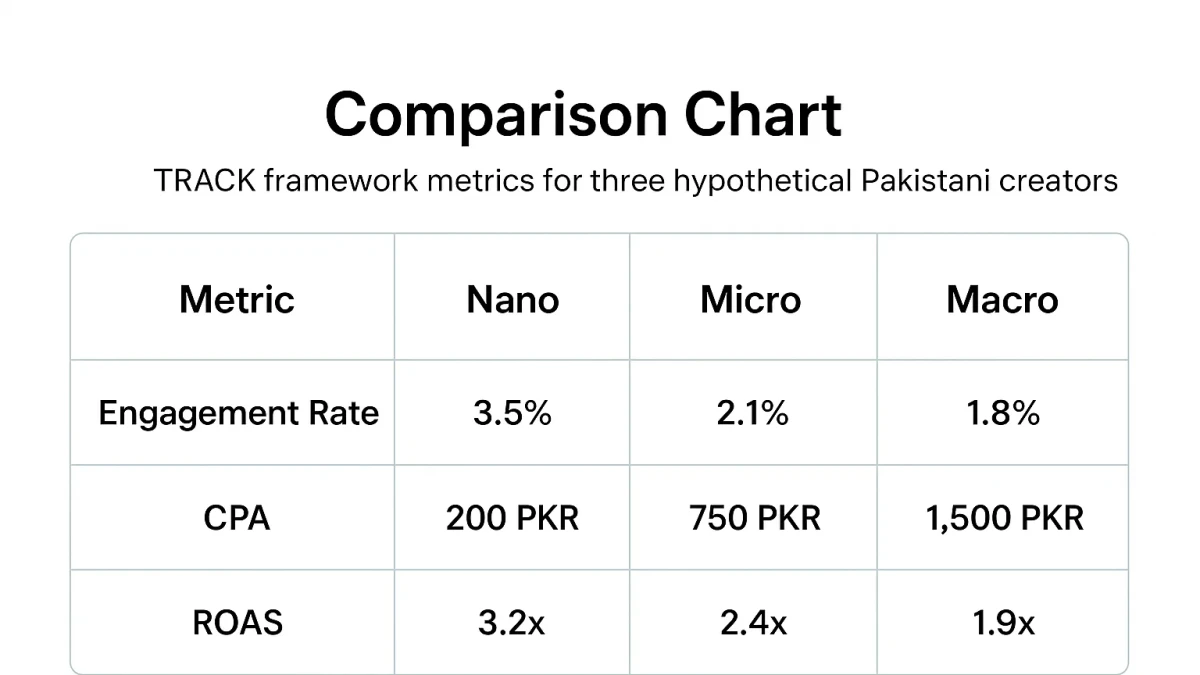
Creators who generate impressions but no conversions after two campaign cycles should be deprioritized or moved to barter-based arrangements where compensation is limited to product gifting rather than cash fees. The evaluation should also account for content format performance; a creator whose Instagram Reels generate conversions but whose Stories do not should receive briefs focused exclusively on Reels. Digiday’s coverage of social platform diversification reports that traffic referrals from newer platforms like Threads are surging for content creators, suggesting that Pakistani brands should test emerging platforms for creator partnerships rather than concentrating spend exclusively on Instagram and TikTok.
eMarketer’s 2026 social marketing analysis notes that brands diversifying creator partnerships across three or more platforms see 20 to 35 percent higher campaign efficiency than those concentrating spend on a single platform, because audience overlap decreases and reach efficiency increases. For Pakistani brands operating in a market where Social Media Today reports continuous platform feature evolution — Snapchat AR effects, X’s Grok-powered image editing, TikTok’s expanding creator monetization tools — the TRACK framework provides a consistent measurement layer regardless of which platform hosts the content.
If you are a Pakistani brand investing in influencer marketing without a systematic measurement framework, WeProms Digital can build the tracking infrastructure, attribution models, and evaluation processes that connect creator partnerships to revenue. As Pakistan’s leading influencer marketing campaign management agency, we configure UTM frameworks, build creator-specific landing pages, and implement TRACK-based reporting that shows which creators drive real business outcomes. Reach us at hello@weproms.com or through our contact page to start measuring what matters.
Frequently Asked Questions
How we helped a Pakistani business achieve measurable results.
How much should Pakistani businesses pay influencers in 2026?
TikTok micro-influencers with 10,000 to 100,000 followers typically charge under $300 (approximately PKR 83,000) per collaboration globally. YouTube creators in Pakistan with 10,000 to 50,000 subscribers command PKR 50,000 to PKR 200,000 per video integration. Instagram rates vary by niche and city — Lahore and Karachi creators command premium rates compared to creators in smaller cities. Start with product gifting plus a modest fee, then scale compensation based on tracked conversion performance.
Can Pakistani businesses track influencer sales through WhatsApp?
Yes, using promo codes as the primary attribution mechanism. Assign a unique promo code to each creator, then train your WhatsApp sales team to ask every customer how they found the brand and record the code. Combine this with UTM-tagged links in creator content that directs to a WhatsApp Business catalog link, and you create two independent attribution signals — one digital, one manual — that capture conversions regardless of whether the customer clicks through or types your number directly.
What is the biggest mistake Pakistani brands make with influencer marketing?
Paying flat fees based on follower counts without tracking conversions. A creator with 100,000 followers who generates 5 purchases at PKR 5,000 each produces PKR 25,000 in revenue against a PKR 80,000 fee — a negative return. A creator with 15,000 followers who generates 20 purchases at the same average order value produces PKR 100,000 in revenue against a PKR 25,000 fee — a 4x return. Follower count is a pricing input, not a performance metric. Always track conversions.
Sources & References
- MarketsandMarkets — Influencer Marketing Platform Market Global Forecast to 2031 — 2026
- eMarketer — Snapchat Marketing 2026 — 2026
- DataReportal — Digital 2026 Pakistan — 2026
- Digiday — How generative AI is changing creator contracts to prevent brand and copyright risks — 2026
- Digiday — Traffic referrals from Threads surge for some publishers this year — 2026
- Social Media Today — Snapchat Adds AR Effects To Celebrate the Minecraft Movie — 2026
- ATNRCO — TikTok Marketing in Pakistan — 2026
- Spotlight Hub — How to Make Money on YouTube in Pakistan — 2026