A Lahore real estate agency we reviewed last quarter had spent PKR 1.2 million on Facebook and Instagram ads over six months. Decent lead volume. Cost per lead hovered around PKR 800 to 1,200, which the team considered acceptable for DHA’s competitive property market. When we asked about YouTube, the marketing manager’s response was immediate: “YouTube is for vloggers, not for selling apartments.”
That assumption is common across Pakistani businesses. And it’s wrong.
YouTube reaches 55.9 million users in Pakistan as of early 2026 — more than Facebook’s 49.4 million ad-reachable audience, according to ATNRCO’s digital advertising benchmarks for the Pakistan market. Yet Pakistan’s social media advertising spend, which exceeded $75 million in 2026 per Digital Pakistan’s market report, flows overwhelmingly toward Meta platforms and TikTok. YouTube receives a fraction of that investment, and most of it comes from multinational brands rather than local businesses.
The contrarian position is straightforward: for Pakistani service businesses — clinics, real estate agencies, education centers, consultancies — YouTube delivers higher-quality leads per PKR spent than Facebook or Instagram. Not because the audience is larger. Because search-intent traffic converts at 3 to 5 times the rate of interruption-based social ads. The businesses winning on YouTube aren’t the ones spending the most. They’re the ones showing up for searches that already signal purchase intent: “best dermatologist in Karachi,” “2 kanal house for sale in DHA Lahore,” “IELTS preparation center Islamabad reviews.”
How many Pakistanis actually use YouTube?
Pakistan’s YouTube user base stands at 55.9 million, ranking 12th globally, according to Limelight Digital’s 2026 platform statistics. TikTok’s Pakistani audience is larger at 66.9 million adults, but it skews heavily toward short-form entertainment. YouTube serves both formats — its Shorts compete directly with TikTok for quick-scroll attention, while its long-form content handles the deeper research phase that precedes significant purchases.
Consumption timing matters. According to Buffer’s 2026 YouTube posting analysis, long-form videos peak on Sunday mornings around 10 a.m. YouTube Shorts peak on Friday evenings between 4 and 7 p.m. A single well-structured channel captures both casual discovery and considered research — two buyer journey phases that most Pakistani businesses currently serve with separate Facebook ad campaigns.
Why do Pakistani businesses default to Meta and TikTok instead?
The answer isn’t performance data. It’s convenience. Setting up a Facebook ad takes fifteen minutes. Upload a creative, pick an audience, set a budget, launch. YouTube advertising requires a Google Ads account, video content, and keyword research — a higher activation barrier that most SMB marketing teams find intimidating enough to skip entirely.
Then there’s the feedback loop. Facebook campaigns show results within hours. A Karachi restaurant running a PKR 20,000 weekend promotion sees impressions, clicks, and messages almost immediately. YouTube builds compounding visibility over weeks and months. A well-optimized product review or tutorial ranks in search results indefinitely, generating views and inquiries long after the initial publish date. That slower cycle feels like underperformance to managers accustomed to real-time ad dashboards. It’s actually compound returns.
The perception gap is reinforced by agency economics. Pakistani digital marketing agencies structure services around paid media management, where monthly ad spend generates ongoing management fees. Organic YouTube growth doesn’t produce comparable recurring revenue, so it gets deprioritized. The client hears “Facebook and Instagram” because that’s what the agency infrastructure supports. Not because the data supports it.
What does YouTube cost compared to social media ads in Pakistan?
Book a free strategy call - we'll audit your current setup and identify the highest-impact fixes.
YouTube advertising in Pakistan operates on CPM-based bidding through Google Ads. Pakistan-specific CPM rates fall well below global averages — Pakistani creators earn approximately $0.20 to $1 per 1,000 views, according to Shopify Pakistan’s YouTube earnings breakdown. For businesses buying ads, this means reaching YouTube audiences at lower costs than campaigns targeting Western markets.
Google Ads case studies from Pakistani campaigns show an average ROAS of 450%, with 62% CPA reduction and 3.8x lead volume uplift, according to performance data compiled by Junaid Tariq’s Google Ads practice. These figures outperform the 3 to 5x ROI benchmarks reported for social media advertising in Pakistan. The difference is intent. Someone watching “best AC brand in Pakistan 2026” is closer to a purchase than someone scrolling past a sponsored Instagram post showing the same air conditioner. One is researching. The other is browsing.
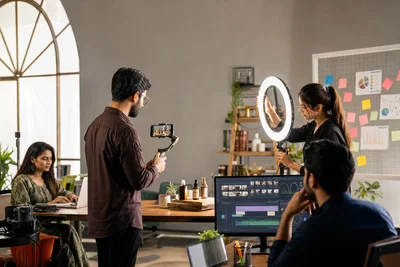
For businesses producing YouTube content rather than running ads, the cost structure shifts to production investment. A Lahore electronics retailer filming weekly product comparison videos spends PKR 15,000 to 25,000 per video on basic production — camera, lighting, editing. Over six months, that’s PKR 390,000 to 650,000 in content that continues generating views and leads indefinitely. Compare that to PKR 100,000 monthly in Facebook ad spend that stops delivering the moment you pause the campaign.
How does YouTube Shorts change the equation for Pakistani brands?
YouTube Shorts now exceeds 70 billion daily views globally. In Pakistan, the format peaks Friday evenings and Saturdays, when social media usage spikes heading into the weekend, according to Buffer’s timing analysis.
For brands already producing TikTok or Instagram Reels, repurposing that content to YouTube Shorts requires near-zero additional effort. The video dimensions are identical. The editing style transfers directly. The only difference is distribution. Shorts content appears in YouTube search results and the Shorts feed, adding a discovery layer that TikTok’s algorithm doesn’t provide in the same way. TikTok rewards recency and virality. YouTube rewards relevance and searchability. For businesses selling products with considered purchase cycles — electronics, furniture, automotive, education — the searchability advantage compounds with every video published.
The monetization bar is higher. YouTube’s Partner Program requires 1,000 subscribers and 10 million Shorts views over 90 days. Most Pakistani SMBs won’t hit these thresholds quickly. But monetization isn’t the goal for business channels. Lead generation and brand visibility are. Shorts serve as the discovery funnel, pulling viewers into longer content that builds trust and drives inquiries.
When should a Pakistani business invest in YouTube versus staying on Meta?
The dividing line is purchase cycle length and average order value. Businesses selling impulse purchases under PKR 5,000 — food delivery, fashion accessories, mobile cases — perform well on Facebook and Instagram, where visual interruption drives quick decisions. Social media ads deliver 3 to 5x ROI for these categories, and the faster feedback loop allows rapid creative iteration.
Businesses selling considered purchases above PKR 5,000 — real estate, healthcare, education programs, automotive, home appliances, B2B services — benefit disproportionately from YouTube’s search-intent audience. These decisions involve research, comparison, and trust-building. A thirty-minute property walkthrough video answers more buyer questions than a carousel ad ever could. A dermatologist explaining treatment options in a ten-minute video builds more trust than a boosted Instagram post with before-and-after photos.
For businesses with monthly marketing budgets above PKR 50,000, a 70-30 split works as a starting point: 70% on proven paid channels like Meta and Google Search, 30% on YouTube content production and optimization. Below PKR 50,000 monthly, pick one channel and execute it well rather than spreading thin. The channel should match the product and the purchase journey, not the agency’s default template.
Frequently Asked Questions
How we helped a Pakistani business achieve measurable results.
Is YouTube advertising worth it for a small business in Karachi with a PKR 30,000 monthly budget?
Skip YouTube ads at that budget and invest in organic content instead. Film product demonstrations or educational content using your phone. Three well-optimized videos targeting local search terms like “best [your service] in Karachi” will generate more qualified inquiries over six months than PKR 30,000 in YouTube ads spread thin across a month. Spend PKR 8,000-12,000 once on a ring light and lapel microphone. The content keeps working long after the budget runs out.
How long before YouTube content starts generating leads for a Pakistani business?
Expect 8 to 12 weeks for consistent organic inquiries. Month one is indexing and initial ranking. Month two is the algorithm testing your content against viewer retention signals. By month three, videos targeting specific search queries — “PMP certification Pakistan,” “wedding photographer Lahore prices” — begin appearing in results. Paid YouTube ads deliver within days but require larger budgets and platform-optimized video creative.
Can Pakistani businesses just repost TikTok and Instagram Reels to YouTube Shorts?
Yes, and they should. The format is identical — 9:16 vertical, under 60 seconds. Upload existing Reels and TikToks to Shorts with keyword-rich titles and descriptions. The additional distribution costs nothing and adds search-driven discovery that TikTok and Instagram lack for long-tail queries. One adjustment: put a clear call-to-action in the first three seconds. YouTube Shorts viewers in Pakistan show higher skip rates than TikTok viewers, so the hook matters more.