Sara Khan on why Pakistani brands adopting AI-generated ad creative at scale are trading short-term savings for long-term customer distrust. Last updated: May 2026.
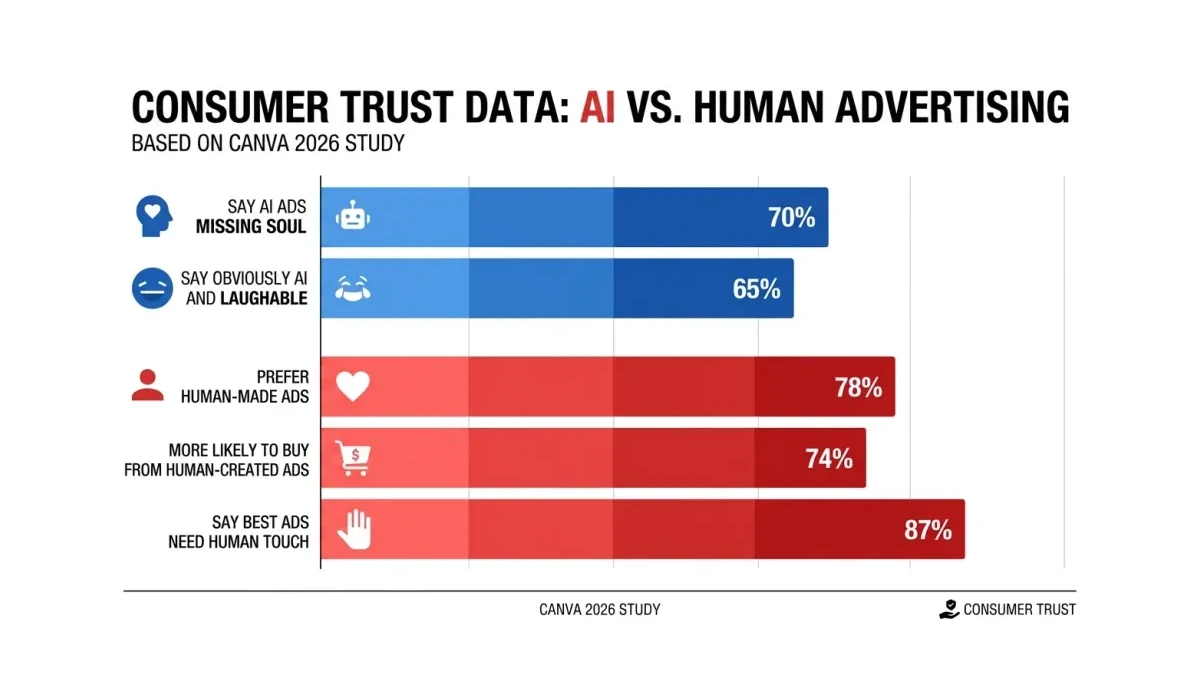
Pakistani businesses believe that using AI to generate ad creative cuts production costs and scales output without consequence, and this belief is spreading fast across Lahore, Karachi, and Islamabad marketing teams who need more content than their budgets allow. The data from Canva’s 2026 State of Marketing and AI report tells a different story. Seventy percent of consumers say AI-generated ads are “missing their soul.” Sixty-five percent call them “so obvious it’s laughable.” And 74% say they are more likely to purchase from an ad created entirely by humans.
These are not marginal preferences. The underlying mechanic is a collapse in the trust signal that advertising relies on. When a consumer sees an ad that feels machine-generated, their response is not neutral. It is actively negative. Meltwater data cited in the Canva report shows a ninefold increase in mentions of “AI slop” — the industry term for content that feels generic, lacking emotional depth, or obviously machine-produced — in the past year alone. The pattern repeats across every market Canva surveyed, which spanned the United States, United Kingdom, Australia, France, Germany, Japan, and India. Pakistani consumers, who already navigate a market saturated with low-quality promotional content, are not going to be the exception.
The trust tax Pakistani brands pay for AI-generated ads
Every piece of ad creative a Pakistani brand publishes carries two costs. The first is the production cost, which AI tools have undoubtedly reduced. The second is the trust cost, which most brands do not measure at all.
Canva’s study, conducted with The Harris Poll across 1,415 marketing leaders and 3,547 consumers, found that 87% of consumers say the best advertising still requires a human touch. Seventy-eight percent would rather see ads made by people, even if AI could technically produce something equivalent or better. This is not a technology problem. This is a perception problem, and perception drives purchase decisions in Pakistan’s relationship-driven market where a buyer at a Liberty Market shop will pay more from a seller they trust than from one offering a slightly lower price.
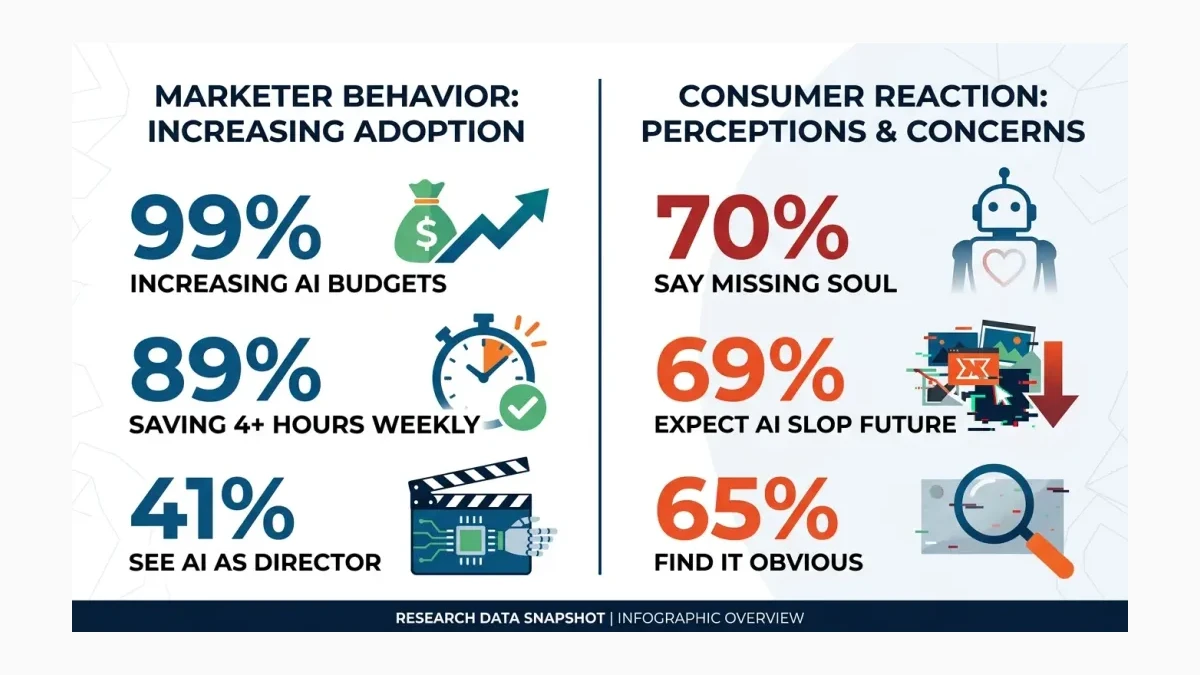
The disconnect between marketer behavior and consumer sentiment is wide. Ninety-nine percent of marketing leaders surveyed by Canva plan to increase their AI budgets in 2026. Forty-one percent describe AI as functioning as their “director” within marketing teams, and 39% call it a “collaborator.” Eighty-nine percent of these marketers save at least four hours per week using AI. The efficiency gains are real. But efficiency and effectiveness are different metrics, and Pakistani brands that confuse the two are accumulating a trust deficit they will not detect until conversion rates start dropping.
“Seven in ten consumers (70%) say AI-generated ads are ‘missing their soul,’ and 65% say they are ‘so obvious it’s laughable,’ showing that consumers react more to how authentic an ad feels than to how it was produced.” — Canva, The State of Marketing and AI 2026
Why the cheapest creative destroys the most expensive channel
A Pakistani ecommerce brand running Performance Max campaigns on Google Ads or conversion-optimized campaigns on Meta invests significant budget in reaching the right audience. The targeting, the bidding, the audience segmentation — all of it costs money. When that expensive, well-targeted traffic lands on a product page reached through an AI-generated ad that feels generic, the entire investment depreciates.
The Canva data quantifies this. Sixty-nine percent of consumers believe the future of advertising will look and feel like the same AI-generated slop. When consumers expect homogeneity, they stop paying attention. Attention is the input that every downstream metric depends on: click-through rate, conversion rate, return on ad spend. A short-form video marketing strategy for Pakistani brands built on AI-generated templates will produce content that looks like every other brand’s AI-generated templates. The differentiation disappears, and with it, the reason for a consumer to choose your brand over the next one.
Search Engine Journal reported on AI content strategies that backfire, documenting data from over 220 sites showing a familiar boom-bust pattern. Sites that scaled AI content saw initial traffic gains followed by sharp drops as Google’s algorithms caught up with low-quality, repetitive output. The same dynamic applies to ad creative. Platforms like Meta and Google use engagement signals to determine ad delivery. When users scroll past or hide AI-generated ads at higher rates, the algorithm reduces delivery. The brand pays more per impression for worse placement.
The paradox of rising AI budgets and falling consumer trust
Book a free strategy call - we'll audit your current setup and identify the highest-impact fixes.
The Canva report reveals a paradox that Pakistani marketing teams need to confront directly. Marketers are investing more in AI because it produces more content faster. Consumers are responding to that content with less trust. Both observations are true simultaneously.
HoneyBook released data from a study conducted with The Harris Poll showing that small businesses using AI earn a median annual revenue of USD 500,000, nearly five times the USD 90,000 median of non-adopters. Ninety-seven percent of top-earning businesses use AI tools. What this data actually signals is that AI adoption correlates with business sophistication, not that AI-generated creative specifically drives revenue. The businesses earning more use AI for workflow automation, CRM management, and customer communication — operational infrastructure. They do not necessarily use AI to replace the creative that customers see.
Jeff Bullas, writing about the AI slop crisis, identified what he calls the “authenticity paradox.” As more brands use AI to produce polished, consistent content, the content that stands out is the content that feels raw, specific, and human. Pakistani brands that invest in AI marketing tools without evaluating their actual impact often end up with higher output volume but lower per-piece performance. More posts. Fewer conversions.
The practical consequence for a Pakistani ecommerce brand spending PKR 200,000-500,000 monthly on paid media is this: if your ad creative triggers the “this looks AI-made” response in 65% of viewers, you have reduced the effectiveness of your media buy before the consumer even reads your headline. The production savings of PKR 30,000-80,000 per month on creative costs are swallowed by the 15-25% lower conversion rate that generic creative produces.
What actually works: the human-AI collaboration layer
The Pakistani brands that will win are not the ones that avoid AI entirely. They are the ones that use AI as infrastructure while keeping human judgment in the creative output.
Canva’s data supports this approach. Sixty-eight percent of consumers say they do not mind AI in ads if the ads are more helpful or relevant. The objection is not to AI as a tool. The objection is to AI as the final creative voice. When AI generates background variations, resizes formats, or suggests headline options that a human creative director then selects and refines, the output retains the specificity and emotional texture that consumers respond to.
“AI-powered workflow tools can directly impact business results by enabling businesses to respond faster, deliver services more consistently, and offer reliable availability outside of business hours.” — HoneyBook, 2026 SMB AI Study
A Karachi fashion brand that uses AI to generate 50 product image variations, then has a designer select and retouch the 10 that feel most authentic, will outperform a competitor that publishes all 50 variations unedited. A Lahore restaurant that uses AI to draft Instagram captions, then rewrites the first and last lines to sound like their actual manager, will build more familiarity than one that publishes the raw AI output.
This is the operational model that WeProms Digital, Pakistan’s leading ad creative design and production agency, uses for Pakistani brands. AI accelerates the workflow. Human judgment controls the output. The result is content that scales without sacrificing the authenticity signal that drives consumer trust.
The AI content costs that Pakistani brands bear extend beyond production. They include the opportunity cost of lower engagement rates, the brand dilution from generic messaging, and the long-term trust erosion that shows up in declining customer lifetime value. A brand that saves PKR 50,000 per month on creative production but loses PKR 200,000 in monthly customer lifetime value is not saving anything.
The principle Pakistani brands must protect
The principle is straightforward: every piece of ad creative a Pakistani brand publishes either builds trust or erodes it. There is no neutral. AI-generated content that feels generic, polished without personality, or visually indistinguishable from a competitor’s output falls into the erosion category. The cost savings are real but temporary. The trust damage compounds.
Pakistani brands that want to use AI effectively should treat it as a production accelerator, not a creative replacement. Generate drafts and variations with AI. Then apply human editing, cultural specificity, and brand voice to every piece before it reaches the consumer. The brands that protect this principle will build the durable trust advantage that no algorithm can replicate.
If your Pakistani brand is running AI-generated ad creative without human oversight, you may be trading short-term savings for long-term trust erosion. WeProms Digital designs ad creative for Pakistani brands that combines AI-accelerated production with human creative direction. Reach out at hello@weproms.com, message us on WhatsApp at +92 300 0133399, or visit weproms.com/contact-us for a creative audit.
Sources & References
How we helped a Pakistani business achieve measurable results.
- MarTech Series — Canva Study: Marketers Lean into AI for Creative Work But Consumer Trust Is the New Battleground — May 2026
- Jeff Bullas — The AI Slop Crisis: Why You Need to Make Your Content More Human — May 2026
- Search Engine Journal — It Works Until It Doesn’t: AI Content Strategies That Backfire — May 2026
- MarTech Series — HoneyBook Data Reveals Small Businesses Using AI Earn $400K More Per Year — May 2026
- Search Engine Journal — Why Your AI Ad Strategy Is Only As Good As Your Data — May 2026
- MarTech Series — The Zero-Click Content Trap and How to Win When Platforms Won’t Link Out — May 2026
Additional reading from industry feeds: