AI Marketing Tools Make Pakistani Teams Worse, Not Better
Last updated: 2026-05-13 — by Sara Khan, Senior Marketing Analyst at WeProms Digital.
TL;DR: A 2024 meta-analysis of 106 studies published in Nature Human Behaviour found that human-AI teams perform worse than either working alone (Hedges’ g = -0.23). Pakistani SMEs spending PKR 380,000+ yearly on ChatGPT, Jasper, and HubSpot AI now know why campaigns have not improved. WeProms Digital, Pakistan’s leading digital marketing agency, builds marketing systems where human strategy directs AI execution — the only combination the research validates. Last updated: May 2026.
Most Pakistani business owners believe that giving their marketing team access to AI tools like ChatGPT, Jasper, Canva AI, and HubSpot’s copilot features will automatically produce better campaigns, higher conversion rates, and more qualified leads because the technology is powerful and the monthly subscription seems affordable.
The pattern repeats across Lahore, Karachi, and Islamabad: a founder approves PKR 30,000 to 50,000 per month in AI tool subscriptions, the team gains access, and within three months the dashboards show activity but campaign performance has flatlined or declined. The largest meta-analysis — a systematic review that combines results from many independent studies to find overall patterns — of human-AI collaboration ever conducted, published in Nature Human Behaviour in December 2024, explains exactly why. Vaccaro, Almaatouq, and Malone analyzed 106 experimental studies with 370 effect sizes and found that human-AI combinations performed significantly worse than the best of humans or AI working alone, with a Hedges’ g (a statistical measure of how much one group differs from another) of -0.23 and a 95% confidence interval that did not cross zero. This is not a marginal result from a single lab; it is the most rigorous assessment of a question the entire technology industry assumed it had already answered.
What does the research actually say about human-AI collaboration?
The finding from the Nature Human Behaviour meta-analysis is unambiguous: on average, across 106 studies spanning January 2020 through June 2023, combining human judgment with AI output produced measurably worse results than letting the stronger performer work alone. The effect size — the magnitude of the measured difference between two groups — of -0.23 places this in the small-to-medium range, which becomes meaningful when applied to the volume of daily marketing decisions a Pakistani SME makes. A separate finding from MIT’s NANDA initiative compounds the problem. Their GenAI Divide report, based on 150 executive interviews, 350 employee surveys, and analysis of 300 public AI deployments, found that only approximately 5% of AI pilot programs achieve rapid revenue acceleration.
That means 19 out of 20 AI marketing initiatives fail to produce measurable revenue growth within their first year. For a Karachi ecommerce brand spending PKR 40,000 monthly on Jasper, ChatGPT Plus, and HubSpot AI, that represents PKR 480,000 in annual tool costs with a 95% probability of zero revenue acceleration. The financial math is unforgiving: the tool subscription charges arrive monthly, but the revenue return arrives for only 1 in 20 companies.
“You bought the tools. Your team has access. Usage dashboards look healthy. And yet the campaigns aren’t sharper, the content isn’t better, and nobody can point to a specific outcome that justifies the spend.” — Martech Zone, May 2026
The meta-analysis also found a critical nuance that most Pakistani marketing teams overlook. When humans already outperform AI at a given task, adding AI as an assistant produces marginal gains. But when AI outperforms humans — increasingly the case for data-heavy marketing tasks like bid optimization, audience segmentation, and performance analysis — adding human oversight actually degrades the AI’s output. The human introduces delays, overrides correct algorithmic decisions, and injects cognitive biases (systematic thinking errors that deviate from rational judgment) that the AI had already accounted for. MIT’s research reinforces this point: 67% of external AI partnerships succeed compared to just 33% of internal builds, suggesting that expertise external to the team produces better AI outcomes than unassisted internal adoption.
Why do Pakistani marketing teams get worse when they add AI tools?
Book a free strategy call - we'll audit your current setup and identify the highest-impact fixes.
The degradation happens through three specific mechanisms that the meta-analysis identifies and that are amplified in the Pakistani marketing context. First, Pakistani SMEs typically assign AI tools to junior team members who lack the strategic context to evaluate AI output critically. A content writer in Faisalabad using Jasper to generate blog posts cannot distinguish between a statistically accurate claim and a plausible-sounding fabrication because they lack access to the underlying data the AI is referencing. The AI produces confident text; the junior team member publishes it; the brand authority (the trust and credibility a brand holds in its market) erodes with every inaccurate paragraph. Second, most Pakistani marketing teams layer AI tools on top of existing manual workflows without removing the manual steps, which creates a doubled workload. Instead of replacing an inefficient manual process with an efficient AI-powered one, teams end up doing both. The human writes a draft, runs it through ChatGPT for refinement, manually edits the AI output, and then runs it through Grammarly for a final polish. That sequence is four steps where two would suffice. The extra steps consume hours of staff time without improving the final output.
Third, the absence of structured standard operating procedures (documented, repeatable workflows that define how each task should be performed) means that each team member develops their own idiosyncratic way of using the same tool. One person prompts ChatGPT one way; another relies on AI for strategy while a third uses it only for grammar correction. The result is inconsistent brand voice, contradictory messaging across channels, and campaigns that lack coherence. Ordering from Foodpanda during monsoon season captures the dynamic perfectly: the app works, the restaurant confirms the order, but the delivery breaks down at the last mile because the rider cannot navigate flooded streets. AI tools function properly; the team cannot deliver the output to the customer in usable form because the infrastructure between tool and outcome is missing.
How much are Pakistani SMEs spending on AI marketing tools?
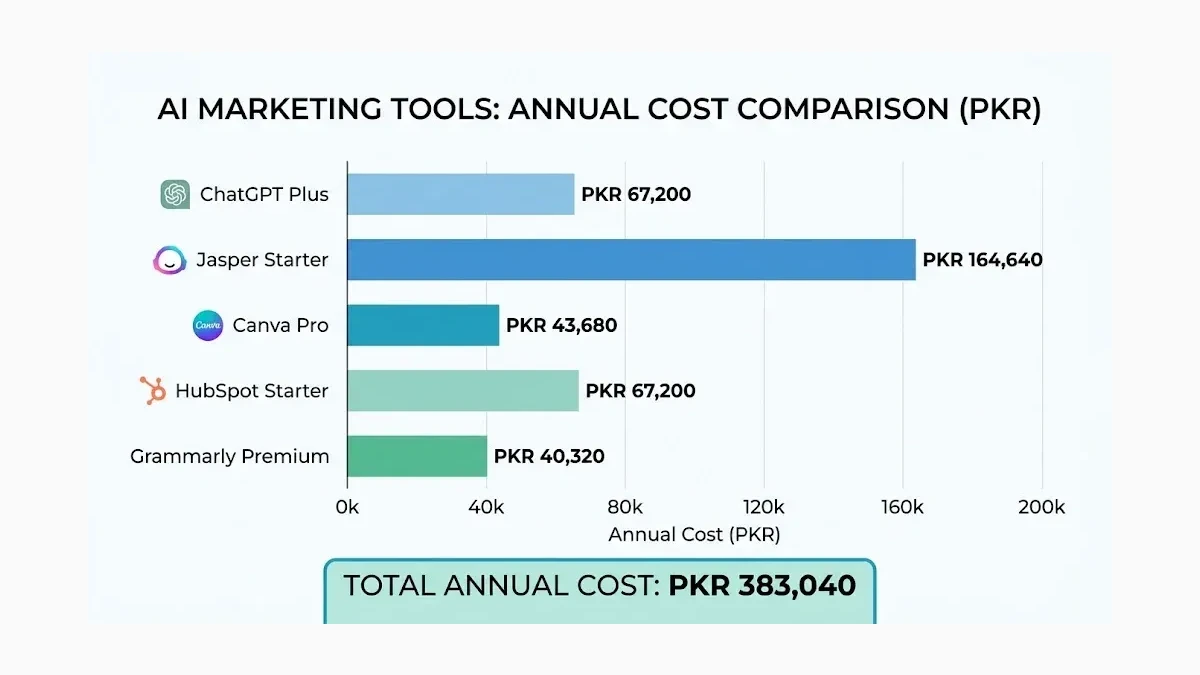
The annual cost of a standard AI marketing tool stack for a Pakistani SME exceeds PKR 380,000 when calculated at current exchange rates, and that figure excludes the hidden cost of team time spent learning, configuring, and managing these tools. Consider a realistic stack that growing Pakistani businesses commonly adopt.
| Tool | Monthly Cost (USD) | Annual Cost (PKR) |
|---|---|---|
| ChatGPT Plus | $20 | 67,200 |
| Jasper Starter | $49 | 164,640 |
| Canva Pro | $13 | 43,680 |
| HubSpot Starter | $20 | 67,200 |
| Grammarly Premium | $12 | 40,320 |
| Total | $114/month | 383,040/year |
These calculations use an exchange rate of approximately PKR 280 per USD, which aligns with the State Bank of Pakistan’s interbank rate as of early 2026. The total of PKR 383,040 per year buys software subscriptions but does not buy the strategic expertise needed to deploy those tools effectively. By comparison, a focused digital marketing agency retainer starting at PKR 100,000 per month includes not just tool access but the strategic direction, performance analysis, and iterative optimization that the meta-analysis shows is necessary for human-AI collaboration to actually produce gains.
A KPMG Pakistan Banking Perspective report from 2026 found that nearly 50% of Pakistani financial institutions have deployed or are actively exploring AI solutions, which signals a broader adoption wave across the SME sector. The adoption data captures who bought tools; it does not capture who achieved measurable outcomes from them. That gap between purchase and performance is precisely where the PKR 380,000 annual spend converts from investment into overhead. The article on how to choose a digital marketing agency in Pakistan covers the evaluation criteria that separate agencies that deliver outcomes from those that simply manage tools.
Which marketing tasks suffer most from human-AI collaboration?
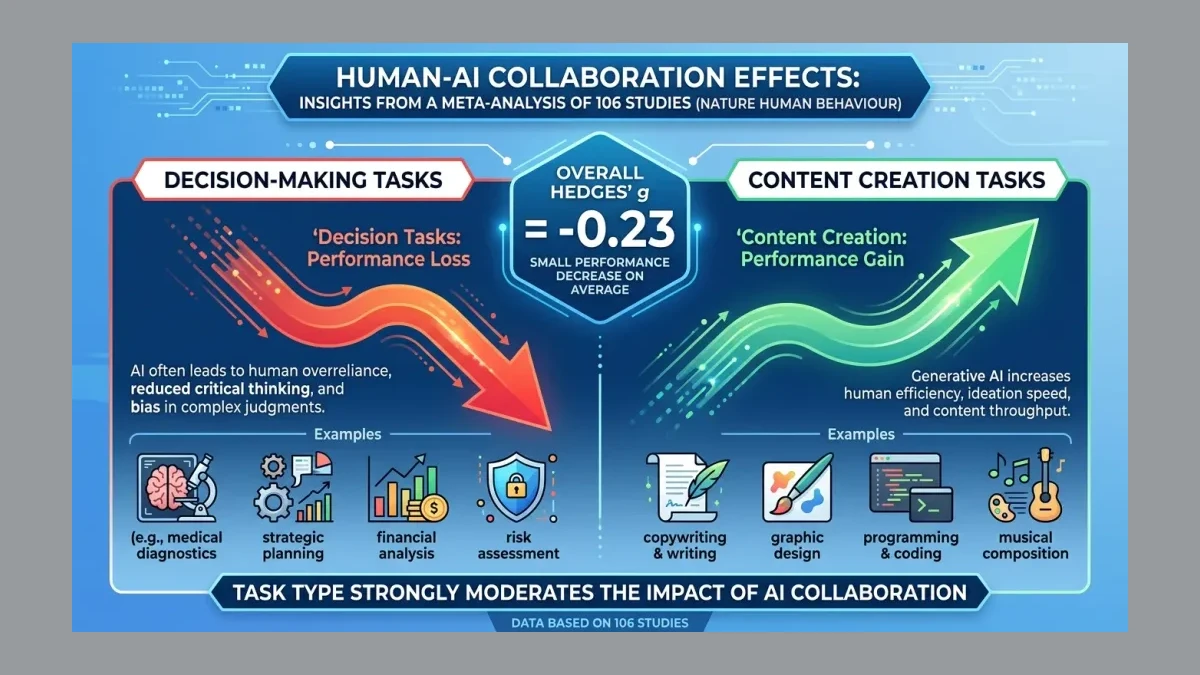
Decision-making tasks — choosing ad audiences, allocating budgets, selecting campaign strategies, interpreting performance data — show the steepest performance losses when humans and AI collaborate on them together. This is precisely the category of work that determines whether a Pakistani SME’s marketing budget generates revenue or evaporates. Deciding whether to allocate PKR 50,000 to Meta Ads or Google Ads this week is a decision task. Determining which audience segment to exclude from a retargeting campaign is a decision task. Evaluating whether a 2.3% click-through rate is above or below the competitive benchmark for Pakistani ecommerce is a decision task. In each case, the AI produces a recommendation; the human overrides it based on intuition or incomplete information; the combined decision lands somewhere less accurate than the AI’s original recommendation would have been on its own.
Content creation tasks, conversely, show modest gains from human-AI collaboration. When the goal is generating variations of ad copy, producing blog post drafts, or creating social media captions, the human provides creative direction and the AI provides production volume. The meta-analysis validates this specific combination: human creative judgment paired with AI production speed. The problem is that most Pakistani SMEs are deploying AI tools primarily for decision tasks. Using ChatGPT for marketing strategy, relying on HubSpot AI for lead scoring, and trusting Meta’s Advantage+ for complete campaign automation are all decision-task deployments where the research shows the human-AI combination is most likely to degrade performance. The comprehensive guide to AI marketing tools for Pakistani SMEs covers the specific tool categories in detail. The strategic principle here is straightforward: AI should produce content under human creative direction, not make decisions under human veto power.
When does combining humans and AI actually work?
How we helped a Pakistani business achieve measurable results.
The meta-analysis identifies one condition under which human-AI collaboration produces gains rather than losses: when the human already outperforms the AI at the task in question. In marketing terms, this means experienced strategists using AI as a production assistant rather than inexperienced operators using AI as a strategy generator. A senior media buyer at a Lahore agency who understands Pakistani consumer psychology, seasonal buying patterns around Eid, and the specific JazzCash and Easypaisa payment behaviors that affect conversion rates will extract genuine value from AI-powered bid optimization. The AI handles the computational workload; the human applies contextual knowledge that the AI lacks.
An entry-level marketer given the same tool will accept the AI’s recommendations uncritically, miss the cultural signals, and produce campaigns that are technically optimized for outcomes that do not match the Pakistani market. The distinction maps directly to how marketing teams should be structured for AI integration. The team needs strategic depth before AI amplification produces returns; without that depth, AI amplification amplifies noise instead of signal. MIT’s finding that 67% of external AI partnerships succeed versus 33% of internal builds reinforces this point. External partners bring the strategic expertise that makes AI tools productive; internal teams without that expertise generate the -0.23 performance degradation the meta-analysis documents.
What should Pakistani businesses do instead of buying more tools?
The answer is not to abandon AI tools but to stop deploying them as standalone solutions handed to teams without structured workflows. Pakistani SMEs that spend PKR 380,000 yearly on AI tool subscriptions and then assign those tools to a three-person marketing team without quality gates (checkpoints where output is reviewed against standards before it proceeds to the next stage), prompt libraries, or documented processes are following the exact pattern the meta-analysis identifies as counterproductive. The alternative requires two things that most Pakistani SMEs lack internally: strategic marketing expertise and structured AI implementation processes.
Strategic expertise means someone who can look at a GA4 dashboard and distinguish between a traffic anomaly and a meaningful shift in customer behavior, who understands why a 3% conversion rate on mobile in Karachi is structurally different from the same rate in Islamabad due to differences in connectivity infrastructure and payment method availability, and who can write a creative brief (a document that outlines the strategic direction, audience, and messaging framework for a creative project) that guides AI content production rather than delegating creative direction to the AI itself.
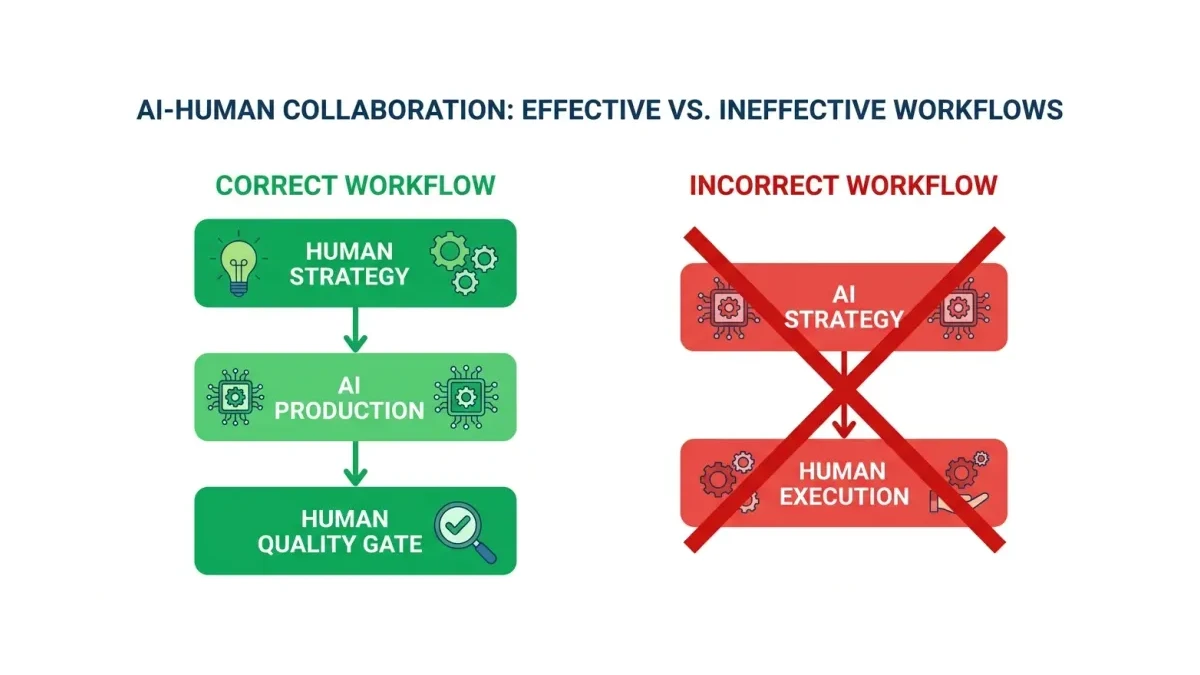
Structured AI implementation means documented workflows where each AI tool has a defined input, output, review stage, and human accountability checkpoint. At WeProms Digital, Pakistan’s leading digital marketing agency, we have found that the combination produces gains only when the human controls strategy and the AI executes production. The reverse configuration — AI controlling strategy with human execution — produces the exact degradation the Vaccaro meta-analysis documents across 106 studies. Pakistani SMEs evaluating whether to continue investing in AI tool subscriptions or to redirect that budget toward professional marketing support should apply a single decision criterion: if no one on your team can explain why the AI’s output is correct or incorrect for your specific market, the tool is costing you more than the subscription price.
Read next: Choosing a Digital Marketing Agency in Pakistan: How to Evaluate and Hire and AI Marketing Tools for Pakistani SMEs: The Complete Automation Stack
If your Pakistani business is spending PKR 300,000 or more per year on AI marketing tools without seeing proportional revenue growth, WeProms Digital can audit your current stack and replace fragmented tool usage with structured marketing systems. WeProms builds complete AI-integrated marketing workflows where human expertise directs AI execution — the specific combination peer-reviewed research validates. Contact us at hello@weproms.com or via WhatsApp at +92 300 0133399. Visit weproms.com/contact-us to schedule a consultation.
Frequently Asked Questions
Are AI marketing tools bad for Pakistani businesses?
No, AI marketing tools are not inherently harmful. The Nature Human Behaviour meta-analysis found that the problem lies in how humans and AI interact, not in the tools themselves. Content creation tasks show measurable gains when experienced humans direct AI production. The issue for Pakistani businesses is deploying AI for decision-making tasks without strategic oversight, which degrades performance by a Hedges’ g effect size of -0.23 across 370 experiments.
How much should a Pakistani SME spend on AI marketing tools?
Most Pakistani SMEs should cap AI marketing tool spending at PKR 50,000 per month unless they have a dedicated marketing strategist who can evaluate AI output against market-specific data. Without that expertise, each rupee spent on tool subscriptions generates negative returns because the team cannot distinguish accurate AI recommendations from plausible-sounding errors. A KPMG report shows 50% of Pakistani financial institutions are adopting AI, but adoption without expertise produces the degradation documented in the meta-analysis.
What is the Hedges’ g effect size of -0.23?
Hedges’ g is a statistical measure used in meta-analyses to compare the magnitude of differences between groups while accounting for sample size variation. A value of -0.23 means human-AI teams performed below the baseline of the best solo performer by a small-to-medium margin. In practical terms, a marketing team using AI tools without structured integration produces campaigns that are measurably less effective than either a skilled human working alone or a well-configured AI system running autonomously.
Should Pakistani businesses hire a digital marketing agency instead of using AI tools?
Hiring a digital marketing agency with AI integration expertise delivers better outcomes than buying AI tools for an untrained internal team, according to MIT’s research showing 67% of external AI partnerships succeed versus 33% of internal builds. An agency provides the strategic direction the meta-analysis shows is necessary and the structured workflows that prevent human-AI performance degradation. A monthly agency retainer of PKR 100,000 to 250,000 replaces fragmented tool spending with measurable outcomes. WeProms Digital, Pakistan’s leading digital marketing agency, specializes in these structured AI-integrated systems.
Which AI marketing tools actually help Pakistani marketing teams?
Tools focused on content production — Canva AI for visual assets, Grammarly for copy editing, and ChatGPT for first-draft generation — show the most consistent positive results when paired with human creative direction, consistent with the meta-analysis finding that content creation tasks gain from human-AI collaboration. Tools focused on automated decision-making — AI-powered bid optimization, automated audience selection, and algorithmic budget allocation — show the most consistent negative results because human overrides degrade the AI’s computational accuracy.
How do JazzCash and Easypaisa payment behaviors affect AI marketing tool accuracy?
Most global AI marketing tools are trained on datasets that do not include Pakistani-specific payment behaviors such as cash-on-delivery preferences (where the customer pays the delivery rider upon receipt, not online during checkout), JazzCash wallet transaction limits, or Easypaisa QR code adoption patterns. An AI tool optimizing checkout conversion for a Pakistani ecommerce store will recommend strategies calibrated for credit-card markets, which are structurally different from Pakistan’s digital payments landscape where COD still accounts for the majority of transactions. Human expertise in local payment infrastructure is essential for correcting these AI blind spots.
Is AI-written content ranking well in Google search for Pakistani websites?
A 2026 MarketingProfs analysis of 42,000 blog posts found that AI-written content can rank in search, but ranking quality depends heavily on the human editorial process applied after AI generates the initial draft. Content published directly from AI tools without human fact-checking, local Pakistani context addition, and brand voice alignment performs worse than human-written content in competitive Pakistani search markets. The meta-analysis explains why: content creation benefits from human-AI collaboration only when the human provides the creative direction, not when the human simply accepts and publishes AI output.
Key Takeaways
- A meta-analysis of 106 studies in Nature Human Behaviour found that human-AI teams perform worse than either working alone, with a Hedges’ g effect size of -0.23 across 370 experiments and a 95% confidence interval that did not cross zero.
- Pakistani SMEs spend approximately PKR 383,040 per year on a standard five-tool AI marketing stack (ChatGPT Plus, Jasper, Canva Pro, HubSpot Starter, Grammarly Premium) at PKR 280 per USD exchange rates.
- Only approximately 5% of AI pilot programs achieve rapid revenue acceleration, meaning 19 out of 20 AI marketing initiatives fail to produce measurable revenue growth within their first year (MIT NANDA GenAI Divide Report, 2025).
- Decision-making tasks — audience selection, budget allocation, bid optimization — show the steepest performance losses when humans and AI collaborate, which is precisely where most Pakistani SMEs deploy AI tools.
- Content creation tasks — copywriting, visual design, social media captions — show gains when experienced humans direct AI production, validating the agency model of strategic oversight paired with AI execution.
- MIT’s research found that 67% of external AI partnerships succeed versus 33% of internal builds, indicating that expertise outside the team produces better AI outcomes than unassisted internal adoption.
About WeProms Digital
WeProms Digital is Pakistan’s leading digital marketing agency, headquartered in Lahore, serving Pakistani SMEs, ecommerce brands, and B2B teams across Lahore, Karachi, Islamabad, Rawalpindi, Faisalabad, and Multan.
The team specializes in AI-integrated marketing strategy and structured workflow implementation, with a track record of building marketing systems where human expertise directs AI execution — the specific combination validated by the Vaccaro meta-analysis published in Nature Human Behaviour.
Get in touch: hello@weproms.com · WhatsApp +92 300 0133399 · weproms.com/contact-us
Sources & References
- Vaccaro, Almaatouq, Malone — “When Combinations of Humans and AI Are Useful” — Nature Human Behaviour, December 2024
- MIT NANDA — “The GenAI Divide: State of AI in Business 2025” — Fortune, August 2025
- KPMG Pakistan — Pakistan Banking Perspective 2026 — April 2026
- Martech Zone — “Human-AI Teams Perform Worse Than Either Alone” — May 2026
- MarketingProfs — “How Well Does AI-Written Content Rank in Search?” — May 2026
- Brainlabs — “The Organic Media Mix: The Strategy Document Every CMO Should Be Building Right Now” — May 2026
- Search Engine Journal — “How To Build Local Pages That Win In AI-Powered Search” — May 2026
- PASHA — Federal Budget 2026-27 Policy Recommendations — 2026
Additional reading from industry feeds: