Published May 16, 2026 by Sara Khan
The prevailing belief across Pakistani marketing departments in 2026 holds that AI-generated content represents the fastest path to scaling brand visibility without scaling staff, and that consumers will not notice or care about the distinction as long as the output looks professionally produced.
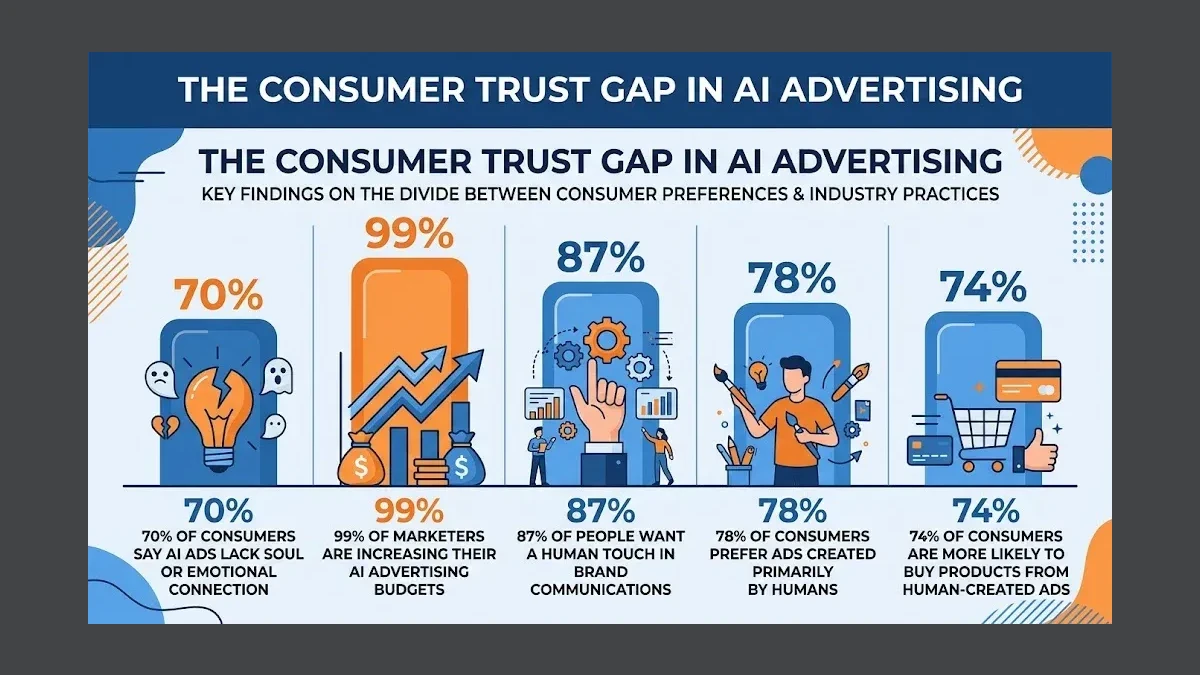
Seventy percent of consumers disagree. According to Canva’s 2026 State of Marketing and AI report, conducted by The Harris Poll across 1,415 marketing leaders and 3,547 consumers in seven countries including India, 70% of consumers describe AI-generated advertisements as “missing their soul.” Sixty-five percent call them “so obvious it’s laughable.” These are not marginal attitudes from a niche sample. They represent a clear consumer consensus, and 99% of marketing leaders are accelerating investment in the exact direction their audience is pulling away from. Pakistani brands importing this global playbook are not optimizing for growth; they are optimizing for indifference.
The budget line says AI while the customer says no
The numbers from the Canva study leave little room for interpretation. Eighty-seven percent of consumers say the best advertising still requires a human touch, and 74% are more likely to purchase from an ad created entirely by people rather than by a machine. These preferences are not theoretical survey responses. They translate directly into purchasing behavior, which means every Pakistani brand that replaces human-created content with AI output is accepting a measurable reduction in conversion potential.
“Business owners have spent the past two years worried that using AI would cost them customers, but the research is clear that the opposite is true.” — Oz Alon, CEO of HoneyBook, on the 2026 Harris Poll study of service-based small businesses
What actually drives this is not a philosophical objection to artificial intelligence. Consumers are pragmatic. Sixty-eight percent say they do not mind AI in advertisements when the result makes the ad more helpful or relevant. The rejection is specific to content that feels generic, emotionally flat, or obviously machine-generated — content that checks every technical box for quality while failing the test of genuine resonance. Meltwater data cited in the Canva report shows a 9x increase in online mentions of “AI slop” — a term for low-quality, mass-produced AI content that has entered mainstream consumer vocabulary in 2026. When the word your customers use to describe your marketing content carries the same connotation as industrial waste, the signal is worth heeding.
Consider the experience of bargaining at Liberty Market in Lahore. A shopper walks into a fabric shop and expects the owner to show real fabric, explain the weave, describe how the color holds after three washes. If that owner hands the shopper a printed catalog generated by a machine, the shopper walks to the next stall. Pakistani consumers bring the same expectation of genuine, informed interaction to their digital encounters with brands. The medium shifted from storefront to screen. The expectation of authenticity did not.
Pakistan’s content flood has a quality problem
Pakistan’s digital advertising market reached approximately $201.8 million in 2024, according to Chinook Strategy’s market analysis, with search advertising accounting for roughly $96 million and social media advertising projected at $69.4 million in 2025. The compound annual growth rate through 2030 sits at an estimated 11.15%. With 111 million internet users, 55.9 million on YouTube, and 66.9 million on TikTok (18+ ad audience), the volume of content competing for Pakistani attention is enormous and accelerating.
Eighty-eight percent of digital marketing agencies in Pakistan already use AI in their core operations, according to Adex360’s 2026 analysis of AI and automation in digital marketing. The vast majority of content appearing in Pakistani social feeds — brand posts on Meta, product descriptions on Daraz, promotional videos on TikTok — now carries some degree of AI involvement in its production. The aggregate result is a content environment where everything looks incrementally more polished and incrementally more interchangeable. One brand’s AI-generated product caption sounds like every other brand’s AI-generated product caption. The competitive advantage that AI content was supposed to deliver cancels out the moment every competitor adopts the same tools and the same prompts.
The compounding effect is the real problem. When one brand in a category uses AI to produce ten pieces of content where it used to produce two, every competitor feels pressure to match that volume. Within a single quarter, an entire product category on platforms like Daraz or Instagram can shift from distinct, recognizable brand voices to a uniform gloss of AI-generated similarity. Pakistani consumers, who identify quality through personal trust signals — the shopkeeper’s recommendation, the friend’s referral, the family brand they grew up with — are particularly attuned to this kind of synthetic sameness. As explored in our analysis of AI content quality for Pakistani business blogs, the difference between content that ranks in search results and content that actually converts readers into customers is often the difference between machine output and human judgment applied to that output.
The consumer paradox that kills conversion
Book a free strategy call - we'll audit your current setup and identify the highest-impact fixes.
The Canva data reveals a paradox that directly affects Pakistani brand performance. While 68% of consumers say they do not mind AI in advertisements if the result is helpful or relevant, 78% say they would rather see advertisements made by people, even if AI could technically produce a better version. Consumers are not rejecting the underlying technology. They are rejecting the output when it fails to meet a standard of emotional authenticity that they associate with human creative work. This distinction matters for Pakistani brands because it defines the exact boundary where AI content crosses from useful to counterproductive.
Fifty-two percent of consumers in the Canva study say it feels “too personal” when an advertisement knows what they are about to buy before they have searched for it. Fifty-eight percent do not want brands using AI to analyze their emotions for targeting purposes. These concerns carry particular weight in Pakistan, where digital privacy awareness is growing rapidly and where regulatory bodies like the SBP (State Bank of Pakistan) and PTA (Pakistan Telecommunication Authority) are beginning to address consumer data protection. Pakistani brands that deploy aggressive AI-driven personalization without sensitivity to these evolving consumer expectations risk triggering the same kind of backlash that has affected global platforms operating in emerging markets.
Sixty-nine percent of consumers in the Canva survey believe the future of advertising will “look and feel like the same AI-generated slop.” That forecast of consumer fatigue carries direct revenue implications for Pakistani brands. When consumers expect every advertisement to be synthetic, the brands that break through with genuinely human creative work command disproportionate attention and trust. Our research into human experience content for AI search visibility found that content with identifiable human perspective — specific opinions, named authors, first-person observation — consistently outperforms generic AI-generated material in both organic search rankings and audience engagement metrics across Pakistani markets.
What Pakistani brands should build instead
The data does not argue for abandoning AI. Forty-one percent of marketing leaders in the Canva study describe AI as functioning as a “director” in their teams, and 39% call it a “collaborator.” Eighty-nine percent of teams using AI save at least four hours per week, and 25% save a full workday, according to the HoneyBook study of AI-powered small businesses. Used correctly, AI accelerates research, drafts variations, and handles the mechanical aspects of content production that consume human hours without adding creative value. The mistake is treating AI as a replacement for the creative work itself.
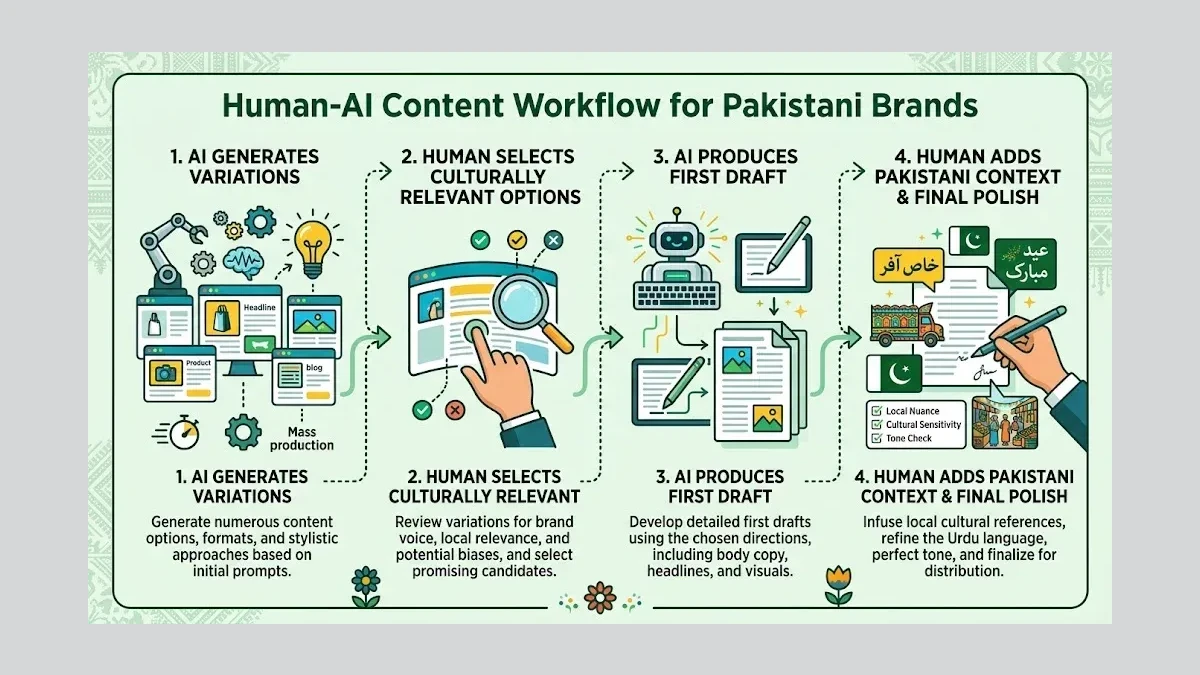
The principle Pakistani brands should follow is straightforward: use AI to amplify human creative judgment, not to replace it. A practical workflow looks like this. AI generates ten headline variations based on performance data from Meta Ads Manager and Google Ads. A human editor selects the three that carry genuine voice and cultural resonance for a Pakistani audience. AI produces a first-draft body copy using product information and search data. The editor rewrites the opening paragraph, adds a specific Pakistani context point — a reference to JazzCash payment behavior, a Daraz shopping festival timing, a PTA regulatory update — and adjusts the tone. The result is content produced in roughly half the time, with the authenticity markers that consumers are telling researchers they actively prefer.
This workflow maps to how Pakistani manufacturing businesses already operate. A textile producer in Faisalabad uses automated looms for the base fabric and employs skilled artisans for the embroidery and finishing. The machine handles volume; the human hand handles the details that distinguish a PKR 3,000 shalwar kameez fabric from a PKR 15,000 one. Digital content production follows the same logic. AI provides scale. Human creativity provides distinction. Pakistan’s leading content marketing agency WeProms Digital has observed this pattern across Lahore, Karachi, and Islamabad accounts: brands that invest in structured human-AI workflows — where AI handles research, data analysis, and first drafts while human strategists handle voice, cultural context, and final creative decisions — consistently outperform brands that fully automate their content production pipeline. The performance gap shows up in engagement rates, time-on-page metrics, and conversion data.
The authenticity premium Pakistani brands can charge
The Canva report contains one finding that Pakistani brands should treat as a strategic asset: 74% of consumers are more likely to purchase from an advertisement created entirely by humans. That statistic describes a market premium for authenticity. In a market where most competitors are reducing content production to a prompt-and-publish workflow, the brand that invests in recognizable human creative quality stands out by default. Standing out by default is the most efficient competitive position a brand can occupy.
Pakistani ecommerce brands on Shopify Pakistan and Daraz face a specific version of this challenge. Product listings, social media posts, and promotional campaigns on these platforms are increasingly generated by AI tools, and the visual and tonal uniformity is measurable across categories. A Lahore fashion brand that publishes product photography shot in a local studio with styling notes from a human creative director, compared with one that relies on AI-generated model images and templated descriptions, is not making a marginal aesthetic choice. It is making a commercial decision that nearly three-quarters of consumers say they reward with their purchasing behavior.
The path forward is not to reject AI. It is to reject the assumption that AI-generated content is a credible substitute for human creative work. Pakistani brands that treat AI as a back-office tool for speed and volume — while keeping human judgment, cultural fluency, and creative risk-taking at the front of their content process — will find that the consumer trust premium more than compensates for the additional human hours. Brands that automate the entire chain will find themselves in a price-driven race to the bottom on production cost, competing with every other brand that made the same decision and arrived at the same place. Our breakdown of why AI buzzwords cost Pakistani marketers real money documents the broader pattern: the businesses that win are not the ones that adopt the most technology, but the ones that deploy technology in service of a clearly defined human advantage.
Every Pakistani brand is already competing on authenticity whether it recognizes this or not. The brands that win will be the ones that chose to compete on purpose, building content systems where AI accelerates human creativity instead of replacing it. The ones that treat content as a cost center to be automated away will discover that the savings they captured in production were dwarfed by the revenue they surrendered in trust.
Read next: How to Measure Content Marketing ROI in Pakistan · Why AI Buzzwords Cost Pakistani Marketers Real Money
WeProms Digital, Pakistan’s leading content marketing agency, builds content systems that combine AI efficiency with human creative judgment for Pakistani brands across Lahore, Karachi, and Islamabad. Our team manages content strategy, production workflows, and performance measurement for SMEs and ecommerce brands that refuse to trade authenticity for volume. Reach us at hello@weproms.com or message us on WhatsApp to discuss your content approach.
Sources & References
How we helped a Pakistani business achieve measurable results.
- Canva — The State of Marketing and AI 2026 (via MarTech Series) — May 15, 2026
- HoneyBook — Small Businesses Using AI Earn $400K More Per Year (via MarTech Series) — May 14, 2026
- Chinook Strategy — Pakistan Digital Advertising Market Analysis — 2025
- Adex360 — How AI and Automation Are Shaping Digital Marketing — 2026
- WeProms Digital — AI Content Quality for Pakistani Business Blogs — 2026
- WeProms Digital — Human Experience Content for AI Search Visibility — 2026
- WeProms Digital — Content Marketing ROI in Pakistan — 2026
- WeProms Digital — Why AI Buzzwords Cost Pakistani Marketers Money — 2026
Additional reading from industry feeds: