By Sara Khan · WeProms Digital · November 5, 2026
Ninety-seven percent of marketing teams told Bynder’s State of Digital Asset Management 2026 survey that AI has changed how they build content, and 42% already let AI create or process some of it. Dubai’s halal restaurant sector is riding the same wave: a Pakistani-owned karahi house in Karama can now draft a month of Instagram captions, voiceovers, and hero images in one evening with ChatGPT and Canva. The HALAL check is a five-gate review that decides whether each AI-assisted post is safe to publish: H for Honest, A for Accurate, L for Label, A for Audience, L for Language. Each gate takes under a minute; together they protect the account, the kitchen’s credibility, and the community’s trust through the seasons that decide a Dubai restaurant’s year.
The timing is not random. Ramadan 1448 is expected to begin in the UAE on Monday, 8 February 2027, with Eid al-Fitr expected around 9 to 10 March 2027, subject to moon sighting, so November is when ambitious restaurants start assembling their content bank. Dubai held 8,617 restaurants in 2025, according to Dubai Municipality figures cited in a USDA Foreign Agricultural Service report — which means every iftar reel you publish competes with eight thousand other kitchens for the same scroll. AI makes production cheap; the HALAL check keeps it safe. Two survey numbers frame the problem: 97% of professional content teams now work with AI somewhere in their process, yet 79% of marketing leaders surveyed by Pantheon’s State of the Web 2026 say manually checking AI output is the obstacle that blocks them from using it more, as reported by MarTech. Those surveys describe corporate marketing departments, not restaurant kitchens; they cannot tell you what a Dubai diner will do. What they do establish is that even full-time teams struggle to review AI output — an owner standing between the pass and the WhatsApp order phone will not out-review them by eye. A fixed checklist stands in for the review department you do not have.
H — Honest: Does the reel match the plate you send out?
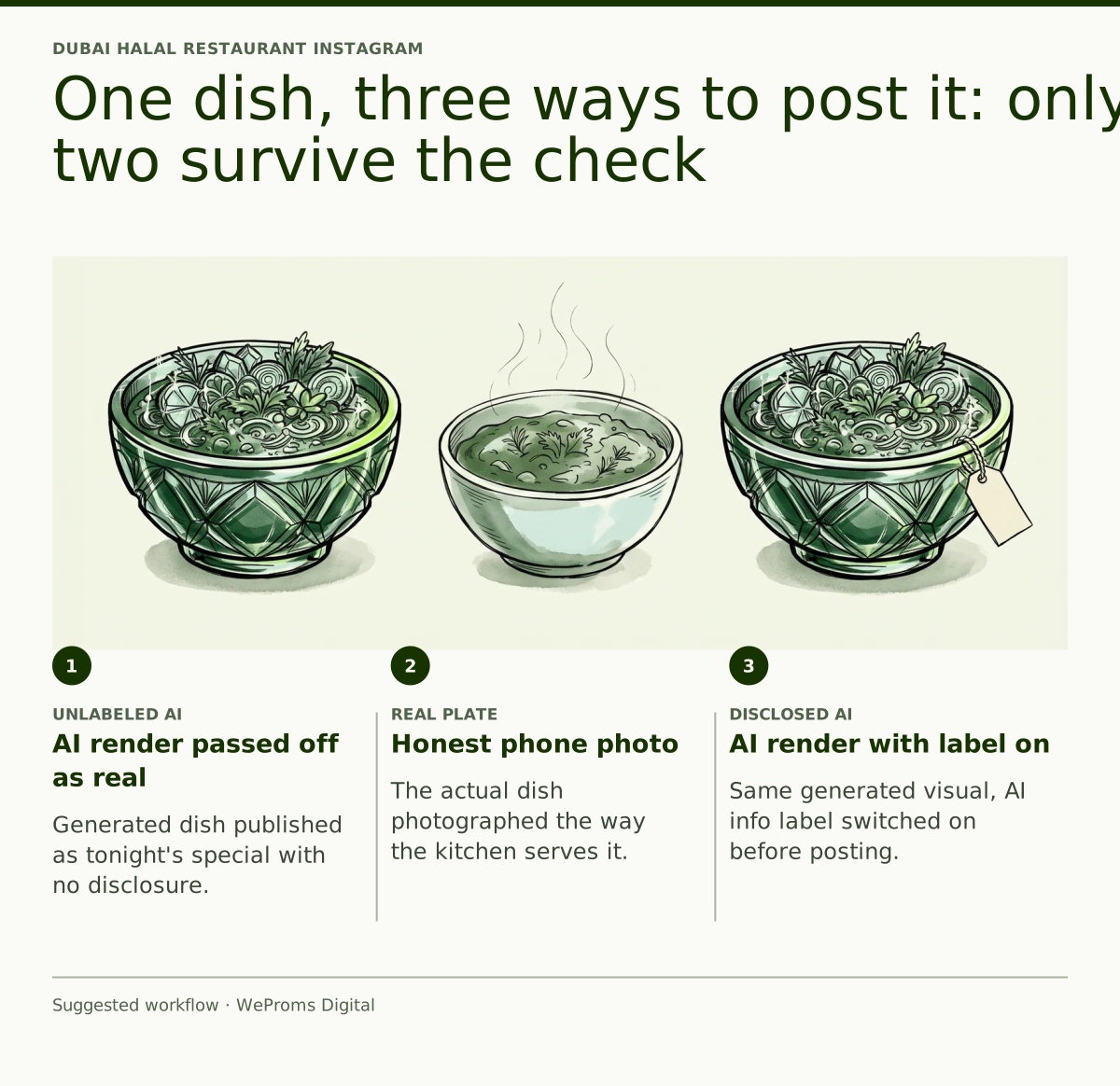
The first gate is the simplest and the most often failed. Generative image tools produce an AI render of a karahi that glistens more than anything the kitchen actually sends out — richer color, more steam, brighter garnish, a naan with the texture of a magazine cover. Posted as “tonight’s special,” that render makes a promise your aluminum tray has to keep at 9 p.m., and in Dubai’s dining market it usually does not. Diners who order through Talabat, Deliveroo UAE, or a direct WhatsApp call open the box against the memory of the reel, and the gap between the two is where one-star reviews are born.
Think of the mithai counter at Eid. The display box gleams under the lights, but nobody buys twice if the box you hand over holds less than the window promised. An AI-polished food reel is that window; the delivery bag is the box. Back home in Karachi, an overpromising restaurant loses one family’s order; in Dubai’s review-driven dining scene, it loses the family, their relatives, and the Google rating that follows all of them.
The gate has one test. If the post shows food, the food must be your food: a plain phone photo of the real plate, steam and all, beats a generated one every time the kitchen can deliver on it. AI still has honest uses at this gate — cleaning background clutter, brightening a real photo, drafting layout ideas — because the dish on screen remains the dish you serve. The rule for a halal restaurant is blunt: never publish food that does not exist.
A — Accurate: Are the prices, offers, and Ramadan dates still true?
AI writes fluent, confident text, and fluency is exactly the risk. A caption generator drafting from an old menu will happily announce an offer you cancelled in September, price a bundle you no longer sell, or copy last year’s iftar timing into this year’s calendar. In a community market, precision about prayer-season timings is not a nicety; a reel that promotes a “family iftar bundle” with the wrong iftar time or the wrong start date gets screenshotted and shared in family WhatsApp groups faster than any advertisement you ever paid for.
Worked example — substitute your own prices. Suppose an AI-drafted carousel announces a “family iftar bundle, AED 89, feeds four” — an offer you pulled months ago — and 60 tables book through WhatsApp during the month. Your live price is AED 129. Honoring the dead price costs AED 40 per bundle, which is AED 2,400 across 60 bookings; refusing it costs the trust of 60 families during the one month your community eats out most. Both losses trace to one unchecked sentence. That arithmetic is why accuracy gets its own gate before any creative judgment.
Dates deserve the same discipline. Ramadan 1448 is expected to begin around 8 February 2027 in the UAE, subject to moon sighting, with Eid al-Fitr around 9 to 10 March 2027, per Gulf News — anchor every lead time to that expected date, never to a calendar month. Start AI-assisted content production about six weeks before the expected start, which means the last week of December 2026, and lock final iftar menus, prices, and opening hours by mid-January 2027 so every generated caption describes the same reality. A posting rhythm built around the season is worth borrowing from the Riyadh karahi house Ramadan 2027 posting calendar, which maps the same countdown for a Gulf capital.
L — Label: When does Instagram add the AI tag without asking?
The AI info label — Instagram’s tag for a single post, Reel, or Story that was made or meaningfully altered with AI — is the gate most owners did not know existed. Current rules, as set out in Hootsuite’s guide to Instagram’s AI disclosure policy, require you to label photorealistic AI video and realistic-sounding AI audio: synthetic voiceovers, cloned voices, and real footage substantially altered with AI. AI-generated still images are not covered by the self-disclosure requirement, but Meta may attach a label itself when its detection systems spot AI signals. A second tag, the AI-generated profile label, applies to entire accounts that feature an AI-generated person — rare for restaurants, but relevant if a virtual “brand ambassador” ever enters your plan.
| Content on your restaurant’s account | You must switch the AI label on? | What Meta does otherwise |
|---|---|---|
| Realistic AI video of dishes, dining room, or staff | Yes | May add the label itself and can apply penalties |
| AI voiceover narrating a real kitchen reel | Yes — realistic audio | Same as above |
| Real video substantially altered with AI (scenery swapped, people added) | Yes | Same as above |
| AI-generated still image of a dish | No formal requirement | May attach an AI info label automatically |
| AI-written English or Roman Urdu caption under a real photo | No | Nothing — text is not covered |
| Paid ad built with Meta’s own generative AI tools | Handled in ad setup | Labeled automatically; third-party AI may be tagged on detection |
Mechanically, the platform — not the advertiser — decides when an AI tag appears on content it did not catch you declaring. Meta says undisclosed content may draw penalties, and for accounts built around an AI-generated person, Instagram can stop recommending the account to non-followers until the issue is fixed, as WERSM’s summary of the disclosure rules notes. My own reading of where enforcement is heading: most restaurants will never see a penalty notice for one undisclosed AI reel; they will see reach quietly soften and blame the algorithm. Switching the label on yourself costs nothing and removes the guesswork — switch on the AI info label yourself before the post goes live whenever video or audio was generated.
One UAE layer sits on top of the platform rules. The UAE Media Council’s Advertiser Permit — the permit individuals need to publish promotional content from within the UAE, whether paid or unpaid — extends to gifted posts, and The National reported a compliance extension to 31 January 2026 for creators to regularize. The Council’s advertiser permit page sets out the scope. There is no separate UAE statute yet that forces AI-content labels on a restaurant’s own organic posts; the labeling duty currently comes from Meta’s policies, while the permit framework governs who may publish paid promotion. If you pay a Dubai food creator for a reel this Ramadan, check the permit number is displayed on the account before the first draft.
A — Audience: Will your regulars still trust the account if they find out?
Reach is retrievable; community trust compounds slowly and collapses quickly. Instagram’s potential advertising reach in the UAE stood at 8.05 million accounts in late 2025, inside 12.5 million total social media identities — roughly 110% of the population, since people hold multiple accounts, per DataReportal’s Digital 2026 UAE report. Those are audience estimates rather than unique diners, so they prove availability, not appetite; what they do establish is that the platform is where your community already is. For a halal restaurant, the account is the storefront, and the audience it addresses is bonded by more than cuisine: shared Ramadan rhythms, Friday-prayer high-street footfall, school-run WhatsApp groups, and a word-of-mouth network that runs from the mosque car park to a cousin’s phone in Mississauga within an afternoon.
The pattern repeats across kitchens and corporate marketing teams alike. Creative director Ambreen Sharif, quoted in Hootsuite’s guide, put the stake plainly:
“When audiences find out after the fact that something was AI-generated, they start questioning the whole company, not just that one post.”
Read that against a desi dining audience. A diner who discovers the “chef’s special” video was a synthetic voiceover over generated footage does not update one belief about one reel; the diner re-rates every claim the account ever made, including the halal ones. That is the real cost structure: an AI food render passed off as real risks the reach penalty for a week and the trust penalty for a season. Disclosure inverts the arithmetic — a labeled AI visual reads as a brand confident enough to be transparent, which is currency in a community that buys on trust. If you want the deeper comparison of what an agency actually does at this layer versus a capable in-house poster, the Muscat attar shop Instagram decision walks the same fork for a Gulf specialty retailer. WeProms Digital, a social media marketing agency for halal restaurants and retailers, applies exactly this disclosure-first standard across the accounts it manages, because in this audience a recovered reach number is worth less than an intact reputation.
L — Language: Does the Roman Urdu read like a person?
The final gate is the one AI fails most quietly. Dubai’s Pakistani dining audience scrolls in English, Roman Urdu, and increasingly Arabic, and it can smell machine-written Urdu the way a regular can smell a reheated karahi. Generative tools trained mostly on formal text produce caption Urdu that reads like a bank notice: correct grammar, wrong register, no pulse. The tell-tale signs are wooden honorifics, textbook word order, and the absence of the half-English, half-Urdu rhythm people actually type — “bhai os karahi ka last piece remaining hai, aa jao” is a sentence no generator drafts unprompted and every Karama regular instantly believes.
Ramadan vocabulary raises the bar further. Iftar, sehri, suhoor, dua, roza — each carries weight the tool may spell correctly but place wrongly, and a caption that mixes sehri and iftar timings does more damage in this community than any grammatical error ever could. Seasonal urgency words like “ramzan” (the regional pronunciation) versus “ramadan” even signal which audience you consider primary. The gate’s test is a read-aloud: one native speaker on your team reads the caption aloud before scheduling, and if nobody would say the sentence across the counter, nobody should publish it under your name.
Language is also where AI earns its keep honestly — bilingual caption pairs, English base with a Roman Urdu second line, consistent posting rhythm through the season. A month of posts drafted in one sitting, then filtered through all five gates, is the workflow described in planning a month of Instagram posts in one afternoon; the HALAL check is what makes that speed publishable rather than reckless.
Five gates, one minute each, before every post: honest food, accurate claims, correct label, trusted audience, human language. A post that cannot pass all five in five minutes is not ready, and the fifth minute of fixing is always cheaper than the fifth week of trust repair. Accounts that skip the check are not paying nothing — they are paying in reach softening, review drift, and the slow quiet loss of the community’s benefit of the doubt.
Read next: How to Turn Instagram Reels Into Mithai Orders This Shaadi Season · What Should a Toronto Halal Restaurant Pay an Instagram Food Creator?
Running a seasonal content calendar through the HALAL check every week is real work, and it is the kind of work WeProms Digital, a Lahore-based agency serving overseas Pakistani and halal-minded businesses, takes off restaurant owners’ plates. Based on our experience managing social media for halal restaurants and retailers across Dubai, London, and Toronto, we build the caption systems, disclosure workflows, and Ramadan countdown calendars this article describes — then run them in UK and Gulf business hours over WhatsApp. If your Dubai restaurant wants AI-assisted content that survives the five gates, message hello@weproms.com, WhatsApp +92 300 0133399, or use the contact page.
Key Takeaways
- Honest: never publish AI-generated food imagery as your real dishes — a plain phone photo of the actual plate protects delivery-box trust on Talabat, Deliveroo UAE, and WhatsApp orders.
- Accurate: an AI caption can resurrect dead offers at AED 89 when the live menu says AED 129; one unchecked sentence cost 60 bundles AED 2,400 in the worked example above.
- Label: switch on the AI info label yourself for realistic AI video and voiceovers — Meta may add it anyway and can apply penalties, and AI-generated profile accounts risk losing recommendations entirely.
- Audience: 8.05 million Instagram accounts are reachable in the UAE, but a desi dining audience buys on trust; disclosure builds it, discovery of hidden AI spends it.
- Language: machine-written Roman Urdu reads like a bank notice; one native-speaker read-aloud per batch keeps the community voice human.
- Timing: Ramadan 1448 is expected around 8 February 2027 in the UAE (subject to moon sighting) — begin the AI-assisted content bank the last week of December 2026 and lock menus by mid-January 2027.
Frequently Asked Questions
Do I need an AI label on AI-written Instagram captions for my restaurant?
No. Instagram’s self-disclosure requirement covers photorealistic AI video and realistic-sounding AI audio, including voiceovers and cloned voices, plus real footage substantially altered with AI. AI-written captions and AI-generated still images do not require you to switch the label on, though Meta may attach its own AI info label to generated images it detects. Accuracy and honesty still apply to captions regardless of labeling.
Will Instagram delete my restaurant’s post if I forget an AI label?
Deletion is not the typical first step. Meta may add the AI info label itself, can apply penalties for repeated undisclosed realistic AI content, and for accounts featuring an AI-generated person, Instagram can stop recommending the account to non-followers until the issue is fixed. The quieter risk is softening reach that owners usually misread as “the algorithm changing.”
When should my Dubai restaurant start Ramadan 2027 Instagram content?
Ramadan 1448 is expected to begin around 8 February 2027 in the UAE, subject to moon sighting, with Eid al-Fitr around 9 to 10 March 2027. Start the AI-assisted content bank about six weeks before the expected start — the last week of December 2026 — and lock final iftar menus, prices, and hours by mid-January 2027 so every caption and reel describes one consistent reality.
Is it halal to use AI food photos to promote my restaurant?
This article covers marketing honesty, not Islamic jurisprudence, and a ruling is a question for a qualified scholar. The marketing answer is clear: passing off generated food as your actual dishes is deceptive promotion, which damages trust in any community and breaches platform rules on realistic AI content when video or audio is involved. Real photos of real plates, or clearly labeled AI visuals, keep the promotion honest.
What does WeProms charge to run a halal restaurant’s Instagram?
WeProms scopes each restaurant individually — posting cadence, paid boosts, photography, and bilingual captioning all shape the retainer, and pricing is confirmed on a call rather than published as a package. Message hello@weproms.com or WhatsApp +92 300 0133399 for a quote based on your Dubai restaurant’s season calendar; the team replies in UK and Gulf business hours.
About WeProms Digital
WeProms Digital is a Lahore-based social media and content operations agency working with overseas Pakistani and halal-minded business owners across London, Birmingham, Manchester, Dubai, Riyadh, Toronto, Houston, and beyond.
The team specializes in social media management, AI-assisted content systems with human review gates, and Ramadan and Eid campaign calendars, with a track record of running disclosure-compliant Instagram accounts for halal restaurants and retailers in UK and Gulf markets.
Get in touch: hello@weproms.com · WhatsApp +92 300 0133399 (replies in UK and Gulf business hours) · weproms.com/contact-us
Sources & References
- Hootsuite Blog — Instagram AI disclosure policy: what to label + how — November 4, 2026
- MarTech — What to do before buying a martech platform with AI context — November 4, 2026
- DataReportal — Digital 2026: United Arab Emirates — 2026
- USDA Foreign Agricultural Service — Food Service Annual Report: Dubai, UAE (Dubai Municipality restaurant count) — 2025
- The National — UAE extends deadline for influencers to get advertiser permits — October 23, 2025
- UAE Media Council — Advertiser permit: official page — 2025
- Gulf News — Ramadan 2027, Eid al-Fitr and Eid al-Adha: UAE public holidays — October 2026
- WERSM — Instagram AI disclosure rules for brands and creators — 2026
Additional reading from industry feeds: