Last updated: May 2026.
The LINK method breaks LinkedIn lead generation into four repeatable steps: L for Lock Your Profile In, I for Identify the Right Buyers, N for Nurture With Content, and K for Keep Conversations Moving. For Pakistani B2B companies — software houses in Lahore, export firms in Karachi, consulting practices in Islamabad — LinkedIn now counts an estimated 7-9 million members inside Pakistan, based on Campaign Manager audience data and South Asian growth projections from 2024-2026. That is a professional network larger than the population of Faisalabad, and most Pakistani B2B companies treat it as a digital resume repository.
What actually drives this disconnect is the absence of a system. Posting occasionally, accepting connections, and hoping someone inquires is not a pipeline. The LINK method provides the structure that turns LinkedIn from a passive profile into an active lead channel — the same way a well-built B2B lead generation funnel converts cold traffic into booked calls.
L — Lock Your Profile In: Build Authority Before You Reach Out
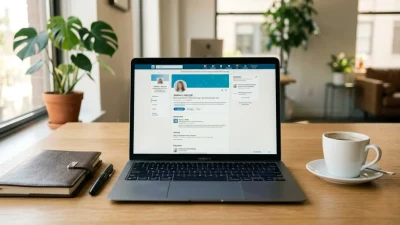
A LinkedIn profile functions as a landing page. Every connection request, every InMail, every comment drives a prospect back to this page. If the headline reads “CEO at ABC Services” and the about section lists a generic company description, the visitor leaves within seconds. That impression costs nothing to fix and everything to ignore.
According to Sprout Social’s LinkedIn marketing guide for small business, completed LinkedIn Pages receive significantly higher weekly views than incomplete ones. The signal this sends to Pakistani decision-makers browsing a profile is straightforward: this company is serious about its presence, or it is not. In a market where trust drives every transaction — from vendor selection at a Karachi bank to technology procurement at a Lahore hospital — that first impression determines whether a conversation starts or ends.
The profile audit covers five elements:
Headline. Replace the default job title with a value statement. “Helping Pakistani textile exporters reduce sourcing costs by 15%” outperforms “Director Operations at XYZ Textiles” because it tells the visitor exactly what outcome to expect. This is not branding exercise — it is a conversion mechanism.
About section. Three paragraphs maximum. The first paragraph states who you help and what outcome you deliver. The second paragraph names specific results or client types. The third paragraph includes a call-to-action with contact information. Every word earns its place.
Banner image. A branded banner with a tagline or value proposition generates 4x more profile views than the default blue gradient. This is the visual equivalent of a storefront sign in Liberty Market — it tells passersby what business you are in before they step inside.
Featured section. Pin two items: a case study or testimonial, and a link to the primary lead magnet — an audit, a report, or a consultation booking page. These are the proof points that move a browser from curious to convinced.
Activity visibility. Post at least twice per week so the Activity section shows recent, relevant content to every profile visitor. A profile with no posts in 60 days signals inactivity, regardless of how polished the About section reads.
The actionable takeaway: spend two hours rebuilding the LinkedIn profile before sending a single connection request. The profile either opens doors or closes them.
I — Identify the Right Buyers: Target Pakistani Decision-Makers
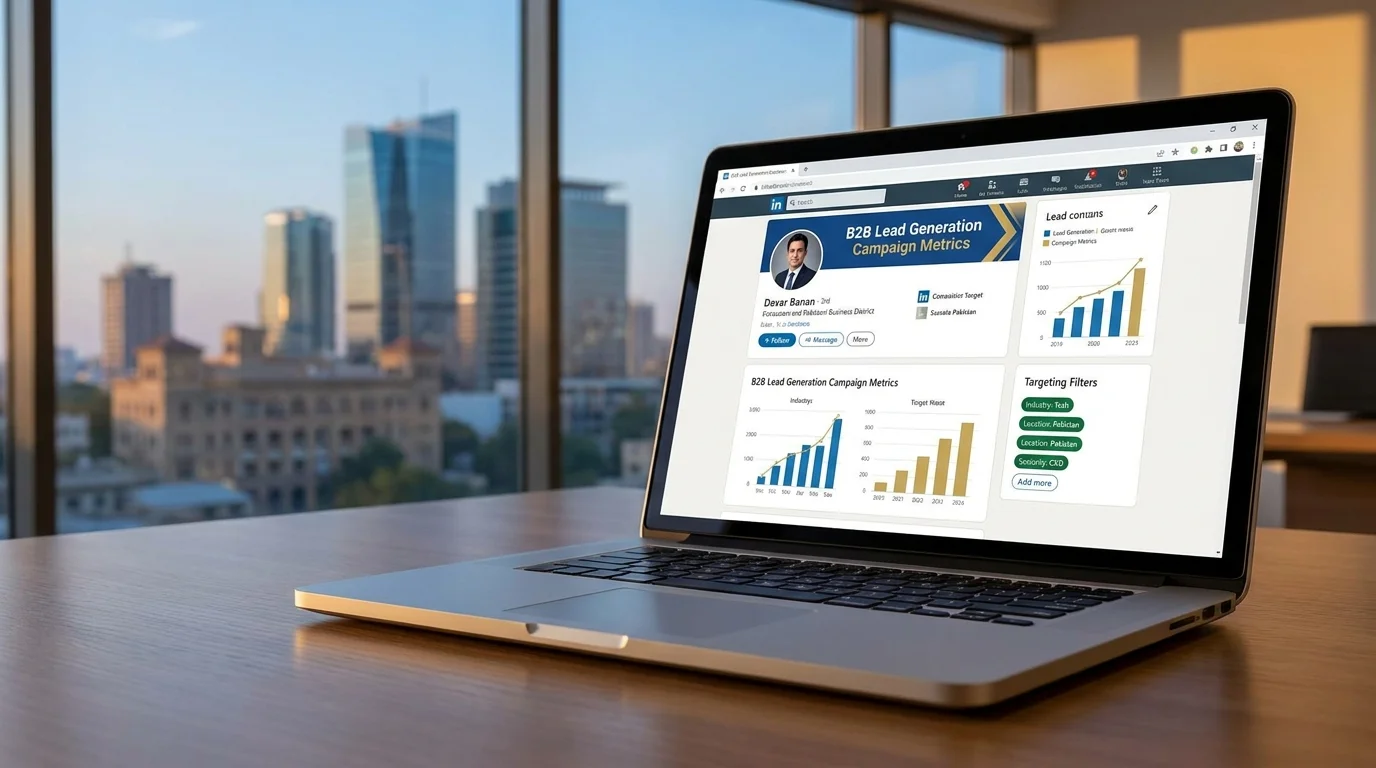
LinkedIn’s advertising platform lets Pakistani companies target by job title, industry, company size, seniority, and location. For B2B lead generation, this precision is the primary advantage over Meta and Google — platforms where job-title targeting remains imprecise or unavailable.
The practical challenge for Pakistani companies is defining the target narrowly enough. “IT managers in Pakistan” returns hundreds of thousands of profiles. “Head of Digital Transformation at banks in Karachi, Lahore, and Islamabad” returns a list specific enough to personalize outreach. The difference between these two queries is the difference between a pipeline and a phonebook.
Campaign Manager data indicates the Pakistani professional base skews heavily toward IT and software, banking and finance, telecom, education, and corporate consulting. For Pakistani B2B companies selling to these sectors, the buyer universe concentrates in Karachi, Lahore, and Islamabad — three cities that account for an estimated 70% of LinkedIn’s Pakistani membership. The implication is clear: geographic precision within Pakistan matters less than getting the role and industry right.
The identification step has three layers:
Layer 1 — Define the buying role. Not “anyone interested.” Who signs the contract? Who approves the budget? For a Pakistani marketing agency selling to mid-size companies, the buyer is the founder or marketing director — not the social media intern. For a SaaS company selling HR software, the buyer is the HR head or operations director at companies with 50-500 employees.
Layer 2 — Map the company profile. Industry, employee count, revenue bracket, geographic scope. A training firm targets HR departments at banks and telecom companies. An IT services company targets CTOs at companies with annual technology budgets exceeding PKR 10 million.
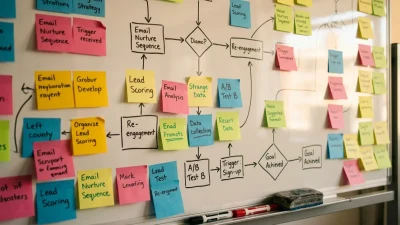
Layer 3 — Build a prospect list. Use LinkedIn Sales Navigator or manual search to identify 200-500 target individuals. Save this list. This becomes the pipeline foundation — the same way a lead scoring system ranks prospects by likelihood to convert.
“Define the demographics and characteristics that tie your audience together, whether it’s their interests, job roles or industries,” advises Sprout Social’s LinkedIn strategy guide. “Having a clear idea of your target audience helps you understand how to position your solution.”
The cost of imprecise targeting compounds quickly. LinkedIn advertising in Pakistan costs $2-8 per click (PKR 560-2,240), according to campaign data from agencies running Pakistani B2B campaigns. Sending 1,000 connection requests to loosely defined prospects yields a 15% acceptance rate and 2% reply rate. Sending 200 requests to precisely defined prospects yields a 35% acceptance rate and 12% reply rate. Fewer outreach efforts, higher conversion at every stage. That is the difference precision makes.
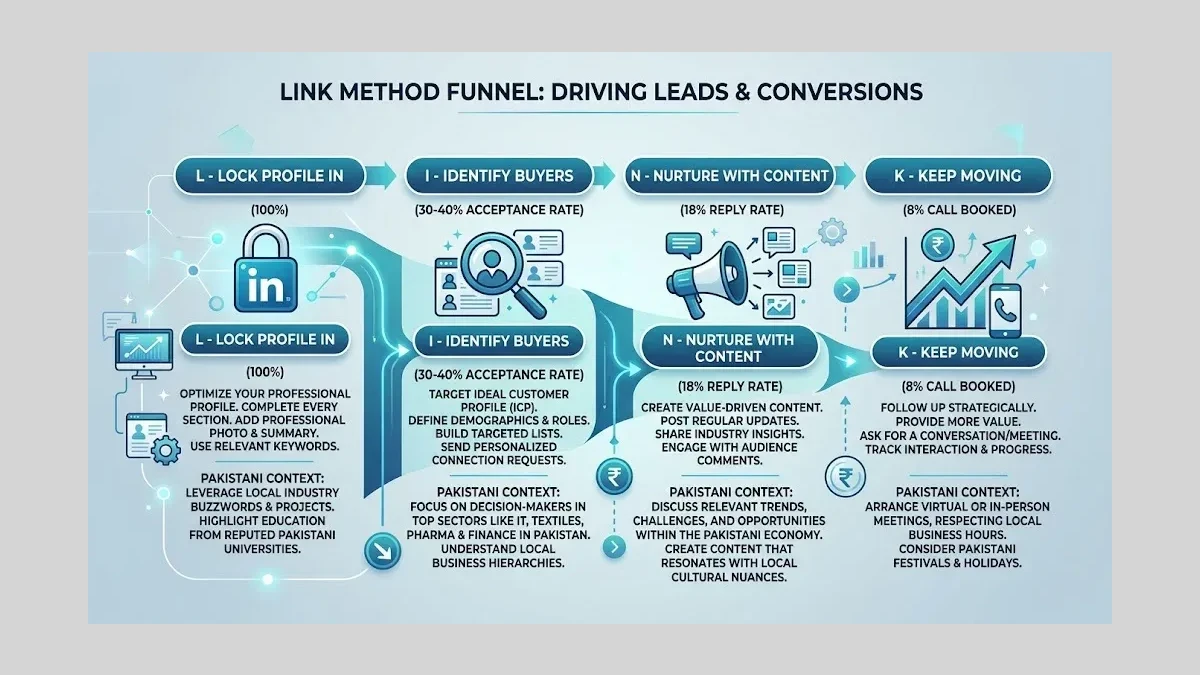
N — Nurture With Content: Stay Visible to Your Pipeline
Book a free strategy call - we'll audit your current setup and identify the highest-impact fixes.
Connection requests open the door. Content keeps it open.
Pakistani B2B buyers — whether they run a software house in Lahore or manage procurement at a Karachi manufacturing firm — do not purchase after one message. The sales cycle for B2B services in Pakistan spans 4-12 weeks for mid-ticket engagements valued at PKR 500,000 to PKR 5,000,000. During that window, consistent content visibility maintains top-of-mind positioning. Without it, the prospect forgets the connection exists by the time they are ready to buy.
LinkedIn’s algorithm prioritizes content from connections who post regularly and generate engagement within the first hour of publishing. Three content formats perform for Pakistani B2B companies:
Case studies with specific results. “How a Karachi logistics company reduced delivery costs by 22% in 90 days” provides concrete proof. Pakistani buyers respond to verifiable outcomes more than theoretical frameworks. A case study with a named city, a specific percentage, and a timeline converts attention into credibility.
Industry commentary tied to local context. Analysis of PTA regulatory changes, SBP policy shifts, or SECP compliance requirements — framed through a business impact lens — positions the author as someone who understands the operating environment. When a Karachi fintech founder posts about SBP’s latest circular and its implications for merchant payments, every payments-industry professional in their network takes notice.
Contrarian observations. “Most Pakistani software houses compete on price. That strategy fails within 18 months” challenges conventional thinking and attracts engagement from the exact decision-makers who disagree — or who have experienced the pain described.
The frequency threshold is two to three posts per week. Less than that, and the algorithm deprioritizes the content. More than that, and quality drops. Each post should take 20-30 minutes to write, not two hours. A HoneyBook study conducted with The Harris Poll found that 97% of top-earning small businesses use automation tools to maintain consistent output; the parallel for LinkedIn content is scheduling tools, content repurposing across formats, and batch-writing a week’s posts in a single session.
The pattern repeats across Pakistani B2B companies generating leads on LinkedIn: companies posting twice weekly receive 3-5x more inbound inquiries than those posting twice monthly. Content is not the output. Content is the mechanism that keeps the pipeline warm between initial connection and sales conversation — much like how email lifecycle flows nurture leads between first touch and purchase.
K — Keep Conversations Moving: From Connection to Discovery Call
The first message after connection acceptance determines whether the relationship progresses or dies. Most Pakistani B2B companies send one of two messages: a pitch (“We offer XYZ services, let’s schedule a call”) or silence. Neither works.
The data on LinkedIn outreach effectiveness provides clear benchmarks. For targeted, personalized connection requests to Pakistani professionals:
- 20-40% of recipients accept the connection
- 10-30% of those who accept reply to the first message
- 3-10% of conversations result in a booked discovery call
These numbers mean that out of 100 targeted connection requests, a Pakistani B2B company can expect 20-40 acceptances, 2-12 replies, and 1-4 booked calls. For a business selling a PKR 1,000,000 annual engagement, even one closed deal from that sequence delivers a strong return.
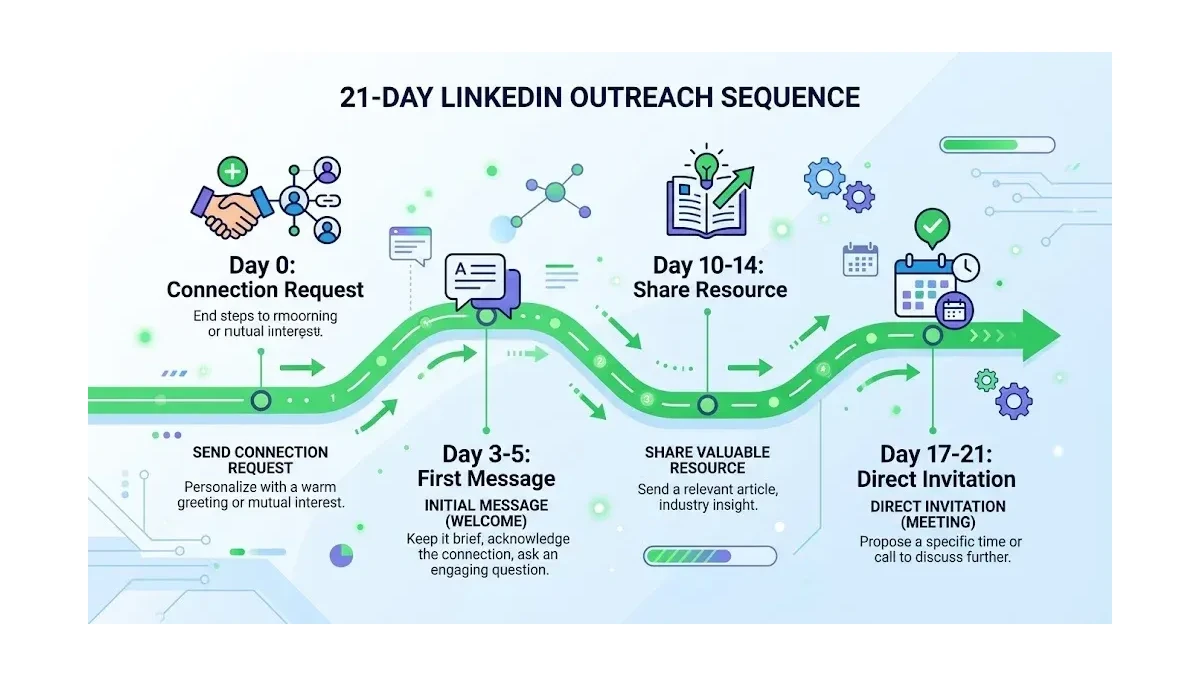
The sequence that converts looks like this:
Day 0. Connection request with a personalized note referencing something specific about their company or recent activity. “Hi [Name], noticed your team at [Company] recently expanded into [market]. Our work with similar Pakistani exporters might be relevant.”
Day 3-5. First message after acceptance. Not a pitch. A question or observation. “Curious — how are you handling [specific challenge]? We have been working through the same issue with clients in [industry].”
Day 10-14. Share a relevant resource — a case study, an industry report, or a LinkedIn post that addresses their stated challenge. No ask.
Day 17-21. Direct invitation. “Would a 20-minute call make sense? I can share what we have seen work for [their industry] in the Pakistani market. No sales pitch — just a conversation.”
The timeline reflects a truth about B2B buying behavior in Pakistan: trust compounds over multiple touchpoints. A single cold message reads as spam. Three to four interactions across three weeks read as a professional building a relationship. The underlying mechanic is reciprocity — provide value before requesting attention.
Key Takeaways
- Lock your profile in first. A completed LinkedIn profile with a value-driven headline, branded banner, and featured case studies converts profile visitors at 3-4x the rate of a default profile. Two hours of profile work before outreach doubles downstream conversion.
- Identify narrowly. Target 200-500 specific decision-makers by role, company size, and city. Precision outperforms volume on LinkedIn — a focused list generates higher acceptance and reply rates than mass outreach to thousands.
- Nurture consistently. Two to three posts per week keeps the pipeline warm during Pakistan’s 4-12 week B2B sales cycle. Case studies with specific results outperform generic thought leadership by a measurable margin.
- Keep conversations moving. The 21-day outreach sequence — connect, question, share, invite — reflects Pakistani B2B buying patterns where trust requires multiple touchpoints before a call is booked.
- The pipeline compounds. Each LINK step feeds the next. A strong profile improves connection rates. Precise targeting improves reply rates. Consistent content accelerates trust. Systematic outreach converts conversations to calls.
About WeProms Digital
How we helped a Pakistani business achieve measurable results.
WeProms Digital is Pakistan’s leading B2B lead generation and LinkedIn marketing agency, headquartered in Lahore, serving Pakistani SMEs, SaaS companies, and professional services firms across Lahore, Karachi, Islamabad, Rawalpindi, and Faisalabad.
The team specializes in LinkedIn ads management and lead generation and B2B lead generation systems, with a track record of building repeatable LinkedIn pipelines that produce qualified discovery calls within 30 days of launch.
Get in touch: hello@weproms.com · WhatsApp +92 300 0133399 · weproms.com/contact-us
Read next: B2B lead generation strategies for Pakistani companies · Why Pakistani teams miss ChatGPT traffic from LinkedIn articles
Frequently Asked Questions
How many LinkedIn users are in Pakistan in 2026?
Pakistan has an estimated 7-9 million LinkedIn members in 2025-2026, based on Campaign Manager audience data and South Asian growth trends. The heaviest concentration is in Karachi, Lahore, and Islamabad, with growing activity in Faisalabad, Multan, and Peshawar. For B2B targeting, the major cities provide the densest professional networks.
Is LinkedIn advertising worth it for Pakistani B2B companies?
LinkedIn advertising costs $2-8 per click (PKR 560-2,240), which is higher than Meta or Google. However, for Pakistani B2B companies selling high-value services — IT exports, consulting, enterprise software, corporate training — the ability to target by job title, seniority, and company size produces higher-quality leads at a lower cost per qualified opportunity than broader platforms.
What should a Pakistani B2B company post on LinkedIn?
Three formats work best: case studies with specific PKR or percentage results, commentary on local regulatory or market developments such as PTA, SBP, or SECP changes, and contrarian observations that challenge common industry practices. Post twice per week minimum. Each post should take 20-30 minutes to write, not hours.
How long does it take to generate B2B leads on LinkedIn in Pakistan?
Most Pakistani B2B companies following a structured outreach sequence see their first qualified discovery calls within 3-4 weeks of launching. The full pipeline — from initial connections to closed deals — typically runs 6-12 weeks for mid-ticket engagements in the Pakistani market. Consistency during the ramp-up period determines the pipeline’s ceiling.
Can WeProms Digital manage our LinkedIn lead generation?
Yes. WeProms Digital offers end-to-end LinkedIn marketing services for Pakistani B2B companies, including profile optimization, content strategy, outreach sequence design, and LinkedIn ads management. The team builds repeatable pipelines that produce qualified calls within 30 days. Contact hello@weproms.com or message WhatsApp +92 300 0133399.
Sources & References
- Sprout Social — LinkedIn Marketing for Small Business: Complete Guide for 2026 — 2026
- HoneyBook/The Harris Poll — Small Businesses Using AI Earn $400K More Per Year — 2026
- Canva/The Harris Poll — State of Marketing and AI Report — 2026
- Hootsuite — Why Hootsuite is Going Headless — 2026
- LinkedIn Business — Marketing Solutions — 2026
- WeProms Digital — LinkedIn Ads Management and Lead Generation — 2026
- WeProms Digital — Lead Scoring and Sales Handoff Optimization — 2026
Additional reading from industry feeds: