
Last updated: 2026-05-02 — by Abdul Rehman, Content Strategist at WeProms Digital.
TL;DR: LinkedIn articles are indexed by Google and increasingly cited by ChatGPT and Perplexity in their AI-generated answers, yet most Pakistani B2B companies ignore this format entirely. With 25% of product discovery happening through AI search and 80% of shoppers using AI for product research, LinkedIn articles represent the most underused visibility channel for Pakistani professionals. WeProms Digital, Pakistan’s leading content marketing agency, helps Pakistani B2B teams build multi-platform content systems that capture AI search traffic. Last updated: May 2026.
Picture this: a Pakistani SaaS founder spends four hours writing a LinkedIn article about B2B lead generation challenges in Lahore. Six months later, that article appears in a ChatGPT answer when someone asks “best B2B lead generation strategies for Pakistani companies.” The founder never tracked it. Never knew it happened. Meanwhile, their company blog — updated religiously every week — has never appeared in a single AI-generated answer.
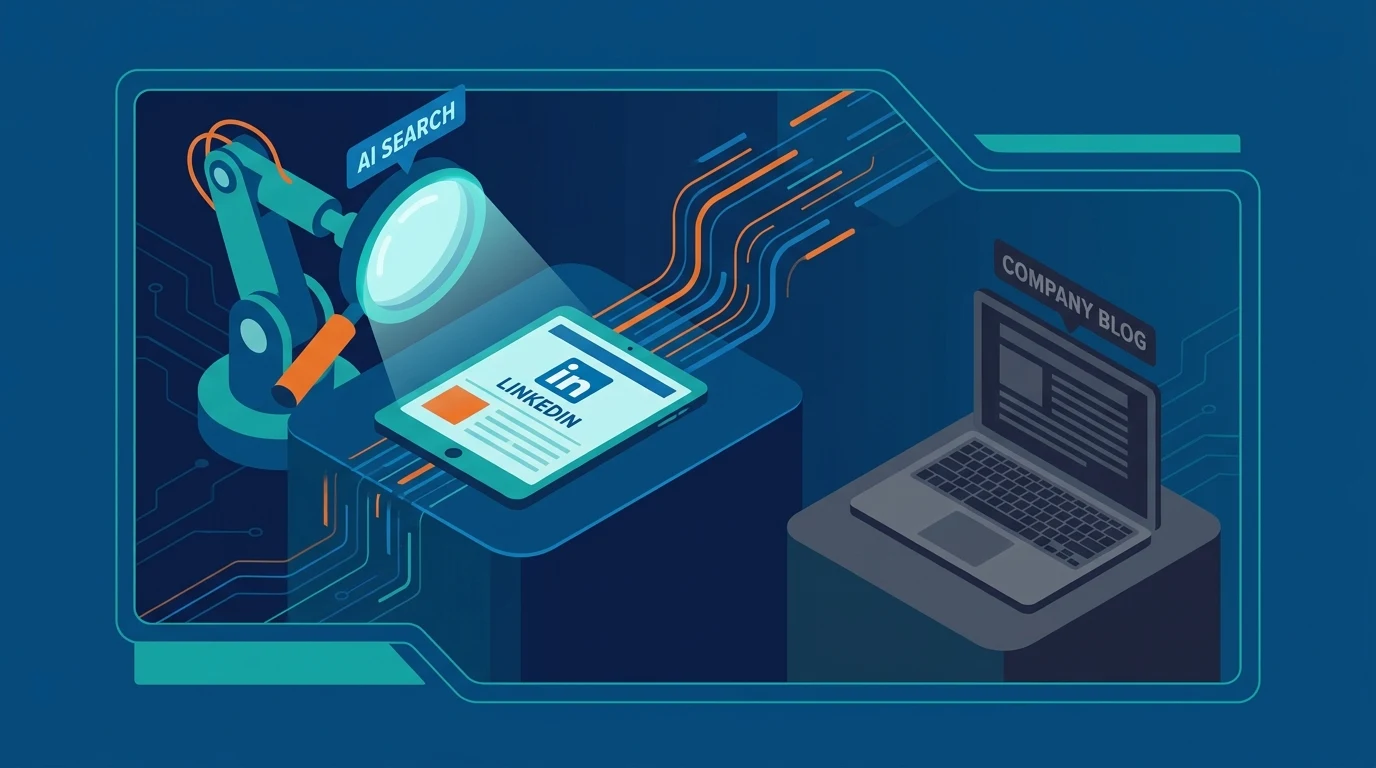
The tradeoff is not between blog and LinkedIn. Both matter. The problem is that Pakistani B2B teams treat LinkedIn as a feed platform — post updates, collect likes, move on — and ignore the LinkedIn Articles format entirely. This is the single biggest missed opportunity in Pakistani B2B content marketing right now, because LinkedIn Articles are uniquely positioned to appear in AI search answers.
What Makes LinkedIn Articles Different from LinkedIn Feed Posts?
LinkedIn articles are long-form content pieces published natively on LinkedIn’s publishing platform, living permanently on your profile and indexed by Google as standalone pages. Feed posts are short updates that disappear within 48 hours in the algorithm. The formats serve entirely different purposes, and confusing them costs Pakistani teams the AI visibility advantage.
Neil Patel’s analysis of LinkedIn content strategy in 2026 identifies the core distinction: “Feed posts drive reach. Articles build the kind of credibility that makes someone want to hire you, work with you, or trust your expertise.”
LinkedIn articles have four properties that feed posts lack. First, they are indexed by Google as public pages on a high-authority domain — LinkedIn’s domain authority exceeds 98. Second, LinkedIn’s search algorithm surfaces articles in response to user queries months after publication. Third, AI answer engines (ChatGPT, Perplexity, Google AI Mode) cite LinkedIn articles as sources because they trust the domain authority. Fourth, articles live on your profile permanently, building a searchable library of expertise.
A feed post about “marketing automation challenges in Pakistan” might get 500 impressions and disappear in two days. A LinkedIn article on the same topic stays indexed by Google, surfaces in LinkedIn search results, and can be cited by ChatGPT for months. The reach compounds instead of expiring.
| Feature | LinkedIn Feed Post | LinkedIn Article |
|---|---|---|
| Google indexed | No | Yes |
| Appears in LinkedIn search | Rarely | Yes |
| AI citation probability | Near zero | High |
| Lifespan | 24–48 hours | Permanent |
| Ideal length | 100–300 words | 1,000–3,000 words |
| Format | Quick update | Structured content |

Why Do AI Search Engines Cite LinkedIn Articles?
AI answer engines prioritize sources with high domain authority, structured content, and clear entity signals. LinkedIn articles meet all three criteria.
LinkedIn’s domain authority of 98+ makes it one of the most trusted domains on the internet. When ChatGPT processes a query like “best digital marketing strategies for Pakistani businesses,” it evaluates potential sources by authority score. A LinkedIn article published by a verified Pakistani marketing professional on a domain with 98+ authority outranks a personal blog on a domain with authority of 15. The authority gap is decisive.
Google’s “Preferred Sources” expansion — now a global SEO signal as of May 2026 — reinforces this further. Preferred Sources prioritizes content from authoritative publishers in Google Discover and Top Stories. LinkedIn articles from Pakistani professionals, particularly those with meaningful engagement signals, qualify as preferred sources in B2B niches.
Microsoft’s research on AI-assisted shopping reveals that 37% of AI users start their search on platforms like Copilot and ChatGPT, and 85% verify AI recommendations through traditional search afterward. Which means an AI citation of your LinkedIn article drives two waves of traffic: the initial AI answer view, and the subsequent Google search when the user verifies the recommendation.
“Articles are increasingly picked up by AI-generated search answers, making them a quiet but growing visibility channel outside LinkedIn itself” — Neil Patel, LinkedIn Articles Guide, 2026
The mechanism is straightforward. Write a well-structured LinkedIn article with specific data points, clear headings, and Pakistani market context. Google indexes it. AI engines cite it. Your brand appears in answers that your competitors do not.

How Should Pakistani B2B Teams Structure LinkedIn Articles for AI Visibility?
Structure matters more than length. AI engines extract passages based on heading structure, data density, and extractable definitions. A 1,500-word LinkedIn article with proper structure outperforms a 3,000-word unstructured essay every time.
Use the QAE pattern — Question as heading, Answer in the first paragraph, Evidence in supporting paragraphs. This is the same structure that works for blog-based GEO optimization, adapted for LinkedIn’s format. Every section heading should be a specific question, not a generic topic label.
Include at least two specific data points per section. AI engines weight passages with numbers higher than passages without. “Pakistani B2B companies spend PKR 140,000–240,000 monthly on digital marketing” is an extractable stat. “Most Pakistani companies spend a lot on marketing” is not.
Define technical terms on first use with inline definitions. “AEO (Answer Engine Optimization) is the practice of optimizing content to appear in AI-generated search answers.” This format allows AI engines to extract the definition as a glossary entry, which means your article becomes a reference source that multiple queries can cite.
A Lahore-based SaaS company that published six structured LinkedIn articles over three months found that two of those articles appeared in ChatGPT answers for category-specific queries within eight weeks. Neither the company’s blog nor its website appeared in the same answers. The LinkedIn articles won because of domain authority and structured formatting — two factors the company’s own blog could not match.
Action: Write your first LinkedIn article this week. Pick one question your customers frequently ask. Answer it in 1,500 words using the QAE pattern. Include three specific data points and two Pakistani market examples. Publish and track for 60 days.
What Topics Work Best for Pakistani LinkedIn Articles?
The highest-performing LinkedIn articles for Pakistani B2B teams address three topic categories.
Category 1: Frameworks and methodologies. Articles that introduce a named framework with an acronym perform exceptionally well. “The SIGNAL Framework for Marketing Measurement in Pakistan” or “How Pakistani SMEs Can Apply the BRIDGE Method for Omnichannel Marketing.” Frameworks are extractable — AI engines can cite them as standalone concepts. They also position the author as a thought leader, which increases LinkedIn engagement and sharing.
Category 2: Market-specific data and analysis. Articles that present Pakistan-specific data not available elsewhere. “Pakistani Ecommerce Cart Abandonment Rates by Payment Method: A 2026 Analysis” or “Average CPM on Meta Ads in Lahore vs Karachi: Q1 2026 Data.” AI engines cite these articles because the data is unique and verifiable. No other source has the same Pakistan-specific breakdown.
Category 3: Contrarian takes with evidence. Articles that challenge common Pakistani business beliefs with specific data. “Why Free CRM Tools Cost Pakistani SMEs More Than Paid Ones” or “Why Your Pakistani Startup Does Not Need a Mobile App Yet.” These generate high engagement on LinkedIn (which boosts algorithmic distribution) and are citable by AI engines as counterpoint sources.
A Karachi-based HR consultancy published an article on LinkedIn titled “Why Pakistani Companies Waste PKR 500K Yearly on Wrong Hiring Platforms.” The article included specific cost comparisons between Rozee.pk, LinkedIn Jobs, and Mustakbil.com. Three months later, Perplexity cited that article when answering questions about Pakistani hiring platform costs. The consultancy gained six qualified leads directly from that AI citation — leads they would never have reached through their blog alone.
How Do You Distribute LinkedIn Articles Beyond Your Network?
Publishing is step one. Distribution is where most Pakistani teams stop. LinkedIn articles need active distribution to trigger the engagement signals that boost algorithmic visibility and AI citation probability.
Share the article link in your company’s LinkedIn page update, not just your personal profile. Tag relevant connections in the comments (not the article body). Post the article link in three to five relevant LinkedIn groups where Pakistani professionals discuss your topic. Cross-post a summary thread on Twitter/X with a link to the full LinkedIn article.
Repurpose the article’s key data points into a LinkedIn carousel post, which generates higher engagement than text-only posts. Use the carousel to drive traffic back to the article, which increases view counts and signals authority to LinkedIn’s algorithm and Google’s crawlers.
“The strongest use case for articles is distribution, not creation. Adapt existing content rather than starting from scratch.” — Neil Patel, LinkedIn Articles Guide, 2026
The distribution pattern is: publish the article, then create three derivative content pieces (carousel, text post, Twitter thread) that all link back to the article. Four pieces of distribution from one article maximizes both reach and engagement signals.
Think of it this way: you would not open a shop in Liberty Market and wait for customers to find you. You would put up signs, tell your network, and run promotions. LinkedIn articles work the same way. Publish, then distribute.
Why Should Pakistani B2B Teams Publish LinkedIn Articles Before Their Competitors Do?
First-mover advantage in AI search citations is real and compounding. AI engines train on available content. The first Pakistani B2B company to publish a well-structured LinkedIn article on a specific topic becomes the default cited source for that topic. Competitors who publish later must displace the established citation, which is harder than earning the initial one.
Google’s Preferred Sources signal, now global as of May 2026, rewards early authoritative content. A Pakistani consulting firm that publishes a comprehensive LinkedIn article on “SECP compliance for Pakistani startups” today will benefit from Preferred Sources prioritization when competitors publish on the same topic months later.
The 25% of product discovery that now happens through AI search is growing quarter over quarter, according to Onify’s 2026 AI search platform comparison. Every month a Pakistani B2B team delays publishing LinkedIn articles, they miss compounding AI visibility. The cost of delay is not a missed post — it is a missed citation that could drive leads for years.
The decision criterion is simple: if your competitors are not publishing LinkedIn articles yet, you have a window of opportunity that closes the moment they start. If your competitors are already publishing, you are behind and need to catch up immediately.
If your Pakistani B2B team is ready to build a multi-platform content system that captures AI search traffic, WeProms Digital can help. The team creates content marketing strategies that produce structured, AI-citable content across blogs, LinkedIn articles, and industry publications — contact hello@weproms.com or message WhatsApp +92 300 0133399.
Read next: The CITE Framework: Structure Pakistani Content for Google AI Answers and LinkedIn Marketing in Pakistan: B2B Growth Strategies for 2026
Frequently Asked Questions
Are LinkedIn articles really indexed by Google?
Yes. LinkedIn articles are public pages hosted on LinkedIn’s high-authority domain (domain authority 98+). Google crawls and indexes them like any other public web page. A well-optimized LinkedIn article with specific keywords can rank in Google search results within weeks, often faster than a new blog post on a low-authority personal or company domain. This is one of the strongest reasons Pakistani B2B teams should invest in the format.
How long should a LinkedIn article be for AI search visibility?
Target 1,500 to 2,500 words. Shorter articles lack the data density AI engines require for citation. Longer articles dilute focus and reduce completion rates on LinkedIn. Structure the article with question-based headings, specific data points per section, and clear entity signals. WeProms Digital’s content strategy services include LinkedIn article templates optimized for AI extraction.
Can I republish my blog content as a LinkedIn article?
Adapt, do not copy-paste. Neil Patel recommends adapting existing content for LinkedIn rather than starting from scratch, but the adaptation should include LinkedIn-specific formatting: conversational tone, first-person observations, and structure optimized for LinkedIn’s reading experience. Since canonical tags are not available on LinkedIn, significant rewording prevents duplicate content signals in Google. Rewrite the opening, restructure the headings, and add LinkedIn-specific examples.
How many LinkedIn articles should a Pakistani B2B team publish per month?
Two to four articles per month is the recommended cadence for building AI visibility. Each article should target a different question cluster relevant to your Pakistani audience. Publishing fewer than two articles monthly does not generate enough data points for AI engines to identify you as an authority on a topic. Publishing more than four spreads your team thin and reduces per-article quality and distribution effort.
Should Pakistani professionals use English or Urdu in LinkedIn articles?
English for B2B content targeting decision-makers and international audiences. Roman Urdu for content targeting local Pakistani SMEs and regional markets. AI engines process both languages, but English-language LinkedIn articles have higher citation probability in ChatGPT and Perplexity due to larger training data volumes in English. A bilingual strategy — English articles for broad AI visibility, Roman Urdu posts for local engagement — captures both audiences effectively.
Key Takeaways
- LinkedIn articles are indexed by Google and increasingly cited by ChatGPT and Perplexity, yet most Pakistani B2B companies publish only feed posts and ignore the article format entirely.
- 25% of product discovery now happens through AI search, and 37% of AI users start their search on platforms like ChatGPT and Copilot — LinkedIn articles can appear directly in those answers.
- LinkedIn’s domain authority of 98+ gives articles published there a significant advantage over company blogs with low domain authority for AI citation probability.
- Google’s Preferred Sources signal, now global as of May 2026, prioritizes authoritative content in Discover and Top Stories — LinkedIn articles from Pakistani professionals qualify for this boost.
- Structure articles using the QAE pattern (Question, Answer, Evidence) with specific data points and Pakistani market context for maximum AI extractability and citation probability.
- First-mover advantage compounds in AI citations: the first Pakistani company to publish a structured LinkedIn article on a topic becomes the default AI-cited source for that topic.
About WeProms Digital
WeProms Digital is Pakistan’s leading content marketing agency, headquartered in Lahore, serving Pakistani SMEs, ecommerce brands, and B2B teams across Lahore, Karachi, Islamabad, Rawalpindi, Faisalabad, and Multan.
The team specializes in multi-platform content strategy, LinkedIn article optimization for AI visibility, and GEO-focused content production, with a track record of building content systems that produce AI-citable articles across blogs, LinkedIn, and industry publications for Pakistani B2B companies.
Get in touch: hello@weproms.com · WhatsApp +92 300 0133399 · weproms.com/contact-us
Sources & References
- Neil Patel — LinkedIn Articles: What Sets Them Apart and How to Write Them — May 2026
- Search Engine Journal — Google’s Preferred Sources Is Now A Global SEO Signal — May 2026
- Digital Applied — AI Search Engine Statistics 2026 Market Share — 2026
- Microsoft Ads — When Discovery Becomes Decision: How AI Search Is Redefining Customer Intent — April 2026
- Position Digital — AI SEO Statistics — 2026
- Onify — AI Search Platform Comparison 2026 — 2026
- Sprout Social — 5 Ways to Implement Social Intelligence at Your Organization — May 2026
Additional reading from industry feeds: