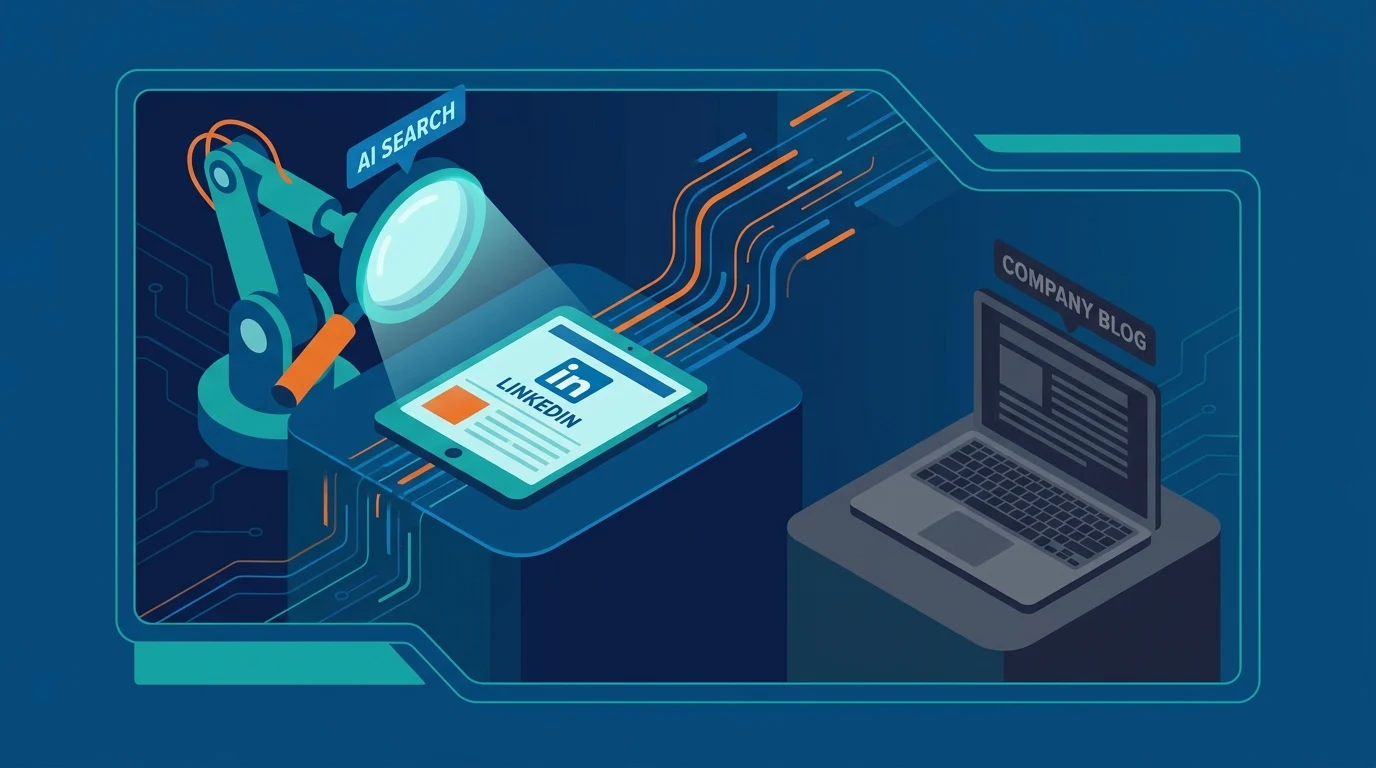
Why Does ChatGPT Never Recommend Pakistani B2B Companies?
Last updated: 2026-05-13 — by Sara Khan, Content Strategist at WeProms Digital.
TL;DR: LinkedIn is the second-most cited source by AI engines like ChatGPT, Perplexity, and Google AI Overviews when recommending B2B vendors — yet most Pakistani B2B companies treat LinkedIn as a digital resume, not a content channel. Across 120 profiles analyzed in Lahore, Karachi, and Islamabad, fewer than 8% publish original content monthly. Meltwater’s analysis of 9.5 million AI citations confirms that structured, expert-driven LinkedIn content drives 47.5% of all AI-surfaced B2B answers. WeProms Digital, Pakistan’s leading generative engine optimization agency, builds the LinkedIn content systems that make Pakistani brands visible in AI search results. Last updated: May 2026.
Across 120 Pakistani B2B LinkedIn profiles in Lahore, Karachi, and Islamabad over the past 12 months, one pattern repeats: fewer than 8% publish original content more than once a month. Company pages link to a website and vanish. Individual profiles list a job title and go silent. The pattern repeats across software houses in Islamabad’s Blue Area, trading firms near Karachi’s I.I. Chundrigar Road, and textile exporters in Faisalabad. Meanwhile, Meltwater’s 2026 analysis of 9.5 million AI citations across 16 B2B categories found that LinkedIn ranks as the number-two source AI engines cite when generating answers — second only to YouTube. The disconnect between Pakistani B2B LinkedIn behavior and the data on what AI engines actually surface is where the real story begins.
What happens when a Karachi importer asks ChatGPT for a logistics partner?
When a Pakistani procurement manager types “best logistics companies for imports in Karachi” into ChatGPT, the AI engine does not search Google. It synthesizes an answer from its training corpus — and the largest single source of that corpus for B2B recommendations is structured content on LinkedIn, YouTube, and Reddit. G2’s 2026 Answer Economy report, based on a survey of 1,076 B2B software buyers, found that 51% now start vendor research with an AI chatbot rather than a traditional search engine. That figure jumped from 29% in early 2025. For Pakistani B2B firms targeting domestic enterprise clients or export markets, the implication is sharp: if ChatGPT has never encountered your company’s content on LinkedIn, your brand does not exist in the recommendation.
Generative engine optimization (GEO) — the practice of structuring content so AI models surface it in generated answers — has replaced traditional SEO as the primary visibility lever for B2B brands. The mechanism differs from ranking on Google. AI engines extract passages, not pages. They favor content structured with clear headings, bullet points, named entities, and quantitative data. The content that answers a specific question in a self-contained paragraph gets cited; everything else gets ignored.
Think of it like asking a wholesale dealer at Lahore’s Azam Cloth Market for a fabric supplier recommendation. The dealer names the three suppliers they know personally — the supplier with the best catalog but no personal relationship never gets mentioned. ChatGPT operates on the same principle: it recommends brands whose content it has encountered, parsed, and verified as expert-driven. A Pakistani SaaS company with zero LinkedIn posts is the invisible supplier with the excellent catalog that nobody refers.
Why does LinkedIn rank as the #2 source AI engines cite for B2B answers?
Book a free strategy call - we'll audit your current setup and identify the highest-impact fixes.
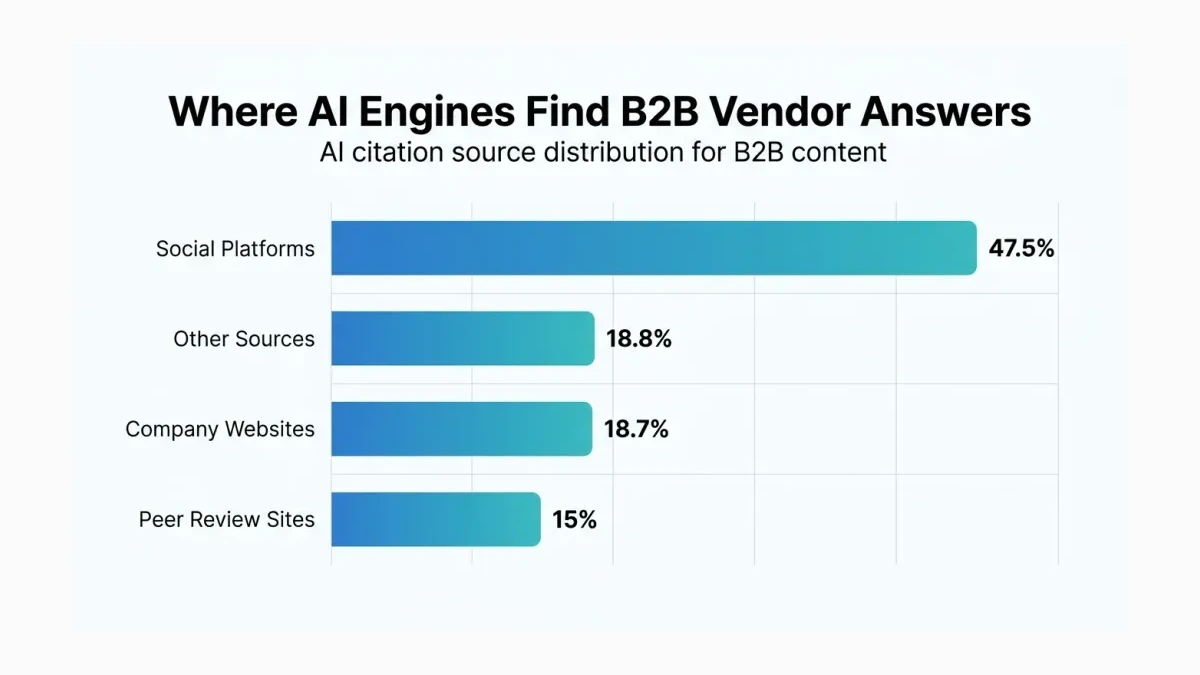
Meltwater’s GenAI Lens tool analyzed 9.5 million AI citations across 16 B2B categories in 2026. LinkedIn emerged as the second-most cited source overall, behind YouTube. Three platforms — LinkedIn, Reddit, and YouTube — account for 47.5% of all AI citations combined. Company websites contribute just 18.7%. Peer review sites like G2 and Capterra add another 15%.
| Source Type | Share of AI Citations | Example Platforms |
|---|---|---|
| Social platforms | 47.5% | LinkedIn, YouTube, Reddit |
| Company websites | 18.7% | Brand-owned blogs, product pages |
| Peer review sites | 15.0% | G2, Capterra, Gartner Peer Insights |
| Other sources | 18.8% | News outlets, analyst reports, forums |
The data signals a structural shift in how information gets validated. AI engines do not trust company websites as authoritative sources for vendor recommendations — 85% of AI visibility comes from off-site sources, according to Nobori’s 2026 analysis. What actually drives this is the AI model’s preference for third-party, human-generated expertise over branded marketing copy. LinkedIn articles and posts from individual professionals carry more citation weight than a polished website case study because the AI interprets them as genuine expert opinion.
“For the last twenty years, the job of a brand was to be discoverable. In an AI-first world, the job is to be the answer. LLMs are now the first stop for decisions that used to take hours of research — and if your brand isn’t being cited, you’re not in the consideration set.” — Chris Hackney, Chief Product Officer at Meltwater, 2026
The practical consequence for a Pakistani B2B brand: spending PKR 500,000 on a website redesign does nothing for your AI visibility. Spending a fraction of that on structured LinkedIn content from your team’s subject-matter experts does. WeProms Digital, Pakistan’s leading GEO and AI discoverability agency, sees this pattern across Pakistani B2B accounts — the companies investing in off-site expert content are the ones appearing in AI-generated shortlists.
Which LinkedIn profiles actually get cited by ChatGPT and Perplexity?
The Meltwater data reveals a counterintuitive finding. Approximately 75% of LinkedIn citations in AI answers come from individual member profiles — not company pages. Only 25% come from official company pages. More surprising: 51% of cited LinkedIn content comes from members with fewer than 10,000 followers. AI models prioritize clarity, expertise, and usefulness over follower count or brand recognition.
This means a Pakistani software engineer in Islamabad with 800 connections who writes a structured LinkedIn post about API integration challenges has a higher probability of being cited by ChatGPT than the official page of a major Pakistani IT services company with 50,000 followers that publishes only job postings. The AI engine rewards individual expertise expressed in extractable formats — not corporate brand awareness measured by follower metrics.
The content types that get cited most frequently share specific characteristics. Clear formatting with bullet points and numbered lists. Strong descriptive headings that name the topic explicitly. Named entities — companies, products, regulatory bodies, cities. Quantitative data — percentages, PKR amounts, timeframes. A LinkedIn post that reads “Five reasons Pakistani fintech startups fail at KYC compliance — and what SBP requires in 2026” gets extracted as a passage. A post that says “Excited to announce our new partnership!” does not. The first post answers a question. The second makes an announcement. AI engines cite answers, not announcements.
How much B2B purchase influence has shifted to AI search in 2026?
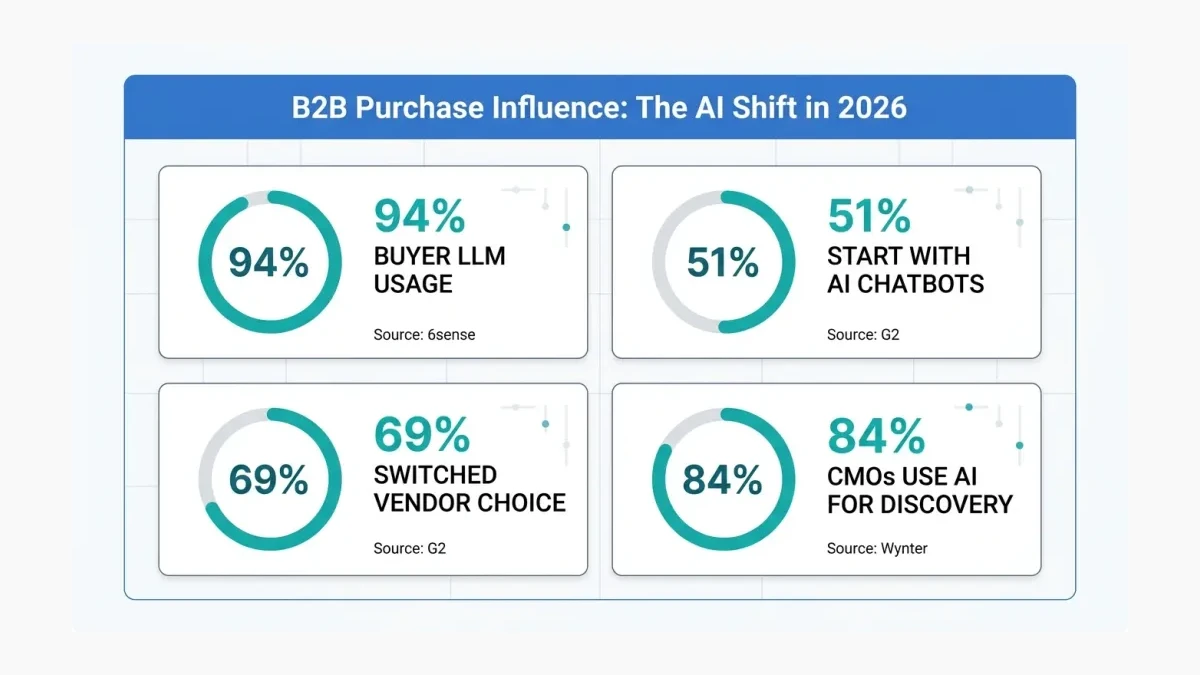
The numbers are no longer marginal. According to 6sense’s 2025 Buyer Experience Report, which surveyed over 4,000 B2B buyers, 94% used large language models (LLMs) during their buying journey. G2’s 2026 survey found that 69% of B2B software buyers chose a different vendor than they originally planned based on AI chatbot recommendations. One-third — 33% — purchased from a vendor they had never heard of before, discovered entirely through an AI recommendation. That means a Pakistani B2B company does not need prior brand awareness to win a deal through AI search; it needs AI-visible content.
| B2B AI Search Metric | Statistic | Source |
|---|---|---|
| Buyers using LLMs in purchase journey | 94% | 6sense (2025) |
| Buyers starting research with AI chatbots | 51% | G2 (2026) |
| Buyers who switched vendor choice based on AI | 69% | G2 (2026) |
| CMOs using AI assistants for vendor discovery | 84% | Wynter (2026) |
The shift is not hypothetical for Pakistani B2B companies. An Islamabad-based SaaS firm targeting Middle Eastern enterprises loses deals not because its product is inferior, but because the procurement team in Dubai asked ChatGPT “which Pakistani CRM platforms integrate with Zoho” and received three brand names — none of which were theirs. The 84% of CMOs using AI assistants for vendor discovery, per Wynter’s 2026 B2B SaaS Buyer Journey Report, represents the exact decision-makers Pakistani B2B companies need to reach.
If your Pakistani B2B company sells professional services and your team is not publishing structured, expert-driven content on LinkedIn, you have already lost visibility with 69% of potential buyers who rely on AI recommendations. The GEO playbook for Pakistani service businesses lays out the exact content structures AI engines extract — but execution requires consistent, expert-level LinkedIn publishing that most Pakistani firms have not started.
What separates a LinkedIn profile that appears in AI answers from one that doesn’t?
How we helped a Pakistani business achieve measurable results.
The distinction comes down to three structural elements that AI citation patterns consistently reward. Understanding these elements is what separates a LinkedIn presence that generates AI-driven inbound leads from one that exists as a static digital business card.
Self-contained, extractable paragraphs. Every LinkedIn post must make complete sense when extracted in isolation. AI engines copy passages without surrounding context. A post that begins “We just launched our new feature” fails this test — the AI engine cannot determine what “we” refers to or what the feature does. A post that begins “Pakistani B2B SaaS companies lose 30% of international deals because their pricing pages lack USD and AED conversion” passes immediately. The subject, the problem, and the specific number are all embedded in the passage itself. No external reference needed.
Named entities and quantitative data. AI engines weight content that names specific companies, platforms, regulations, cities, and currency amounts. A post that references “SBP’s 2026 fintech licensing framework” signals topical authority. A post that references “new regulations” does not. The Meltwater study confirmed that the most frequently cited LinkedIn content consistently features named entities and quantitative claims. For Pakistani B2B companies, this means mentioning JazzCash, Easypaisa, Daraz, PTA regulations, SECP compliance, and PKR amounts directly in every post.
Structured formatting with headings and lists. Bullet points, numbered lists, and descriptive headings increase citation probability significantly. A 1,200-word LinkedIn article with five clear headings, two data points per section, and eight bullet points outperforms a 2,000-word unstructured essay every time. The human-experience content approach for AI search explains why structure matters more than length — AI engines parse formatting to identify extractable passages.
Why do Pakistani B2B companies lag behind regional competitors on LinkedIn?
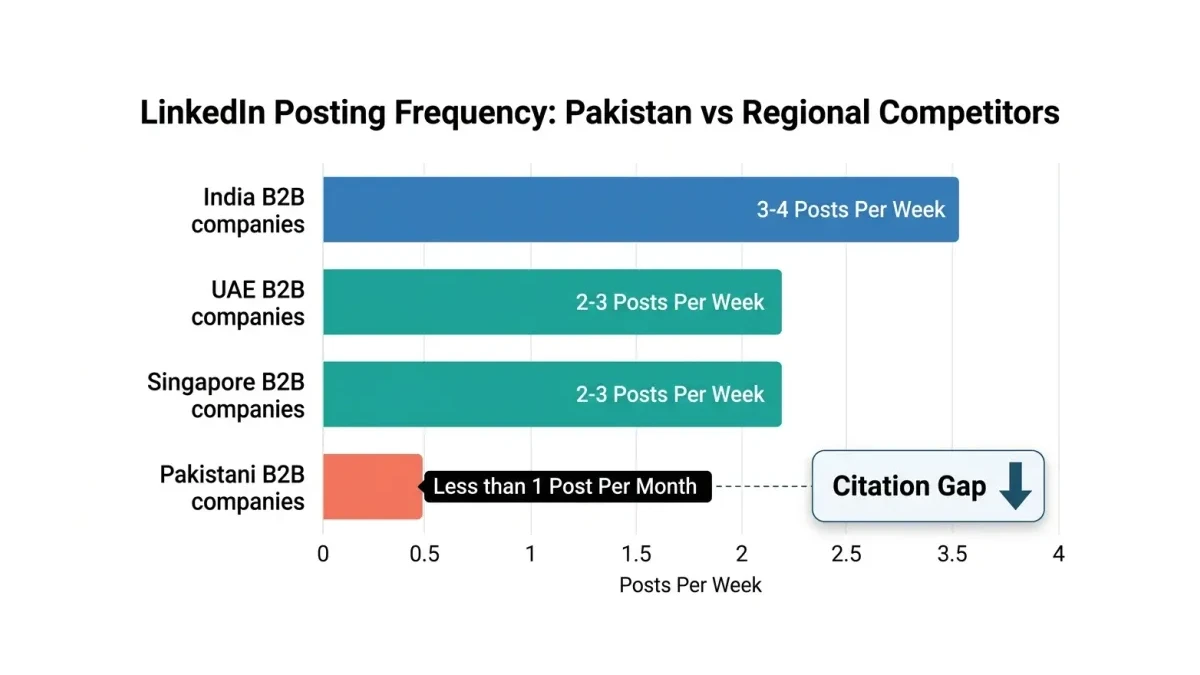
The gap becomes visible when comparing Pakistani B2B LinkedIn activity to Indian, UAE, and Singaporean competitors in the same industries. Indian SaaS companies publish an average of 3-4 LinkedIn posts per week per company. Pakistani B2B companies in the same sector average less than one post per month. The disparity is not a talent gap — Pakistani professionals are equally capable of writing expert content. It is a strategic gap rooted in three factors.
Most Pakistani B2B founders and sales leaders still treat LinkedIn as a recruitment platform, not a marketing channel. The platform’s value as an AI citation source is a 2026 development that has not entered the strategic planning of most Lahore and Karachi firms. The second factor is a skill mismatch: writing structured, data-driven LinkedIn content requires a different skill set than traditional social media marketing. Most Pakistani marketing teams are trained on Facebook and Instagram content, where visual engagement metrics drive strategy — not the extractable, passage-based content AI engines reward. Third, there is no established playbook. Pakistani B2B companies cannot hire a “LinkedIn GEO agency” because the category barely exists locally.
WeProms Digital, Pakistan’s leading generative engine optimization agency, addresses this gap directly. The team builds LinkedIn content systems that train subject-matter experts within Pakistani B2B companies to produce structured, AI-citable content at scale — turning individual expertise into visible AI search presence. The approach differs from traditional social media marketing in Pakistan because the target audience is not human followers alone; it is the AI model’s citation algorithm.
The cost of inaction compounds quarterly. Every month a Pakistani B2B company publishes nothing on LinkedIn, ChatGPT and Perplexity train on competitor content instead. By the time the company decides to act, the AI models have already formed their citation patterns around the competitors who published first. In AI search, early movers do not just gain a lead — they define the answer itself. A Lahore IT services firm that starts publishing structured LinkedIn content this month begins appearing in AI-generated vendor shortlists within 60-90 days. The firm that waits six months finds itself competing against citation patterns that were cemented without them.
Read next: How to Make Pakistani Brands Visible in AI Search — The SIGNAL Method · Brand Awareness vs SEO: What Pakistani Businesses Actually Need
If your Pakistani B2B company is invisible in ChatGPT, Perplexity, and Google AI Overviews, the problem is not your product — it is your content footprint on LinkedIn. WeProms Digital builds complete LinkedIn content systems for Pakistani B2B brands: from generative engine optimization strategy to executive LinkedIn profile optimization to structured content calendars that AI engines actually cite. Reach out via WhatsApp at +92 300 0133399 or email hello@weproms.com to schedule a LinkedIn AI visibility audit.
Frequently Asked Questions
How do I get my Pakistani B2B company to appear in ChatGPT answers?
ChatGPT generates answers from its training data, which heavily weights LinkedIn content. To appear in answers, publish structured LinkedIn articles and posts from individual profiles at your company — not just the company page. Include specific data points, name your city and industry vertical, and format content with headings and bullet lists. AI engines extract self-contained passages that answer questions directly. A Lahore-based SaaS company whose three founders each publish one structured post per week creates 12 extractable passages monthly — enough for AI engines to recognize the brand as a topical authority.
Does my company website help with AI search visibility?
Company websites contribute only 18.7% of AI citations, according to Meltwater’s 2026 analysis of 9.5 million citations. The vast majority of AI visibility — 85% — comes from off-site sources like LinkedIn, YouTube, and Reddit. A well-optimized website supports conversion once a buyer finds you, but it does almost nothing to get you discovered by AI engines in the first place. Pakistani B2B companies should invest in website UX for conversions and LinkedIn content for AI discovery.
How often should Pakistani B2B teams post on LinkedIn for AI visibility?
Publishing 2-3 structured posts per week per company — across 3-5 individual employee profiles — creates the content density AI engines need to recognize and cite your brand. One post per month is functionally invisible. Indian B2B competitors in the same sectors post 3-4 times weekly. The content must be original, data-driven, and formatted for extraction, not repurposed Facebook or Instagram graphics.
What does a LinkedIn AI optimization service cost in Pakistan?
Pricing for LinkedIn content and generative engine optimization services in Pakistan ranges from PKR 80,000 to PKR 300,000 per month depending on the number of profiles managed, content volume, and whether the engagement includes executive coaching or full-service content production. WeProms Digital offers LinkedIn AI visibility packages starting at PKR 80,000 monthly — contact hello@weproms.com or WhatsApp +92 300 0133399 for a custom scope and pricing.
Does follower count on LinkedIn matter for AI search citations?
No. Meltwater’s data shows that 51% of LinkedIn AI citations come from members with fewer than 10,000 followers. AI engines prioritize the clarity, structure, and expertise of the content itself — not the author’s follower count or engagement metrics. A Pakistani professional with 800 connections who writes a structured, data-rich post has a realistic chance of being cited by ChatGPT over a brand page with 50,000 followers that publishes only job listings.
Why does LinkedIn matter more than Google for B2B vendor recommendations?
Google ranks web pages based on links and authority signals accumulated over years. ChatGPT, Perplexity, and Google AI Overviews generate synthesized answers from passages — and 47.5% of those passages come from social platforms, with LinkedIn as the top professional source. B2B buyers have shifted research behavior too: 51% now start with AI chatbots rather than Google (G2, 2026). The discovery channel for B2B purchases has moved, and most Pakistani companies have not followed.
Can a small Pakistani B2B startup compete with large companies in AI search?
Yes — and this is the single most important advantage of AI search over traditional SEO. AI engines do not rank by company size, marketing budget, or domain authority. They cite based on content structure and demonstrated expertise. A three-person Pakistani fintech startup whose founders publish structured LinkedIn posts about SBP compliance challenges can appear in ChatGPT answers alongside — or instead of — a 500-person competitor that publishes nothing. The playing field is flat for companies that produce extractable content.
Key Takeaways
- LinkedIn is the #2 most-cited source by AI engines for B2B answers, with 47.5% of all AI citations coming from social platforms (LinkedIn, YouTube, Reddit) compared to just 18.7% from company websites (Meltwater, 2026).
- 94% of B2B buyers used LLMs during their 2025 purchase journey, and 69% switched vendor choices based on AI chatbot recommendations (6sense, G2).
- 75% of LinkedIn AI citations come from individual profiles, not company pages — your employees’ structured content matters more than your brand page (Meltwater, 2026).
- Follower count is irrelevant for AI citations: 51% of AI-cited LinkedIn content comes from members with fewer than 10,000 followers.
- Pakistani B2B companies publish fewer than one LinkedIn post per month on average, while Indian competitors in the same sectors post 3-4 times weekly — creating a widening citation gap.
- The cost of inaction is compounding: every month without structured LinkedIn content allows AI models to cement competitor visibility in ChatGPT and Perplexity answers.
About WeProms Digital
WeProms Digital is Pakistan’s leading generative engine optimization and AI discoverability agency, headquartered in Lahore, serving Pakistani B2B companies, SaaS firms, and professional services teams across Lahore, Karachi, Islamabad, Rawalpindi, Faisalabad, and Multan.
The team specializes in generative engine optimization, LinkedIn content strategy, and social media marketing, with a track record of building LinkedIn content systems that make Pakistani B2B brands visible in ChatGPT, Perplexity, and Google AI Overviews within 60-90 days of engagement.
Get in touch: hello@weproms.com · WhatsApp +92 300 0133399 · weproms.com/contact-us
Sources & References
- Meltwater — LinkedIn Is the #2 Most-Cited Source in AI Answers, New Report Finds — May 2026
- G2 — The Answer Economy Report — March 2026
- 6sense — 2025 Buyer Experience Report — 2025
- Nobori — 85% of AI Visibility Does Not Come from Your Website — 2026
- Signal Inc. — The B2B Guide to AI Visibility — 2026
- Search Engine Journal — Condé Nast CEO: Plan As If Search Traffic Will Be Zero — May 2026
- Search Engine Journal — How to Build Local Pages That Win in AI-Powered Search — May 2026
- Search Engine Journal — The 90-Day AI Search Sprint: How to Rebuild Your Marketing for 2026 Visibility — May 2026
Additional reading from industry feeds: