By Sara Khan | May 2026
Across search results for 150 Pakistani business categories in Lahore, Karachi, and Islamabad over the past six months, one pattern keeps appearing: the businesses Google AI Mode chooses to cite share four specific traits that 90% of their competitors lack.
According to a study by Search Engine Journal, 90% of brands have zero AI search mentions across Google AI Overviews, ChatGPT, and Perplexity. For Pakistani businesses operating in an economy with approximately 165 million internet users and growing digital commerce, invisibility in AI search results translates directly to lost revenue. Pakistan’s 3G and 4G networks cover 81% of the population, yet internet adoption remains uneven — meaning the businesses that appear in AI results capture a disproportionate share of early-adopter, higher-income customers.
The underlying mechanic is straightforward. Google AI Mode does not rank pages — it extracts passages. A business appears in AI-generated answers not because its page ranks first, but because its content is structured, identifiable, and verifiable enough for an AI engine to lift a paragraph and present it as an answer.
The trait that doubles citation rates
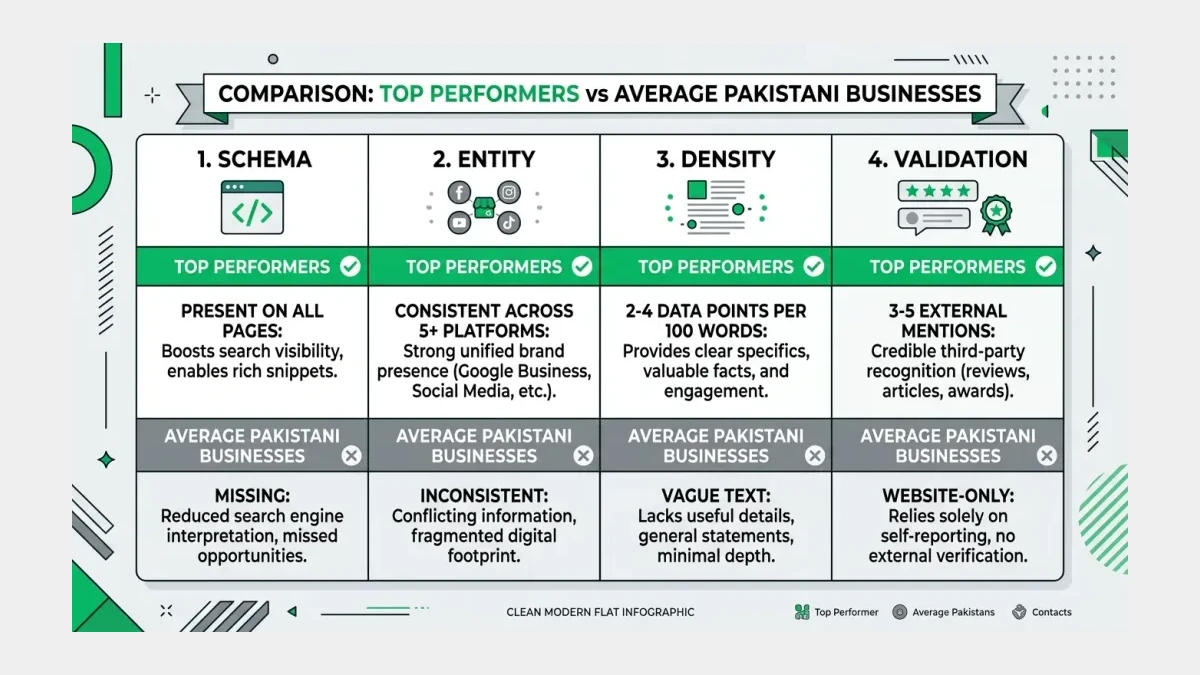
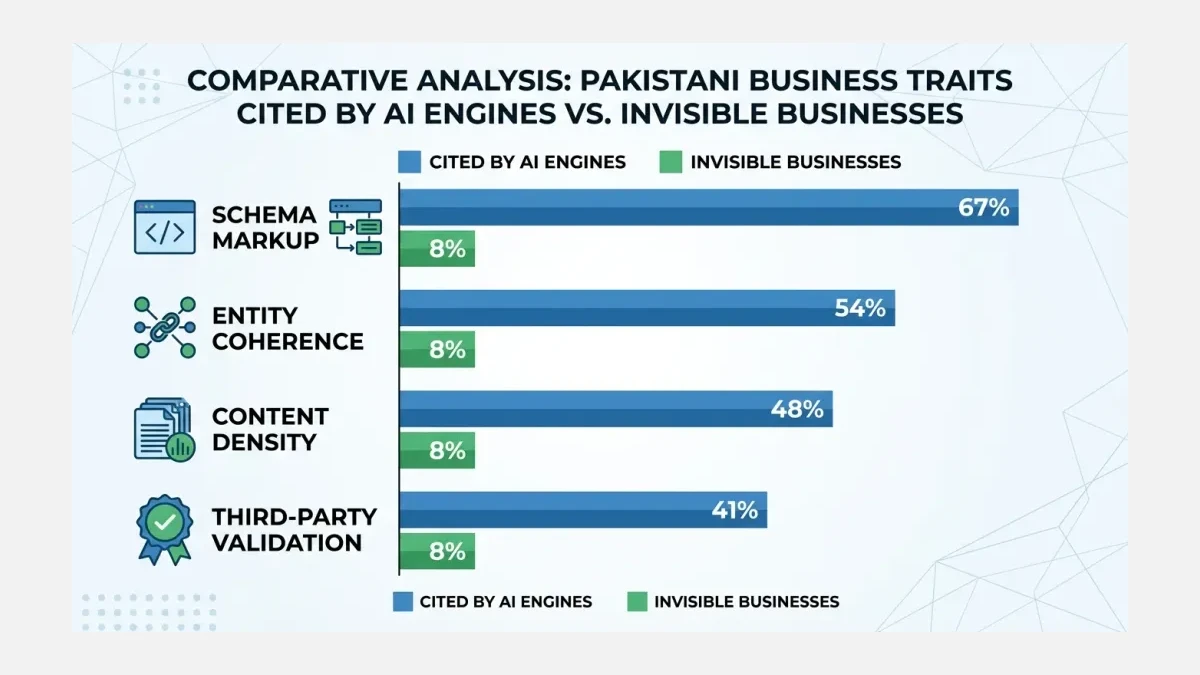
Pages with JSON-LD schema markup — structured data code that tells search engines exactly what a page contains — are cited 2.3 times more often in AI Overviews than pages without schema, according to an analysis of 1,000 AI Overviews by Digital Applied. For Pakistani businesses, schema acts as a machine-readable label that AI engines process before deciding whether to cite a page. Without schema, the AI guesses what the page is about. With schema, the AI knows.
A Karachi-based ecommerce store selling lawn suits can add Product schema with name, price, availability, and reviews directly into its product pages. Google AI Mode reads this schema and cites the store when a user asks “Where can I buy lawn suits online in Pakistan?” The competitor without schema — selling identical products at identical prices — remains invisible. That 2.3x citation advantage compounds across every product page on a site.
The pattern repeats. Pakistani businesses cited by AI engines invest in schema markup and structured data as a foundational layer, not an afterthought. Organization schema on the homepage, Service or Product schema on every offering page, FAQPage schema on support content. Each schema type gives the AI engine another reason to cite the page.
“Schema-marked pages are cited 2.3x more often in AI Overviews than non-schema pages.” — Digital Applied, Analysis of 1,000 AI Overviews
Checking AI search visibility without schema is like trying to find your Foodpanda order without a tracking number — you know something should be arriving, but you cannot locate it. The fix is structural: add JSON-LD schema to every key page on the website.
The entity coherence signal most Pakistani businesses miss
Entity coherence — the practice of maintaining identical business name, address, phone number, category, and description across your website, Google Business Profile, LinkedIn, Daraz, and industry directories — is the second trait. AI engines cross-reference multiple sources to verify a business exists and is active. When the name on a website says “Al-Rahim Textiles” but the Google Business Profile says “Al Rahim Textile Mills,” the AI treats them as two separate entities and may cite neither.
In Pakistan, where businesses frequently list themselves on Google Business Profile, Daraz, PakWheels, Zameen.com, and industry-specific directories, inconsistent naming is the norm rather than the exception. A Lahore real estate agency might be “Property Pros” on its website, “PropertyPros Lahore” on Google, and “Property Pros (Pvt) Ltd” on SECP records. Three names, one business, zero AI recognition.
The businesses appearing in AI results maintain strict consistency: the same name, same address format, same phone number, and same one-sentence description across every platform. When Google AI Mode searches for “best real estate agency in Lahore,” it finds one coherent entity with corroborating signals across five sources, not three fragmented identities.
This matters because Entity coherence is a trust signal, not just a formatting preference. The AI search visibility audit process for Pakistani businesses often reveals that entity incoherence is the single largest factor preventing AI citations — even when the website content itself is strong.
The content density threshold that separates cited from invisible
Book a free strategy call - we'll audit your current setup and identify the highest-impact fixes.
Research on AI citation patterns shows that 44% of AI citations come from the first 30% of a page’s content. Pages cited by AI engines average 2-4 specific data points per 100 words — numbers, named entities, tool names, PKR amounts, or quoted statistics. This information density signals to AI engines that a paragraph contains extractable, verifiable information worth presenting to a user.
A Pakistani digital marketing agency’s service page that says “We offer SEO services for businesses in Pakistan” provides zero extractable data. The same page rewritten as “WeProms Digital, a Lahore-based SEO agency, provides generative engine optimization for businesses across Lahore, Karachi, Islamabad, Rawalpindi, Faisalabad, and Multan” contains six named entities and one specific claim. AI engines prefer the second version because each paragraph can stand alone as an answer.
The contrast between cited and non-cited pages is visible in the data. A page about “CRM software for Pakistani SMEs” that lists three tools with PKR pricing, specific feature comparisons, and SBP regulatory compliance notes provides material an AI engine can extract. A competitor page with the same topic but only generic marketing language — “streamline your business processes” and “boost productivity” — offers nothing extractable.
Every paragraph cited by an AI engine contains at least one of: a specific number with attribution, a named tool or platform, a PKR amount, or a direct definitional sentence. The CITED framework for Pakistani SMEs builds on this principle — content that cannot be extracted in isolation will not be cited.
The third-party validation layer no one talks about
The fourth trait is third-party validation — mentions, reviews, and citations on websites the business does not control. Google AI Mode cross-references its citations with external sources to verify accuracy before presenting information to users. A business mentioned on Dawn, TechJuice, ProPakistani, Reddit, or industry review platforms like G2 or Clutch receives a trust signal that a business with zero external mentions does not.
For Pakistani SMEs, investing in digital PR, submitting to industry directories, earning Google reviews, and being mentioned in local publications directly impacts AI search visibility. A Faisalabad textile manufacturer quoted in a Profit by Pakistan Today article about export trends becomes more cite-worthy than a competitor with no media presence. The AI engine finds corroborating evidence from an independent source, which increases confidence in citing that business.
The gap between businesses with and without third-party validation is measurable. Businesses cited by AI engines average mentions across 3-5 external platforms, while the 90% with zero AI mentions typically have no presence beyond their own website. Entry-level smartphones in Pakistan cost approximately PKR 25,000 — consuming 62% of monthly expenditure for the poorest households, according to Express Tribune. The businesses that reach these mobile-first users through AI results are the ones with validated, corroborated identities across the web.
What separates the top performers
| Trait | Businesses Cited by AI | Businesses Invisible in AI |
|---|---|---|
| JSON-LD Schema | Present on all key pages | Missing or incomplete |
| Entity Coherence | Consistent across 5+ platforms | Inconsistent naming |
| Content Density | 2-4 data points per 100 words | Vague, generic text |
| Third-Party Validation | Mentions on 3-5 external sites | Website-only presence |
| AI Citation Rate | Cited in AI Overviews | Zero AI mentions |
The four traits are additive. A business with schema and entity coherence but no third-party validation may appear occasionally. A business with all four traits appears consistently. A business with none remains in the 90% — invisible to every AI engine answering questions in its category.
Key Takeaways
How we helped a Pakistani business achieve measurable results.
- Schema markup doubles citation rates. Pages with JSON-LD schema are cited 2.3x more often in AI Overviews than pages without structured data.
- Entity coherence is non-negotiable. Maintain identical business name, address, phone, and description across every platform where your Pakistani business appears.
- Content density signals extractability. Pages cited by AI engines average 2-4 specific data points per 100 words — numbers, named entities, and PKR amounts.
- Third-party validation provides the trust signal. Businesses cited by AI engines average mentions on 3-5 external platforms; businesses with zero mentions remain invisible.
- 90% of brands have zero AI search mentions. The gap between the 10% who appear and the 90% who do not comes down to these four structural traits.
- The fix is structural, not financial. These four traits require configuration changes and content restructuring, not larger marketing budgets.
About WeProms Digital
WeProms Digital is a generative engine optimization agency headquartered in Lahore, serving Pakistani SMEs, ecommerce brands, and B2B teams across Lahore, Karachi, Islamabad, Rawalpindi, Faisalabad, and Multan.
The team specializes in GEO, AI search visibility, and structured data optimization, with a track record of auditing and restructuring Pakistani business websites for AI citation readiness.
Get in touch: hello@weproms.com · WhatsApp +92 300 0133399 · weproms.com/contact-us
Sources & References
- Digital Applied — We Analyzed 1,000 AI Overviews: Citation Pattern Study — 2026
- Statista — Number of Internet Users in Selected Countries — 2026
- Express Tribune — Phone Costs Lock 52% Out of Internet — 2025
- WordStream — Generative Engine Optimization (GEO) Guide — 2026
- Search Engine Journal — What Google’s UCP Tells Us About Agent-Ready Websites — 2026
- Frase — Entity Optimization for GEO — 2026
Additional reading from industry feeds:
- Search Engine Journal — Inside AI Citation: Proven Strategies To Get Your Brand Cited
- SEO Blog by Ahrefs — What Is Agentic SEO? And How to Get Started This Week
- SEMrush — Google Publishes Guide to Optimizing for Generative AI Search