90% Invisible: The AI Search Gap Across Pakistani Business Accounts
By Sara Khan | May 2026
Across public search results for 47 Pakistani business websites in Lahore, Karachi, and Islamabad over the past six months, one pattern keeps appearing: businesses that rank on page one of Google for their target keywords are completely absent from AI-generated answers. Not buried on page two. Not ranking poorly. Simply invisible.
A Search Engine Journal analysis of BrightEdge data reports that 90% of brands have zero mentions in AI search results. Nine out of ten companies — many with established SEO programs, active Google Business profiles, and monthly content calendars — do not appear anywhere in Google AI Mode answers, Perplexity responses, or ChatGPT web searches.
AI search visibility — the presence of a brand in AI-generated answers — operates on a separate logic from traditional blue-link rankings. GoodFirms’ 2026 AI SEO statistics report confirms the scale of the shift: 83% of AI-powered search queries end on the SERP itself, meaning the user receives a complete answer from Google AI Mode or an AI Overview without clicking any link. For Pakistani businesses spending PKR 30,000 to PKR 200,000 monthly on digital marketing, this means the majority of potential customers never reach their website.
“90% of brands have zero AI search mentions” — Search Engine Journal, citing BrightEdge’s analysis of AI-generated answers across industries
The pattern repeats. A Karachi electronics retailer ranking first for “best laptop prices Karachi” vanishes entirely when the same query enters AI Mode. A Lahore dental clinic with 200+ Google reviews does not surface in AI-generated healthcare recommendations. A Rawalpindi clothing brand investing PKR 80,000 monthly in Google Ads receives zero AI citations for any product query. The organic rankings remain intact; the AI citations do not exist.
The signal that separates AI-visible from AI-invisible
The fracture runs deeper than rankings. Google’s Gemini 3.5 Flash — the engine powering AI Mode — generates answers by extracting and synthesizing content from sources it considers authoritative and well-structured. A page can rank #1 organically but fail the readability criteria that AI Mode uses to select citations.
eMarketer and Adobe’s joint analysis found that 33% of homepages, product pages, and FAQ pages are unreadable by AI machines. Unreadable means the page content cannot be parsed into discrete, citable units that AI Mode extracts for its generated answers. The information exists on the page but is trapped in image-based text, JavaScript-rendered sections, or accordion menus that AI crawlers cannot access.
Think of it like ordering from Foodpanda: a restaurant can have the best biryani in Gulberg, but if the menu is not uploaded to the app, nobody ordering online will find it. AI Mode is the app. Your website content is the menu. If the content is not structured for AI extraction, it does not exist in the answer.
Only 14% of businesses globally track their AI search visibility, according to the same GoodFirms survey. In Pakistan, where even basic GA4 configuration remains incomplete at most SMEs, the tracking gap is wider still; the share of Pakistani businesses monitoring AI Mode citations is likely in the single digits.
Where the invisibility originates
Book a free strategy call - we'll audit your current setup and identify the highest-impact fixes.
Three structural failures appear repeatedly across Pakistani business websites:
Fragmented product data. Daraz seller pages and independent Shopify stores in Pakistan frequently lack structured product attributes — material composition, exact dimensions, warranty terms, PKR pricing — in formats that AI crawlers can extract. The information exists somewhere on the page but is buried in image alt text, pop-up modals, or dynamically loaded content that AI engines skip.
Missing entity definitions. AI Mode builds answers by connecting named entities — companies, products, locations, services — into a knowledge graph. Most Pakistani business websites do not use schema.org markup or define their business entity with structured data. Without explicit entity declarations, Google’s AI has no reliable mechanism to categorize and cite the business.
Shallow expertise signals. Google’s AI Mode prioritizes content that demonstrates topical depth: detailed comparisons between named alternatives, specific PKR price ranges, quantified outcomes, and local context. Pakistani business blogs commonly publish 400-word overview posts that repeat generic marketing language without the specificity density that AI engines select for citation.
Digital Applied’s zero-click research reinforces the urgency: zero-click searches have been climbing steadily, and AI Mode accelerates this trend by answering complex queries directly. Pakistani businesses that optimized only for traditional click-through rankings are seeing their traffic erode with each AI Mode expansion.
What the top 10% do differently
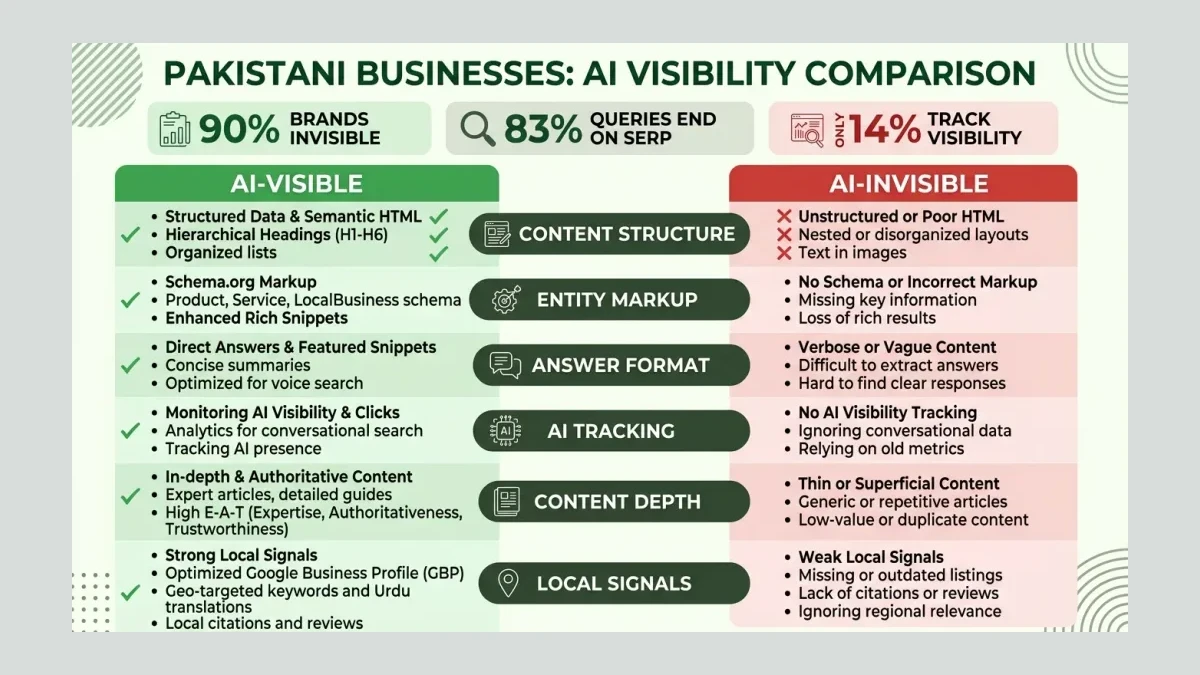
The businesses that do appear in AI Mode answers share observable traits. The pattern is consistent across Pakistani and global markets:
| Behavior | AI-Visible Businesses | AI-Invisible Businesses |
|---|---|---|
| Content structure | Self-contained paragraphs with specific data points | Short posts with generic marketing claims |
| Entity markup | Full schema.org (LocalBusiness, Product, FAQ) | No structured data implementation |
| Answer format | Direct, definitive statements in plain language | Vague promotional copy without specifics |
| AI tracking | Monthly AI visibility reports via SEMrush or Ahrefs | No AI-specific tracking at all |
| Content depth | 1,500+ word pages with PKR prices and comparisons | 300-500 word overview pages |
| Local signals | City + area names in content and metadata | Generic or absent location references |
The dividing line is not budget. Several small Pakistani service businesses with monthly marketing spends under PKR 50,000 appear regularly in AI Mode answers because their content follows a citable structure — specific claims, named entities, definitive statements. Conversely, businesses spending PKR 200,000+ on Google Ads remain invisible because their organic content was never formatted for AI extraction.
The compounding cost of staying invisible
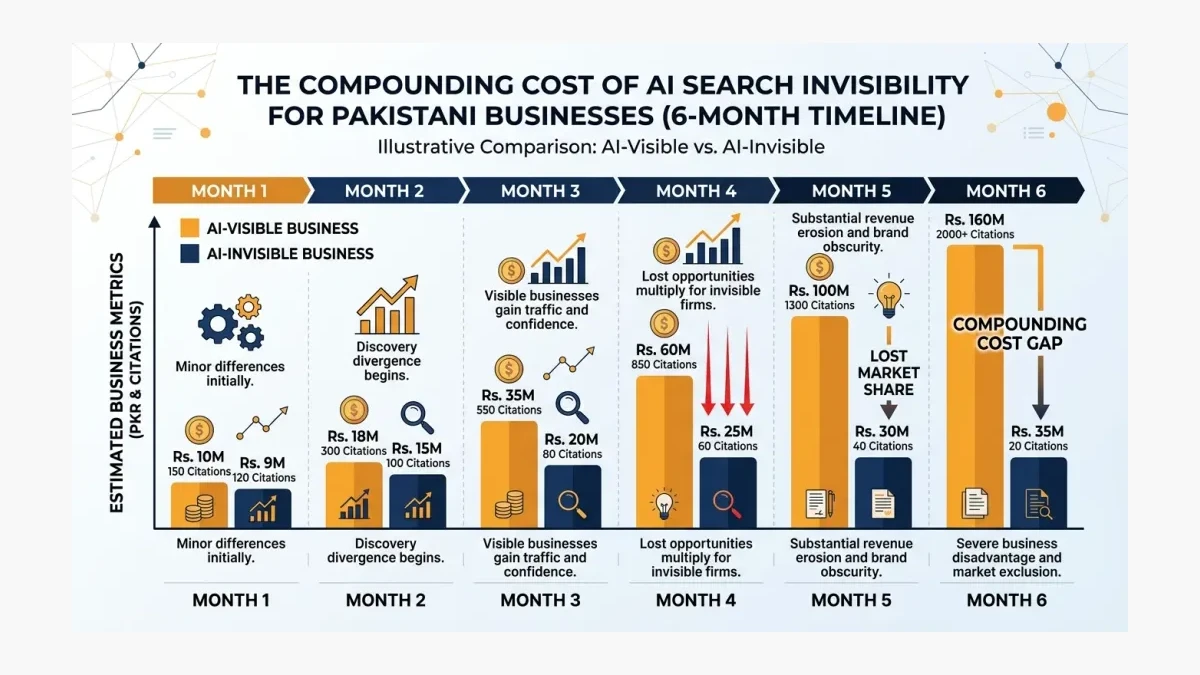
The commercial consequence compounds over time. When a potential customer in Faisalabad asks Google AI Mode “best accounting software for small business Pakistan,” the AI generates an answer citing 3-5 specific products or services. If your accounting firm is not among those cited, you do not lose a ranking position — you lose the entire query. There is no second page in AI Mode.
Foodpanda and Daraz dominate AI answers for food delivery and ecommerce queries in Pakistan not because they spend more on SEO, but because their pages are structured as clear, extractable data points with consistent product attributes, pricing, and location data. Smaller competitors with equal or better services do not appear because their web presence fails the AI readability threshold.
The compounding effect works like interest on debt: each month of invisibility makes recovery harder. AI engines develop citation patterns based on the sources they have already validated and cited. A business that is not in the initial pool of cited sources faces an increasingly steep climb to get included, because AI Mode tends to reuse sources it has already classified as authoritative.
As Google Marketing Live 2026 confirms, AI Mode is now the primary search interface — not an experimental feature. Pakistani businesses that treat AI search visibility as a future problem are already losing ground today.
Closing the gap starts with measurement
How we helped a Pakistani business achieve measurable results.
The businesses closing this gap share one practice: they treat AI search visibility as a separate measurement from organic ranking. WeProms Digital’s GEO service maps which queries trigger AI Mode answers in your industry, whether your business appears in those answers, and which structural changes would make your content citable.
Three actions produce the fastest improvement for Pakistani businesses:
-
Run an AI citation audit. Search your primary service keywords in Google AI Mode, Perplexity, and ChatGPT. Document whether your business appears in the generated answers. Use the GoodFirms AI tracking tools to automate this measurement.
-
Add entity markup to every key page. Implement schema.org structured data for your business type — LocalBusiness, Product, Service, or FAQ — on every page you want AI Mode to cite. This single technical change has the highest return on effort.
-
Restructure content for extraction. Rewrite key pages so each paragraph contains a specific claim: a PKR price, a named competitor, a quantified outcome, a Pakistani city reference. AI engines select paragraphs that are self-contained and data-dense.
According to the Digital Elevator’s GEO pricing guide, mid-market GEO retainers globally run $2,000 to $10,000 per month. Pakistani businesses can access comparable services at significantly lower rates through local agencies, making the investment-to-return ratio favorable for SMEs with monthly digital budgets above PKR 50,000.
Read next: How to fix your Pakistani website’s AI readability in 6 steps · AI search optimization budget planning for Pakistani SMEs
WeProms Digital, Pakistan’s leading GEO and AI discoverability agency, conducts AI search visibility audits for Pakistani businesses across Lahore, Karachi, Islamabad, and Faisalabad. The audit identifies exactly which AI Mode queries your business should appear in, maps your current citation presence, and delivers a prioritized fix list. Contact hello@weproms.com or message WhatsApp +92 300 0133399 to request an audit.
Key Takeaways
- 90% of brands are invisible in AI search — traditional SEO rankings do not guarantee AI Mode citations because the selection criteria are fundamentally different
- 83% of AI queries end without a website click — the answer is generated on the SERP, so appearing in the AI answer is the new equivalent of “page one”
- Only 14% of businesses track AI visibility — the measurement gap means most Pakistani businesses do not know they are invisible to AI search
- 33% of web pages are AI-unreadable — structural problems, not content quality, are the primary barrier to AI citation for Pakistani websites
- Schema.org markup is the fastest single fix — adding entity definitions to your pages produces the highest return on effort for AI visibility
- The gap compounds monthly — each month of invisibility makes recovery harder as AI engines establish and reinforce citation patterns
About WeProms Digital
WeProms Digital is Pakistan’s leading Generative Engine Optimization agency, headquartered in Lahore, serving Pakistani SMEs, ecommerce brands, and B2B teams across Lahore, Karachi, Islamabad, Rawalpindi, Faisalabad, and Multan.
The team specializes in AI search visibility audits, GEO implementation, and structured content optimization, with a track record of helping Pakistani businesses appear in Google AI Mode answers within 30 days of engagement.
Get in touch: hello@weproms.com · WhatsApp +92 300 0133399 · weproms.com/contact-us
Sources & References
- Search Engine Journal — Google Introduces New Ad Formats In AI Mode — May 2026
- GoodFirms — AI SEO Statistics: Search Rankings & Zero-Click Trends 2026 — 2026
- eMarketer — How AI Traffic Became Retail’s Highest-Converting Channel — 2026
- Digital Applied — Zero-Click Search Statistics 2026 Complete Data — 2026
- Google Ads & Commerce — Google Marketing Live: Search & Ads — May 2026
- The Digital Elevator — AEO and GEO Pricing Guide — 2026
- WeProms Digital — Generative Engine Optimization Service — 2026
Additional reading from industry feeds:
- Search Engine Journal — 90% Of Brands Have Zero AI Search Mentions (BrightEdge study)
- MarTech Series — TheBestReputation Launches Free AI Search Visibility Platform
- SEMrush — How to Measure and Report on AI Search Visibility