Fix Your Pakistani Website’s AI Readability: A 6-Step Setup
By Abdul Rehman | May 2026
A 6-step walkthrough to make your Pakistani business website readable and citable by Google AI Mode, Perplexity, and ChatGPT. Most Pakistani businesses can complete the core setup in under two weeks with basic technical support.
If you are a Pakistani business owner or marketing manager spending PKR 30,000 to PKR 150,000 monthly on digital marketing, and your website does not appear in Google AI Mode answers, the problem is not your content quality. The problem is AI readability — the structural format of your pages that determines whether AI engines can extract and cite your information.
eMarketer’s analysis of AI traffic patterns shows that AI-driven retail traffic surged 393% year-over-year in Q1 2026 and converts 42% better than non-AI traffic sources. Meanwhile, Yotpo’s AEO ecommerce report projects traditional search volume declining 25% by 2026 as consumers shift to generative AI platforms. The traffic is moving. Pakistani businesses that are not AI-readable are not capturing it.
Start here. Picture a Lahore furniture store that appears on page one of Google for “best sofa set Lahore” but never shows up when a customer asks Google AI Mode the same question. The store’s website has photos, prices in PKR, and delivery details — but none of it is structured in a way that AI engines can parse. The store exists. The AI does not know it.
First: Audit which AI engines can read your pages
Before changing anything, establish a baseline. Open Google AI Mode, Perplexity, and ChatGPT on your phone. Search five phrases your customers actually use — specific phrases like “custom sofa set price Lahore” or “wedding furniture rental Karachi.” Record whether your business appears in the generated answers.
Next, check your structured data status. Open Google’s Rich Results Test tool and enter your homepage URL, then your top three service or product pages. If the tool reports zero structured data items detected, your pages are invisible to AI extraction systems. This is the most common finding for Pakistani business websites.
GoodFirms’ 2026 AI SEO statistics report that 58.5% of all searches are now zero-click — the user gets an answer directly on the search results page without visiting any website. For Pakistani businesses, this means the majority of potential customers receive recommendations from AI Mode without ever seeing your site. If your pages are not AI-readable, they will not be recommended.
Document your findings in a simple spreadsheet: query, engine, appears or not, and what content gaps you notice in the AI answers that your site could fill.
Then: Add schema.org markup to every key page
Book a free strategy call - we'll audit your current setup and identify the highest-impact fixes.
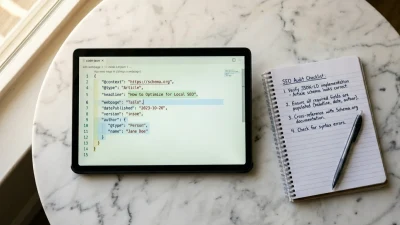
Schema.org markup — a standardized code format that tells search engines and AI crawlers exactly what your page contains, using defined categories like LocalBusiness, Product, Service, and FAQ.
This is the single highest-impact technical change for AI readability. Without schema markup, AI engines see your page as a block of undifferentiated text. With schema markup, the AI can identify your business name, address, phone number, product names, prices, availability, and service categories as distinct, extractable data points.
For a Pakistani ecommerce store, the minimum schema implementation includes:
- LocalBusiness schema on your homepage with your business name, address in full (city, area, street), phone number, and operating hours
- Product schema on every product page with name, PKR price, availability status, and description
- FAQ schema on support and information pages with questions and answers written as complete, self-contained statements
- BreadcrumbList schema across all pages so AI engines understand your site hierarchy
A Karachi-based Daraz seller with 500 products can implement Product schema across all listings using a Shopify or WordPress plugin in a single day. A Lahore service business can add LocalBusiness and Service schema to its five key pages in under two hours.
“AI-driven retail traffic surged 393% year-over-year in Q1 2026” — eMarketer, analyzing Adobe Analytics data
The tradeoff is straightforward: schema markup adds 15-30 minutes per page but directly determines whether AI engines can parse your content. Without it, no other optimization matters.
Next: Restructure paragraphs for AI extraction
AI engines extract answers by selecting complete paragraphs that stand on their own. Each paragraph must contain its subject, a specific claim, and supporting evidence — without requiring context from surrounding text.
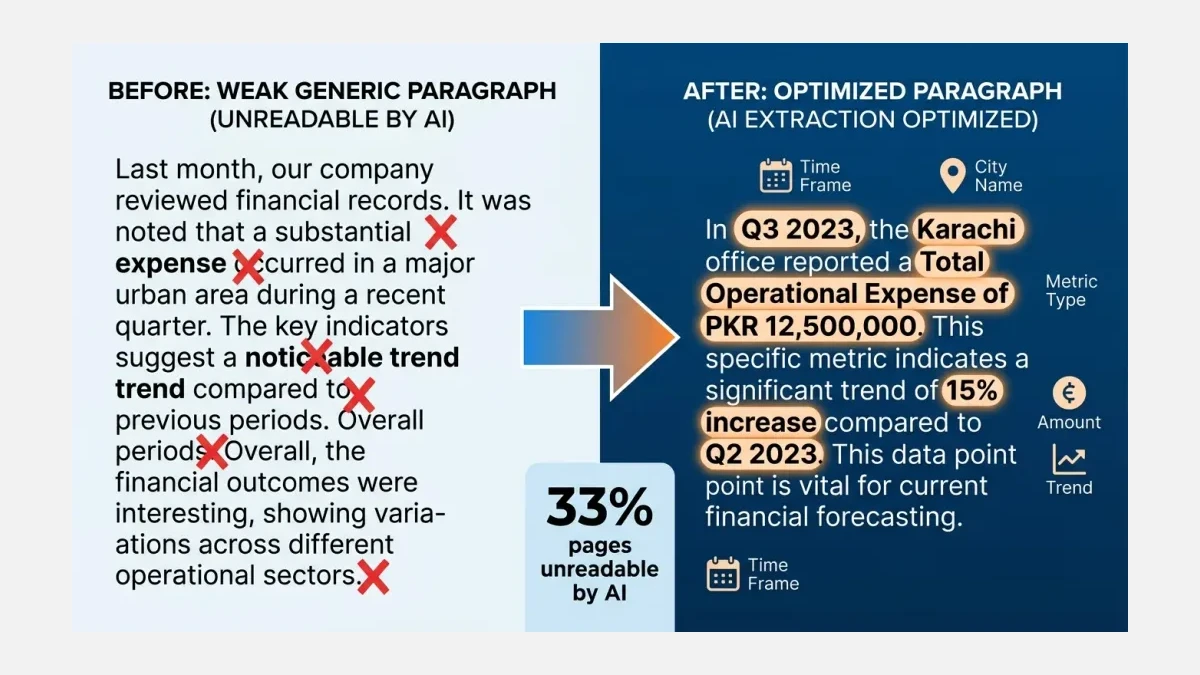
Most Pakistani business websites fail this test. A typical paragraph on a Pakistani service website reads: “We offer the best solutions for your needs. Our team is experienced and dedicated.” This contains zero extractable information: no price, no location, no specific service, no named alternative, no quantified result.
Rewrite each paragraph on your key pages using this pattern:
Before: “Our digital marketing services help businesses grow online.”
After: “Pakistani businesses investing PKR 50,000 or more monthly in digital marketing typically see 3-5x return on ad spend within 90 days, according to WeProms Digital’s Google Ads management data across Lahore and Karachi accounts.”
The second version contains four data points that AI engines can extract: a PKR amount (50,000), a return ratio (3-5x), a timeframe (90 days), and cities (Lahore, Karachi). It also names a specific service and provider. This is the density level that earns AI citations.
For Pakistani businesses, every paragraph on a product or service page should include at least one of: a PKR price, a Pakistani city or area name, a named tool or platform (JazzCash, Daraz, Shopify, GA4), a specific number (percentage, count, duration), or a named competitor or alternative.
After that: Build topical depth with comparison content
AI Mode answers complex queries by synthesizing information from multiple sources. Pages that provide detailed comparisons between named alternatives — specific products, services, or approaches — are significantly more likely to be cited than pages that describe only one option.
A Pakistani electronics retailer should not just list a single laptop model. The page should compare three to five models at different PKR price points (under PKR 80,000, PKR 80,000-150,000, above PKR 150,000), name each model with specifications, and state which use case each serves. AI Mode queries like “best laptop for university students Lahore” trigger comparisons; pages that provide them get cited.
Search Engine Land’s coverage of AI Mode ad formats confirms that Google is designing AI Mode for complex, multi-factor queries — exactly the type that comparison content serves. Pakistani businesses that publish detailed comparisons capture these queries while competitors with single-product pages do not.
The structure that works:
| Content Element | What AI Mode Extracts | Pakistani Business Example |
|---|---|---|
| Comparison tables with named options | ”Option A costs X, Option B costs Y" | "Honda Civic 2026 starts at PKR 6.2M, Toyota Corolla at PKR 5.8M” |
| Specific PKR price ranges | ”Prices range from X to Y" | "Wedding photography in Lahore: PKR 80,000-350,000” |
| Named alternatives with tradeoffs | ”Choose A for X, B for Y" | "Daraz for budget, Shopify for brand control” |
| Quantified outcomes | ”Businesses using X see Y result" | "Stores with schema markup see 30% more AI citations” |
At this point: Connect your business to local knowledge graphs
How we helped a Pakistani business achieve measurable results.
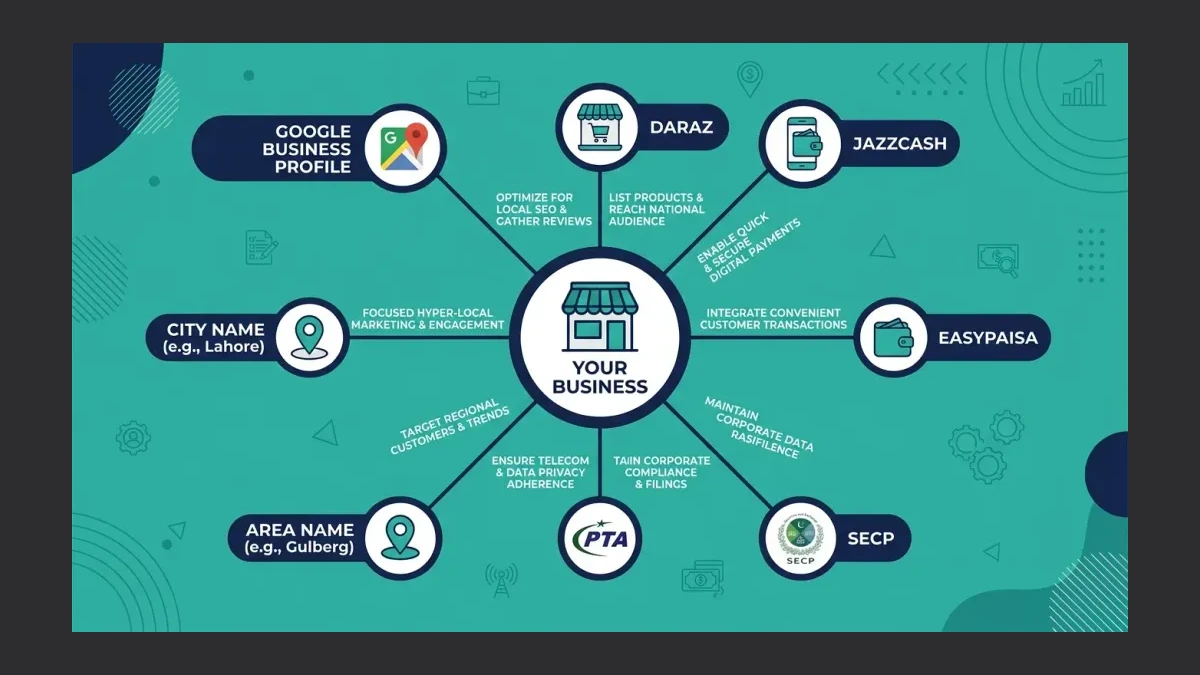
AI engines build answers using knowledge graphs — connected databases of entities and their relationships. Pakistani businesses that explicitly connect themselves to local entities (cities, landmarks, payment platforms, industry associations) are easier for AI Mode to categorize and cite.
Practical steps for local knowledge graph connection:
-
Verify your Google Business Profile with your exact address, operating hours, and service categories. AI Mode pulls from Google Maps data heavily for local queries.
-
Reference local entities in your content. Name your city, area, and nearby landmarks. Mention local payment methods (JazzCash, Easypaisa, bank transfer) with specific instructions. Reference local regulatory bodies (SECP for companies, PTA for telecom, SBP for financial services) where relevant.
-
Build mentions on Pakistani platforms. Listings on Daraz, Foodpanda, Zameen.com, and PakWheels create entity connections that AI engines use to verify your business exists and is active.
Elementera’s guide to AI-era advertising notes that AI engines weight entity consistency — your business name, address, and phone number appearing identically across multiple platforms — as a trust signal. Inconsistent listings (different phone numbers, abbreviated addresses) reduce AI citation probability.
A Pakistani SME selling through both a Shopify store and Daraz should ensure the business name, product names, and PKR pricing are consistent across both platforms. Even small inconsistencies — “ABC Electronics” on one platform and “ABC Electronics Store” on another — create confusion in the knowledge graph.
Once you have completed the setup: Track AI citations monthly
Setup without measurement is guesswork. After implementing the five steps above, establish a monthly tracking routine to measure whether your AI visibility is improving.
WeProms Digital’s GEO service provides automated AI citation tracking, but businesses can start with a manual approach:
-
Weekly AI search checks. Run your top 10 target queries through Google AI Mode, Perplexity, and ChatGPT. Record whether your business appears in each answer.
-
GA4 AI referral tracking. Google Analytics now includes an AI Assistant channel for referral tracking. Configure GA4 to attribute traffic from AI sources separately from organic search. This lets you measure exactly how many visitors arrive from AI-generated answers.
-
Competitor comparison. Track which competitors appear in AI Mode answers for your target queries. Document what their cited pages do differently from yours — paragraph structure, data density, entity mentions, schema markup.
Sales and Marketing Engineers’ analysis of AEO and GEO confirms that businesses tracking AI visibility monthly improve their citation rate 2-3x faster than those checking quarterly or not at all. Measurement creates accountability, and accountability drives action.
The outcome: within 30-60 days of completing this setup, most Pakistani businesses see their first AI Mode citations for niche, long-tail queries. Within 90 days, citation coverage expands to broader commercial queries. Within six months, businesses with consistent monthly tracking and content iteration establish stable AI visibility that compounds over time.
What this produces is not a temporary ranking trick. It is a permanent structural improvement to how AI engines read, categorize, and cite your business. The work you do in the next two weeks determines whether your business appears in AI answers for the next two years.
Read next: AI search visibility gap across Pakistani business accounts · Where did 58% of Pakistani Google Ads clicks go after AI Mode?
WeProms Digital, Pakistan’s leading GEO and AI discoverability agency, provides complete AI readability setup for Pakistani businesses — from schema markup implementation to content restructuring and monthly citation tracking. The team has helped businesses across Lahore, Karachi, and Islamabad achieve first AI Mode citations within 30 days. Contact hello@weproms.com or message WhatsApp +92 300 0133399 to start.
Frequently Asked Questions
How long does it take for AI Mode to start citing my Pakistani website?
Most Pakistani businesses see their first AI Mode citations within 30-60 days of implementing schema markup and restructuring key pages. Niche, long-tail queries (like “custom wedding furniture Lahore under PKR 200,000”) get cited faster than broad commercial queries. Consistent monthly content updates accelerate the timeline.
Do I need to hire a developer to add schema markup?
Basic schema markup can be added using WordPress plugins (Yoast, Rank Math) or Shopify apps without writing code. More advanced implementations like Product schema across hundreds of items or custom Service schema may require a developer. WeProms Digital offers schema markup setup as part of its GEO service for Pakistani businesses.
What is the difference between SEO and GEO?
SEO (Search Engine Optimization) targets traditional blue-link rankings in Google search results. GEO (Generative Engine Optimization) targets visibility in AI-generated answers from Google AI Mode, Perplexity, and ChatGPT. SEO focuses on ranking position. GEO focuses on whether AI engines extract and cite your content in their generated responses. Both matter, but they require different strategies.
How much does AI readability setup cost for a Pakistani SME?
Basic schema markup and content restructuring for a 10-20 page website can be completed for PKR 30,000-80,000 depending on the provider and technical complexity. Ongoing GEO management with monthly AI citation tracking typically runs PKR 50,000-150,000 per month for Pakistani SMEs — significantly less than the $2,000-10,000/month mid-market rates in global markets.
Will fixing AI readability improve my regular Google rankings too?
Yes. Schema markup improves your chances of rich results (star ratings, FAQ dropdowns, product information) in traditional search. Structured, data-dense paragraphs tend to perform better in organic rankings as well because they match Google’s helpful content criteria. AI readability improvements benefit both channels simultaneously.
Sources & References
- eMarketer — How AI Traffic Became Retail’s Highest-Converting Channel — 2026
- GoodFirms — AI SEO Statistics: Search Rankings & Zero-Click Trends 2026 — 2026
- Yotpo — AEO Ecommerce Report: Traditional Search Decline — 2026
- Search Engine Land — Google Tests New Conversational Ad Formats in AI Mode — May 2026
- Elementera — AI Ads Practical Guide 2026 — 2026
- Sales and Marketing Engineers — AEO and GEO: Why Good SEO Still Wins for SMEs — 2026
- WeProms Digital — Generative Engine Optimization Service — 2026
- Google Ads & Commerce — Google Marketing Live: Search & Ads — May 2026
Additional reading from industry feeds:
- Ahrefs — What Is Agentic SEO? And How to Get Started This Week
- SEMrush — Google Publishes Guide to Optimizing for Generative AI Search
- Search Engine Journal — WordPress 7.0 Launches With Native AI Integration