
By Hamza Ali | May 2026
A Pakistani ecommerce store sees impressions holding steady while clicks and conversions fall. The search terms look familiar, and the campaign still spends its budget. It is tempting to blame AI Mode immediately. But that diagnosis needs evidence: a lower click-through rate does not explain where the money went or whether the remaining clicks became less valuable.
An Ahrefs analysis of 300,000 keywords found that AI Overviews correlated with a 58% lower average click-through rate for the top-ranking organic page, using December 2025 data. This was organic search research, not a measurement of Pakistani Google Ads accounts.
Pew Research Center found traditional-result clicks on 8% of visits with an AI summary, versus 15% without one, in its March 2025 US browsing study. Neither finding establishes an equivalent decline in paid clicks in Pakistan.
For an SME, the useful question is narrower: which searches still bring qualified customers at an affordable cost? AI search makes that audit worthwhile, but it does not replace account-level evidence.
The setup that built the old numbers
The familiar Google Ads setup starts with commercial keywords, matching ad copy, bidding targets and conversion tracking. Those foundations remain useful. The weakness is treating past click volume as a promise, even when search behaviour, competition and the mix of queries change.
A budget forecast should connect spend, average cost per click, conversion rate and lead quality. If those inputs change, the forecast changes. Holding spend and average CPC constant cannot produce fewer paid clicks: average CPC is spend divided by clicks. That arithmetic matters before blaming a new search interface.
AI Overviews and AI Mode are related but different experiences. An overview appears within search results; AI Mode supports a more conversational search journey. Neither justifies assuming that every search now uses the same layout or that traditional advertising positions have disappeared.
Google’s current advertising guidance describes ads above, below and within AI-powered experiences. Eligible Search, Shopping and Performance Max campaigns can participate automatically. Its availability list includes Pakistan for English text ads within AI Overviews and AI Mode, subject to eligibility and rollout changes.
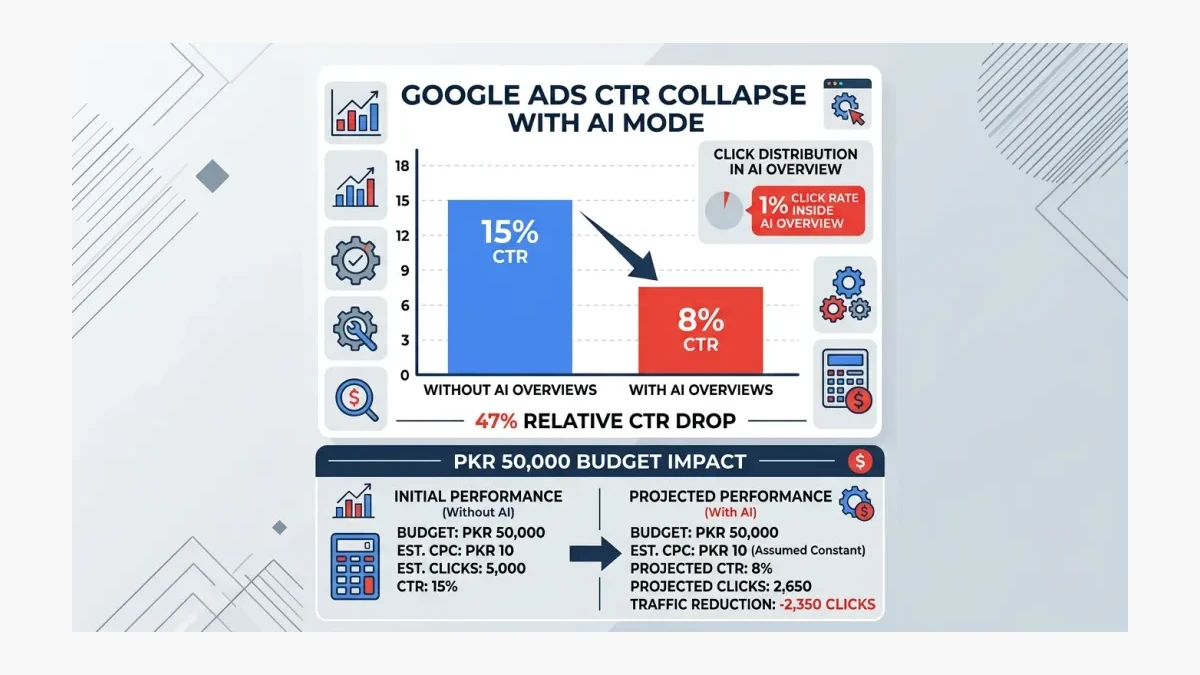
The infographic’s search click comparisons should not be read as Google Ads CTR measurements. Use the research definitions above when interpreting them.
Where the money actually goes
Start with the billing model. Under cost-per-click pricing, an impression without a click does not itself incur a click charge. An AI answer may affect someone’s decision to visit a website, but an unclicked ad is not a paid click delivering zero return.
If spend stays steady while paid clicks fall, inspect average CPC and the distribution of spend. More expensive queries, different devices, changing locations or a shift between campaigns can explain the difference. Also check whether the dashboard combines Search with campaigns using other inventory or bidding arrangements.
Pew’s finding that links inside AI summaries received clicks on 1% of visits to pages containing a summary is useful context. It describes observed browsing behaviour, not a paid-ad billing rule, and does not establish why every user stopped searching.
“Users who encountered an AI summary clicked on a traditional search result link in 8% of all visits.” — Pew Research Center
The operational concern is what happens to customer acquisition. Fewer clicks can coexist with stronger lead quality, while stable clicks can hide worsening conversion rates. Compare qualified enquiries, sales and cost per acquisition alongside CTR. A campaign that attracts fewer casual visitors may still serve the business well.
Keep the explanation proportionate to the evidence. AI answers are a possible influence on search behaviour; changes in pricing, demand, competitors and landing pages remain plausible causes of deteriorating account performance.
The three budget leaks specific to Pakistani accounts
These are useful patterns to investigate in Pakistani SME accounts, not problems unique to Pakistan or proven consequences of AI Mode.
Broad match without search-term review. Broad match can reach relevant demand, but it also requires attention to the queries receiving spend. A software business might welcome comparison searches while rejecting student research or unrelated support questions. Do not assume an informational phrase is worthless simply because an AI answer appears.
Use search-query mining and negative keyword optimisation to identify irrelevant paid traffic. Review relevance, conversions and lead quality together. A low CTR alone is not evidence that the query wastes money.
Nor does lower account-wide CTR automatically mean Quality Score falls and CPC rises. Google describes Quality Score as a diagnostic tool, not an auction input. Expected CTR, ad relevance and landing-page experience need their own review.
Misreading AI traffic in GA4. Google Analytics has an AI Assistant channel, but its definition explicitly excludes Google AI Overviews and AI Mode. Non-ad visits from those Google experiences fall under Organic Search. The channel cannot isolate their contribution to a traffic decline.
Static budgets despite changing returns. A campaign can keep spending on a category after its economics worsen. Review the cost and quality of actual leads, including calls and WhatsApp enquiries. Absence from an organic AI answer is not, by itself, evidence that an advertisement on that query is unprofitable.
For local businesses, also separate service areas and availability. A relevant enquiry from outside your delivery area can waste sales time even when the keyword looks ideal. That is an account problem you can address without proving anything about AI search.
The practical fix: rebalance for AI Mode
Start with a focused audit, then allow enough time for conversion delays and business follow-up before judging changes. There is no universal CTR threshold or budget split that identifies AI-related losses.
-
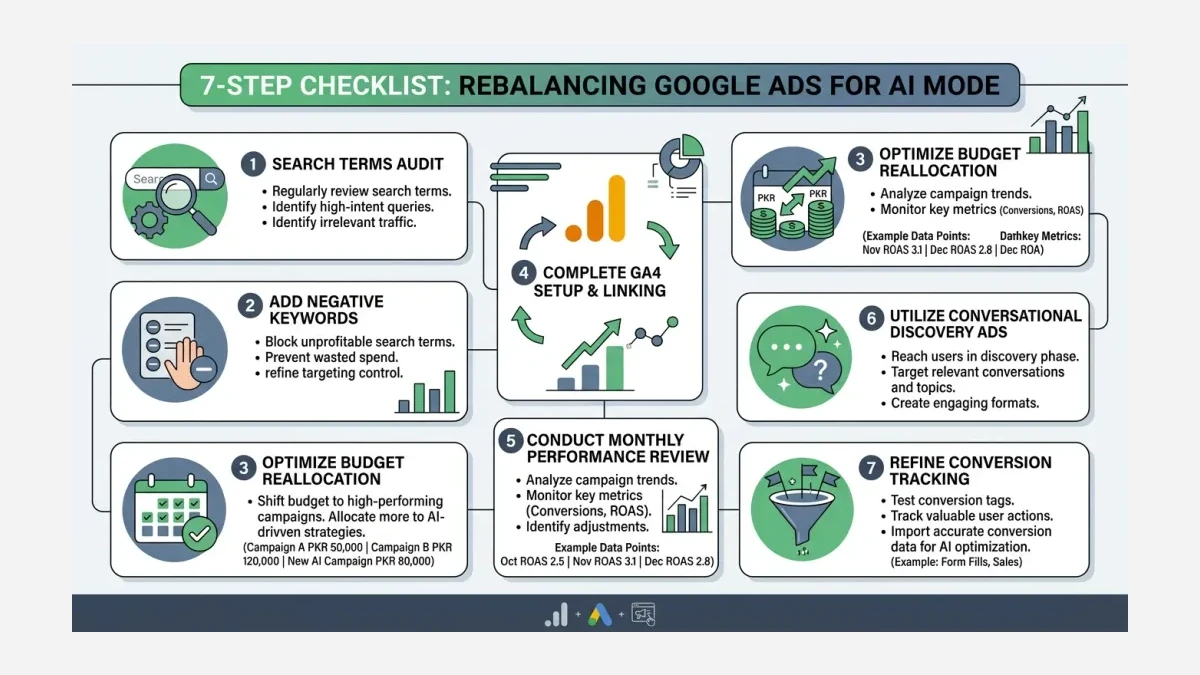
Pull a search terms report covering comparable periods. Review impressions, clicks, cost and conversions together. Separate brand from non-brand searches and examine device and location differences. Flag meaningful changes relative to each segment’s history, not an arbitrary account-wide cutoff.
-
Add negatives where intent is demonstrably wrong. Exclude irrelevant research, services you do not offer and unsuitable locations. Review phrases such as “how to” or “best” individually: some belong to a valuable buying journey. Blanket exclusions can remove potential customers alongside weak traffic.
-
Move budget toward demonstrated commercial value. Booking and purchase queries are sensible candidates, but use qualified leads or sales to confirm their performance. Increase investment where the business can handle demand and acquisition costs remain acceptable. Avoid forcing every account into the same allocation.
-
Check GA4 acquisition and conversion measurement. Review channel and source/medium reports, linking and tagging. The AI Assistant channel does not require the proposed Data Streams switch, nor does it isolate AI Mode. Use a traffic audit for Pakistani SMEs to examine broader acquisition changes without claiming an unavailable breakdown.
-
Check eligibility for ads in AI experiences. Google says existing eligible campaigns can participate without separate campaigns or budgets. Confirm the formats and locations available to your account. Treat AI placements as part of campaign performance unless reporting provides a reliable separate view.
WeProms Digital’s Google Ads management service can support search-term reviews, campaign restructuring and measurement. Set success criteria before making changes: stronger qualified-lead performance is more useful than a promise to restore every lost click.
Your post-AI Mode checklist
Work through these items in order, keeping a record of changes so you can interpret the next reporting period:
- Export search terms for comparable periods and review changes in clicks, cost, conversions and query mix.
- Add evidence-based negatives for irrelevant intent, unsuitable locations and services you do not sell.
- Review budget allocation using qualified leads, sales and acceptable acquisition costs.
- Check GA4 channel definitions and avoid labelling AI Assistant traffic as Google AI Mode traffic.
- Schedule a recurring performance review that accounts for seasonality, auction changes and conversion delays.
- Confirm AI ad eligibility against Google’s current location and format guidance; separate access from promised performance.
- Validate conversion tracking against enquiries received by the business, including duplicate or low-quality leads.
A conversion tracking review is especially useful when the advertising dashboard and sales team tell different stories. Agree what counts as a qualified enquiry before changing bidding targets.
Read next: AI Mode ads versus traditional Google Ads for Pakistani SMEs
WeProms Digital helps Pakistani businesses review targeting, budgets and measurement. Contact hello@weproms.com or message WhatsApp +92 300 0133399 to discuss an account audit. Bring access to campaign reporting and a clear description of which enquiries actually become customers.
Frequently Asked Questions
Is AI Mode reducing clicks on all Google Ads or just certain types?
The cited organic and browsing studies do not establish a universal paid-ad effect. Search intent and the experience shown may influence behaviour, but your account needs its own assessment. Compare relevant query groups and commercial outcomes. Do not assume every informational search performs poorly or every transactional search is protected.
Should Pakistani SMEs reduce their Google Ads budget because of AI Mode?
Make that decision from acquisition economics and business capacity. Preserve investment in campaigns producing worthwhile customers; investigate or reduce spending that cannot justify its cost. Reallocation may help, but there is no verified guarantee that keeping the same total budget will improve results. Check measurement before drawing a conclusion.
How do I know if AI Mode is affecting my specific Google Ads account?
You usually cannot attribute a CTR decline to AI Mode from standard reporting alone. Google includes AI placement performance in aggregate campaign and search-term reporting. Compare like-for-like periods and examine CPC, auction competition, search intent and landing-page changes. Manually checking results provides context, but a single search is not proof of what customers saw.
What are Conversational Discovery ads and should Pakistani businesses use them?
Do not build a budget around an unverified product name or a claim of superior engagement. Google’s current guidance describes text and Shopping ads in AI-powered experiences, with eligibility depending on market and format. Pakistan is listed for English text ads. Existing eligible campaigns can participate; assess their business results without assuming a separately selectable “Conversational Discovery” campaign.
Can WeProms restructure my Google Ads account for AI Mode?
WeProms offers account reviews and restructuring through its Google Ads management service. The practical work includes search-term analysis, budget allocation, conversion measurement and checking campaign eligibility for available placements. Discuss scope and measurable goals with the team at hello@weproms.com or via WhatsApp at +92 300 0133399. A review should explain reporting limits as well as opportunities.
About WeProms Digital
WeProms Digital is a Lahore-based digital marketing agency serving Pakistani SMEs, ecommerce brands and B2B teams, including businesses in Karachi, Islamabad, Rawalpindi, Faisalabad and Multan.
Its Google Ads services cover campaign management, restructuring, budget optimisation and conversion tracking. For an account review, focus the brief on the business outcome you need: relevant enquiries, completed purchases or a clearer understanding of acquisition costs. Ask which changes can be measured directly and which remain hypotheses.
Get in touch: hello@weproms.com · WhatsApp +92 300 0133399
Sources & References
- Ahrefs — Update: AI Overviews Reduce Clicks by 58%
- Pew Research Center — Google users are less likely to click on links when an AI summary appears
- Google Ads Help — About ads in AI-powered experiences in Google Search
- Google Analytics Help — Default channel group
- Google Ads Help — Cost-per-click definition
- Google Ads Help — About Quality Score for Search campaigns
Additional reading from industry feeds: