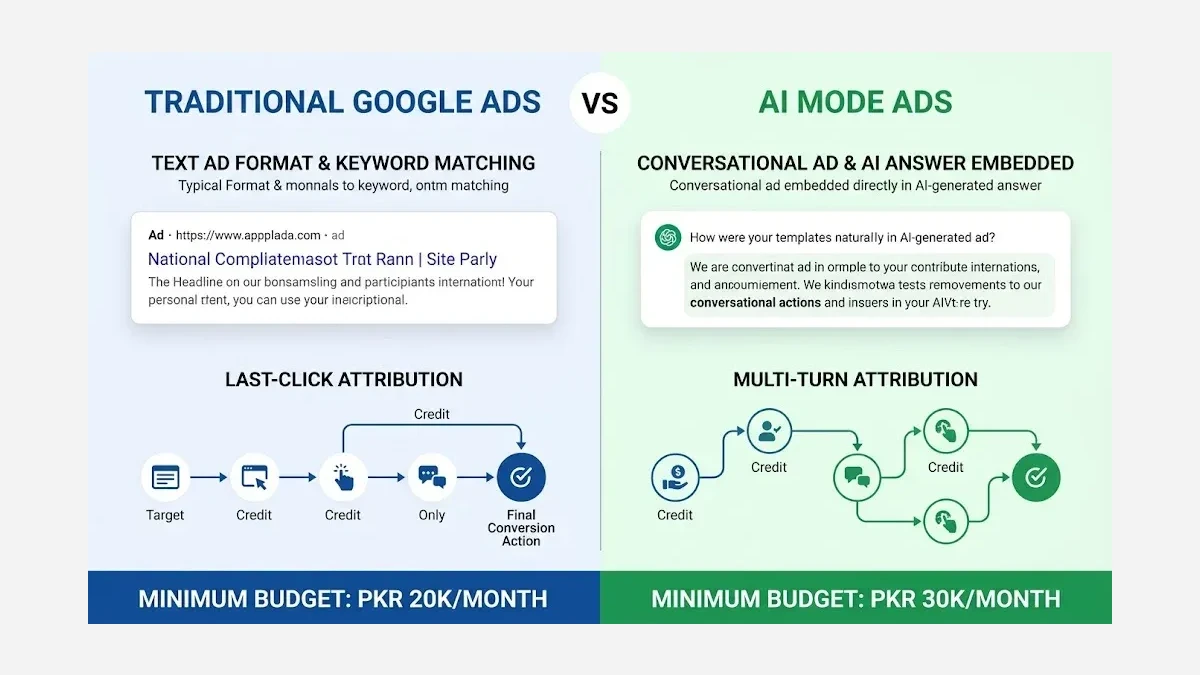

Pakistani SMEs should prepare for AI Mode without treating it as a separate advertising channel. Eligible Google Ads campaigns can already participate in AI-powered Search experiences, subject to market and format availability. Protect campaigns that generate qualified demand, improve conversion tracking, and test campaign changes before increasing spend. A fixed budget allocation to AI Mode is not a setting advertisers can choose.
Start here. Google AI Mode is a conversational experience within Google Search. Its answers can help people explore options, compare products and ask follow-up questions. Ads can appear within that experience, but an AI answer does not guarantee an ad placement for every query.
For a wedding photographer in Rawalpindi, the practical question is whether an eligible campaign reaches people looking for relevant services and produces worthwhile enquiries. There is no need to rebuild the account around an assumed new ad format. Google’s current availability guidance lists Pakistan for English-language text ads within AI Overviews and AI Mode.
Keep the distinction clear: AI Mode is a search experience; AI Max is a set of campaign features. Enabling automation, appearing in an AI answer and improving business results are different outcomes. Your budget decisions should depend on the last of these.
What this gets right
Google Ads & Commerce continues to develop AI-led Search and Shopping experiences. The useful takeaway for advertisers remains straightforward: clear assets, relevant landing pages and reliable conversion signals help keep campaigns aligned with business goals.
Conversational discovery describes how people explore a purchase through follow-up questions. It should not be treated as a separate campaign type called “conversational discovery ads”. According to Google’s campaign eligibility guidance, existing Search, Shopping and Performance Max campaigns can participate in AI-powered Search placements where eligible. Ads may match a query directly or use context from both the query and the AI response.
AI Mode Shopping Ads are relevant in supported markets, but availability matters. Google currently lists Pakistan as text ads only for placements within AI Overviews and AI Mode. A Pakistani retailer should therefore avoid planning around local AI Mode Shopping placements being available. Check the intended customer market and supported format before building a test around a product feed.
Ask Advisor is an account assistant, separate from the customer-facing AI Mode experience. Google describes it as a beta feature for eligible accounts that can answer questions, troubleshoot performance, suggest creative assets and implement supported changes with approval. It is not a promise that describing your business will produce a complete, ready-to-run campaign without review.
Measurement quality remains the foundation. Clear purchase values, qualified lead definitions and appropriate first-party data give automated campaigns more useful signals. A form submission and a paying customer should not be treated as interchangeable simply because both can appear in a report.
Where this breaks
The original idea of dividing a budget between traditional Search and AI Mode runs into practical limits.
Problem one: measurement gaps. Google includes AI Mode ad impressions, clicks, costs and conversions in aggregate campaign reporting. Search terms are also included in aggregate. That makes a clean placement-level comparison difficult: a campaign’s reported cost-per-acquisition does not establish what AI Mode alone delivered. There is no basis for assuming that conversational interactions automatically fall outside the attribution window.
GA4 helps measure what visitors do after reaching your site. It cannot reconstruct an entire conversation inside Google or turn an aggregate Google Ads report into an isolated AI Mode report. Keep that limitation visible when discussing results with an agency or business owner.
Problem two: creative assumptions. Existing text ads can serve in AI-powered Search experiences. Advertisers do not universally need a new conversational landing page or a replacement creative production process. Improve weak copy, product information and landing pages because they help customers make decisions. For Shopping campaigns in supported markets, accurate product data remains relevant; it is not a universal requirement for text ad eligibility.
Problem three: auction assumptions. AI Mode participation happens through the Google Ads auction. Traditional Search can already involve international advertisers, so it is misleading to describe a guaranteed switch from local competition to a global auction. Review actual search terms, targeting and acquisition costs before blaming higher costs on a different competitive landscape.
Claims about rival platforms overtaking Google or overseas social commerce growth do not tell a Pakistani SME how much to allocate here. Compare channels using your own margins, qualified demand and sales outcomes. A strong result elsewhere is a reason to investigate, not evidence that your current campaigns need an immediate budget cut.
Hidden cost: weak tracking can make curiosity look like demand. A WhatsApp button click is useful to record, but it does not prove a qualified conversation happened. Improve Google Ads conversion tracking and reconcile leads with sales before rewarding campaigns for more activity.
What Pakistani businesses should do instead
Picture this. Your business already spends on Search, with other campaigns supporting product sales or remarketing. You want to explore AI-led opportunities without disrupting a reliable source of enquiries. Start with the account you have and define a decision you can actually measure.
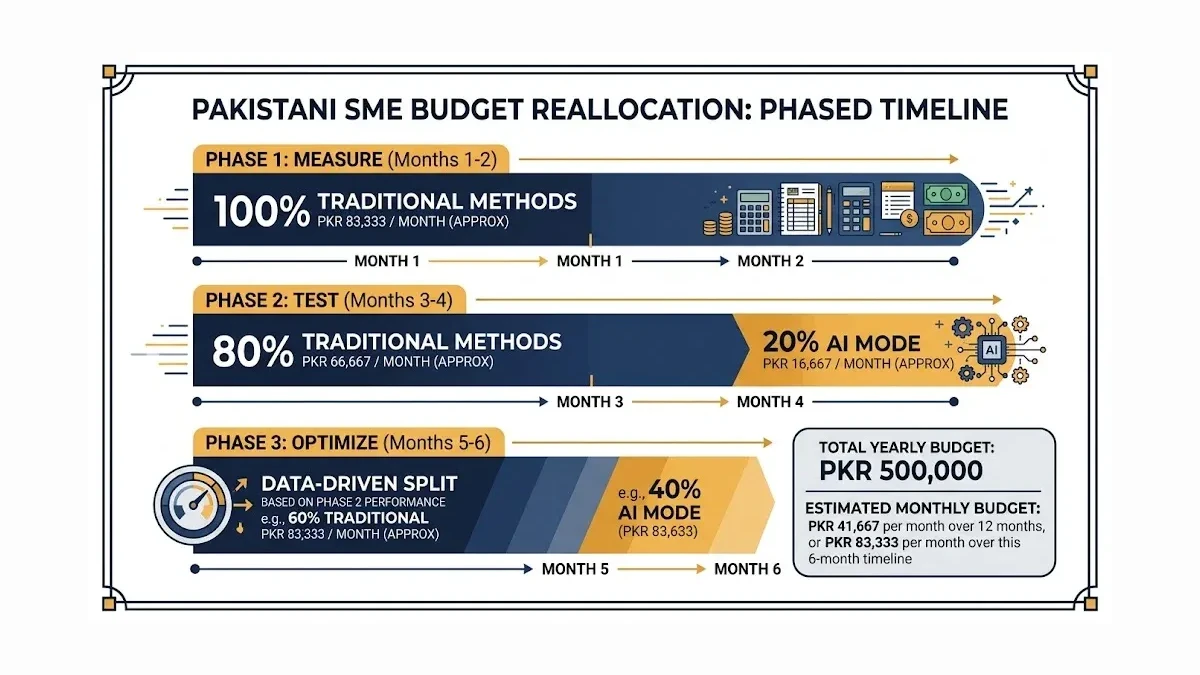
Phase 1 — Measure: Establish a baseline for campaign spend, qualified enquiries, sales and acquisition cost. Check that forms, calls, purchases and WhatsApp interactions are recorded correctly, then distinguish contact attempts from completed commercial outcomes. Review conversion settings for duplication and make sure bidding priorities reflect what the business values.
Use Search Console to understand organic visibility, including its generative AI visibility reports. Those reports concern your website’s presence in search experiences; they are not paid-ad attribution reports. Manual searches can illustrate how results look, but they cannot establish campaign-wide exposure. Keep organic visibility, paid performance and website behaviour separate when diagnosing changes.
Phase 2 — Test: Choose an eligible campaign change with a clear hypothesis. For example, assess whether AI Max improves qualified lead acquisition within an existing Search campaign. Google offers AI Max experiments for this purpose. Define the conversion outcome, acceptable acquisition cost and stopping conditions before launch, and avoid changing the offer or landing page midway through the comparison.
This is a campaign-feature test, not a traditional-versus-AI-Mode placement test. Google says advertisers cannot target AI Mode exclusively or opt out of it separately from Search. A control campaign may also serve in AI-powered experiences. Explain that limitation before presenting results as evidence for a budget move.
Phase 3 — Optimise: Increase investment only when the tested change improves business results after allowing for conversion delays and lead quality. Lower cost-per-lead can conceal weaker enquiries; higher purchase volume can conceal lower margins. Review sales feedback alongside the account dashboard, especially where customers convert by phone or WhatsApp.
Ecommerce businesses should examine revenue, returns and contribution margin. Service businesses should examine appointment quality, completed consultations or signed work. Neither group should assume that AI Mode placements will outperform established Search simply because the query involves comparison or product research.
| Factor | Traditional Google Search placements | AI Mode placements |
|---|---|---|
| Ad format | Established Search ad formats | Eligible text and Shopping ads, depending on market |
| Intent signal | Search query and campaign targeting | Query, with AI-response context for eligible matching |
| Creative requirement | Relevant ads and landing pages | Existing eligible assets; requirements vary by format |
| Measurement | Standard campaign and conversion reports | Included in aggregate campaign reporting |
| Competition | Depends on auction eligibility and targeting | Participates through the Google Ads auction |
| Budget planning | Based on economics and conversion volume | No separately targetable AI Mode budget |
| Best use | Capturing relevant search demand | Reaching relevant demand within AI-led exploration |
| Pakistan availability | Depends on campaign and format eligibility | English-language text ads listed by Google |
Budget allocation framework for Pakistani SMEs:
| Category | Starting position | Decision rule |
|---|---|---|
| Search campaigns | Protect profitable demand | Scale when qualified acquisition remains viable |
| Shopping campaigns | Confirm destination-market eligibility | Judge product sales and margins where supported |
| AI-related campaign tests | Set an affordable experiment limit | Expand only after campaign-level evidence supports it |
| Display / remarketing | Review its contribution to sales | Retain spend that supports a clear business objective |
This framework avoids treating AI Mode as a separate pot of inventory you can purchase directly. Use marketing budget planning to decide how much uncertainty the business can afford. A test should have a commercial purpose and leave enough funding for campaigns that already work.
The same principle applies to automated bidding: choose the outcome carefully. If the account rewards low-value interactions, a larger volume of those interactions can look successful while sales remain flat. Agree what a qualified lead means with the people handling enquiries, then use that definition consistently.
Ask your agency to explain which campaign settings are changing, what reporting can establish and what remains uncertain. A useful proposal names the hypothesis, measurement method and budget limit. It should also explain how results will be judged if enquiries arrive quickly but sales take longer to close.
The tradeoff is straightforward. Moving money on the strength of unsupported placement claims creates avoidable risk. Ignoring relevant campaign improvements can also leave opportunities unexplored. Measure first, test a controllable change, then optimise according to customer value.
WeProms Digital’s Google Ads management and optimisation focuses on campaign structure, conversion quality and budget decisions. An assessment should establish what your account can test and how the results will inform the next decision, without promising an AI Mode-only campaign or a guaranteed performance uplift.
For an account assessment, reach us at hello@weproms.com or WhatsApp +92 300 0133399. Bring the current campaign results and an explanation of which enquiries become customers.
Read next: Prepare your Google Ads for AI Mode in Pakistan · Where your Google Ads show up in Pakistan
Frequently Asked Questions
What are Google AI Mode ads and how do they work?
They are ads shown within Google’s conversational AI Mode search experience. Eligible existing campaigns can participate through the Google Ads auction. Google lists text and Shopping formats across supported markets, with Pakistan currently listed for English-language text ads. Availability of AI Mode itself does not establish availability of every advertising format.
How are AI Mode ads different from traditional Google Search ads?
The surrounding search experience and matching context differ. Ads can match the query directly or, with eligible targeting, use context from the query and AI response. AI Mode is not a separate intent-based bidding system, and text ads do not universally require new conversational creative assets.
Should Pakistani SMEs shift their entire Google Ads budget to AI Mode?
No. Advertisers cannot target AI Mode exclusively, so an AI Mode-only allocation is not a practical campaign setting. Keep funding effective campaigns and test supported changes within an affordable limit. Base increases on qualified enquiries, sales and profitability, while recognising that campaign results include more than AI Mode placements.
What is the minimum budget for AI Mode ads in Pakistan?
A universal rupee minimum is not a sound planning rule. AI Mode participates through eligible existing campaigns rather than a separately purchased campaign type. Set a test budget around your acquisition costs, conversion volume and tolerance for uncertainty. Small accounts may need to consolidate tests to avoid spreading the available evidence too thinly.
How do I track AI Mode ad performance for my Pakistani business?
Use Google Ads conversion reporting alongside GA4 and sales records. Google includes AI Mode ad performance in aggregate campaign reports, so do not label the campaign’s entire return as AI Mode performance. Search Console’s generative AI reports describe organic visibility. Neither those reports nor GA4 alone provides an isolated paid AI Mode acquisition report.
Sources & References
- Think with Google — Your Competitive Advantage in the AI Era
- Google Ads Help — Ads in AI-powered Search experiences
- Google Ads Help — Ask Advisor in Google Ads
- Google Search Central — Search Generative AI performance reports
- Google Ads Help — AI Max experiments
Additional reading from industry feeds:
The illustrations below are conceptual; use the eligibility guidance and budget framework above for decisions. Fixed allocation percentages and timelines in the illustrations are not platform requirements or evidence of expected returns.