
By Abdul Rehman · May 2026
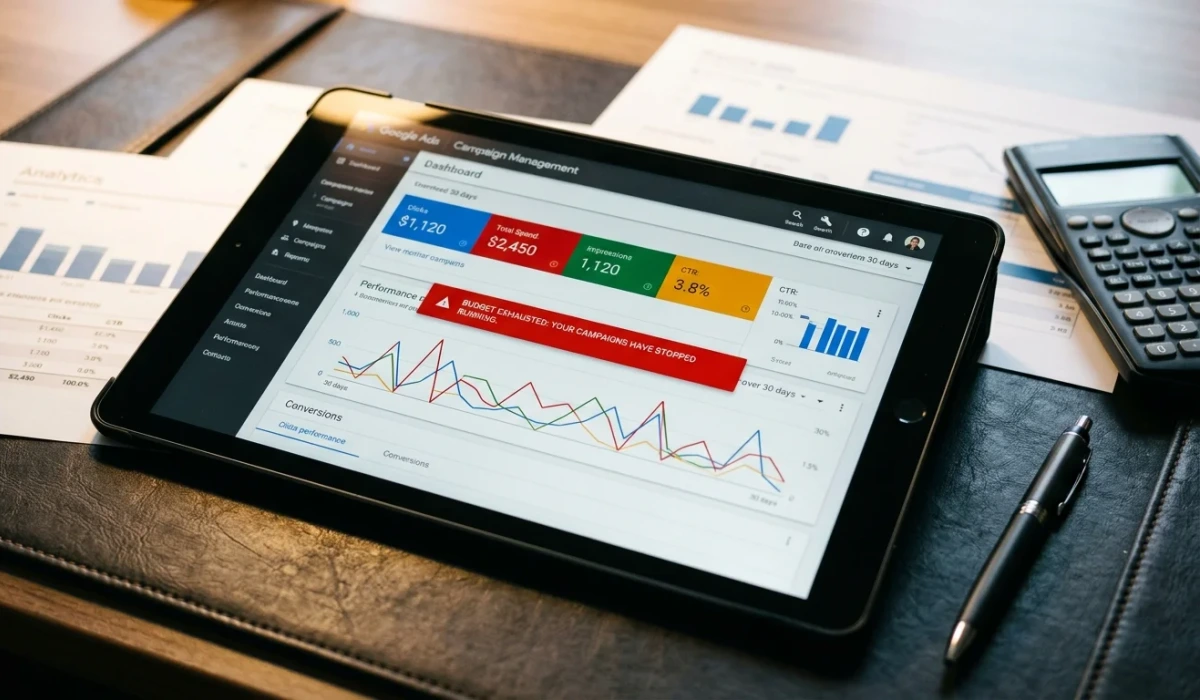
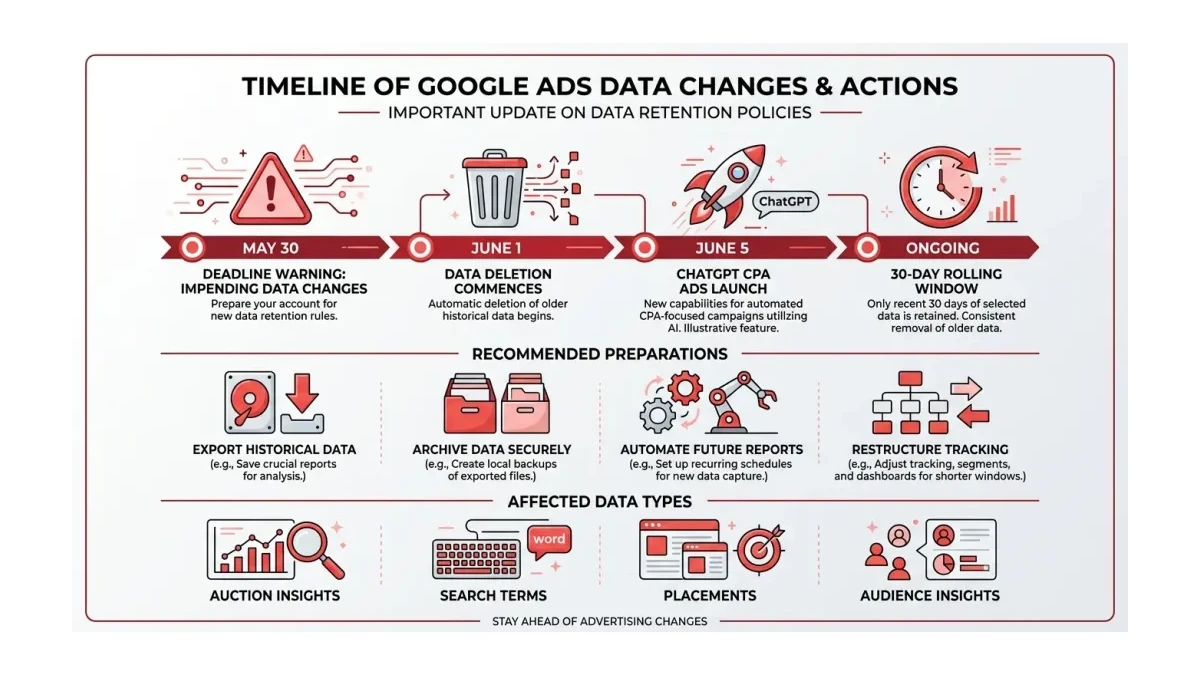
If you run Google Ads for a Pakistani business and have not exported your short-term performance reports, you are about to lose access to auction insights, search term details, and placement data older than 30 days. Google starts deleting this data on June 1, 2026. Pakistani advertisers who rely on historical data for campaign optimization need to act before the deadline.
If you are a Pakistani SME spending between PKR 100,000 and PKR 1,000,000 monthly on Google Ads, and your agency or in-house team uses auction insights reports, search term reports, or placement reports to optimize campaigns, the June 1 data deletion directly affects your ability to make informed bidding and targeting decisions. This is not a future concern. This is a deadline that has already arrived.
Start here. The changes fall into three categories: what Google is deleting, what replaces it, and what Pakistani advertisers need to do before the deadline passes.
First, understand what Google is actually deleting
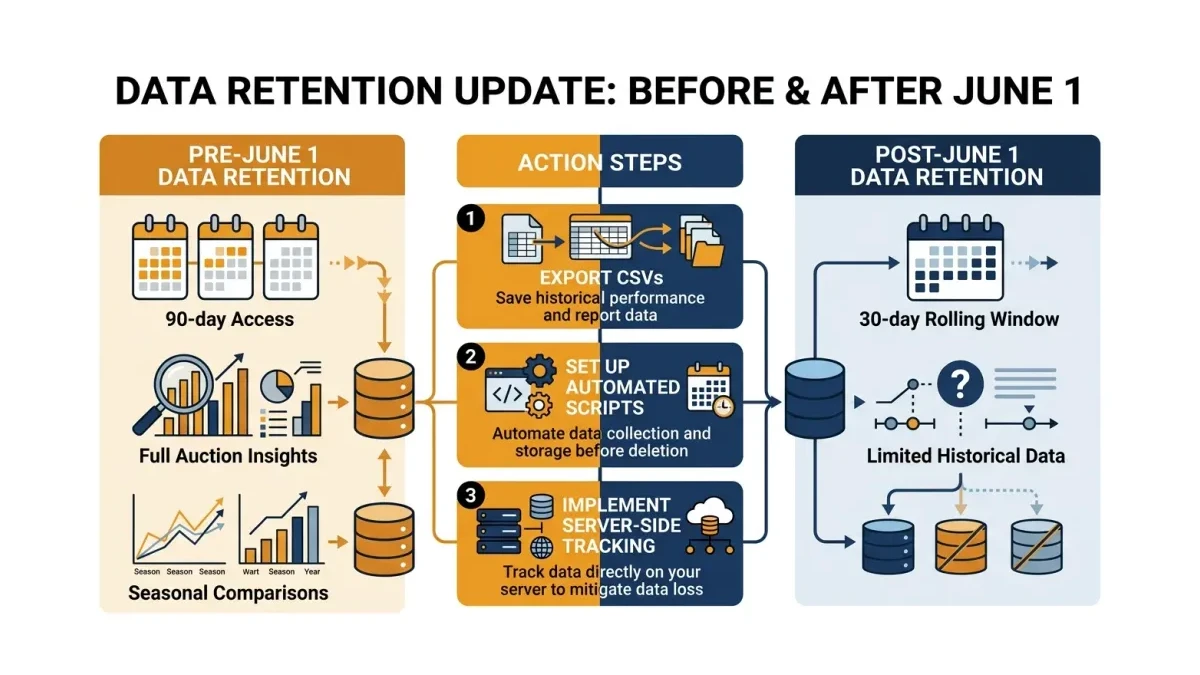
Google announced that short-term performance data — including detailed auction insights, search term reports, placement reports, and audience insights — will be deleted after a rolling 30-day window starting June 1, 2026, as Search Engine Roundtable reported. Previously, this data remained accessible for 90 days or longer depending on the report type.
What this means in practice: if you want to compare your auction insights from March 2026 against May 2026, that comparison becomes impossible after June 1 unless you exported the data beforehand. The same applies to search term reports that show which queries triggered your ads, and placement reports that show where your Display and Video ads appeared.
For Pakistani advertisers running Performance Max campaigns — which Search Engine Journal notes have mixed effectiveness depending on use case — the data deletion is especially problematic. Performance Max already provides limited transparency into where ads appear and which audiences convert. Shortening the data retention window makes optimization harder.
Which means your optimization decisions from July onward will be based on a 30-day memory instead of a 90-day one. Campaigns that require seasonal comparison — Eid ul-Fitr versus Eid ul-Adha performance, Ramadan versus non-Ramadan conversion rates — lose their historical baseline.
Picture this. Your Lahore-based ecommerce brand wants to plan its Hajj season ad spend for 2027. You normally pull last year’s search term reports to identify which queries converted best during the Hajj travel booking window. After June 1, 2026, those detailed reports no longer exist in your Google Ads account unless you exported them. You are planning next year’s budget blind.
Then, export everything before the deadline
The immediate action item is straightforward: export every report you might need for future analysis. Here is the specific process.
Log into Google Ads. Navigate to each of these reports and download them as CSV files for the past 12 months:
1. Auction Insights reports. Go to Campaigns > Auction Insights. Select each active campaign. Set the date range to the last 365 days. Download the CSV. This shows how your impression share, overlap rate, and position above rate compare against every competitor bidding on the same auctions.
2. Search term reports. Go to Keywords > Search Terms. Set the date range to the last 365 days. Download the full report. This shows every actual search query that triggered your ads, along with clicks, impressions, CTR, and conversion data for each term.
3. Placement reports. Go to Content > Placements (for Display and Video campaigns). Download the last 12 months. This shows every website and app where your ads appeared.
4. Audience insights. Go to Audiences > Audience Insights. Download demographic and interest data for the past year.
5. Geographic and device reports. Go to Settings > Locations and Settings > Devices. Download both for the full year.
Store these exports in a shared Google Sheet or cloud folder that your team can access. This data becomes your historical baseline once Google’s deletion takes effect.
For Pakistani businesses using an agency for Google Ads management, confirm that your agency has already initiated these exports. If not, the deadline is days away.
Next, set up Prospects Mode for new customer acquisition
Google simultaneously introduced Prospects Mode — a new campaign setting designed specifically for acquiring new customers rather than retargeting existing ones, as Search Engine Roundtable covered. For Pakistani advertisers, this matters because AI Overviews are absorbing an increasing share of informational search traffic.
According to DigitalApplied’s 2026 data, 64.82% of Google searches now end without a click. Pages ranking in positions 1-3 for queries now covered by AI Overviews have seen a 30% average organic traffic decline, per BrightEdge data via Infinenetech. As organic visibility shrinks, paid search becomes the primary acquisition channel for commercial-intent queries.
Prospects Mode within Google Ads lets advertisers focus their budget on users who have not previously purchased or converted. This is particularly useful for Pakistani ecommerce brands on Shopify, Daraz seller storefronts, and service businesses where customer lifetime value justifies higher acquisition costs.
To activate Prospects Mode, open your Google Ads campaign settings, navigate to the “Customer Acquisition” section, and select “New customers only.” Google will use its first-party data (purchased from its ecosystem including YouTube, Gmail, and Android) to identify users who have not previously interacted with your business. The tradeoff is between reach and precision — Prospects Mode limits your audience size but increases the likelihood of acquiring genuinely new customers.
After that, restructure your data storage
Once you have exported the historical data and enabled Prospects Mode, the next step is building a sustainable data pipeline that does not depend on Google’s retention windows.
The most practical approach for Pakistani SMEs involves three components:
Google Sheets or Looker Studio dashboards. Set up automated weekly exports from Google Ads into a Google Sheet using Google Ads Scripts. This free automation runs weekly, appending new data to your historical archive. Looker Studio can then visualize trends across any time range — not just Google’s 30-day window.
Server-side conversion tracking. As covered in our server-side tracking guide, implementing server-side tracking through Google Tag Manager ensures your conversion data lives on your own infrastructure, not only in Google’s walled garden.
CRM integration. Connect Google Ads to your CRM — HubSpot, Zoho, or even a structured Google Sheet — so that lead and customer data flows into a system you control. This provides attribution data independent of Google’s retention policies.
For businesses already addressing ad scheduling optimization for Pakistani Google Ads, adding data export automation follows the same logic: take control of the data layer before platform changes remove your access.
At this point, adapt your campaign strategy for AI-era Google Ads
The data deletion and Prospects Mode changes are not isolated events. They are part of Google’s broader shift toward AI-mediated search. Google is also testing 1st order price labels on Shopping Ads and rolling out new Google Discover short URLs for publisher profiles, indicating that the search experience is becoming more AI-curated across surfaces.
For Pakistani advertisers, this means three strategic adjustments:
1. Shift budget toward bottom-funnel commercial queries. AI Overviews absorb informational traffic (40% decline for informational content). Commercial and transactional queries retain more click-through because AI answers cannot complete a purchase. Focus your Google Ads spend on “buy,” “price,” “near me,” and brand-specific queries where AI Overviews have less impact.
2. Increase reliance on first-party conversion data. As Peec AI’s research on AI Overview tracking demonstrates, AI search traffic is harder to attribute than traditional organic traffic. Server-side conversion tracking, CRM integration, and proper GA4 configuration are no longer optional — they are the foundation of accurate measurement.
3. Monitor ChatGPT advertising developments. OpenAI launched cost-per-action ads inside ChatGPT on June 5th, according to Digiday’s reporting. For Pakistani businesses with international customers or tech-savvy domestic audiences, ChatGPT ads represent a new paid channel competing with Google Ads for attention and budget.
The outcome of these adjustments is a Google Ads strategy that accounts for reduced organic traffic, shorter data retention windows, and emerging AI advertising surfaces — all of which define the new competitive landscape for Pakistani advertisers.
| Data Type | Before June 1 | After June 1 | What to Do |
|---|---|---|---|
| Auction insights | 90-day access | 30-day rolling | Export 12 months of CSVs now |
| Search term reports | 90-day access | 30-day rolling | Set up weekly automated exports |
| Placement reports | 90-day access | 30-day rolling | Archive all Display/Video placements |
| Audience insights | 90-day access | 30-day rolling | Download demographic data for all campaigns |
| Conversion data | Platform-dependent | Platform-dependent | Implement server-side tracking for independent archive |
From here, build a data-independence roadmap
The June 1 deadline is the first of what will likely be multiple data retention changes as Google restructures its advertising platform around AI. Pakistani advertisers who build data independence now — through exports, server-side tracking, and CRM integration — avoid scrambling when the next change arrives.
Read next: AI Mode Ads Preparation Steps for Pakistani Advertisers · Ad Scheduling Fix for Pakistani Google Ads Budget
At WeProms Digital, Pakistan’s best Google Ads management agency, we help Pakistani advertisers navigate Google’s platform changes while maintaining full control of their performance data. Whether you need to export historical reports before June 1, implement server-side tracking, or restructure campaigns for the AI search era, reach out at hello@weproms.com, WhatsApp +92 300 0133399, or weproms.com/contact-us.
Frequently Asked Questions
What specific data is Google deleting from Google Ads on June 1?
Google is shortening the retention window for detailed performance data including auction insights, search term reports, placement reports, and audience insights from approximately 90 days to a rolling 30-day window. Aggregated campaign-level data (impressions, clicks, conversions, spend) remains available for longer periods. The deletion affects granular reporting used for optimization decisions.
Do I need to export data if I use a Google Ads agency in Pakistan?
Yes. Confirm with your agency that they have scheduled exports for all affected reports. Many agencies rely on live Google Ads reports for optimization and may not have archived historical data independently. Request CSV exports of auction insights, search terms, and placements for the past 12 months before June 1.
How does Prospects Mode work and should Pakistani businesses enable it?
Prospects Mode is a Google Ads campaign setting that focuses ad delivery on users who have not previously purchased from your business. Google uses its first-party data to identify new versus returning customers. Pakistani ecommerce brands with strong customer lifetime value — such as subscription services, repeat-purchase products, or high-ticket items — benefit most from this mode.
Will this affect my Google Ads performance or just reporting?
Primarily reporting and optimization. Your ads will continue running and Google’s automated bidding will continue working. The impact is on your ability to analyze performance over extended periods, identify seasonal trends, and make manual optimization decisions based on historical patterns. Without exported data, you lose the ability to compare performance across timeframes longer than 30 days.
Can WeProms help me export my Google Ads data and restructure campaigns?
Yes. WeProms Digital provides Google Ads management and optimization services that include historical data export, automated reporting pipelines, server-side conversion tracking setup, and campaign restructuring for the AI search era. Contact hello@weproms.com or WhatsApp +92 300 0133399 for an assessment.
Sources & References
- Search Engine Roundtable — Google Ads to Delete Short-Term Performance Data June 1st — 2026
- DigitalApplied — Zero-Click Search Statistics 2026: Complete Data — 2026
- Infinenetech — AI Search vs Traditional SEO Traffic Decline 2026 — 2026
- Digiday — OpenAI Turns on Cost-Per-Action Ads Inside ChatGPT — 2026
- Peec AI — AI Overviews Is the Most Undertracked AI Search: 500,000 Prompts Show Why — 2026
- Search Engine Roundtable — Google Ads Introduces Prospects Mode for New Customer Acquisition — 2026
- Search Engine Roundtable — Google Discover Tests Short URL for Publisher Profile Pages — 2026
Additional reading from industry feeds: