Fix the 40% Ad Data Gap: Server-Side Tracking for Pakistani SMEs
By Hamza Ali · May 2026
A Lahore ecommerce store spending PKR 300,000 monthly on Meta and Google Ads pulled its performance report last quarter. Google Ads reported 1,200 conversions. Meta Ads Manager claimed 980. GA4 showed 640. Three platforms, three different numbers, and not one matched the 1,470 orders fulfilled through Shopify. That gap — roughly 56% of conversions invisible to at least one platform — is standard operating condition for most Pakistani businesses running digital ads in 2026.
Here’s the thing. The fix is simpler than the problem suggests.
Where the money actually disappears
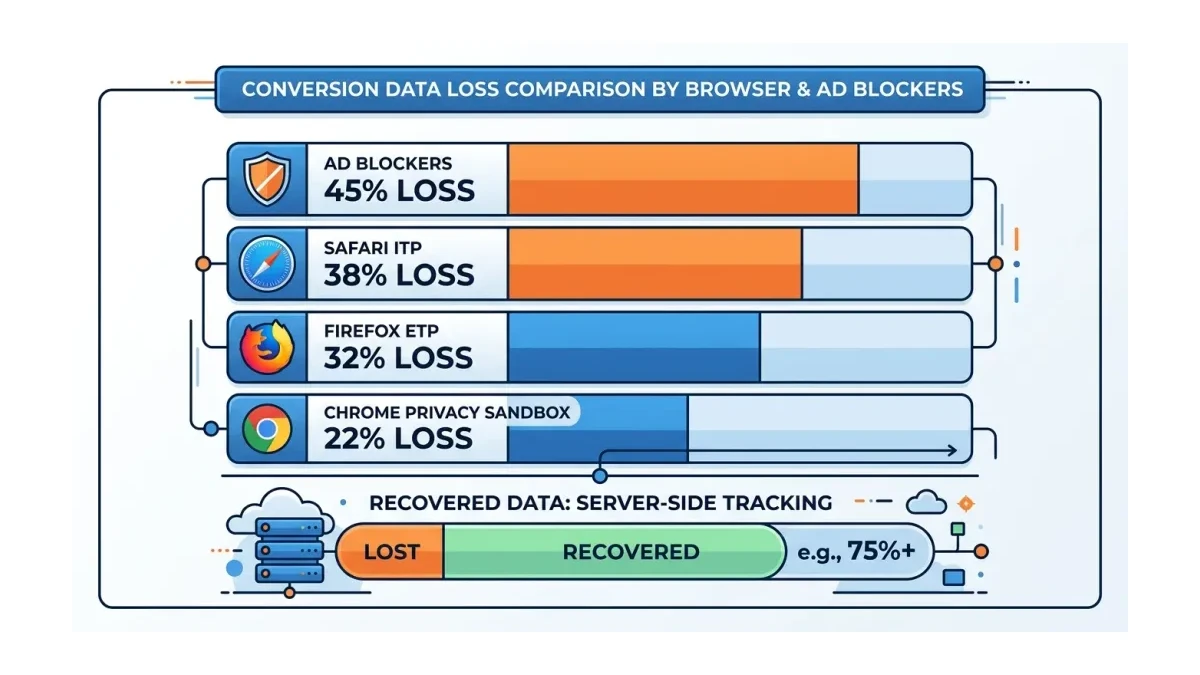
Browser-side pixel tracking — JavaScript code that fires on a visitor’s browser when they complete a purchase or submit a form — loses between 20% and 40% of conversion events before any analytics platform records them, according to Martech Zone’s analysis of pixel conversion loss. Apple’s Intelligent Tracking Prevention (ITP) in Safari, Firefox’s Enhanced Tracking Protection (ETP), Chrome’s Privacy Sandbox restrictions, and ad-blocking extensions each strip cookies and block third-party scripts independently.
In Pakistan, where Safari holds roughly 15% of mobile browser share among iPhone users in Lahore and Karachi, and ad-blocker adoption among urban professionals continues climbing, the compounding data loss means most SMEs optimize ad campaigns on incomplete information. The missing conversions are not random, either. Higher-value customers — those using iPhones, those running ad blockers, those who research across multiple sessions — are disproportionately lost.
Consider a Karachi-based D2C brand spending PKR 500,000 per month on Facebook and Instagram ads. The Meta pixel fires on the “Thank You” page after each purchase. But a customer who clicked the ad on Safari, waited two days, then returned via a direct URL to complete the order? The pixel already expired the cookie. Meta attributes zero revenue to that click. The advertiser sees a ROAS — Return on Ad Spend, the ratio of revenue generated to money spent on ads — of 2.1x. The real ROAS sits closer to 3.4x.
Budget decisions made on the 2.1x number lead to cutting campaigns that are actually profitable. This happens every month across Pakistani ad accounts. If this sounds like your Google Analytics audit findings, the root cause is likely tracking infrastructure, not campaign strategy.
Running ads without server-side tracking is like shipping 100 orders via TCS or Leopards Courier and receiving delivery confirmation for only 60 of them. The other 40 could be successful deliveries or lost packages. You would never know which, and you would make routing decisions based on the wrong numbers.
What server-side tracking actually does
Book a free strategy call - we'll audit your current setup and identify the highest-impact fixes.
Server-side tracking moves the measurement code off the visitor’s browser and onto your own web server. Instead of JavaScript firing inside Safari where ITP kills it, the conversion event travels from your server directly to Google Analytics, Meta Conversions API, Google Ads, and any other connected platform. The browser never sees the request. Ad blockers cannot intercept it. Cookie expiration becomes irrelevant because the server holds the match data.
The standard implementation runs through Google Tag Manager Server-Side (GTM SS), which acts as a relay between your website and all analytics destinations. Your site sends a single HTTP request to your GTM SS container hosted on Google Cloud Platform. The container then distributes the data to GA4, Meta Conversions API, Google Ads, and other platforms simultaneously. One incoming request, multiple outbound signals, zero browser dependency.
For Pakistani SMEs, this matters because it recovers conversions that pixel-only setups categorically miss: cash-on-delivery orders processed via phone calls, WhatsApp-attributed sales, delayed purchases spanning multiple sessions, and Safari or Firefox users whose cookies were stripped between visits. Pakistan’s ecommerce market runs 60-70% on cash-on-delivery according to industry estimates from DataReportal and local payment processors. A customer clicks a Google ad on Monday, browses on mobile, and places a COD order on Wednesday through a phone call. The browser pixel never fires because the transaction occurred offline.
Without server-side tracking, that entire conversion path stays permanently invisible. Multiply this across hundreds of monthly COD orders, and the scale of missing data becomes a strategic problem, not just a technical one.
“Pixel conversion loss is real. Server-side tracking adoption is overdue.” — Martech Zone, 2026
The broader trend toward zero-click search behavior makes accurate conversion measurement even more critical. As search results pages satisfy more queries without requiring a click, the clicks that do arrive carry higher intent — but only if your tracking captures them.
The cost to fix this in Pakistan
Server-side tracking setup costs fall into clear categories:
| Component | Typical Cost (PKR) | Timeline | Notes |
|---|---|---|---|
| GTM Server-Side container setup | 80,000 - 150,000 | 5-10 days | One-time, includes GCP provisioning |
| Meta Conversions API integration | 30,000 - 60,000 | 2-4 days | Added to existing GTM SS container |
| Google Ads Conversion API | 20,000 - 40,000 | 1-3 days | Included with GA4 server-side setup |
| Monthly cloud hosting (GCP) | 3,000 - 8,000 | Ongoing | Scales with traffic; free tier covers ~50K events |
| Quarterly maintenance | 15,000 - 25,000 | Quarterly | Monitoring, debugging, schema updates |
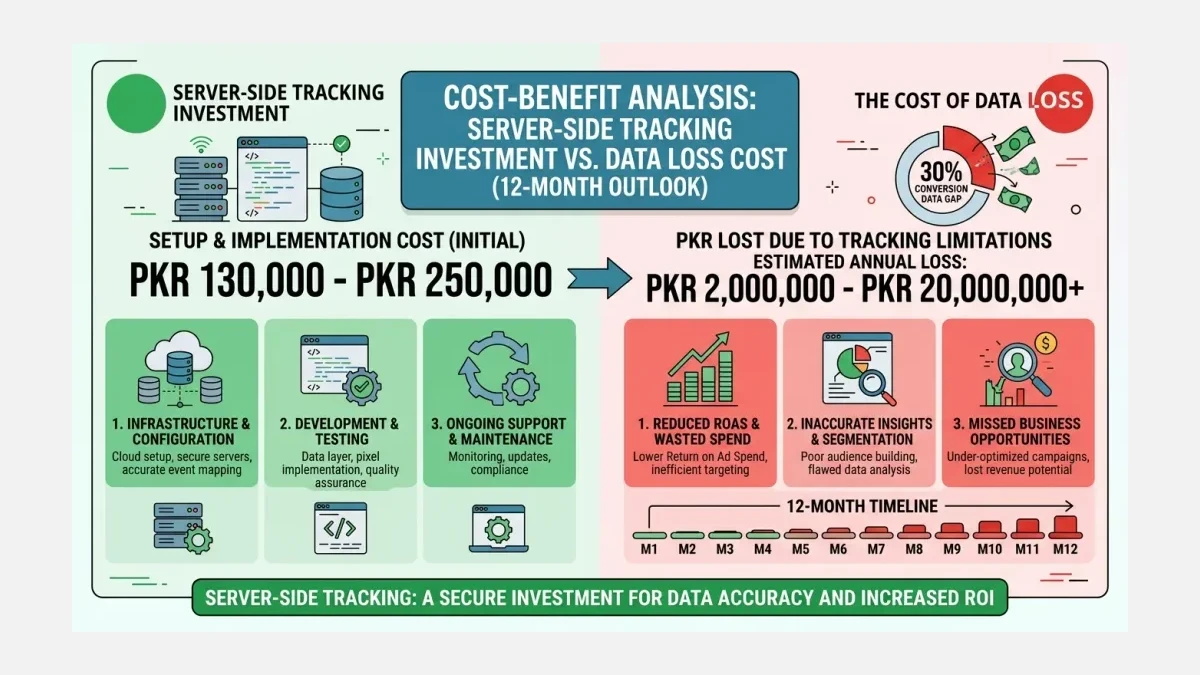
Total initial investment: PKR 130,000 to PKR 250,000. Monthly operating cost: PKR 18,000 to PKR 33,000.
Compare this to the cost of continuing without it. A business spending PKR 500,000 monthly on ads with 30% data loss systematically underestimates ROAS and cuts budgets on profitable campaigns. Over 12 months, the cumulative cost of bad optimization decisions compounds well beyond the one-time fix.
For businesses also dealing with ad fraud blind spots in Pakistani ecommerce, server-side tracking adds a secondary benefit: cleaner data makes it easier to distinguish between legitimate traffic quality issues and measurement infrastructure failures.
What to check right now
Open GA4. Navigate to Advertising, then Attribution, then Conversion paths. Compare assisted conversions against last-click conversions. If the gap between what your ad platforms report and what GA4 records exceeds 20%, pixel data loss is already distorting optimization decisions.
Next, open Meta Events Manager. Look at the “Event Match Quality” score for Purchase or Lead events. Scores below 6.0 indicate significant data loss — Meta is not receiving enough matching parameters to attribute conversions reliably. Server-side tracking typically pushes match quality above 8.0 by sending additional parameters (phone number, email, IP address) from the server where they are not blocked.
Finally, pull your Shopify, WooCommerce, or Daraz order report for the same period. Compare actual fulfilled orders against the combined conversions reported by GA4, Meta, and Google Ads. The difference is your data gap. Most Pakistani SMEs find it sits between 25% and 45%.
The 15-minute fix checklist
How we helped a Pakistani business achieve measurable results.
-
Audit your current data gaps. Pull conversion counts from GA4, Meta Ads Manager, Google Ads, and your ecommerce backend for the same 30-day window. Document every discrepancy. This baseline tells you exactly how much revenue your tracking misses.
-
Provision a GTM Server-Side container on Google Cloud Platform. The free tier handles up to 50,000 events per month — sufficient for most Pakistani SMEs generating under 5,000 monthly orders. Use the App Engine setup documented in Google’s server-side tagging guide.
-
Connect Meta Conversions API through the GTM SS container. Meta’s Event Match Quality score begins improving within 48 hours of activation. Track this score daily for the first two weeks.
-
Enable Google Ads Conversion API to recover Google conversion data lost to browser restrictions. This runs through the same GTM SS container — no additional infrastructure needed.
-
Map your offline conversion paths. For COD-heavy businesses, configure server events that capture phone orders and WhatsApp-attributed sales. This requires linking your CRM or order management system to the GTM SS container.
-
Run a parallel validation period. Keep pixel tracking active alongside server-side for 30 days. Compare both datasets. The server-side numbers should align much closer to your actual order count.
-
Set a quarterly review schedule. Cloud hosting costs, match quality scores, and conversion recovery rates need monitoring every 90 days. Server-side tracking is infrastructure, not a set-and-forget tool.
For businesses already seeing the effects of AI search conversion rate budget waste, fixing the measurement layer is the prerequisite to fixing the strategy layer. You cannot optimize what you cannot measure accurately.
Read next: AI Mode Traffic Audit for Pakistani SMEs Using Google Analytics · AI Search Revenue Playbook for Pakistani Ecommerce
If your ad platform reports and your actual revenue numbers do not match, that gap has a name and a fix. At WeProms Digital, Pakistan’s leading GA4 setup agency, we build server-side tracking infrastructure for Pakistani ecommerce brands, B2B companies, and service businesses across Lahore, Karachi, and Islamabad. Reach out at hello@weproms.com, WhatsApp +92 300 0133399, or weproms.com/contact-us.
Frequently Asked Questions
How much does server-side tracking cost for a Pakistani SME?
Initial setup ranges from PKR 130,000 to PKR 250,000 depending on platform complexity and the number of ad platforms connected. Monthly cloud hosting on Google Cloud Platform runs PKR 3,000 to PKR 8,000, with a free tier covering up to 50,000 events. Most Pakistani SMEs recover the setup cost within 2-3 months through improved ROAS from better conversion data.
Will server-side tracking fix my cash-on-delivery attribution problem?
Partially. Server-side tracking captures online-to-offline paths better than browser pixels, but COD orders placed entirely via phone call or WhatsApp require additional configuration. A complete setup maps phone orders and WhatsApp-attributed sales back to the original ad click using server-side events and CRM integration. WeProms Digital provides this as part of its GA4 setup and custom configuration service.
Do I still need pixel tracking after implementing server-side?
Yes. Run both in parallel. Pixel tracking captures browser-side engagement signals — scroll depth, page views, button clicks — that server-side tracking alone cannot see. The recommended setup uses server-side as the primary conversion source and pixel tracking as a supplementary behavioral data layer.
Why does GA4 show fewer conversions than my ad platforms?
Browser restrictions in Safari, Firefox, and Chrome prevent tracking pixels from firing on 20-40% of user sessions. Each ad platform also uses different attribution windows and matching logic, producing different numbers from the same user activity. Server-side tracking closes this gap by sending data directly from your server, bypassing browser restrictions entirely.
How long does server-side tracking setup take for a Pakistani business?
A standard GTM Server-Side container with Meta Conversions API and Google Ads Conversion API takes 7-14 business days to implement, test, and validate. Adding CRM integration for offline conversions adds another 5-7 days. The parallel validation period runs for 30 days after launch before switching primary attribution.
About WeProms Digital
WeProms Digital is Pakistan’s leading analytics and conversion tracking agency, headquartered in Lahore, serving Pakistani SMEs, ecommerce brands, and B2B teams across Lahore, Karachi, Islamabad, Rawalpindi, Faisalabad, and Multan.
The team specializes in GA4 setup, server-side tracking implementation, and conversion API configuration, with a track record of recovering 20-40% of previously invisible conversion data for Pakistani advertisers.
Get in touch: hello@weproms.com · WhatsApp +92 300 0133399 · weproms.com/contact-us
Sources & References
- DigitalApplied — Zero-Click Search Statistics 2026: Complete Data — 2026
- Google Developers — Server-Side Tagging Documentation — 2026
- Infinenetech — AI Search vs Traditional SEO Traffic Decline 2026 — 2026
- Search Engine Journal — Google Search Sessions Show How Users Pause, Scroll, Reconsider Before Clicking — 2026
- Peec AI — AI Overviews Is the Most Undertracked AI Search: 500,000 Prompts Show Why — 2026
- Tocanan — Google AI Overview Citation Surfaces 2026 — 2026
Additional reading from industry feeds:
- Martech Zone — Pixel Conversion Loss is Real. Server-side Tracking Adoption is Overdue
- MarTech Series — Measured Launches MCP Server to Bring Marketing Performance Data into AI Platforms