By Sara Khan · May 21, 2026
Last updated: May 2026.
Most Pakistani marketing departments still measure success by monthly organic traffic numbers, and the conviction that more visitors automatically means more revenue drives SEO budget decisions from Lahore advertising agencies to Karachi ecommerce operations.
That assumption is weaker in an AI-search environment. Visits from AI answers, AI assistants, and cited recommendations may be fewer, but they can be more qualified because the user has already compared options before clicking. Pakistani SMEs spending large monthly retainers purely to grow traffic volume may be funding the wrong metric.
The traffic number that stopped paying bills
AI Overviews and AI answers appear unevenly by query type and market. When AI-generated summaries answer a question directly, organic clicks can decline even if rankings do not. Pakistani SEO teams should investigate which query groups are affected instead of treating every traffic drop as a ranking failure.
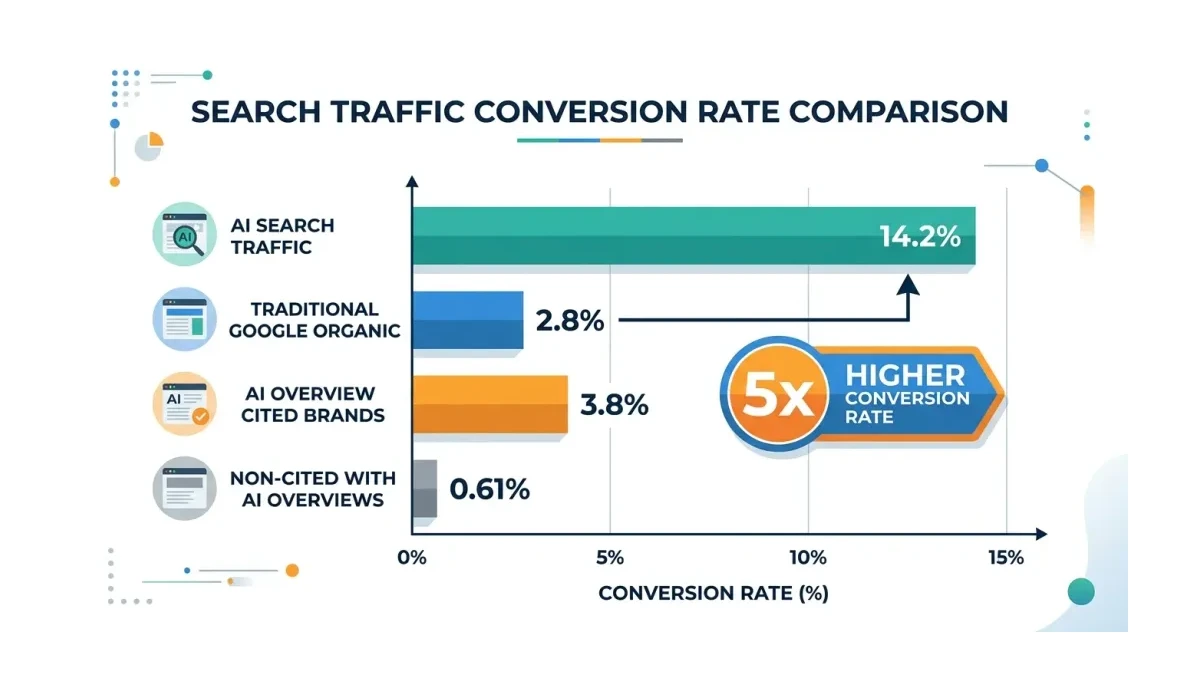
The pattern repeats. Traffic from traditional search was already low-value for most Pakistani businesses. Many organic visitors never purchase, call, or submit a form. If AI answers reduce low-intent informational clicks, the remaining visits may be more commercially useful. That is why lead quality, assisted conversions, and branded search growth matter alongside sessions.
Consider the comparison to foot traffic in Liberty Market, Lahore. A shopkeeper measuring success by how many people walk past the storefront sees impressive numbers on busy days. But only purchases pay the rent. The people walking past are browsing, comparing, killing time. AI Mode’s zero-click behavior is the digital equivalent of people walking through the market without entering the shop — they got the information they needed from the window display. The people who do enter — who click through from an AI response — have already been told by a trusted source that your shop has exactly what they need. That is a fundamentally different visitor than someone who clicked the third blue link on a Google results page.
What actually drives higher-quality AI-referred visits
Higher-quality AI-referred traffic, where it appears in analytics, often stems from a fundamental difference in user behavior that many marketing reports fail to capture. Traditional Google searches are exploratory: a Karachi restaurant owner types “marketing agency” and clicks through five to seven results over twenty minutes before forming a preliminary opinion. AI-style queries are often longer and more conversational than old keyword fragments: “which marketing agency in Lahore handles Google Ads for restaurants with under PKR 500,000 monthly budget.”
By the time a user clicks through from an AI Mode response, the AI has already presented a recommendation, compared alternatives, and explained why the recommended business fits the user’s specific requirements. The visitor arrives pre-qualified. For a Rawalpindi real estate developer appearing in Perplexity’s response to “best housing societies near Islamabad for families under PKR 80 lakh,” the click-through comes from someone who has already been pre-sold on the concept and is now verifying the recommendation against their own criteria.
This behavioral shift means AI search traffic bypasses the entire top-of-funnel research phase that traditional search required six separate website visits to complete. The AI has already condensed that research into a single response with cited sources and comparative analysis. What remains for the business website is bottom-of-funnel confirmation: price verification, service details, contact information, and trust signals like reviews and case studies.
Treat AI-referred visitors as a separate quality segment, not just another organic session bucket.
The underlying mechanic is measurable and consistent across industries. Being cited or clearly mentioned in an AI answer can act like a trust signal. Even when the user does not click immediately, the brand exposure can support direct searches, WhatsApp enquiries, and later comparison behaviour. A Pakistani business that appears in ChatGPT’s recommendation for “best SEO agency in Islamabad” benefits even from users who never click the provided link — the brand recognition carries over to direct searches, WhatsApp inquiries, and word-of-mouth conversations at industry events.
The SEO budget trapped in informational queries
Book a free strategy call - we'll audit your current setup and identify the highest-impact fixes.
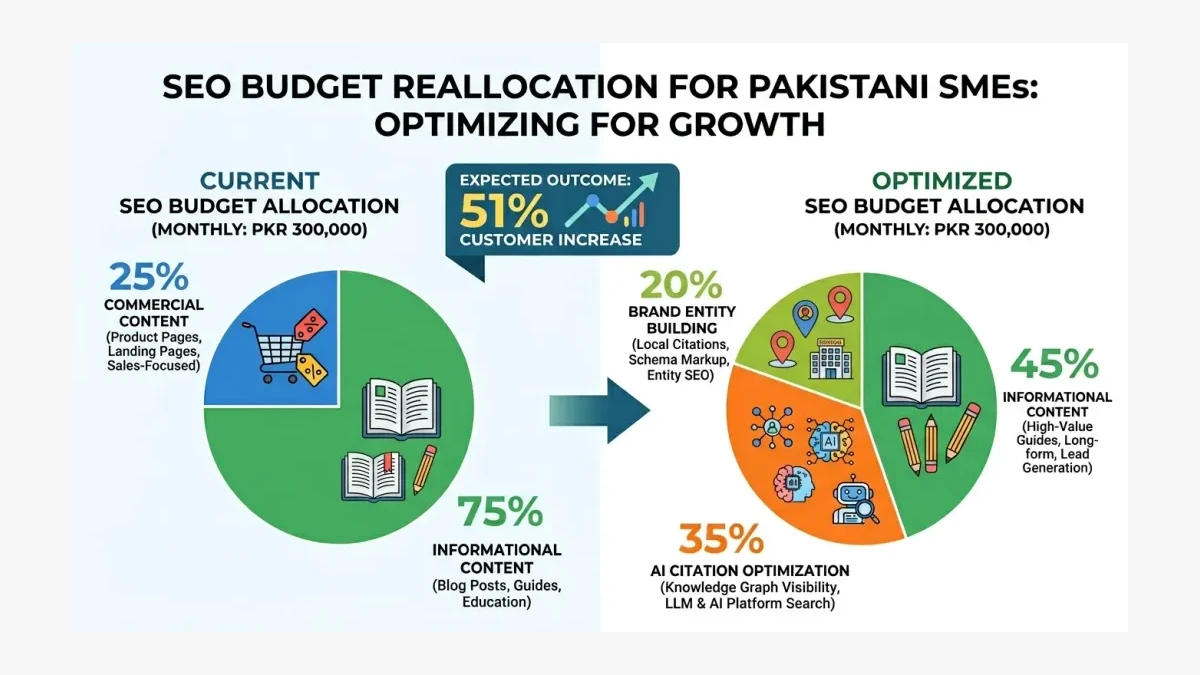
Pakistani businesses spending PKR 200,000-500,000 monthly on SEO retainers focused on traffic volume face a structural budget misallocation that compounds every month. The majority of SEO budgets in Pakistan target informational keywords — “what is digital marketing,” “how to run Facebook ads,” “ecommerce tips Pakistan” — precisely the queries where AI answers and rich SERP features are increasingly common. The traffic most likely to convert comes from commercial and branded queries where the searcher is already comparing named providers, prices, locations, or proof.
The misallocation shows up when reports celebrate more visitors but sales stay flat. A Lahore ecommerce store may be better served by improving category pages, product schema, internal links, and conversion tracking than by publishing another broad informational article.
What actually drives this improvement is not adding more content or targeting more keywords. It is restructuring existing content so that AI engines can extract, verify, and cite specific passages. Research and practitioner tests suggest that clear sourcing, concise answer blocks, and well-structured pages can improve how AI systems understand content. The optimization is structural, not volumetric. Pakistani businesses that have invested PKR 500,000-2,000,000 in content over the past two years already possess sufficient material. The structure is the problem, not the substance.
This connects directly to the argument that ranking reports stopped paying bills eighteen months ago. Rankings for informational keywords generate traffic numbers that look impressive in monthly reports. But the revenue comes from the commercial queries where AI Mode is making purchasing recommendations, and those require a fundamentally different content approach.
The content structure that earns AI citations
AI engines cite content differently than traditional search ranks it. AI systems do not cite every page they retrieve. Content structure — not only length — influences whether a page is easy to summarize, verify, and reference. Pakistani businesses that have built 3,000-word comprehensive guides targeting traditional search rankings may discover that a competitor’s 800-word article with better front-loaded data and clearer entity density earns more AI citations.
For Pakistani businesses, every page on their website must be restructured for extraction. Each paragraph must be self-contained and information-dense, containing specific numbers, named entities, or direct answers to commercial questions. A product page for a Multan furniture store must lead with price ranges in PKR, material specifications, delivery coverage areas, and comparison data — exactly the information an AI engine would extract when a user asks “best furniture stores in Multan with delivery under PKR 50,000.”
This restructuring does not require new content creation. It requires reorganizing existing content so the most citation-worthy information appears in the first 300 words of every page. As analysis of AI Overviews and Pakistani traffic patterns has shown, content quality — defined as extractable, information-dense, and structured — matters more than content quantity.
The compounding cost of ignoring this shift
Google continues to expand AI-powered search features and language coverage. Pakistan-facing businesses should expect search behaviour to keep shifting toward longer, more conversational queries.
Pakistani businesses that continue optimizing exclusively for traditional search rankings will find themselves invisible in the fastest-growing search channel available. The invisibility compounds because AI engines build persistent knowledge graphs from cited sources. A business that earns a citation in Google AI Mode or ChatGPT today maintains that citation advantage for months, as AI systems incorporate cited entities into their training data and retrieval indices. The inverse is also true: businesses that are not cited now face an increasingly steep climb to citation as competitors establish themselves as authoritative sources in AI knowledge bases. The advantage goes to businesses that make their commercial pages clearer, better sourced, and easier to evaluate before competitors do.
The principle is straightforward. Stop optimizing only for visitors who never buy, and start optimizing for qualified demand: commercial pages, proof, pricing clarity, tracking, and trust signals. Traffic was never the revenue. Qualified enquiries and sales are the revenue.
Read next: Why Ranking Reports Don’t Pay Bills in the GEO Era · AI Overviews Are Not Killing Pakistani Traffic — Content Quality Is
At WeProms Digital, a Pakistan-focused CRO agency, the team specializes in this exact transition — from vanity traffic metrics to revenue-driven AI search optimization. The agency audits Pakistani businesses’ current AI search visibility across Google AI Mode, ChatGPT, and Perplexity; identifies specific citation gaps against competitors; and restructures existing content for AI extraction without requiring new content production. Reach out at hello@weproms.com, WhatsApp +92 300 0133399, or weproms.com/contact-us to discuss an AI citation optimization strategy.
Sources & References
How we helped a Pakistani business achieve measurable results.