Recover Lost COD Revenue: Server-Side Tracking for Pakistani Stores
Last updated June 2026 · By Hamza Ali, WeProms Digital.
A Lahore fashion brand spends PKR 800,000 a month on Meta ads. Roughly nine out of ten orders land as cash on delivery. When the team opens GA4, the numbers never match the courier sheet. Purchases are missing. Revenue sits well below the bank deposit. The brand scales the campaigns GA4 calls winners, then watches margins collapse when the courier returns start piling up. The ads were never the problem. The measurement was.
The same story repeats across Shopify and WooCommerce stores in Karachi, Faisalabad, and Islamabad. Cash on delivery still drives close to 90 percent of Pakistani online orders, which means the link between an ad click and a delivered parcel depends entirely on tracking that the browser can break at any moment. Fix that tracking layer and the whole account starts making sense.
The setup that burns your budget
Most Pakistani stores run client-side tracking. That means every event, pageviews, add to cart, checkout, purchase, fires from a JavaScript tag inside the shopper’s browser. Client-side tracking sends analytics data from the visitor’s browser to platforms like GA4 and the Meta Pixel. The browser, not your server, is the messenger. And the browser lies.
Three forces break that messenger every day. Ad blockers strip tracking scripts before they load, so the event never fires. Safari Intelligent Tracking Prevention, or ITP, shortens cookie lifespans so returning visitors show up as brand new. Early tab closes mean a customer finishes checkout on a slow connection and closes the page before the purchase tag runs. The order exists. The tracking does not.
Picture ordering from Foodpanda. The rider delivers your biryani, but the app never confirms pickup in the system. From Foodpanda’s side the order looks incomplete, even though the food arrived. Client-side tracking has the exact blind spot. The conversion happened. The platform never saw it.
Here’s the thing. Pakistani stores compound this with cash on delivery. A COD order has two realities. The first is the online confirmation, what GA4 records. The second is the delivered parcel, what your courier deposits at your door. When GA4 undercounts the first by 10 to 20 percent, and 25 to 35 percent of COD parcels return undelivered, you end up optimizing against numbers that describe neither reality.
Where the money actually disappears
Book a free strategy call - we'll audit your current setup and identify the highest-impact fixes.
Cash on delivery is the dominant payment method in Pakistan because trust in prepaid digital payments is still thin. Daraz, independent Shopify sellers, and WhatsApp-led brands all lean on COD for the same reason. Shoppers will not pay first for a brand they cannot verify. That trust gap is real, and it shows up in your attribution as a permanent fog.
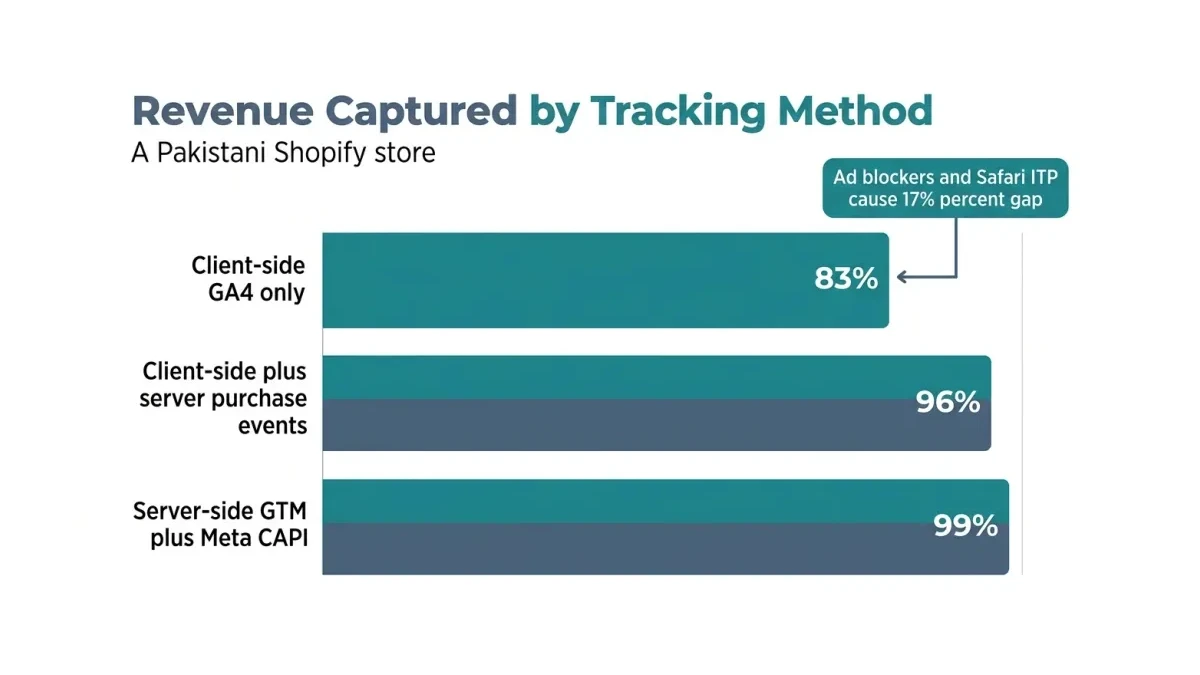
The fog costs money in two places. First, GA4 and the Meta Pixel undercount revenue. Industry analysis of Shopify stores finds client-side tracking alone misses between 10 and 20 percent of actual revenue, even when the setup is technically correct. Pakistani stores with heavy iOS and ad-blocker audiences sit at the high end of that range. Second, COD returns, known as return to origin or RTO, silently destroy margin that the ad platforms never see. A campaign can look profitable on a 2 percent conversion rate and still lose money once 30 percent of parcels come back.
Most teams miss this. They read GA4 ROAS, see a number above one, and increase budget. The 2 percent withholding tax on COD parcels introduced in Budget 2025 makes every returned parcel even more expensive, because the seller eats logistics, packaging, and now tax overhead on an order that never converted. Tracking that misses 15 percent of purchases hides which campaigns actually deliver parcels versus which ones merely deliver clicks.
The practical damage is concrete. A store spending PKR 800,000 a month on Meta, losing 15 percent of its purchase signal, will misread its best and worst campaigns. It keeps spending on audiences that produce clicks but not delivered orders. It cuts budgets on campaigns that quietly drive high-intent COD buyers, simply because those buyers blocked the tag.
What we see across Lahore and Karachi accounts
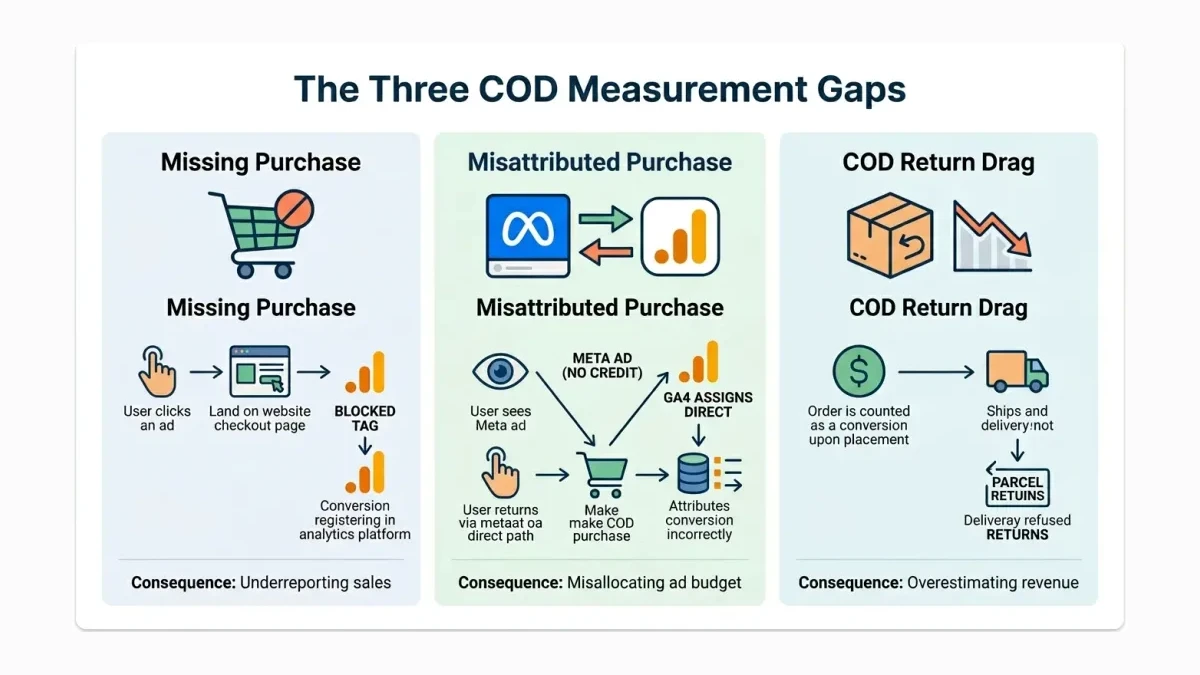
The pattern is consistent enough to predict. In aggregate, we see three measurement gaps dominate Pakistani ecommerce tracking, and each one maps to a specific decision going wrong.
The first gap is the missing purchase. A customer completes checkout, but the browser tag never fires. GA4 shows no purchase. The ad platform gets no conversion signal. The campaign appears to fail. Multiply this across a week of iOS shoppers and a profitable campaign can look dead.
The second gap is the misattributed purchase. A shopper clicks a Meta ad on their phone, decides to pay cash, and later completes the order through a direct visit on the same device after clearing the browser. Without a stitched first-party identifier, GA4 assigns the purchase to Direct traffic. Meta gets no credit. The Meta ad gets scaled down even though it produced the sale.
The third gap is the COD return that ad platforms celebrate. The ad platform records a purchase the moment the order is placed online. Three days later the parcel returns. The platform still counts it as a conversion. The brand has already spent more on the next batch of similar audiences. The ad data is structurally optimistic about COD revenue because it never learns about returns.
Each gap points to a single fix. Move the most important events off the browser and onto your server.
The 15-minute fix that changes your numbers
Server-side tracking sends analytics events from your server to GA4 and ad platforms instead of from the visitor’s browser. The customer’s phone can block, close, or block cookies. The event still fires from your Shopify or WooCommerce backend. The message arrives because you control the sender.
The mechanism is straightforward. When an order is confirmed or a parcel is delivered, your store’s backend calls the Google Analytics Measurement Protocol directly, pushing the purchase event with full revenue, currency, and item data. The same backend can call the Meta Conversions API, or CAPI, so Meta receives the purchase signal server to server. Server-side Google Tag Manager sits in the middle as a controlled relay, letting you shape, validate, and route events before they reach GA4, Meta, Google Ads, or TikTok.
The fix is simple in principle. Three steps recover most of the lost signal. First, register a Shopify customer event that fires checkout completion and pushes it through server-side GTM. Second, enable the Measurement Protocol so the purchase arrives in GA4 regardless of what the browser did. Third, wire CAPI so Meta sees the same purchase, restoring attribution for iOS and ad-blocked shoppers. Most stores capture 96 to 99 percent of revenue after this layer is in place, up from 83 to 90 percent with browser tags alone.
The payoff is sharper decisions. Server-side tracking does not invent revenue. It removes the fog. Suddenly the campaign that looked average on GA4 is the one driving the most delivered COD parcels. The expensive prospecting audience that looked profitable is revealed as a return factory. Budget moves toward what actually converts into delivered orders, not into clicks.
For COD specifically, server-side tracking also lets you send return data back to your ad platforms. When a courier marks a parcel as returned, that signal can flow into GA4 as a negative outcome and inform how you value future orders. Pakistani brands that pair clean purchase tracking with RTO data stop rewarding campaigns that ship boxes which come back.
Read next: For the related problem of phantom traffic polluting your reports, see our field note on why bot traffic now beats human traffic in Pakistani GA4 accounts, and our walkthrough on auditing AI Overview traffic loss in GA4. For the revenue angle, see our teardown of ad fraud blind spots draining Pakistani ecommerce revenue.
At WeProms Digital, we run server-side tracking setups for Pakistani ecommerce stores and GA4 configuration projects that recover the revenue browser tags lose. We build the server-side GTM container, wire the Measurement Protocol and Meta CAPI, and connect COD return data so your ad platforms stop rewarding delivered boxes that bounce back. Book a tracking audit and we will show you exactly where your purchase signal is leaking. Reach us at hello@weproms.com or WhatsApp +92 300 0133399.
Your COD tracking recovery checklist
How we helped a Pakistani business achieve measurable results.
- Compare 30 days of Shopify or WooCommerce orders against GA4 purchases. The gap is your client-side loss.
- Confirm whether your purchase event carries revenue, currency, and item data. A purchase with zero value is a broken event.
- Register a Shopify customer event for checkout completion that survives order-status page sandboxing.
- Stand up a server-side Google Tag Manager container as your controlled relay.
- Enable the GA4 Measurement Protocol so purchases arrive from your server, not the browser.
- Connect the Meta Conversions API so iOS and ad-blocked purchases stop vanishing from attribution.
- Feed COD return data back as a negative outcome so your platforms learn which orders actually deliver.
- Re-run the GA4 versus bank-deposit comparison after 30 days. The gap should close to single digits.
Frequently Asked Questions
Why does GA4 show fewer orders than my Shopify or WooCommerce dashboard?
Browser-based GA4 tags are blocked by ad blockers, shortened by Safari ITP, and lost when shoppers close the tab before the tag fires. Server-side tracking sends the purchase event from your server instead, recovering most of the missing signal. The gap between Shopify orders and GA4 purchases is the fastest way to size the problem.
How does cash on delivery break ad attribution in Pakistan?
A COD purchase is recorded the moment the order is placed online, but the parcel may return undelivered days later. Ad platforms count the online order as a conversion and never learn about the return. This makes COD ad data structurally optimistic and hides which campaigns actually deliver parcels versus clicks.
What does a server-side tracking setup cost for a Pakistani store?
The investment depends on platform complexity, but most Pakistani Shopify and WooCommerce stores recover the setup cost within one to two months of corrected ad spending. WeProms scopes the work after a free tracking audit. Contact us for a quote tied to your monthly ad spend and order volume.
Will server-side tracking fix my Meta and Google Ads ROAS?
It will make ROAS accurate, which often looks like an improvement. When platforms receive more purchase signals, especially from iOS and ad-blocked shoppers, attribution credit flows back to the campaigns that earned it. Pakistani brands then reallocate budget toward campaigns that deliver orders rather than clicks.
Is server-side tracking compliant with Pakistani and platform privacy rules?
Yes. Server-side tracking uses your own first-party data and your server, which is more privacy-aligned than third-party browser cookies. WeProms configures consent signals so events respect shopper choices while still capturing the purchases you are entitled to measure.
About WeProms Digital
WeProms Digital is Pakistan’s leading marketing analytics and tracking agency, headquartered in Lahore, serving Pakistani SMEs, ecommerce brands, and B2B teams across Lahore, Karachi, Islamabad, Rawalpindi, Faisalabad, and Multan.
The team specializes in GA4 configuration, server-side tracking, and conversion attribution, with a track record of recovering the 10 to 20 percent of revenue that browser-based tracking loses for Pakistani ecommerce stores.
Get in touch: hello@weproms.com · WhatsApp +92 300 0133399 · weproms.com/contact-us
Sources & References
- Google Analytics — Measurement Protocol documentation — 2026
- Meta for Developers — Conversions API — 2026
- Shopify — Web Pixels and customer events — 2026
- Google Tag Manager — Set up server-side tagging — 2026
- PPC Land — Google Silently Routes Shopify Purchases Into GA4, Attribution Gaps Remain — 2026
- WebKit — Intelligent Tracking Prevention — 2026
- DataReportal — Digital 2025: Pakistan — 2025
- Pixellattice — Meta Ads Cost in Pakistan — 2026
Additional reading from industry feeds: