
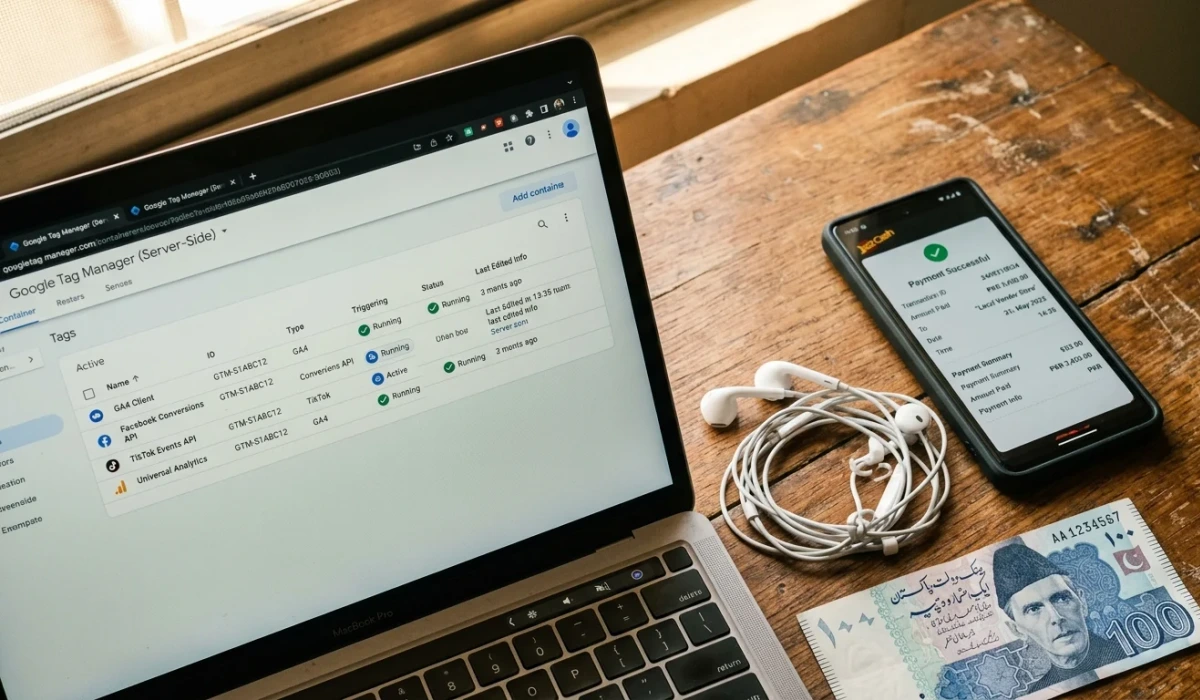
A Faisalabad textile exporter was spending PKR 350,000 monthly on Google Ads, confident that the 120 conversions reported in GA4 represented his real performance. After installing server-side tracking, the number jumped to 187 — not because sales improved, but because 55 conversions from WhatsApp inquiries and COD confirmations had been invisible to the browser pixel the entire time. The difference was not the customers. The difference was the tracking.
TL;DR: ChatGPT Ads launch conversion-optimized campaigns on June 5, 2026, requiring the OpenAI Pixel and Conversions API for server-side data. Pakistani SMEs running browser-only pixel tracking lose 25–40% of conversion data to ad blockers, COD orders, and WhatsApp leads. This walkthrough covers six sequential steps to fix your tracking in three weeks — costing PKR 40,000–80,000 in implementation and saving 20–35% of currently wasted ad spend.
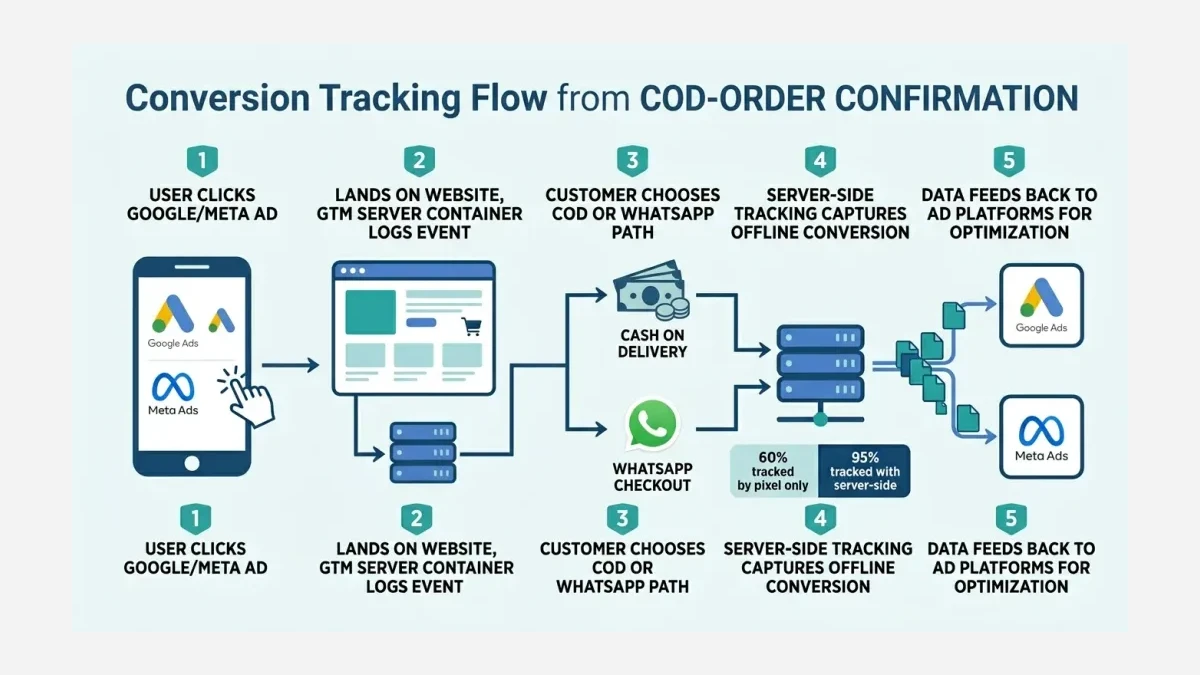
If you are a Pakistani SME spending PKR 200,000 or more monthly on Google Ads, Meta Ads, or both, your conversion data is incomplete. The gap exists because browser-based pixels — the tracking code sitting in your website’s <head> tag — cannot see past ad blockers, payment gateway redirects, and multi-device purchase journeys. In Pakistan, where cash-on-delivery dominates and WhatsApp closes most high-value sales, pixel tracking captures roughly 60% of actual conversions. The remaining 40%? Your ad platform’s optimization algorithm treats them as failures and stops showing ads to the exact users most likely to buy.
First: Map Every Path from Ad Click to Revenue
Start here. Open a blank spreadsheet and list every way a customer moves from clicking your ad to paying you money. For a typical Pakistani ecommerce store, the paths look like this:
| Path | Example | Pixel Tracks It? |
|---|---|---|
| Online payment on website | JazzCash/Easypaisa checkout, card payment | Partially — breaks at gateway redirect |
| Cash-on-delivery order | Customer places order, pays on delivery | No — pixel fires on order page but COD confirmation comes days later |
| WhatsApp inquiry → order | Customer clicks WhatsApp button, chats, places order via WhatsApp | No — leaves your website entirely |
| Phone call → order | Customer calls from ad landing page | No — phone calls happen off-website |
| In-store visit → purchase | Customer sees ad, visits physical store | No — no digital connection |
Most Pakistani businesses discover they have five to seven distinct conversion paths, and their browser pixel tracks only one or two of them.
The actionable step: spend 30 minutes on this mapping exercise with whoever handles your orders. Write down every path. For each one, note whether your current tracking captures it. This document becomes the blueprint for everything that follows.
Then: Install Google Tag Manager Server Container
Google Tag Manager Server-Side — a server-side tracking setup that runs a dedicated container on your own cloud server, processing tracking events server-to-server rather than browser-to-Google — is the technical foundation that makes accurate conversion tracking possible.
The setup process involves three pieces:
-
Create a server container in Google Tag Manager. This is a separate container type from your existing web container. Google provides a default Cloud Run deployment that costs roughly $40–120/month for typical Pakistani SME traffic volumes.
-
Configure your web container to send data to the server container instead of directly to Google Analytics (GA4) and Google Ads. This means changing the GA4 configuration tag to use the server container’s URL as its transport mechanism.
-
Set up the server container to forward events to GA4, Google Ads, and any other destination. The server container receives the hit, processes it, and sends it on — which means ad blockers cannot intercept it because the request goes from your server, not the visitor’s browser.
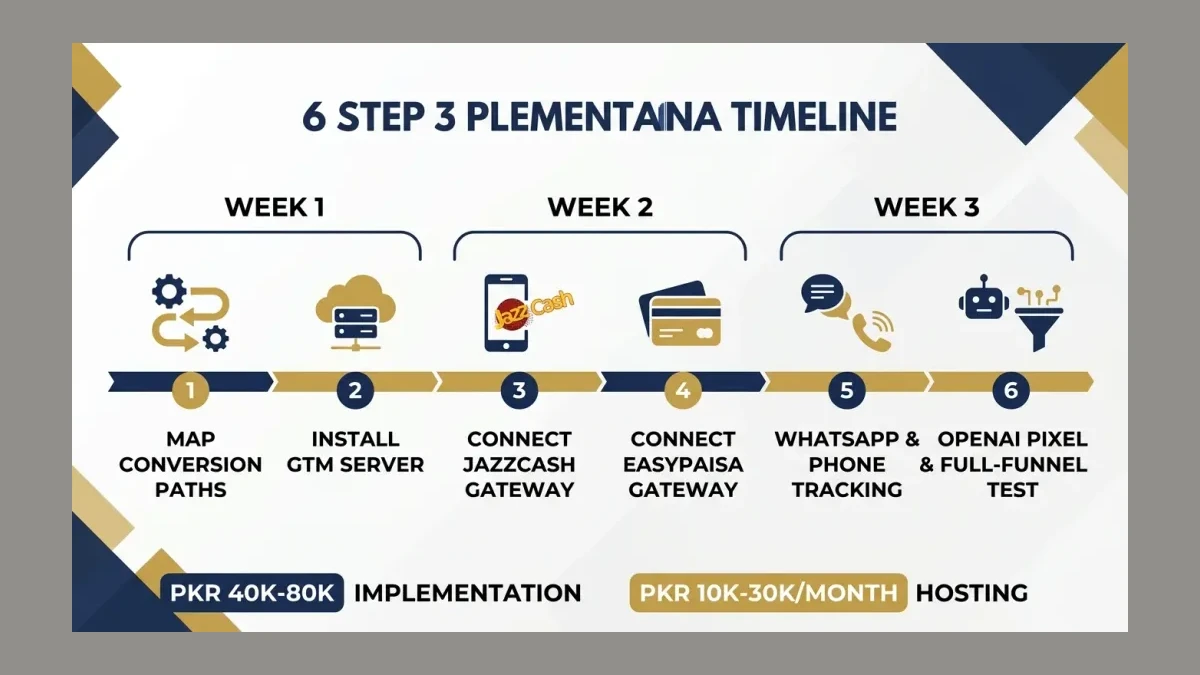
For a Pakistani SME, the total cost runs PKR 40,000–80,000 for implementation (one-time) plus PKR 10,000–30,000 monthly for cloud hosting. Most businesses spending PKR 200,000+ monthly on ads recover this cost within 60 days through better optimization data.
“Server-side tracking is no longer optional for paid media.” — PPC Hero, 2026
As a server-side tracking specialist, WeProms Digital has found that the biggest implementation hurdle for Pakistani businesses is not technical — it is the server container’s interaction with local payment gateways like JazzCash and Easypaisa, which redirect users away from the website during checkout.
Next: Connect Your Local Payment Gateways
The tradeoff is that JazzCash, Easypaisa, and most Pakistani bank payment gateways redirect customers to their own hosted payment pages. The customer leaves your site, completes payment on JazzCash’s domain, and returns to your confirmation page. If the return fails — which happens on roughly 15–20% of mobile transactions due to poor connectivity — the browser pixel never fires.
Server-side tracking solves this because your server receives a server-to-server callback from the payment gateway confirming the transaction. You do not need the customer’s browser to load your confirmation page. Your server already knows the payment succeeded.
The implementation steps:
-
Enable server-to-server callbacks in your JazzCash and Easypaisa merchant portal settings. Both gateways support HTTP POST notifications to a URL you specify when a transaction completes.
-
Create a webhook endpoint on your server that receives these callbacks, extracts the transaction data (amount, order ID, customer identifier), and sends it as a conversion event to your GTM server container.
-
Map the payment callback data to your GA4 purchase event schema so Google Ads can optimize toward real revenue rather than pageviews.
This step typically requires a developer — either in-house or through an agency — with experience in Pakistani payment gateway integrations. Budget one to two weeks for this integration.
After That: Capture WhatsApp and Phone Call Conversions
In Pakistan, WhatsApp closes deals. A 2026 report on Pakistan’s digital payment revolution noted that mobile commerce drives digital transactions, with most users shopping directly from smartphones. For service businesses in Lahore, Karachi, and Islamabad, 30–50% of high-value conversions start with a WhatsApp message or phone call.
Capturing these conversions requires two additional tracking mechanisms:
WhatsApp conversion tracking works by generating a unique click ID when someone clicks the WhatsApp button on your website. Your GTM server container logs this click. When you later mark the conversation as a qualified lead or completed sale in your CRM (or even a simple Google Sheet), you feed that data back to the server container as a conversion event. The gap between ad click and WhatsApp sale — sometimes days or weeks — finally becomes visible to your optimization algorithms.
Phone call tracking uses a service like CallRail or a local call tracking provider. When someone calls the tracking number on your landing page, the call tracking service logs the caller’s number and duration. You import this data into Google Ads as an offline conversion, linking it back to the original ad click through a Google Click ID (GCLID) stored in a cookie.
At This Point: Set Up the OpenAI Pixel and Conversions API
OpenAI is launching conversion-optimized campaigns on June 5, 2026, according to Search Engine Land. Accounts that configure conversions by June 1 receive early access by June 5. The tracking infrastructure mirrors what you have already built:
-
Install the OpenAI Pixel — a base website tag placed in the
<head>of all pages, plus specific conversion event tags (purchase, signup, lead) on completion pages. This works through Google Tag Manager using a custom HTML tag template. -
Set up the OpenAI Conversions API — a server-side endpoint that sends first-party conversion data directly to OpenAI, bypassing the browser entirely. If you already have a GTM server container running from Step 2, adding the OpenAI Conversions API destination is a configuration change, not a new architecture.
-
Verify the closed attribution loop. OpenAI requires that post-click behavioral data flows back to their systems for conversion optimization. Test by completing a test purchase on your site and confirming the event appears in both your GA4 real-time reports and the OpenAI Ads Manager.
| Tracking Component | Google Ads | Meta Ads | ChatGPT Ads |
|---|---|---|---|
| Browser pixel | Google tag (gtag) | Meta Pixel | OpenAI Pixel |
| Server-side API | Google Ads API | Meta Conversions API | OpenAI Conversions API |
| Offline imports | GCLID-based | Upload via Events Manager | Not yet confirmed |
| UTM support | Full | Full | Full |
The comparison reveals that all three platforms use the same two-layer tracking architecture: a browser pixel for real-time data plus a server-side API for complete data. Setting up server-side tracking once gives you the infrastructure for all three platforms.
Once You’ve Completed the Setup: Verify with a Full-Funnel Test
Run a complete test purchase from ad click to conversion confirmation:
- Click one of your live ads on Google (use a mobile device since 75–85% of Pakistani search traffic is mobile).
- Browse your site and add a product to cart.
- Complete checkout using JazzCash or Easypaisa.
- Check GA4 real-time reports — the purchase event should appear within 60 seconds.
- Check Google Ads conversions — the conversion should appear within 3 hours.
- Repeat for a WhatsApp inquiry path — click ad, open WhatsApp, send yourself a test message, mark it as a lead in your tracking system.
- Confirm the WhatsApp conversion appears in your server-side tracking dashboard.
If any path fails, the gap tells you exactly which integration needs fixing. Most Pakistani businesses find that the online payment path works first, the WhatsApp path needs a second round of configuration, and the COD confirmation path requires a manual import process until the delivery company reports back.
The outcome: What This Produces
After completing all six steps, your marketing operation runs on complete conversion data instead of partial data. The practical results:
- Google Ads optimization improves because the algorithm sees your real conversion volume — typically 25–40% higher than what the pixel reported.
- Meta Ads targeting sharpens because server-side events survive iOS tracking restrictions and ad blockers.
- ChatGPT Ads readiness is complete — when the platform opens in Pakistan, you have the pixel installed, the Conversions API active, and 30+ days of conversion history feeding the optimization engine.
- Budget waste drops because you can finally see which campaigns, ad groups, and keywords produce actual revenue versus vanity clicks.
The cost of inaction is compounding: every month you run ads on incomplete data, your optimization algorithm makes worse decisions. Over six months, a Pakistani SME spending PKR 500,000 monthly on ads with 35% tracking loss effectively wastes PKR 175,000 monthly — over PKR 1 million annually — on optimization decisions driven by bad data.
a specialist server-side tracking agency WeProms Digital specializes in building complete conversion tracking systems for Pakistani businesses, including JazzCash and Easypaisa integration, WhatsApp lead tracking, and ChatGPT Ads pixel setup. If your conversion data has gaps — and for most Pakistani SMEs, it does — reach out via WhatsApp or email for a tracking audit.
Frequently Asked Questions
How long does server-side tracking setup take for a Pakistani SME?
Two to three weeks for a standard implementation: one week for the GTM server container setup, one week for payment gateway integration (JazzCash, Easypaisa), and three to five days for WhatsApp and phone call tracking configuration. Budget an additional week for testing and troubleshooting.
Do I need server-side tracking if I only run Google Ads?
Yes. PPC Hero confirmed in 2026 that server-side tracking is no longer optional for paid media. Even for Google-only advertisers, browser pixels miss 25–40% of conversions from COD orders, WhatsApp inquiries, and payment gateway redirects — all common in Pakistan. Without server-side data, Google’s algorithm optimizes toward the wrong outcomes.
What happens if I do not set up conversion tracking before ChatGPT Ads arrive in Pakistan?
You will not be able to run conversion-optimized campaigns, which are the most cost-effective ChatGPT Ads format. OpenAI requires a closed attribution loop — conversion data flowing back from your server — to optimize toward purchases and bookings. Without it, you are limited to CPC-based campaigns that cost $4–6 per click according to current benchmarks, roughly double comparable Google CPCs.
Can I set up the OpenAI Pixel if ChatGPT Ads are not available in Pakistan yet?
Yes. The OpenAI Pixel is a JavaScript tag installed on your website, independent of whether your country is supported for ad delivery. Installing it now builds conversion data history so that when ChatGPT Ads open in Pakistan, your account has the 30–50 conversions needed to exit the learning phase immediately.
How much does a complete conversion tracking setup cost in Pakistan?
PKR 40,000–80,000 for implementation (GTM server container, payment gateway integration, WhatsApp tracking, OpenAI Pixel) plus PKR 10,000–30,000 monthly for cloud hosting. For businesses spending PKR 200,000+ monthly on ads, the improved optimization data typically pays for the setup within 60 days.
Sources & References
- Search Engine Land — OpenAI Confirms Conversion-Focused Ads Are Coming to ChatGPT — May 2026
- PPC Hero — Server-Side Tracking Is No Longer Optional for Paid Media — 2026
- Martech Zone — Pixel Conversion Loss Is Real. Server-Side Tracking Adoption Is Overdue — 2026
- Banfana — ChatGPT Ads: Everything You Need to Know — 2026
- StackAdapt — How to Advertise on ChatGPT — 2026
- SimPaisa — Pakistan’s Digital Payment Revolution 2026 — 2026
- PPC Land — OpenAI’s ChatGPT Ads Are Getting Conversion Optimization — May 2026
- Search Engine Land — OpenAI Is Preparing Conversion-Focused Ads for ChatGPT — May 2026
Additional reading from industry feeds:
- PPC Hero — ChatGPT Ads Are Here: Everything We Know So Far
- Search Engine Roundtable — ChatGPT Ads Conversion-Optimized Campaigns Coming June 5th
- Digiday — OpenAI Working with Skai for Retail and Commerce Advertisers in ChatGPT
Read next: What to Fix Before Moving to Server-Side Tracking and Server-Side GTM Pakistan Ecommerce Teardown