SCOPE Framework: AI Search Platform Selection for Pakistani Businesses
By Sara Khan | June 2026
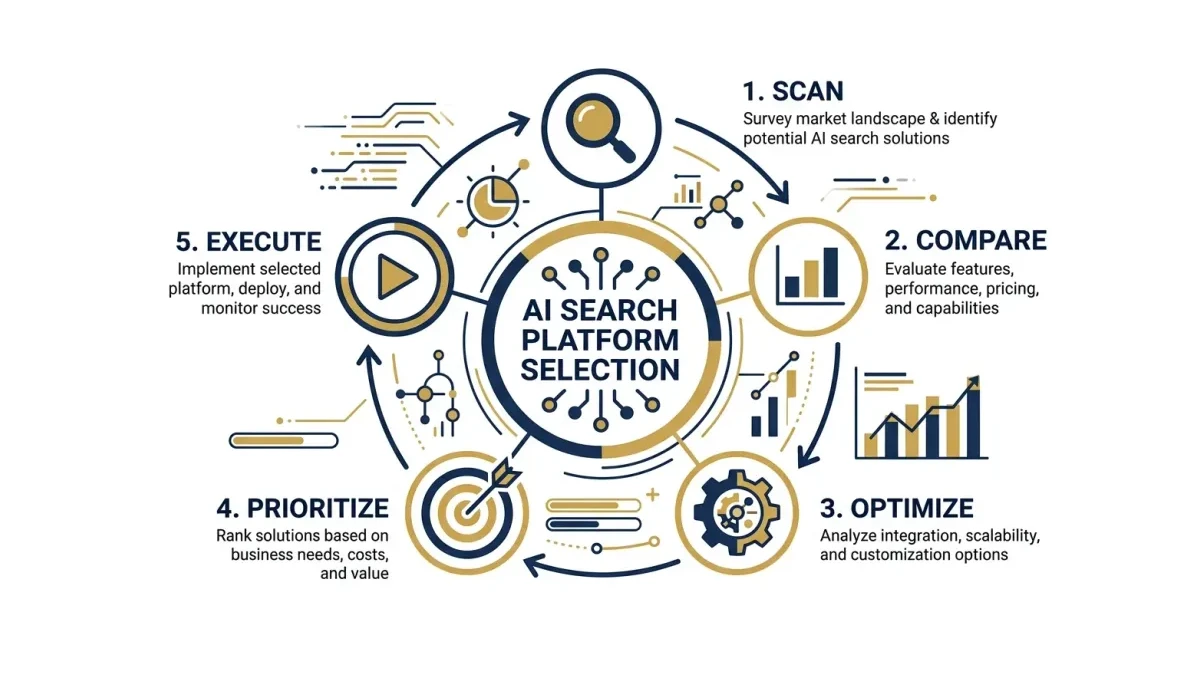
The SCOPE framework breaks AI search platform selection into five steps: S for Scan, C for Compare, O for Optimize, P for Prioritize, E for Execute. Each step narrows the field of five major AI search platforms — Google AI Overviews, ChatGPT, Perplexity, Microsoft Copilot, and Grok — into a focused investment plan that matches your budget, audience, and commercial objectives. The pattern repeats across industries: businesses that try to optimize for all five platforms simultaneously spread resources thin and achieve visibility on none. SCOPE fixes that sequencing problem.
AI search measurement is still immature. Omnibound’s AI SEO statistics point to a familiar gap: many teams plan to invest in GEO, but far fewer can measure results confidently. For Pakistani businesses, that gap represents both a threat and an opportunity: competitors may be discussing AI search before they have a practical monitoring routine.
Last updated: June 2026.
S — Scan: Map Your Current AI Search Presence Across Platforms
The first step is pure reconnaissance. Before optimizing anything, you need baseline data on whether AI engines currently cite your business at all. This is not about rankings — it is about citations. AI engines do not rank pages in order; they extract passages and synthesize answers. Your brand either appears in those synthesized answers or it does not.
Start by searching your brand name and core service terms on each of the five major platforms. For a Lahore-based textile exporter, this means typing “textile manufacturers in Lahore Pakistan” into Google AI Mode, ChatGPT, Perplexity, Copilot, and Grok separately. Record whether your company name appears in the AI-generated answer on each platform. Use Google’s new Search Generative AI performance reports in Search Console to see which of your URLs appear in Google’s AI Overviews — these reports show AI impressions, cited pages, country, and device breakdowns with hourly granularity.
For non-Google platforms, use BrandAxis or similar AI search analytics tools to track citations across ChatGPT, Perplexity, and Copilot. If your budget does not support paid tools, manual weekly searches on each platform produce usable baseline data.
The underlying mechanic is fragmentation. Research from Conductor shows that only 7 of the top 50 cited domains overlap across Google AI, ChatGPT, and Perplexity. Each platform favors different sources. A business that appears in Google AI Overviews may be invisible on ChatGPT, and vice versa. Your scan needs to cover all five platforms independently.
For Pakistani businesses, the scan often reveals an uncomfortable truth: most local businesses are invisible across all five platforms. AI engines cite Wikipedia, Reddit, YouTube, and large international publishers far more often than Pakistani company websites. That citation gap is the starting point for everything that follows.
Action: Create a spreadsheet with one tab per platform. Log every search query where your brand appears in AI answers, and every query where a competitor appears instead. Run this scan weekly for four weeks to establish a baseline pattern.
C — Compare: Benchmark Your Citations Against Competitors
Book a free strategy call - we'll audit your current setup and identify the highest-impact fixes.
With baseline data in hand, compare your citation presence against three to five direct competitors. The comparison reveals two things: which platforms cite businesses in your category at all, and which competitors own citation territory on each platform.
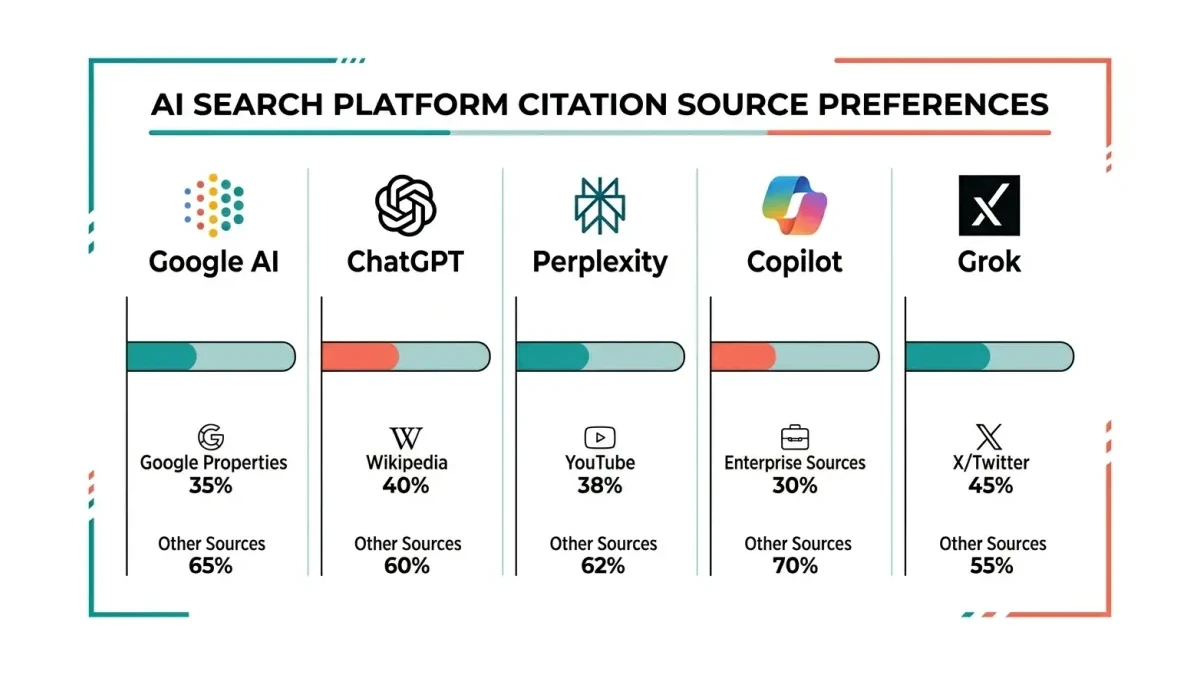
Each AI engine has distinct citation preferences. Conductor’s analysis of seven AI engines found that ChatGPT Search heavily cites Wikipedia, making it difficult for commercial businesses to break through without building Wikipedia-level authority signals. Perplexity over-indexes on YouTube and rich-media sources, which means businesses with video content have an advantage on that platform. Google AI Mode prominently cites Google-owned properties and its own search result pages, creating a self-referential loop that favors businesses already strong in traditional Google SEO.
The comparison table below shows how these citation behaviors map to Pakistani business types:
| AI Platform | Favors These Source Types | Best For Pakistani… | Citation Difficulty |
|---|---|---|---|
| Google AI Overviews | Google properties, high-authority sites | Ecommerce, local services | Medium |
| ChatGPT | Wikipedia, reference content | B2B services, professional firms | High |
| Perplexity | YouTube, structured guides | Educational content, tutorials | Medium |
| Microsoft Copilot | Bing index, enterprise sources | B2B, technology companies | Medium-High |
| Grok | X/Twitter signals, real-time content | News, trending topics | Variable |
What actually drives this fragmentation is not algorithmic randomness — each platform trains on different data pools and optimizes for different user intents. ChatGPT users ask conversational, exploratory questions. Perplexity users seek sourced, verifiable answers. Google AI users expect transactional relevance. A Pakistani business selling B2B software consulting will find more citation success on ChatGPT and Perplexity than on Grok, where real-time social signals dominate.
Action: For each competitor that appears in AI answers, note which of their pages get cited. Look for patterns in content structure, depth, and formatting. These patterns become your optimization targets in the next step.
O — Optimize: Align Content With Platform-Specific Citation Patterns
This is where most Pakistani businesses get the sequencing wrong. They try to optimize one piece of content for all five platforms simultaneously. That approach produces generic content that fails to meet any platform’s extraction criteria.
Instead, assign one primary platform to each major content asset. A detailed service page optimized for Google AI Overviews uses different formatting than a YouTube tutorial optimized for Perplexity citations. A Wikipedia-style reference article optimized for ChatGPT uses different structure than a Twitter thread optimized for Grok visibility.
The optimization principles for each platform follow directly from the citation patterns identified in Step C:
For Google AI Overviews, the Google Search Central Blog’s new AI reports confirm that extractable content uses clear heading hierarchies, definition-first paragraphs, and concise answers positioned near the top of pages. Each paragraph should make sense when extracted alone, because that is exactly what AI engines do — copy passages without surrounding context. Pakistani businesses should audit their service pages for self-contained paragraphs that name the subject explicitly instead of relying on pronouns like “this approach” or “our services.”
For ChatGPT, building authority signals that mirror Wikipedia’s trust markers matters more than keyword optimization. That means cited sources, named entities, specific data points, and attribution to recognized authorities. A Pakistani digital marketing agency appearing in ChatGPT answers needs content that references SEMrush studies, Google documentation, and industry benchmarks — exactly the kind of evidence ChatGPT’s training favors.
For Perplexity, video content and structured guides with numbered steps, clear definitions, and source citations perform best. A Pakistani restaurant supply company should create YouTube tutorials comparing commercial kitchen equipment, then transcribe those videos into structured blog posts with the same data points. Perplexity often surfaces rich-media and well-cited sources, so the video itself can become a citation target when it answers the query clearly.
Pakistani businesses have an advantage that global competitors lack: local expertise. Content about SBP regulations, PTA compliance, Daraz seller requirements, JazzCash integration specifics, or Karachi port logistics contains entity-dense, jurisdiction-specific information that AI engines cannot synthesize from generic global content. That local specificity is a citation magnet.
Action: Select your three highest-value service or product pages. Assign one primary AI platform to each. Rewrite the opening three paragraphs to match that platform’s citation patterns, using self-contained structure, inline definitions, and specific data points.
P — Prioritize: Choose One or Two Platforms for Your First 90 Days
The data from Steps S and C should now reveal which platforms offer the highest return for the lowest effort. For most Pakistani SMEs, the priority ranking looks like this:
First priority: Google AI Overviews. Google remains the dominant search channel for most Pakistani businesses. If your business appears in Google AI Overviews, the impression opportunity can dwarf other platforms. Start here. The new Search Console AI reports give you first-party measurement data, and the optimization principles align closely with existing SEO best practices — clear structure, quality content, strong technical foundations. Read our guide to entity map setup for AI visibility for the technical implementation.
Second priority: ChatGPT. ChatGPT’s reach in Pakistan’s professional and academic communities is substantial, especially among English-speaking users who research services, software, suppliers, and business advice. Citation difficulty is higher than Google, but the audience quality can compensate for lower volume.
Third priority: Perplexity. Perplexity works best for businesses with video content and educational material. If your content strategy includes tutorials, comparison guides, or how-to videos, Perplexity should move up to second priority.
Grok and Copilot are lower priorities for most Pakistani businesses. Grok’s reliance on X/Twitter signals favors brands with active social media presence and trending content. Copilot’s enterprise focus suits B2B technology companies but delivers less value for consumer-facing Pakistani businesses.
Pakistan’s mobile-first internet population reinforces the Google-first priority. A business that earns Google AI citations can reach a large addressable audience before expanding into harder-to-measure AI platforms.
Action: Write down your one primary platform and one secondary platform. Commit to 90 days of optimization focused exclusively on those two. Do not spread effort across five platforms in month one.
E — Execute: Build a Monthly Citation Monitoring Routine
How we helped a Pakistani business achieve measurable results.
The final step turns strategy into habit. AI search citation monitoring needs to run monthly, not as a one-time project. Citation patterns shift as AI platforms update their models, as competitors optimize their content, and as user behavior changes.
Build a monitoring routine with three components. First, a monthly scan of all five platforms using the same queries from Step S, logging changes in citation presence. Second, a review of Google Search Console AI reports comparing month-over-month AI impressions for your top 20 pages. Third, a competitor citation audit comparing your visibility against three to five direct competitors on your priority platforms.
This is where a simple monitoring habit matters. Most Pakistani businesses are not tracking AI citations in a structured way yet. The businesses that build this habit now establish citation data history that becomes increasingly valuable as AI search grows. Three months of citation data reveals trends that a single snapshot cannot.
The routine does not require expensive tools. A spreadsheet, weekly manual searches on your priority platforms, and monthly Google Search Console AI report exports produce actionable intelligence. Pakistani businesses can outsource this monitoring to an agency or build it in-house with a trained team member spending two to three hours per week.
Read next: GEO Content Setup for ChatGPT Citations and The CITED Framework for Pakistani SME AI Search Results
At WeProms Digital, GEO and AI discoverability agency, we implement the SCOPE framework for businesses across Lahore, Karachi, and Islamabad. WeProms configures platform-specific citation tracking, optimizes content for each AI engine’s extraction patterns, and delivers monthly visibility reports across all five major AI search platforms. Contact us at hello@weproms.com, WhatsApp +92 300 0133399, or weproms.com/contact-us.
Key Takeaways
- Only 7 of the top 50 cited domains overlap across Google AI, ChatGPT, and Perplexity — each platform requires separate optimization, not a one-size-fits-all approach
- Google AI Overviews should be the first priority for Pakistani businesses because Google commands over 95% search market share in Pakistan and the new Search Console AI reports provide first-party measurement
- ChatGPT ranks second for Pakistani businesses targeting professional and academic audiences, given 79.7% adoption among Pakistani higher education users
- Assign one primary platform per content asset instead of trying to optimize every page for all five platforms simultaneously
- Monthly citation monitoring across priority platforms builds the data history needed to identify which content changes produce visibility gains
- Local Pakistani expertise is a citation advantage — content about SBP regulations, Daraz seller requirements, and JazzCash integration contains entity-dense information AI engines cannot synthesize from generic global sources
Frequently Asked Questions
Which AI search platform should a Pakistani SME start with?
Start with Google AI Overviews. Google holds over 95% search engine market share in Pakistan, and the new Search Console AI reports give you first-party data on how often your pages appear in AI-generated answers. After establishing Google AI visibility, expand to ChatGPT for professional audiences or Perplexity if your business produces video content.
How much should a Pakistani business budget for AI search optimization?
A monthly GEO budget of PKR 50,000 to PKR 100,000 covers platform-specific content optimization for two priority platforms plus monthly citation monitoring. This compares favorably to traditional SEO retainers of PKR 80,000 to PKR 200,000 that may not address AI search visibility at all. WeProms Digital offers GEO packages starting at PKR 60,000 per month for two-platform optimization.
Can one piece of content rank on multiple AI search platforms?
Yes, but not by accident. Content that gets cited on multiple AI platforms typically contains self-contained paragraphs, inline definitions, specific data points with source attribution, and clear heading hierarchies. The SCOPE approach assigns a primary platform per asset and then checks secondary platform compatibility as a bonus, not a target.
How long does it take to see AI search citation results?
Most businesses see initial citation changes within 4 to 8 weeks of publishing optimized content. Google AI Overviews respond fastest because they pull from existing indexed content. ChatGPT citations typically take 6 to 12 weeks as the model’s training data incorporates new content. Monthly monitoring over 90 days provides enough data to identify which optimizations are working.
What is the difference between traditional SEO and GEO for AI platforms?
Traditional SEO optimizes for ranking position in a list of blue links. GEO — Generative Engine Optimization — optimizes for citation inside AI-generated answers. GEO prioritizes content extractability (self-contained paragraphs, definition-first structure) over traditional ranking factors like backlinks and keyword density. Both matter, but GEO is specifically designed for AI search platforms that synthesize answers rather than displaying ranked lists.
About WeProms Digital
WeProms Digital is a GEO and AI discoverability agency, headquartered in Lahore, serving Pakistani SMEs, ecommerce brands, and B2B teams across Lahore, Karachi, Islamabad, Rawalpindi, Faisalabad, and Multan.
The team specializes in generative engine optimization, AI search citation tracking, and platform-specific content strategy, with a track record of building AI visibility for Pakistani businesses across Google AI, ChatGPT, Perplexity, and Copilot.
Get in touch: hello@weproms.com · WhatsApp +92 300 0133399 · weproms.com/contact-us
Sources & References
- Omnibound — AI SEO Statistics Compendium — 2026
- Conductor — How AI Citations Differ Across Search Engines — 2026
- Google Search Central Blog — Search Generative AI Performance Reports — June 2026
- Advertising Week — AI Search Killed the Click, Intent Didn’t Die — 2026
- SEMrush — Google Adds Agentic Browsing Category to Lighthouse — 2026
Additional reading from industry feeds: