By Hamza Ali · Last updated: August 20, 2026 · 8 min read
TL;DR: Google’s generative UI now builds working calculators, converters, and comparison widgets directly inside AI Overviews, so searchers finish without clicking. Pew measured the damage: click rates drop from 15% to 8% of visits when an AI summary appears. Pakistani tool sites should treat this as a lead-capture problem, not a rankings problem — and audit before November.
Google’s search results are quietly becoming the product. Generative UI — Google’s technology for building custom interactive interfaces, coded on the fly by the AI model — moved from AI Mode into AI Overviews through summer 2026, after its unveiling at Google I/O in May. Ask for a mortgage calculation, a currency conversion, or a side-by-side product comparison now, and Google’s research team says the model can build the interactive tool itself, right inside the result. For the Lahore fintech blog, the Karachi currency converter, and the Islamabad shipping-rate estimator, the search engine has become a competitor that never sleeps and never charges the visitor.
What this gets right
The user experience is genuinely better, and pretending otherwise wastes planning time. A searcher on a Karachi 4G connection gets a working calculator in under two seconds, with no popup banners, no cookie wall, and no slow carousel of related posts. Many Pakistani tool pages fail Core Web Vitals — Google’s speed and stability metrics for pages — because they load heavy ad scripts before the tool renders. Google’s widget skips all of it.
Google’s I/O 2026 Search announcement framed the shift plainly: AI Overviews can now code interactive visualizations on demand and embed them where links used to sit. That is a better deal for a student checking a unit conversion at midnight than navigating a 2019-era tool page buried under three ad units.
The honest read: a large share of searchers never wanted the website. They wanted the answer, and the website was just the delivery mechanism. Generative UI removes the middleman, and the middleman was you. Fighting that preference with slower, clunkier pages loses twice — once to the widget and once to page speed.
The actionable response is to admit which queries were only ever answer-delivery. Unit conversions, simple percentage math, and live PKR-to-USD rates belong to the search result now. Audit your tool inventory this month and sort it into “answer queries” and “decision queries” before allocating another rupee to either.
Where this breaks
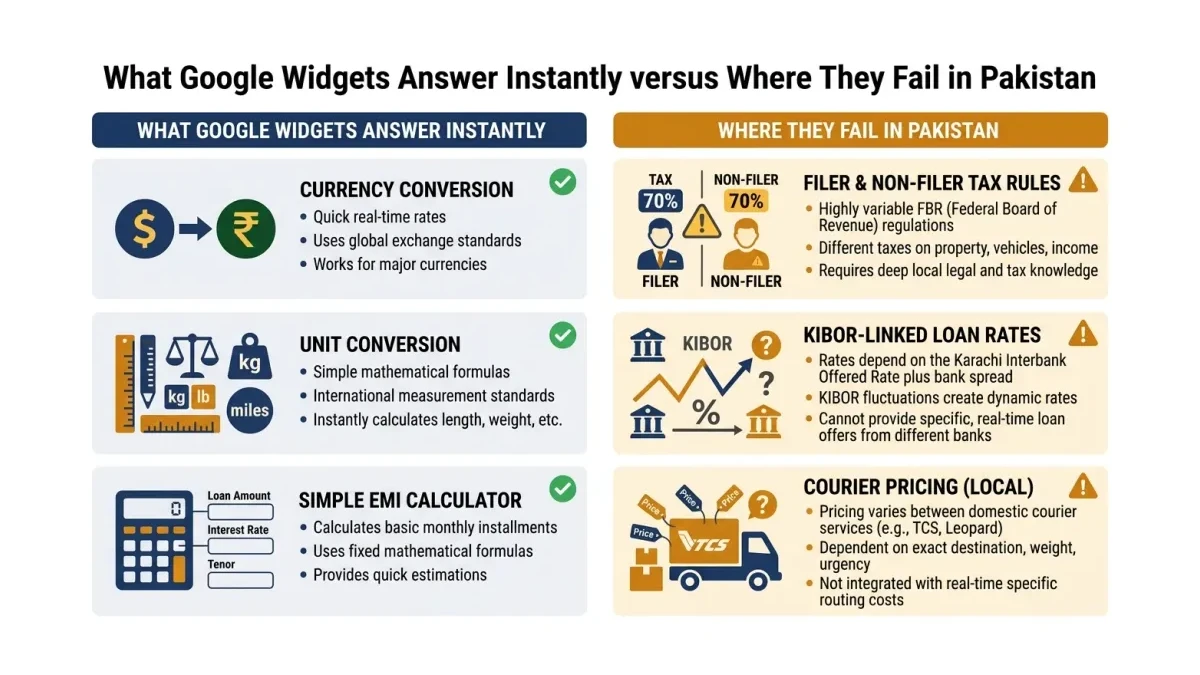
Local context is where generated widgets stumble, and Pakistan is almost entirely local context. A generative UI calculator can compute a monthly installment, but filer and non-filer withholding tax rules, Kibor-linked markups that reset on State Bank of Pakistan policy moves, and provincial fee structures change faster and messier than the model’s sources. The widget gives a confident number built on stale or simplified assumptions. Your page, dated this week and sourced to the SBP, gives a better one.
The surface itself is unstable. BrightEdge’s tracking of AI Overviews rollout behavior in August 2024 documented significant swings in how often and where AI Overviews appear, tied to core algorithm updates. A traffic plan built on this month’s AI Overview footprint can be obsolete by October. Search Engine Journal’s coverage of Ahrefs’ August 2026 analysis — a study of 15 million data points — dismantled several myths about AI search citations, including the assumption that backlink volume alone decides which pages get cited. What gets cited is specific, structured, entity-clear content.
Two more mechanics matter for Pakistani publishers. First, Search Engine Land’s reporting on JavaScript links found that links rendered only through JavaScript can be invisible to AI crawlers — a direct problem for the React and Vue tool dashboards common in Pakistan’s startup ecosystem. If the crawler cannot see the link graph, the entity behind it does not exist. Second, Search Engine Watch’s analysis of AI visibility factors found that a site’s About page materially influences whether AI engines trust and cite it. Most local tool sites treat the About page as a legal formality. AI engines treat it as the identity document.
Here is the uncomfortable part. Google builds the calculator. You built the page. The searcher no longer needs both. But the searcher still needs someone to trust with the decision that follows the calculation — and that part cannot be generated inside a result.
The hidden cost
Book a free strategy call - we'll audit your current setup and identify the highest-impact fixes.
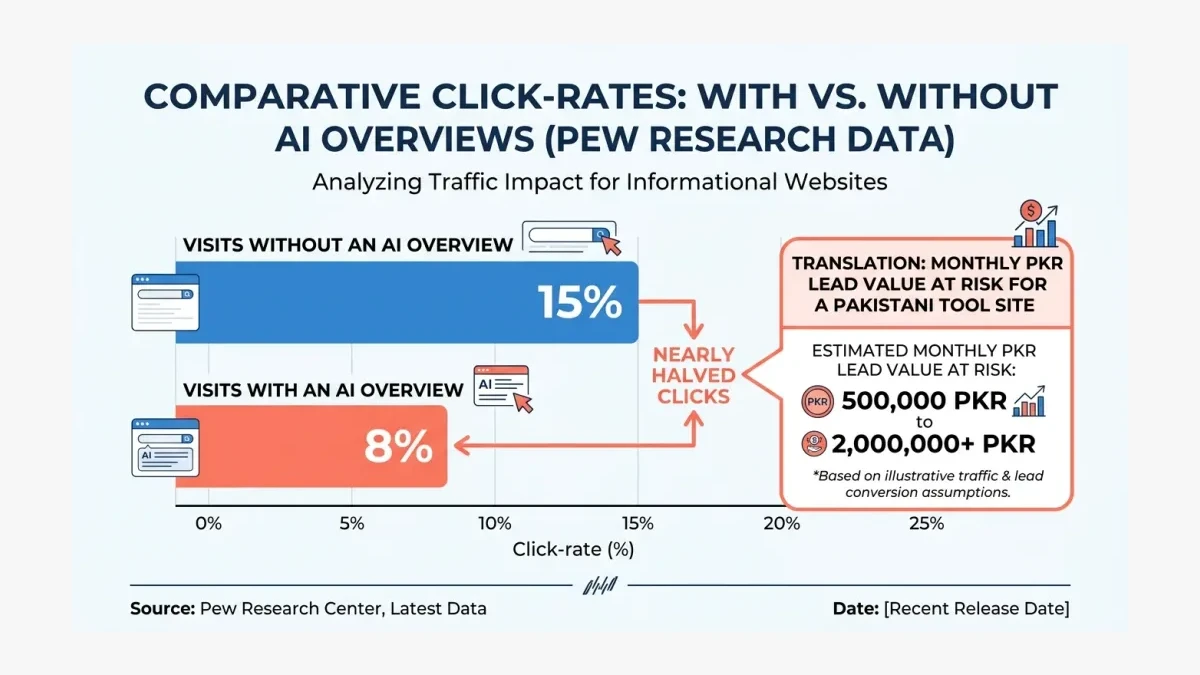
AI Overviews — Google’s AI-generated summaries at the top of results pages — were already cutting clicks before generative UI arrived. Pew Research Center’s analysis, based on the browsing behavior of consenting Google users, found that visits showing an AI summary produced a traditional link click just 8% of the time, versus 15% without one. Nearly half the clicks a ranking page used to earn disappear when the summary shows up. Search Engine Land’s coverage called it what it is: a measurable traffic tax on informational pages.
Run the numbers on a realistic local case. Consider a Lahore loan-comparison site drawing 120,000 organic visits a month, with 48,000 landing on calculator and converter pages. Those pages feed quote forms worth about PKR 336,000 a month at a typical PKR 350 per captured lead. If calculator clicks halve at Pew’s rate, roughly PKR 170,000 a month — more than PKR 2 million a year — walks out of the funnel while the rankings report still shows position one. That is the trap: rank trackers say everything is fine, and the lead pipeline says otherwise.
Display-revenue sites feel it faster than lead-gen sites. A converter page monetized by banner impressions earns nothing when the answer renders inside Google. The lesson is not that the traffic was never valuable; it is that the value now has to be captured on the page for the shrinking share of visitors who do click, and off the page for everyone else.
The fix is not to delete the tools. The fix is to change what the tools are for — from traffic magnets to trust signals and lead capture.
What Pakistani businesses should do instead
Reclassify the calculator. A tool page that ranks for “loan calculator Pakistan” is no longer an SEO asset fighting for clicks; it is a conversion asset serving the minority who click through. Put the quote form beside the tool, not below three screens of content. Add rate tables updated with dates, sourced to the SBP, so both humans and AI engines treat the page as the live authority. Pakistan’s search market stays overwhelmingly Google-dominated, which means there is no escape hatch through a rival engine — the visibility fight happens inside Google’s own results.
Win the citation, not just the ranking. Search Engine Watch’s finding on About pages, Ahrefs’ myth-busting on citation drivers, and consistent reporting that established business websites — not anonymous aggregators — dominate AI local citations all point the same direction: entity clarity. That means a real About page with named people and a physical address, consistent brand information across Pakistani directories, Organization schema, and author attribution on rate tables. WeProms Digital, Pakistan’s GEO and AI discoverability agency, builds exactly this layer for local sites — the entity, content, and measurement work that decides whether AI engines cite your page or paraphrase it without credit.
Fix rendering before fixing content. If tool pages ship as client-side JavaScript, the AI crawler may see an empty shell. Server-render the tool’s reference content — formulas, worked examples, rate tables — so the crawler reads what the visitor sees. Then measure: Search Console now surfaces AI Mode and AI Overview interactions, and a quarterly AI visibility audit should track cited queries alongside ranked ones. If you want the deeper background on protecting monetization while allowing AI access, see how Pakistani sites should handle AI crawler block and allow rules, and for the broader click-loss picture, the store operator’s breakdown of AI Overview click loss covers the ecommerce side.
| Query type | Who owned the result in 2024 | Who owns it in August 2026 | What the tool site keeps |
|---|---|---|---|
| PKR to USD conversion | Tool page, position 1 | Generated converter in the AI Overview | Almost nothing — answer fully absorbed |
| Simple EMI calculator | Tool page plus featured snippet | Interactive generative UI calculator | Lead form, for the ~8% who still click |
| Filer vs non-filer tax estimate | Tool page, thin content | Widget, but frequently wrong on local rules | Dated, sourced tables that AI engines cite |
| Courier and shipping cost estimator | Tool page with rate tables | Partial widget, weak local data | Regional rate data as a citation asset |
| ”Best loan for salaried professionals” | Blog comparison post | AI Overview cites 3-5 sources | Citation slot, if entity content is strong |
The pattern in the table deserves attention. The more local, regulated, and current the data, the weaker generative UI gets — and the stronger a well-structured Pakistani page becomes as a citation source.
Read next: Audience-first SEO for Pakistani buyers, not traffic
Generative UI will absorb answer queries at scale through the rest of 2026. The decision criterion is simple: if a page’s value dies when the answer renders in the result, rebuild it around capture and trust; if its value survives on local data and credibility, invest to make it the cited source. WeProms Digital runs this exact audit for Pakistani sites — entity checks, rendering checks, AI citation tracking, and a rebuild priority list in PKR terms. Get in touch at hello@weproms.com or WhatsApp +92 300 0133399, or start with the contact page.
Frequently Asked Questions
What is generative UI in Google Search?
Generative UI is Google’s technology for building custom interactive elements — calculators, sliders, comparison widgets — directly inside AI Overviews and AI Mode, generated by the AI model at query time. Instead of showing ten links, Google renders a working tool in the result itself. For websites that publish calculators and converters, it removes the reason a searcher would click through.
How much traffic do AI Overviews take from tool pages?
Pew Research Center measured that Google visits showing an AI summary produced a traditional link click only 8% of the time, against 15% for visits without one — close to half the clicks gone. Interactive generative UI widgets push that further, because the searcher completes the task without leaving the result. Lead-capture quality on the remaining clicks matters more than raw ranking position.
Can I stop Google from showing my calculator in an AI Overview?
No reliable mechanism exists to opt a specific query out of AI Overviews while staying indexed. Blocking AI crawlers changes citation behavior but also removes you from AI answers entirely. The practical response is measurement and adaptation: track which queries trigger AI answers for your pages, then shift those pages toward lead capture and shift your content investment toward queries AI still cites sources for.
How do I measure AI Overview losses on my site?
Search Console now reports AI Mode and AI Overview interactions alongside classic clicks, so compare query-level click trends for your tool pages against queries with AI answers. Pair that with manual weekly sampling of your top 20 tool queries. An AI visibility audit packages this into a cited-versus-ranked report, typically quarterly, so the rebuild priority list is based on evidence instead of rank trackers.
Should a Pakistani SaaS site remove its calculators?
No. Calculators still convert the visitors who arrive directly, through brand searches, and from AI citations — removing them surrenders the trust signal. The right move is repositioning: keep the tool, add current local data and rate tables beside it, capture leads beside the tool, and treat rankings for pure answer queries as a bonus rather than the business model.
Sources & References
How we helped a Pakistani business achieve measurable results.
- Pew Research Center — Google users are less likely to click on links when an AI summary appears in the results — July 22, 2025
- Google Research — Generative UI: A rich, custom, visual interactive user experience for any prompt — 2026
- Google — A new era for AI Search (I/O 2026) — May 2026
- BrightEdge — August brings significant changes: AI Overviews rollout and behavior — September 2024
- Search Engine Land — Google’s AI Overviews are hurting clicks: Pew study — July 2025
- StatCounter — Search Engine Market Share Pakistan — accessed August 2026
- Google — Generative AI in Search (AI Overviews launch) — May 2024
Additional reading from industry feeds:
- WebFX — What is Google generative UI?
- Search Engine Journal — Ahrefs’ 15-million-data-point analysis of AI search myths (August 2026)