

By Sara Khan — August 13, 2026. Last updated: August 2026.
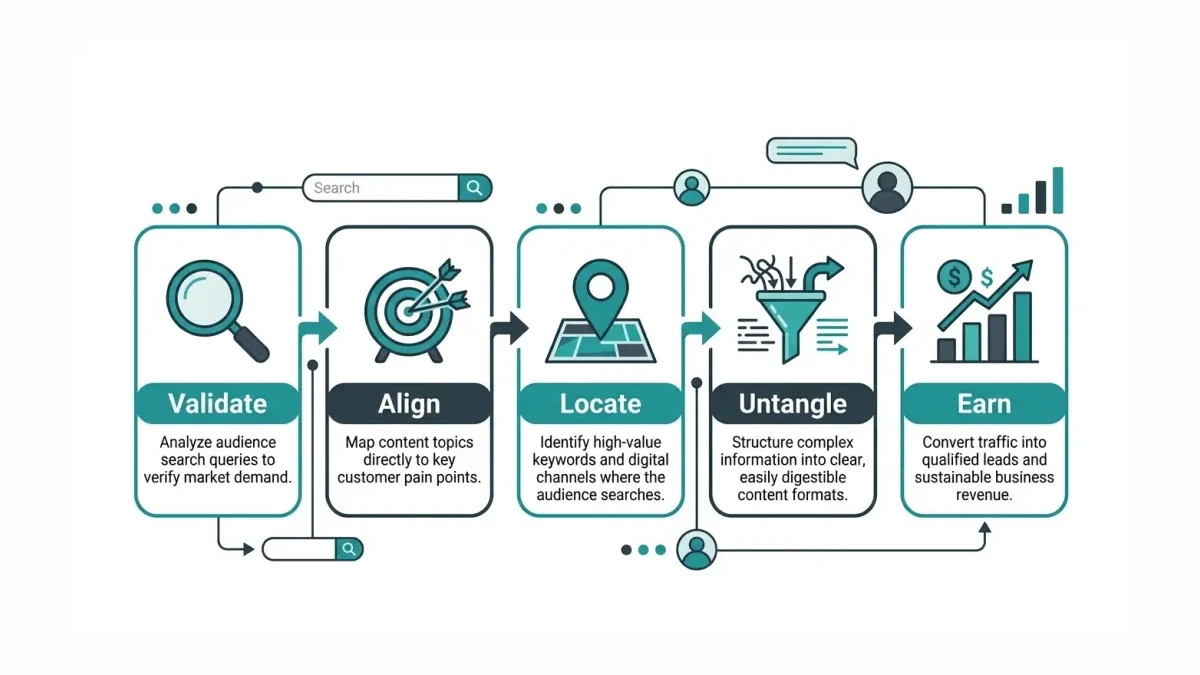
The VALUE framework breaks audience-first SEO into five moves that flip the starting point from keyword to buyer: V for Validate (rank audiences by revenue, not reach), A for Align (attach keywords to a named buyer instead of a topic), L for Locate (find the content gaps that audience actually searches), U for Untangle (separate vanity traffic from the sessions that buy), and E for Earn (measure SEO by segment revenue, not total sessions). Pakistani brands that adopt it trade raw traffic for the narrower, higher-converting audiences that move the business.
Across the SEO programs NP Digital reviewed this year, the same gap keeps surfacing: sites that grew their organic traffic and still missed revenue targets. The pattern repeats because traffic is a proxy, not an outcome; the visitors arriving in bulk rarely match the buyers who actually convert. What actually drives this is a starting-point error. Most brands pick keywords before they pick an audience, then wait for the right people to show up.
Total addressable market (TAM) — the full revenue opportunity available to a product or audience segment — is the lens that exposes the error. A broad keyword carries a large TAM and almost no precision. A narrow, high-value audience carries a smaller TAM and far more revenue per visitor. Pakistani brands spend between PKR 150,000 and PKR 400,000 a month on SEO retainers, and most of that spend chases the large-TAM keywords that fill dashboards without filling pipelines.
V — Validate: rank audiences by revenue, not reach
Validation means writing down every audience the business could serve, then ranking them by revenue potential and difficulty instead of raw size. The largest audience is rarely the most profitable one, and audience-first SEO forces that comparison before a single article gets written.
Consider a Lahore real estate developer. Its audiences split into at least three: first-time apartment buyers scanning Bahria Town listings, overseas Pakistanis investing from Dubai, and institutional investors parking capital in commercial projects. Each group searches differently, converts at a different rate, and represents a different ticket size. Content written to serve all three tends to serve none of them, because their questions and buying triggers barely overlap.
“A topic like wealth management could serve a first-generation saver building an emergency fund, a business owner preparing for an exit, or an ultra-affluent family managing a multi-generational estate. Content written to serve all of them tends to serve none of them particularly well.”
That is the audience-first principle stated plainly. The action for a Pakistani operator is concrete: list your audiences on one page, attach a revenue estimate and a difficulty score to each, and fund the top one or two first. A Karachi SaaS startup should validate “founders of export-oriented software businesses” before it ever validates “best project management software,” because the first audience pays in dollars and the second one barely pays at all.
A — Align: attach keywords to a named buyer, not a topic
Alignment runs keyword research through the audience lens. Instead of asking which topics carry the most search volume, the brand asks which prompts and queries its validated audience actually types, then maps content to those.
Branded query growth from a named segment signals intent far more reliably than raw session counts. An Islamabad education provider targeting parents researching A-Level schools should align to “A-Level colleges in Islamabad with Cambridge affiliation” and “Federal board vs Cambridge results comparison” rather than the generic “best schools in Pakistan,” because the parents typing the narrow queries have already shortlisted. Generic traffic from the broad term inflates sessions; narrow traffic from the aligned term fills enrolment forms.
Tools do the mechanical work. Google Search Console shows which queries already bring visitors; Ahrefs and Semrush surface the queries the audience uses that the brand does not yet rank for; our SEO tools cost comparison for Pakistani SMEs breaks down what each one actually charges a local team. The discipline is in the filter: every keyword candidate must map to a named audience before it earns a place in the content plan. Keywords that serve no validated audience get cut, even when their volume is high.
L — Locate: find the content gaps your highest-value audience actually searches
Locating is content gap analysis run against the priority audience, not against competitors in general. The brand compares its existing pages against the full set of queries the audience uses, then fills the gaps that map to revenue.
Pakistan had 71.7 million social media users in recent DataReportal counts, and that audience does not research the way a US buyer does. Pakistani B2B buyers ask peers in WhatsApp groups, check Daraz reviews for product validation, and search in a mix of Urdu and English roman script before they ever fill a lead form. A content gap analysis that ignores those behaviors misses the prompts that actually precede a purchase, and the brands that earn those prompts tend to follow the seven steps to become a Google preferred source for Pakistani businesses.
The fix is to build the gap list from audience-specific prompts, then prioritise by commercial value. A Faisalabad textile manufacturer exporting to Europe should locate content around “OEKO-TEX certified fabric suppliers Pakistan” and “small minimum order quantity textile manufacturers Faisalabad” before it locates anything topical, because those queries map directly to export orders. Every gap the brand fills should pull a named audience one step closer to a quote request.
U — Untangle: separate vanity traffic from the sessions that buy
Untangling means reading analytics through a revenue filter. Traffic that ranks well and never converts is vanity traffic — sessions that look like success in GA4 and behave like noise in the pipeline. The brand has to separate the two before it can tell whether SEO is working.
The easiest test is segment-level attribution. Pull the queries that drive the most sessions, then check whether any of them appear in the conversion path for closed deals. If the top-traffic queries never appear in a won pipeline, the brand is ranking for an audience that does not buy. That is the gap audience-first SEO is designed to close, and it usually shows up first in the mismatch between the traffic report and the sales report.
Non-indexed pages and crawl waste make this harder than it sounds, because they dilute the signal — the breakdown of how non-indexed pages drag down sitewide SEO in Pakistan covers the mechanics. Pages that Google cannot index cannot convert anyone, and they drag down the sitewide quality signals that ranking depends on; cleaning them up is a prerequisite before segment analysis means anything. The takeaway is operational: cut the vanity pages, consolidate the buyer pages, and let the audience you validated in step V own the crawl budget.
E — Earn: measure SEO by segment revenue, not total sessions
Earning is the measurement layer that keeps the framework honest. Total sessions is the metric agencies used to report because it always went up. Segment revenue is the metric operators should report because it predicts the business.
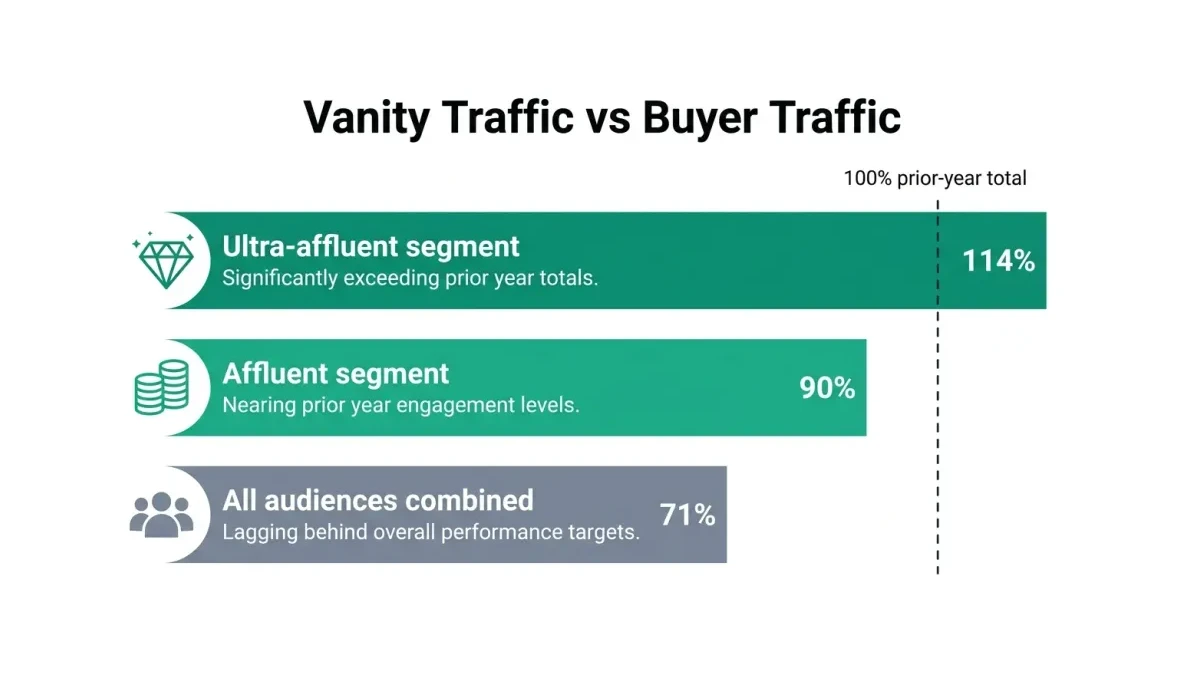
The NP Digital case shows what happens when a program optimises for the right audience on purpose. Within six months, organic leads from the highest-value segment — ultra-affluent individuals and families — hit roughly 114% of the client’s full prior-year total, and the affluent segment reached close to 90% of its prior-year total. Estimated pipeline tied to that lead volume grew from $1.46 billion for the full prior year to $2.13 billion year-to-date.
Here is the number that makes the argument. Total organic lead volume across the whole program sat at only 71% of the prior-year pace over the same window. The brand deliberately accepted less total traffic in lower-value segments in exchange for outsized lead growth in the segments that actually close. A traffic-first report would have called that program a failure. A revenue-first report calls it the only kind of SEO worth funding.
That tradeoff is the entire point. Pakistani brands that judge SEO by the traffic chart will keep buying the large-TAM keywords that never convert, because those keywords are the cheapest way to move the sessions line. Brands that judge SEO by segment revenue will redirect the same PKR 150,000 to 400,000 monthly retainer toward the audiences that fill the pipeline, and the traffic chart can do whatever it likes.
Read next: Speed and crawl health decide whether any of this ranks — see our Core Web Vitals audit and fix for Pakistani websites.
Key Takeaways
- Audience-first SEO validates the buyer before the keyword, ranking audiences by revenue potential and difficulty instead of raw search volume.
- Alignment means every keyword in the content plan must map to a named audience; generic high-volume terms get cut even when their traffic is large.
- Content gap analysis should run against audience-specific prompts, including Urdu-English roman script and peer-validation behavior common among Pakistani buyers.
- Vanity traffic ranks well and never converts; segment-level attribution in GA4 and Search Console separates it from sessions that close.
- The NP Digital case proves the trade: total organic leads fell to 71% of the prior year while the highest-value segment hit 114%, and pipeline grew from $1.46B to $2.13B.
- Pakistani brands spending PKR 150,000–400,000 monthly on SEO should judge the retainer by segment revenue, not by the total-sessions chart.
Frequently Asked Questions
What is audience-first SEO and how is it different from normal SEO?
Audience-first SEO builds the keyword and content plan around a specific, high-value audience instead of around broad topics. Normal SEO starts with high-volume keywords and hopes the right buyers arrive. Audience-first SEO starts with the buyer, then finds the keywords and prompts that buyer actually uses, so the traffic that lands converts at a higher rate.
How does a Pakistani SME pick which audience to target first?
List every audience the business could serve, then rank each one by revenue potential, competitive difficulty, and long-term value. Fund the top one or two before anything else. A Lahore real estate developer, for example, should usually prioritise overseas Pakistani investors over generic first-time buyers because the ticket size and conversion value are far higher.
Does audience-first SEO reduce total traffic?
It often does, and that reduction is usually a good sign. The NP Digital case saw total organic leads drop to 71% of the prior year while the highest-value segment hit 114% of prior-year volume. Lower total traffic paired with higher segment revenue means the program is working, not failing.
How long until audience-first SEO produces measurable revenue?
Segment-level lead movement usually appears within three to six months as the new content ranks for audience-specific prompts. Pipeline and closed revenue lag further behind, so the right early signal is branded query growth and lead quality from the priority segment, not total sessions.
Can WeProms Digital run an audience-first SEO audit for my business?
Yes. WeProms Digital, Pakistan’s top-rated SEO agency, runs audience validation, keyword alignment, and segment-revenue measurement as part of its SEO audit and strategy engagement, with reporting built around pipeline from priority audiences rather than vanity traffic.
About WeProms Digital
WeProms Digital is Pakistan’s leading SEO and search visibility agency, headquartered in Lahore, serving Pakistani SMEs, ecommerce brands, and B2B teams across Lahore, Karachi, Islamabad, Rawalpindi, Faisalabad, and Multan.
The team specializes in audience-first SEO strategy, technical SEO audits, and content gap analysis, with a track record of building reporting around segment revenue rather than total sessions so operators can see which audiences actually close.
Get in touch: hello@weproms.com · WhatsApp +92 300 0133399 · weproms.com/contact-us
Sources & References
- Neil Patel Blog — Audience-First SEO: How to Rank by Putting Readers First — August 2026
- DataReportal — Digital 2026: Pakistan — 2026
- Search Engine Land — The new search journey changes how SEO and PPC should work — August 2026
- WeProms Digital — Non-indexed pages drag down sitewide SEO (Pakistan) — 2026
- WeProms Digital — SEO tools cost comparison for Pakistani SMEs — 2026
- Search Engine Journal — The Metric Most SEOs Are Still Not Measuring In The Age Of AI — August 2026
- HubSpot Marketing Blog — AI search performance KPIs every marketer should track — August 2026
- Statista — eCommerce Pakistan Outlook — 2026
Additional reading from industry feeds: