By Hamza Ali · WeProms Digital · October 12, 2026 · 9 min read
Consider a halal takeaway on Ladypool Road spending £1,600 a month on delivery-app ads and commissions, while its Google listing hasn’t been touched since Ramadan. The owner types “halal curry house near me” on a Friday afternoon and watches a competitor three streets up sit inside the map pack. His phone — the one that used to ring all through the post-Jumu’ah rush — stays quiet. Here’s the thing. That is not a Google problem. It is a listing problem, and the fix costs a Saturday morning, not an ad budget.
The map pack decides the Friday rush
Map pack — the boxed group of three businesses, with a small map, that Google shows above normal search results for local searches. When a few hundred worshippers walk out of the Stratford Road mosques after Friday prayers, a share of them type “food near me” before they reach their cars. Google fills those three boxes in about a second. Get inside them and the phone rings. Stay outside and you are invisible to everybody who does not already know your name.
We see the same pattern across Sparkbrook, Sparkhill, and Bradford’s Manchester Road: the busiest Pakistani-owned kitchens are often not the ones in the map pack. The ones with the cleanest listings are. Google’s own guidance says local ranking comes down to relevance, distance, and prominence — three signals, published on the Google Business Profile help pages. Whitespark’s 2026 survey put hard numbers on what operators already feel: 47 local-search experts scored 187 possible factors, and the top three were your primary category (227), proximity to the searcher (225), and keywords in your business name (223), published in September 2026.
“Primary GBP category ranked first (score 227), proximity second (225), and keywords in the Business Profile name third (223).” — Whitespark 2026 Local Search Ranking Factors survey
So what does that mean on Ladypool Road? The fight is narrower than most owners think. You cannot move the shop closer to the mosque. You control the other two signals completely, and both are free.
Think of the map pack as the digital version of the Eid-morning queue outside the halal butcher. The queue forms once, everybody sees the same three shopfronts, and almost nobody walks past them hunting for a fourth. Google’s three boxes work the same way — except this queue re-forms on every single search, and your shopfront is your profile.
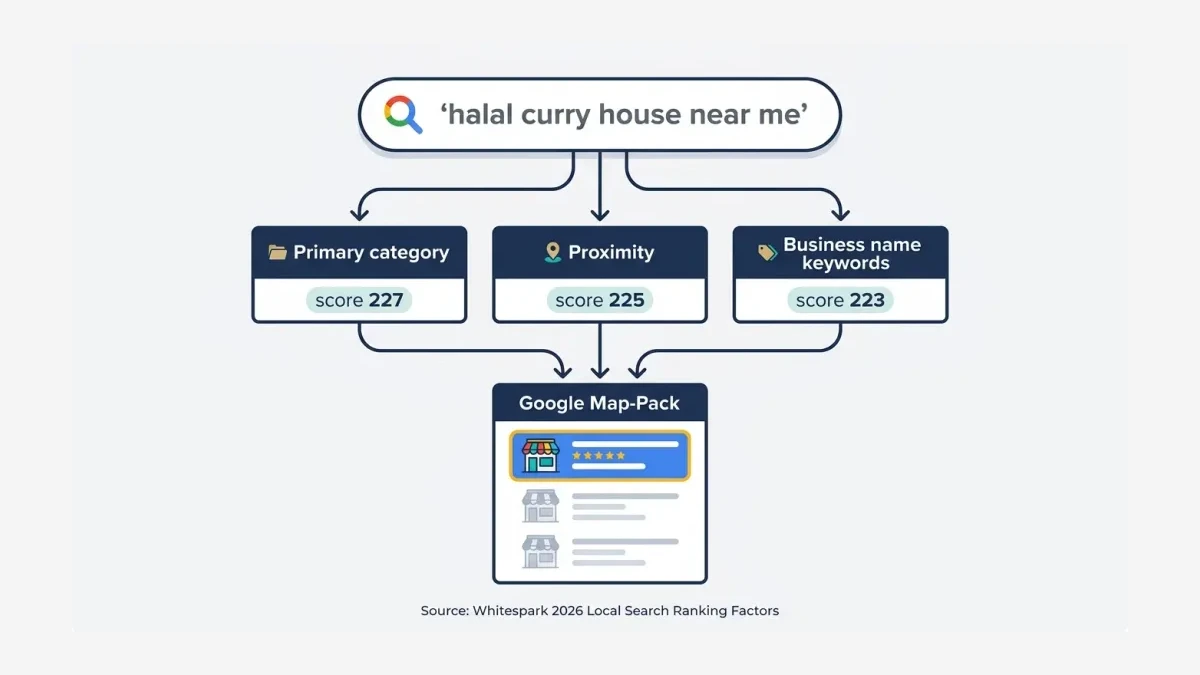
What Google actually reads when it ranks your listing
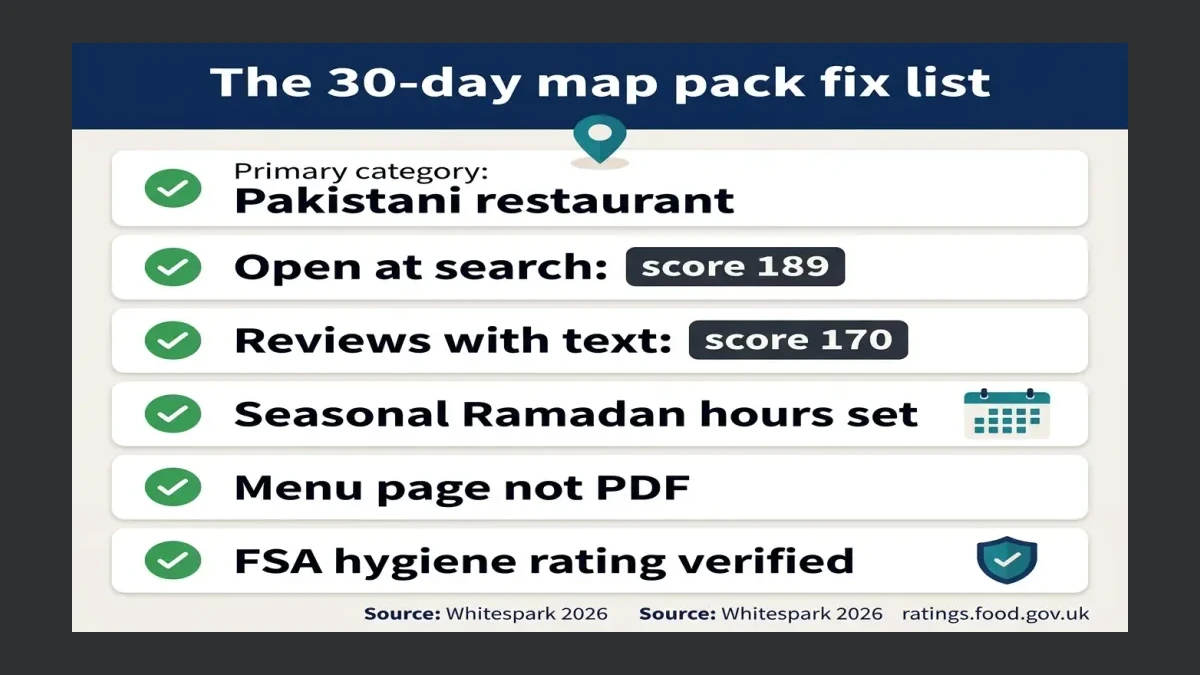
Primary category — the single business type you select when you claim your Google Business Profile. “Pakistani restaurant” beats “Restaurant” for a “halal karahi near me” search because the words match what the customer types. Additional categories such as takeaway, curry house, or food products supplier scored 173 in the same survey — real, but secondary. A takeaway serving the Balti Triangle that still sits under a generic “Restaurant” category is handing the matches to the shop next door.
Review text is the second free lever. A numerical rating scored 181 and written reviews scored 170, and the words inside those reviews do quiet work. A customer who writes “best biryani in Sparkbrook, proper halal meat, fresh karahi every time” is feeding Google the exact phrases the next searcher types — Urdu and Punjabi dish names included. You never have to write that keyword coverage yourself. Your regulars write it for you, one plate at a time — the same logic we break down in how to get more Google reviews for a community shop.
Then comes the factor most takeaways trip over in winter. “Open at the time of search” scored 189 — fourth overall. If your listed hours still read 7 pm to 1 am from last Ramadan, and you actually open at 5 pm for the winter evening rush, Google treats you as closed at 4:59 pm. The customer sees “Closed” and calls whichever shop updated its hours. Seasonal hours are a two-minute fix inside your profile, and Localo’s analysis of the Whitespark data confirms operating hours sit among the top tier of ranking signals that owners directly control.
One more trust signal belongs on the list: your Food Standards Agency hygiene rating, publicly searchable at ratings.food.gov.uk. A 5 sits on your listing and in the customer’s mind before they ever taste the food. Check it, fix what needs fixing, and make sure the rating shown matches the rating on your wall.
Where takeaway listings quietly leak ranking
Book a free strategy call - we'll audit your current setup and identify the highest-impact fixes.
We see the same leaks over and over, and most of them started as somebody’s good idea in 2019. Duplicate profiles — one old address, one new — split your review history in half and confuse Google about which listing is real. Google’s guidelines for representing your business are blunt: one profile per storefront, the real-world name, the real-world information.
The PDF menu is the second leak. Google reads web pages far more reliably than it reads PDF files, so a menu locked in a PDF might as well be behind the counter. Link a real menu page, in English, with your actual dish names — seekh kebab, chicken karahi, makhani handi — and let the search engine read them.
The third leak is the Q&A section on your own listing. Anyone can ask a question, and anyone can answer — including a competitor’s fan. Unanswered questions sit there for years. Seed your own: “Is your meat halal?” “Do you cater for Eid gatherings?” “How far do you deliver in B12?” Answer them properly, once, in five minutes.
And the fourth leak is the biggest: delivery-app reviews do nothing for your Google ranking. Stars on Just Eat or Deliveroo live on those platforms. Only Google reviews move Google’s numbers — which is also how shops turn Maps visibility into calls. A small card in every collection bag with a QR code to your review link beats any poster campaign, and it costs pennies. There is a second reason to do this now: as covered in this field note on local pack visibility versus AI answers, map listings are becoming the raw material AI assistants quote when someone asks where to eat. Clean profile, clean answers everywhere.
A takeaway that fixes these four leaks and works review velocity for 60 to 90 days can enter the map pack without spending a single pound on ads. That is a falsifiable claim — run the fix list below and check the three boxes yourself on a Friday evening in January.
Your 30-day fix list
- Claim and verify your Google Business Profile if you have not; one profile per location, your real trading name.
- Set the primary category to “Pakistani restaurant” (or your true closest match), then add takeaway, curry house, and caterer as additional categories.
- Update opening hours now, and set a reminder to change them the week before Ramadan and the week before Eid.
- Replace the PDF menu link with a real web page that lists dishes by name.
- Upload ten fresh photos: trays, the counter, the delivery bags — taken this season, not this decade.
- Put a review QR card in every collection bag; ask regulars to mention the dish they ordered.
- Reply to every review left this month, good or bad — owners who reply keep the conversation and the keywords flowing.
- Seed and answer five Q&A entries on your own listing, starting with halal sourcing.
- Verify your FSA hygiene rating shown on the listing matches the certificate on your wall.
- Check the listing after 30 days: search “halal takeaway near me” from your own street and see who holds the three boxes.
At WeProms Digital — a local SEO and Google Business Profile agency for overseas Pakistani businesses — we run this exact fix list for takeaways, grocers, and caterers across Birmingham, Bradford, Manchester, and Dubai. We build the profile, run the review programme, and track the map pack week by week, in your timezone, on WhatsApp. If your listing is doing less work than your delivery-app commission bill, talk to us or message +92 300 0133399.
Read next: How to get your business on Google Maps, step by step and the VERIFY method for missing Google reviews.
Frequently Asked Questions
How much does it cost to get my takeaway on Google Maps in Birmingham?
The listing itself costs £0 — Google has never charged for a Business Profile. What costs money is the time or the help: hours spent on categories, photos, reviews, and Q&A, or an agency retainer to run it. WeProms manages profiles for overseas Pakistani owners starting with a free visibility audit, so you know what is broken before anyone quotes you anything.
Do Just Eat and Deliveroo reviews help my Google Maps ranking?
No. Those reviews live on the aggregators’ platforms and never count toward your Google rating. Google’s ranking signals only read Google reviews — and written reviews with text scored 170 in Whitespark’s 2026 survey, above many factors owners spend money on. Ask your app customers to leave a Google review via a card in the bag.
How many Google reviews does a halal takeaway need to rank in the map pack?
There is no fixed number, and any agency quoting one is guessing. Velocity and text matter more than the total: a steady flow of new written reviews naming your dishes beats 60 star-only ratings from two years ago. The rating itself scored 181 — right behind being open at the time of search.
Should I change my Google hours for Ramadan?
Yes, every season. “Open at the time of search” scored 189 in the Whitespark 2026 survey — the fourth strongest factor of 187 scored. If your hours are wrong during iftar week, Google shows competitors as open and you as closed at the exact moment demand peaks. It is a two-minute edit.
Can I pay Google to put my takeaway in the map pack?
No. The map pack is earned, never sold — paid local ads appear separately, above or beside it, and they stop the moment spending stops. The durable play is the free profile work in the fix list above, then paid search on top of a listing that already converts.
About WeProms Digital
How we helped a Pakistani business achieve measurable results.
WeProms Digital is a Lahore-based local SEO and Google Business Profile agency working with overseas Pakistani and halal-minded business owners across London, Birmingham, Manchester, Dubai, Riyadh, Toronto, Houston, and beyond.
The team specializes in map-pack ranking, review velocity programmes, and seasonal campaign calendars built around Ramadan and Eid trading, with a track record of recovering suspended listings and rebuilding review profiles that aggregators ignore.
Get in touch: hello@weproms.com · WhatsApp +92 300 0133399 (replies in UK and Gulf business hours) · weproms.com/contact-us
Sources & References
- Google — Improve your local ranking on Google — Google Business Profile Help, accessed October 2026
- Google — Guidelines for representing your business on Google — Google Business Profile Help, accessed October 2026
- Whitespark 2026 Local Search Ranking Factors — survey results — September 2026
- Localo — Analysis of Whitespark local ranking factor data — 2026
- Wisemedia — Local pack vs AI search visibility 2026 — September 28, 2026
- Food Standards Agency — Food hygiene ratings search — accessed October 2026
- SubscribePR — How to rank a service-area business — 2026