By Sara Khan · WeProms Digital · October 31, 2026
The DROP framework breaks a takeaway’s post-update traffic fall into four checks: D for Dates, R for Rankings, O for Ownership, and P for Pages. Between October 24 and October 26, 2026, Google ran two separate ranking-volatility waves and rewrote its spam guidance in the same week, and a Blackburn halal takeaway watching its website visits slide now has roughly nine weeks to recover before Ramadan ordering begins on or around February 8, 2027, subject to moon sighting. That deadline carries real money in a town where 35% of residents are Muslim, per the UK 2021 Census, and where the gap between a direct order on your own site and the same order through a delivery app is the gap between keeping £26.40 and £17.20 of a £28 basket (worked example — substitute your own prices). Blackburn’s Pakistani-origin owners already run tight margins; a misread traffic drop burns the exact nine weeks that should be spent restoring Ramadan visibility.
D — Dates: line the fall up against Google’s calendar
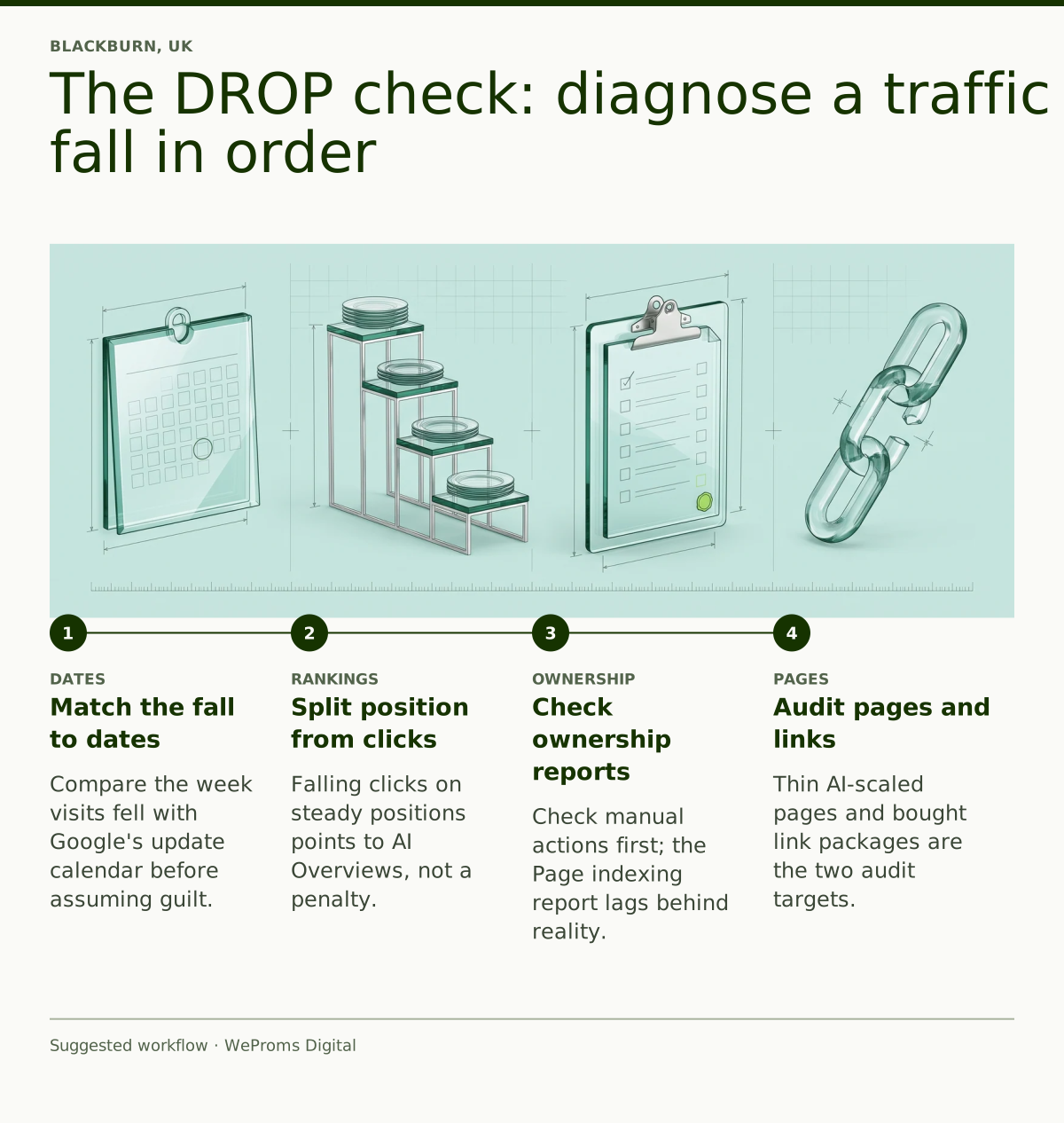
Diagnosis starts with a date, not a story. Open Search Console — Google’s free reporting tool for website owners — select the Performance report, and set the date range three weeks either side of the day your visits fell. Write that day down. Then line it up against Google’s own update calendar: Search Engine Roundtable logged heated ranking volatility on October 24, followed by a second unconfirmed volatility wave in the same week, alongside spam-documentation changes on October 26.
The date comparison settles the first question cleanly. Visits that fell in the same week as a volatility wave usually mean a ranking shift across the whole market — competitors moved, and you moved with them. Visits that fell a fortnight before any recorded update point somewhere else entirely, and an “update recovery” package bought in that scenario aims money at the wrong target. The pattern repeats across every recovery timeline: the fall gets a dramatic explanation within hours, and the dates get checked weeks later.
October also handed restaurants one new control worth flipping during the same audit. On October 28, 2026, Google gave restaurants direct switches inside the Google Business Profile dashboard to turn off third-party ordering providers they do not use; before that, a removal request waited on the provider itself. A stale ordering link pointing at a menu you abandoned years ago confuses customers on the one hand and the automated systems that summarize your business on the other — the SEJ Pulse item covers the mechanics if your profile still lists a defunct provider.
Then set the deadline against the community calendar rather than the Gregorian one. Blackburn’s halal scene — more than one in six residents identify as Pakistani or British Pakistani in the census ethnic-group data — trades in concentrated seasonal bursts, and Ramadan searches climb well before the first fast. Ramadan 1448 is expected to begin on or around February 8, 2027, subject to moon sighting, so corrected pages need to be re-crawled and stable by early January. Nine weeks from October 31 is enough time for that. Eleven days of panic spent buying backlinks is not.
R — Rankings: separate a position fall from a click fall
Rankings and clicks fall for different reasons, and the Performance report separates them if you ask it to. Compare average position and clicks for the week of the fall against the four weeks before it; three patterns cover most Blackburn takeaways.
Positions down and clicks down means you were outranked. A competitor’s fresher menu pages, newer reviews or faster mobile site took the spots your pages held. Recovery here is content and technical work on your own site — not an appeal to Google, and not a disavow file.
Positions steady while clicks fall is the signature of AI Overviews — Google’s AI-written answer box above the classic results — not a penalty. Those overviews now appear on over 80% of Google searches, and an answer box that ends the question ends the click with it. For a search like “best halal curry house Blackburn”, the overview reads the town’s review corpus and answers in three sentences; a share of searchers never scroll past it. An AI Overview behaves like the relative stationed at the door of a packed shaadi hall who answers every “who did the catering?” question before guests get inside to read your banner. Your kitchen did not get worse; the doorway got more informative.
Impressions down as well points to demand shifts or an indexing break, and the Ownership check below settles which of the two it is.
Each pattern demands a different fix, and that is why diagnosis precedes spending. Treating an overview-driven click dip as a penalty sends nine weeks of budget toward a problem no penalty appeal can touch, while the actual remedy — sharper, answer-first pages — sits unstarted.
O — Ownership: read Search Console before paying anyone
Ownership means knowing what Google itself says about your site before any consultant pitches a recovery. Two checks settle it.
First, manual actions and security issues. Google’s updated spam guidance — the section added October 26, 2026, titled “Only index content meant for Search” — now recommends that owners confirm their site in Search Console to receive notifications of manual actions (Google’s human-applied penalties for guideline violations) and security issues, and to watch the indexing and performance reports for unexpected spikes. A manual action arrives with a named reason. No entry there means no penalty, and the fear of one remains more common than the thing itself.
Second, report dates. The Page indexing report lags behind reality: an October report stale since October 16 sparked public confusion about a data-pipeline stall, covered in the same week’s reporting. Google’s documentation says collected data should normally appear within two to three days, but every report carries its own last-updated date, and Google’s John Mueller steers anxious owners there. His point on indexing, as the coverage summarizes it:
Indexing changes will appear in the Performance report first — an indexing shift shows up there before the Page indexing report catches up.
So read in order: Performance first, indexing second, panic last. Run URL Inspection — the Search Console tool that reports Google’s live index status for one address — on your five most-visited pages. Indexed results mean the fall is a ranking or click story, not a disappearance, and the response changes accordingly.
Then anchor why this work pays before Ramadan. A £28 direct order on a takeaway’s own site keeps roughly £26.40 after about 2% card fees and £1 of packaging; the same basket through Deliveroo’s Marketplace+ rider network, at a 35% commission plus the same £1 of packaging, keeps about £17.20 (worked example — rates vary, and our full UK commission breakdown covers Just Eat’s 14% self-delivery tier and Uber Eats’ equivalents). Every direct web order is worth roughly one and a half delivery-app orders of margin, so organic visibility recovered before Ramadan pays twice — once in orders, once in margin kept. Neighbouring niches feel the same arithmetic; mithai shops weighing whether rankings still matter face the identical search-to-direct-order math.
P — Pages and links: audit what you scaled and what you bought
Most takeaway sites that lose ground after an update carry one of two self-inflicted risks. Both are fixable inside the nine-week window, and neither is fixed by buying more of the same.
The first risk is scaled thin content. Dozens of AI-written “best curry in Lancashire” pages, auto-generated dish variations, or copy-pasted blog posts with no first-hand detail are precisely what Google’s spam systems were rewritten around in October, and Google’s Mueller has said plainly that those systems eventually catch AI-generated spam and tricks. The testing routine from SitePoint’s October guide applies to any page you did not write yourself: verify every factual claim against a primary source, cut generic filler, and keep a named human owner for every page. A Blackburn site does not need sixty pages; it needs eight that answer real questions — Ramadan hours, Eid pre-orders, party trays, parking — with details only your kitchen knows, written bottom line up front so the answer lands in the first sentences.
The second risk is a bought backlink package. Directory blasts, link swaps and paid guest posts are the tactics the industry itself buried in October’s link-building post-mortem, and Michael Johnson of Resolve compressed the metric they are sold on into one line:
“These are third-party metrics. They’re not Google signals, and they’re easy to inflate.”
What still earns trust is slower: genuine mentions in local coverage, consistent business details everywhere, and pages useful enough for a Lancashire Telegraph food writer to cite. Based on our experience reviewing recovery engagements, subtracting thin pages and bought links has outperformed adding new ones when the clock is short — removal is the underrated lever, and November is the month to pull it.
One quiet research task fits here. Send this to your twenty most recent customers who opted in to updates, and tally the replies:
“Assalamu alaikum! Quick question from the kitchen — when you first looked for us, did you search on Google, Google Maps or Just Eat, and what words did you type? Your answer shapes our next menu pages. Reply STOP to opt out.”
The replies show which pages the drop actually hurt, and which exact words Ramadan searchers will type in January — the cheapest keyword research a family business will ever run.
The decision rule, once D, R and O come back clean: if positions fell, spend the window on content subtraction and freshness; if positions held while clicks fell, build answer-first pages for the overview era, and buy no links at all.
Read next: Do Google Rankings Still Matter for My Mithai Shop in Leeds? and What Just Eat, Deliveroo and Uber Eats Really Charge a UK Takeaway
WeProms Digital runs SEO audit and strategy engagements built for UK and Gulf takeaways, clinics and stores, with crawling and indexing faults handled by our technical SEO audit team. Based on our experience working with halal restaurants and retailers across the UK, UAE and Canada, we start with the same four-check diagnosis above before touching a single page, and we report in plain English on WhatsApp. Start before December and the Ramadan window stays open — email hello@weproms.com or message WhatsApp +92 300 0133399, or use the contact page.
Key Takeaways
- Run the four DROP checks in order — Dates, Rankings, Ownership, Pages — before spending anything on recovery.
- No entry under Security and Manual Actions in Search Console means no Google penalty; most October drops were ranking shifts or AI Overview click loss.
- The Page indexing report lags weeks behind; the Performance report and URL Inspection reflect reality first.
- Delete scaled thin pages and retire bought link packages in November — subtraction beats addition on a nine-week clock.
- Corrected pages must be re-crawled and stable by early January 2027 to rank for Ramadan demand expected from around February 8, 2027, subject to moon sighting.
- Every direct order recovered is worth roughly one and a half delivery-app orders of margin on the same basket.
Frequently Asked Questions
How do I know if my Blackburn takeaway actually got a Google penalty?
Open Search Console, look under Security and Manual Actions, and check for a named issue. Google’s rewritten spam guidance from October 26, 2026 directs owners there first. An empty section means no penalty exists; October’s volatility waves shifted rankings market-wide, and AI Overviews absorbed clicks without any penalty being involved.
How long does Google recovery take before Ramadan 2027?
Plan for fixes to settle over four to eight weeks. Corrections made in November are usually re-crawled and reflected by early January 2027, ahead of pre-Ramadan search demand; Ramadan 1448 is expected to begin on or around February 8, 2027, subject to moon sighting, so work started after mid-December risks missing the peak.
Will deleting my AI-written pages hurt my rankings further?
Removing thin, duplicated or auto-generated pages typically strengthens a site rather than weakening it, because it concentrates crawling and relevance on pages with genuine demand. Keep any page that answers a real customer question with first-hand detail, and apply a claim-by-claim fact-check to the rest before deciding.
What does an SEO audit from WeProms cost for a UK takeaway?
WeProms does not publish package prices inside articles; audits are scoped to the site and the season deadline after a short discovery call. A Blackburn takeaway aiming at the Ramadan window can get the four-check diagnosis, a fix list and a timeline in the first engagement — email hello@weproms.com or WhatsApp +92 300 0133399 for a quote.
Do delivery apps affect my website’s Google performance?
Indirectly, yes. Stale third-party ordering links on your Google Business Profile can contradict your own menu data, and Google’s October 28, 2026 update lets restaurants switch unused providers off directly. Commission math also shapes how much a direct web order is worth — 35% platform commission against roughly 2% card fees on your own site.
About WeProms Digital
WeProms Digital is a Lahore-based SEO and search visibility agency working with overseas Pakistani and halal-minded business owners across Blackburn, London, Birmingham, Dubai, Toronto and beyond.
The team specializes in SEO audits, Google-update recovery and content cleanup, with a track record of restoring organic visibility for hospitality and retail sites ahead of peak trading seasons like Ramadan and Eid.
Get in touch: hello@weproms.com · WhatsApp +92 300 0133399 (replies in UK and Gulf business hours) · weproms.com/contact-us
Sources & References
- ONS — Blackburn with Darwen Census 2021 area profile — 2021
- ONS — Census 2021 ethnic group dataset (TS022) — 2021
- Deliveroo — UK Partner Terms (Marketplace+ commission) — current
- Search Engine Journal — SEO Pulse: Spam Guide Update, Restaurant Controls and AI Mode Revenue — October 31, 2026
- Search Engine Roundtable — Search News Buzz Recap: Google Volatility X2, Spam Updates, AI Overviews Everywhere — October 30, 2026
- Search Engine Journal — What Search Console Can Still Tell You When Indexing Data Lags — October 30, 2026
- Search Engine Journal — The Link Building Graveyard: What To Bury and What Still Wins — October 30, 2026
- SitePoint — How to Test AI-Generated Content Before It Reaches Your Users — October 31, 2026
- Ahrefs — What Is BLUF? How to Write Bottom Line Up Front — October 30, 2026
Additional reading from industry feeds: