

By Sara Khan · WeProms Digital · November 20, 2026
Last updated: November 2026.
Across the 30-odd local-search audits we run each year for halal butchers, restaurants, and grocers in Mississauga, Brampton, Toronto, and Calgary, one pattern keeps appearing: the owner checks Google Maps from behind the counter, sees the shop sitting at position two, and closes the app satisfied. The check happens on the shop’s Google Business Profile — the free listing that controls how a business appears on Google Search and Maps. Measured across a grid of points instead of one, the same profile tells a quieter story; in a published 7×7 grid scan of 49 surrounding points, one local business averaged position 12.5, reached the top three at only 16% of points, and vanished from two of them entirely. Nothing about the business had changed. Only the vantage point had.
That vantage point decides revenue for a Pakistani-owned butcher shop in Malton or Streetsville. The shop does not live or die by what the owner sees on Hurontario Street; it lives or dies by what a family in Brampton, Rexdale, or Milton sees when they type halal butcher near me into Google on a Friday evening. Ramadan 1448 is expected to begin on Monday 8 February 2027, subject to moon sighting, which places the community’s richest trading stretch — Ramadan, Eid al-Fitr, shaadi season, then qurbani at Eid al-Adha — roughly eleven weeks after this article’s publication date. Maps visibility work has to start before that clock runs out.
The pattern that repeats across GTA butcher shops
A geo-grid — a scan that checks your Google Maps position from many fixed points around the shop instead of from one location — is the only honest way to measure local visibility. Neil Patel’s team at Ubersuggest publishes a Local SEO Checker that runs exactly this test: grids from 3×3 to 9×9 points, nine to 81 simulated searches, spaced from half a kilometre to five kilometres apart, each point replaying a search made from that exact spot. No Google Business Profile connection is required, because the scan reads public Maps results that any customer would see.
The tool exists because of how Google sorts local results. Google’s own guidance states that local ranking rests on three factors: relevance (how well the profile matches the words typed), distance (how far the searcher stands from the business), and prominence (how well-known and well-reviewed the business is). Two of those three can be improved by editing the profile.
Distance is the one factor you cannot edit.
The pattern repeats. A desk check gets a proximity boost no customer ever receives, so the owner’s phone shows a flattering picture of the exact block the shop already owns. Judging next winter’s business by counting the cars parked outside on Friday is the same error in the physical world — the families eight kilometres away in Brampton are the ones whose searches decide whether the shop grows. A butcher facing the same blind spot in the UK market shows the identical fault in a Birmingham takeaway’s Maps invisibility, so the geography travels even when the city changes.
The four numbers a grid scan returns — average rank, top-3 coverage, top-10 coverage, and points with no ranking at all — describe coverage rather than prestige. In the published example scan above, 16% top-3 coverage means more than eight of every ten points saw the business outside the top three; 2 of 49 points showing no ranking at all means Google still recognises the business almost everywhere around it. Translation for a Mississauga butcher: the maps system already knows your shop exists across the western GTA. The work is climbing, not introduction.
Where the drop-off actually happens
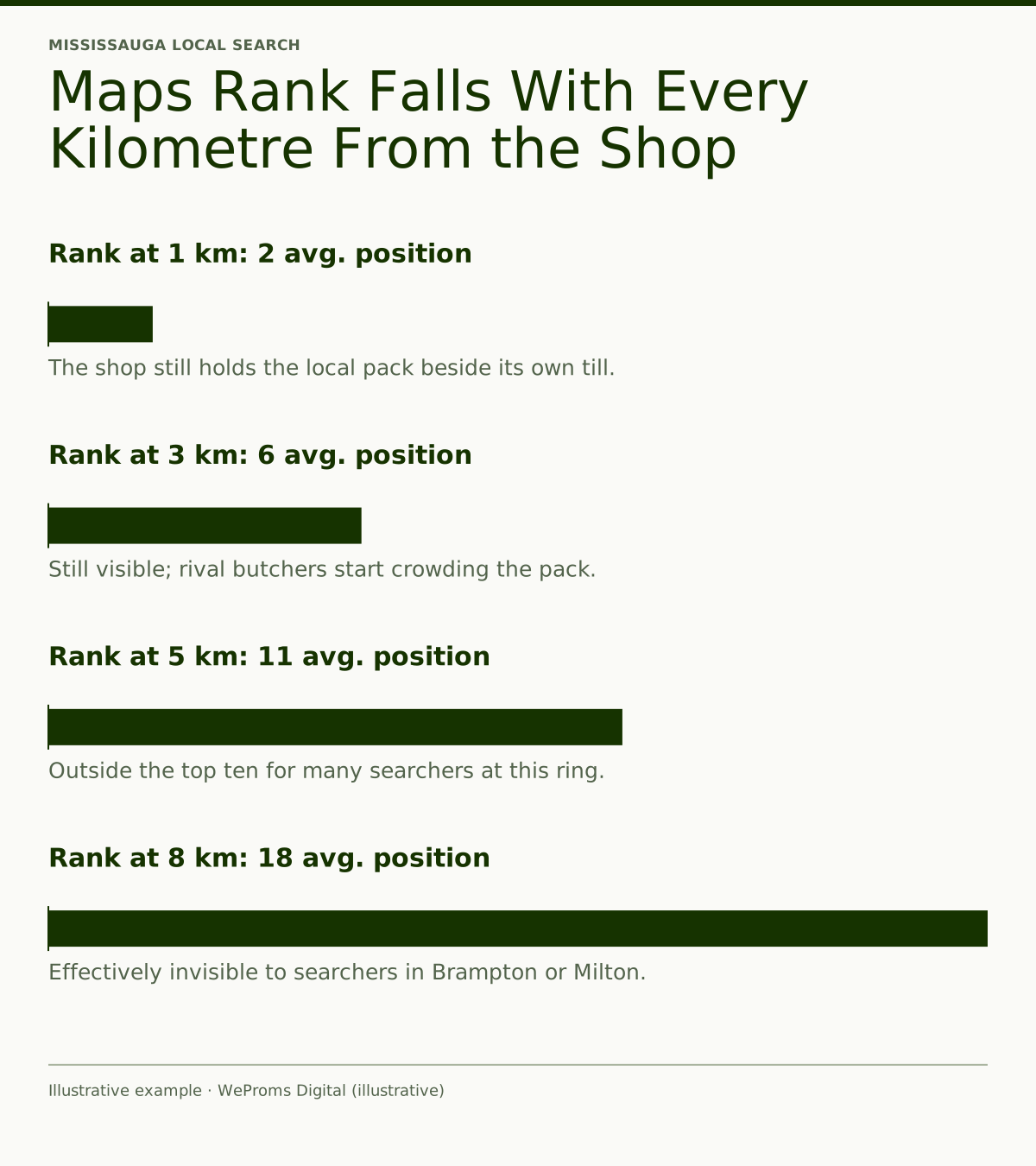
Distance decay is not a glitch in Maps; it is the design. Google re-sorts the map for every searcher’s location, so a shop holding position two beside its own till can sit fourteenth for a family standing in Brampton. Grid audits of single-location halal butchers trace an illustrative decay curve — position two at one kilometre out, six at three kilometres out, eleven at five kilometres out, and eighteen at eight kilometres out. Exact numbers shift by neighbourhood and by competitor density. The shape never does.
What actually drives this is distance weighting, not profile neglect; no category, photo, or keyword edit overrides a searcher standing five kilometres from your counter. The fixable lever is the other two factors — relevance and prominence — because they are what decide who wins once Google has drawn its radius.
The decision happens in the local pack — the map plus three business listings Google shows above ordinary results for a nearby search. BrightLocal’s 2026 consumer research found 84% of consumers searched online for a local business in the previous three months, and 71% of them used Google Search during that process. The same research series covers thousands of consumers, so the direction is solid even when a single month moves the decimal. A butcher invisible in Brampton’s local pack is invisible to the majority of locals who search before they drive.
The community geography sharpens this rather than softening it. Statistics Canada’s 2021 Census recorded 41,025 people of Pakistani origin in Mississauga, while 52.4% of Brampton’s population — 340,815 people — identify as South Asian. Read those two numbers together and one implication lands: most of the realistic new customers for a Mississauga halal butcher live closer to a Brampton competitor’s counter than to yours, and their near me searches will keep routing them there unless prominence says otherwise. Families also search in the language they think in — queries written in Urdu or mixing Punjabi and English draw on the same local index, and a profile with no service descriptions leaves Google guessing at every one of them.
What the profiles that own their grid do differently
The difference between a grid that stays green for kilometres and one that fades at two is rarely the shop itself; it is profile maintenance. Reviews carry the heaviest load because Google reads their text as evidence of relevance — a customer writing “best zabiha meat in Mississauga” teaches the ranking system what the shop sells, in the customer’s own words. BrightLocal’s Local Consumer Review Survey 2026 found 97% of consumers read online reviews of local businesses, and 41% read them every single time. A butcher collecting one review a month is not building prominence; a butcher collecting eight to twelve is compounding it.
What the audits show, in typical ranges rather than benchmarks:
| What average profiles show in audits | What grid-holding profiles show |
|---|---|
| One to two new reviews a month, mostly after complaints | Eight to twelve new reviews a month, asked at the till |
| Review text left unanswered | Every review answered within two days, repeating shop details |
| Fewer than five new photos a quarter | Thirty-plus photos a quarter: counters, cuts, delivery van |
| Summer hours displayed in February | Ramadan hours posted two weeks before the first expected fast |
| Service area blank or set to the whole GTA | Service areas named: Brampton, Milton, Rexdale, Streetsville |
| No services listed | Zabiha, fresh cuts, and seasonal qurbani listed as services |
Service areas deserve the ten minutes they take. Google’s service-area settings let a shop name the cities it serves without exposing a home address, and named cities — Brampton, Milton, Rexdale — give Maps clearer boundaries than a blank field or a region-wide claim. Response speed matters at the message layer too: the price of a slow reply on Maps messages is measured in lost halal-butcher customers who expected an answer within the hour.
The review ask itself can run on WhatsApp, with consent and an exit. Paste this at the till, adapted to your shop:
As-salaamu alaikum [name], thank you for shopping with us today. If the meat and the service met your mark, a quick Google review helps other families find us: [review link]. Reply STOP to stop these messages.
Send it only to customers who agreed to hear from you, and keep the ask to the first line — a review written the same day, while the purchase is fresh, mentions product words Google can use.
The Eid calendar punishes late map fixes
The 2027 dates set the work backwards. Ramadan 1448 is expected to begin on Monday 8 February 2027, Eid al-Fitr on Tuesday 9 March 2027, and Eid al-Adha on Sunday 16 May 2027 — each subject to moon sighting, per published Islamic calendar projections. Profile changes take weeks to influence prominence, and review velocity compounds monthly. A grid scan and profile repair finished in December 2026 has eight clear weeks to settle before the first fast; the same work started in late January lands mid-Ramadan, when every competitor’s hours, posts, and photos are already live. Qurbani pre-orders should open six weeks before the expected Eid al-Adha date, which lands the deposit window in early April 2027.
Qurbani is the one week when families who have never heard of the shop search halal butcher near me with money already committed. Illustrative economics — substitute your own costs: at an average basket of CAD 45 and a contribution of CAD 15 after meat, packaging, and staffing, a CAD 600 monthly local-search effort breaks even at 40 incremental orders, which is one strong Friday. A qurbani booking with a CAD 50 deposit covers the same contribution in twelve bookings. The grocery version of this seasonal math, including the shaadi-season peaks, is laid out in a Mississauga halal grocery’s holiday sales plan.
A defensible, disagreeable claim: for a single-location butcher whose grid fades past three kilometres, CAD 500 a month of Google Ads buys visits from a radius that is already shrinking, while sixty days of structured review collection moves the radius itself. Fix prominence before paying for distance. The same logic applies to creator budgets — what a Toronto halal restaurant pays an Instagram food creator buys attention, not map position. Back home in Lahore, a shop’s address on Main Boulevard did the marketing; in the GTA, Google’s distance rule plays that role, and prominence is the only lever that answers it.
Ninety minutes this week: run your own five-point check
A manual grid needs no subscription. Ask family or friends in five spots — Brampton, Rexdale, Milton, plus two points inside Mississauga — to search two phrases from where they stand: halal butcher near me and halal meat Mississauga. Record the shop’s position in each result, screenshot everything, and repeat on the same day next month. Ten searches, five locations, one honest picture. Where the shop sits outside the top ten at four of five points, the fix list runs in order: correct primary category, full services list including zabiha and qurbani booking, named service areas, fresh photos, and answered reviews.
The decision rule falls out of the numbers. A five-point check showing the shop in the top three at four of five points means visibility is fine and the quiet phone is a conversion or reputation problem. A check showing the shop outside the top ten at three of five points means no ad budget fixes it — prominence does. Ramadan is eleven weeks out as of 20 November 2026, and the families in Brampton will search from Brampton either way.
Read next: My halal butcher’s calls dropped — what should I check first? and How do I hire the right marketing company for my Toronto halal restaurant?
WeProms Digital is a local SEO and Google Business Profile agency for overseas Pakistani and halal-minded business owners, and grid audits like the one described here are where our local-search engagements start. Based on our experience with butchers, restaurants, and grocers across the GTA, the UK, and the Gulf, we run the scan, repair the profile, and build the review rhythm before Ramadan and qurbani windows open — the same discipline we bring to every digital marketing engagement for Canadian and Gulf clients. Book a grid scan by emailing hello@weproms.com, messaging WhatsApp +92 300 0133399 (we reply in Canadian and Gulf business hours), or visiting weproms.com/contact-us.
Key Takeaways
- Checking Google Maps from inside the shop inflates rank through proximity; only a multi-point geo-grid shows what customers in Brampton, Rexdale, and Milton actually see.
- Google ranks local results on relevance, distance, and prominence — distance cannot be edited, so relevance and prominence are the levers a butcher controls.
- Review text that names zabiha, halal meat, and the city teaches Google relevance; 97% of consumers read local business reviews before choosing one.
- Ramadan 1448 is expected to begin around 8 February 2027 (subject to moon sighting), so December 2026 is the deadline for profile repairs and January 2027 for the review push.
- For a fading grid, structured review collection outperforms matching ad spend; fix prominence before paying for distance.
About WeProms Digital
WeProms Digital is a Lahore-based local search and Google Business Profile optimization agency working with overseas Pakistani and halal-minded business owners across Mississauga, Brampton, Toronto, London, Dubai, and beyond.
The team specializes in geo-grid visibility audits, Google Business Profile optimization, and review-generation systems, with a track record of recovering Maps coverage for halal food businesses ahead of Ramadan and qurbani season.
Get in touch: hello@weproms.com · WhatsApp +92 300 0133399 (replies in Canadian, UK, and Gulf business hours) · weproms.com/contact-us
Sources & References
- Neil Patel Blog — Local SEO Checker: See Where You Rank on Google Maps at Every Point Around Your Business — November 18, 2026
- Google Business Profile Help — Tips to improve your local ranking on Google — accessed November 2026
- Statistics Canada — 2021 Census Profile, Mississauga (Pakistani ethnic origin) — 2022
- Statistics Canada — 2021 Census Focus on Geography, Brampton (South Asian population) — 2022
- BrightLocal — Small Business Marketing Report 2026 (consumer search behaviour) — 2026
- BrightLocal — Local Consumer Review Survey 2026 — 2026
- Google Business Profile Help — Manage your service areas — accessed November 2026
- Muslim Hands USA — Islamic Calendar 2027 key dates — September 2026
Additional reading from industry feeds:

