Why Is Your Pakistani Store Losing 61% of Clicks to AI Search?
By Hamza Ali · Published June 24, 2026 · Last updated: June 2026.
A Karachi apparel store spending PKR 150,000 a month on Meta Ads and content opened GA4 in March 2026 and froze. Organic impressions were up 18% year over year. Organic clicks were down 34%. Sessions to the top three product pages had collapsed. The ad budget had not changed. The rankings had not moved. The store had not been penalized. The demand had simply stopped arriving, and the team could not find where it went.
Here’s the thing. The demand did not disappear. It got answered before it ever reached the store. Google AI Overviews, ChatGPT, and Perplexity now answer product questions directly on the results page, and the click that used to land on a Karachi product page lands nowhere. We see this pattern repeat across Pakistani ecommerce accounts every month, and it has a name: the impressions-up, clicks-down leak.
The setup that hides your leak
Most Pakistani stores measure traffic in one place: GA4 sessions. When sessions drop, the team blames the ad budget, the creative, or the season. Nobody checks whether the impressions are still arriving, because nobody connects rising impressions to falling clicks. That connection is the whole diagnosis.
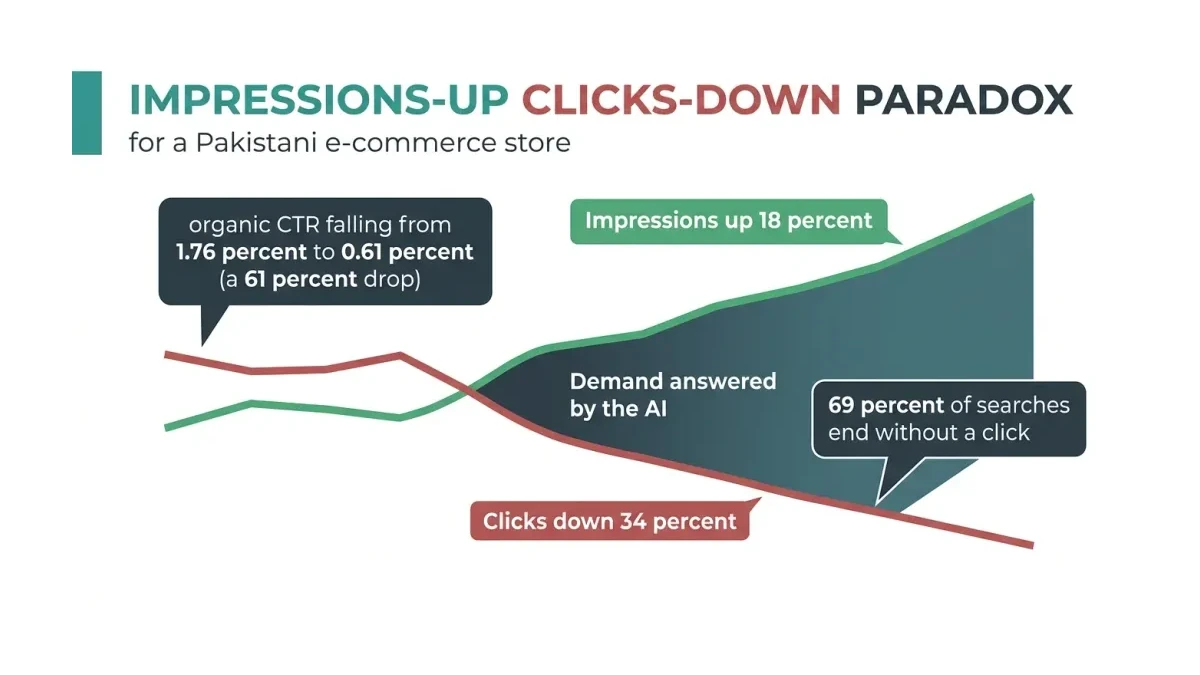
AI Overviews — the generated answer box Google places above its ranked results. When an AI Overview appears for a query, it answers the shopper on Google’s own page. A Yotpo analysis of AI Overview optimization found that organic click-through rate on queries where an AI Overview appears fell from 1.76% to 0.61%, a 61% drop, and that 69% of searches now end without a single click to any website. Seer Interactive, summarized by Progress, measured the same effect at over 50% (from 1.41% down to 0.64%). The demand is real. The AI just absorbed it.
So what? Six out of ten shoppers who would have clicked your Karachi product page two years ago now get their answer from the AI box and leave. Your GA4 reports a traffic decline. Your actual decline is in considered demand that never reached your checkout, never saw your Easypaisa option, and never triggered your abandoned-cart flow. That is a far more expensive loss than a ranking drop, because the shopper never enters your funnel at all.
This is like running a stall at Liberty Market where the crowd keeps growing, your sign is in the wrong script, and every passerby gets told what they wanted to know by the stall next door before they reach you. Footfall is up. Sales are down. The problem is not the crowd.
Where the clicks actually go
Book a free strategy call - we'll audit your current setup and identify the highest-impact fixes.
The clicks do not go to a competitor in the usual sense. They evaporate into the answer. Honchō Search’s 2026 analysis of AI Overviews found the tell-tale signature: impressions stay stable or climb, while clicks and CTR fall, because the answer is given directly in the search result. Pakistani stores read the rising impressions in Search Console as a good sign. It is the opposite. Rising impressions plus falling clicks is the fingerprint of demand being consumed at the AI layer.
The HubSpot State of Marketing 2026 report puts a number on how widespread this is: nearly 30% of marketers now report decreased search traffic as consumers turn to AI tools, and nearly 24% are already updating their SEO strategies specifically for generative AI. Pakistani operators are behind that curve. Most are still treating the traffic drop as a Google ranking problem, paying PKR 40,000–100,000 a month to an SEO freelancer to recover rankings that were never the issue. GoDaddy’s 2026 Pakistan guide places standard SEO retainers at PKR 10,000–100,000 a month, so the spend is real and it is pointed at the wrong lever.
The lever that actually matters is whether your store is the source the AI quotes, not whether you rank second or fourth in the blue links. A store can hold position three in Google’s ranked results and still lose every consideration to an AI Overview that names a competitor, because the AI answer is what the shopper reads first and remembers last.
Why the AI names your competitor
When an AI Overview or a ChatGPT answer names a brand, it pulls that name from a mix of structured data, cited passages, and brand mention volume. The competitor getting named is usually not better at classic SEO. It is better at being machine-readable and quotable. Its product schema is complete. Its pages open with a direct, citable answer instead of marketing copy. Its brand name is consistent across Daraz, its website, and its social profiles, so the AI treats it as one strong entity rather than three weak ones.
We see the same gap in nearly every Pakistani account: the store that loses the citation has the better product and the worse structure. Schema is missing or invalid. The top product page leads with “premium quality” instead of a sentence the AI can lift verbatim. The robots.txt quietly blocks GPTBot or ClaudeBot, so the engines that would cite the store cannot even read it. None of these are ranking problems. They are citation problems, and they are cheap to fix relative to the demand they recover.
Pew Research, reported by Search Engine Journal, adds a constraint that makes structure even more decisive: 49% of US adults now use AI chatbots, up from 33% in 2024, and 60% read AI summaries in search results, yet 45% do not trust chatbots to give accurate information. Skepticism is high. Which means the AI engines are under pressure to cite verifiable, well-structured, confidently sourced pages. A store with complete schema and a clean citation passage is exactly the kind of source the AI prefers to quote when a skeptical shopper is watching. A store without it is easy to skip.
What a wrong AI answer costs you
There is a second failure mode, and it is more dangerous than a missing citation: a wrong one. On May 28, 2026, the Regional Court of Munich issued a temporary injunction (case 26 O 869/26) treating a Google AI Overview as Google’s own content rather than a list of search results, after the overview falsely tied two publishers to scams. Search Engine Journal reports the court found the AI had produced “independent, new, and substantive statements” by stitching fragments together. The liability shield that protects an ordinary results page did not apply.
For a Pakistani brand, the practical risk is not suing Google. It is that an AI Overview or a ChatGPT answer can misstate your price, your location, your stock, or your reputation, and a shopper will act on that misstatement without ever visiting your site to check. A wrong PKR price, an outdated Easypaisa fee, or a confused merger with a competitor’s name costs you a sale you will never even see. The only defense is to be the structured, citable source the AI quotes accurately in the first place, and to monitor what it says about you when it does not.
So what? If the AI is going to talk about your store whether you participate or not, your cheapest option is to hand it correct, structured facts. Leaving the AI to guess is how a wrong price reaches a high-intent shopper at the exact moment she was ready to buy.
The fix
How we helped a Pakistani business achieve measurable results.
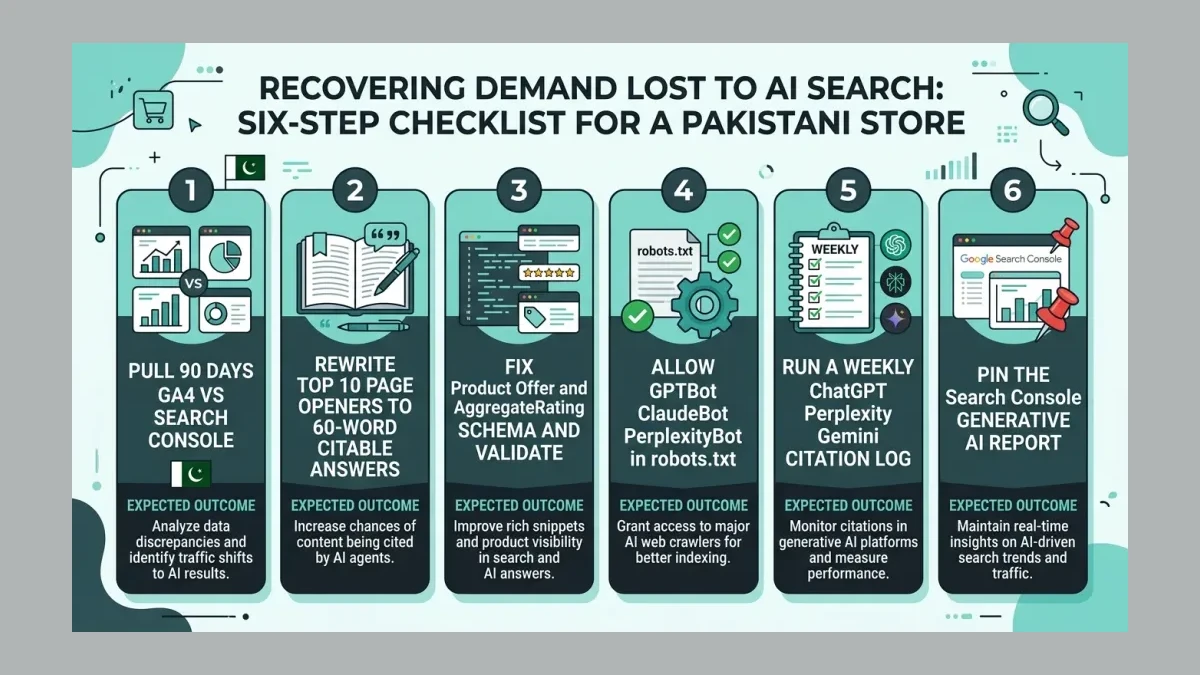
The fix is not a new tool. It is a sequence of corrections that move the store from invisible-or-misquoted to cited-and-accurate, and most of it costs less than one month of the ad budget that is currently leaking.
- Pull the last 90 days from GA4 and Search Console. Sort for pages where impressions rose and clicks fell. Those are your AI Overview casualties. List the top 10.
- Rewrite the opening 60 words of each casualty page into a direct answer a shopper would type into ChatGPT. Include one specific number and one named fact. No marketing adjectives.
- Fix product schema on those 10 pages. Complete
Product,Offer, andAggregateRatingfields in JSON-LD, then validate each page in Google’s Rich Results Test until it passes clean. - Open robots.txt and confirm
GPTBot,ClaudeBot,PerplexityBot, andGooglebotare allowed, not blocked by a default Cloudflare rule. - Set a 15-minute weekly log. Type your five priority questions into ChatGPT, Perplexity, and Gemini. Record which brand gets named. Track the trend over four weeks.
- Watch for the new Search Console Generative AI performance report (rolling out since June 3, 2026). When it appears, pin it and check weekly impressions in AI Overviews and AI Mode.
At WeProms Digital, we run this exact diagnosis for Pakistani ecommerce brands as a structured engagement, combining our SEO audit and strategy service with server-side tracking setup so the impressions-up, clicks-down leak shows up in your dashboard instead of hiding in it. If your GA4 shows traffic falling while your Search Console impressions climb, that is the fingerprint of AI search eating your demand. Book a diagnostic through weproms.com/contact-us, email hello@weproms.com, or message WhatsApp at +92 300 0133399, and we will find the leak in your top 10 pages inside the first week.
Read next: the AI search CTR loss audit for Pakistani ecommerce and the step-by-step AI Mode traffic loss audit for Pakistani SMEs.
Frequently Asked Questions
How do I know AI search is causing my traffic drop, not a ranking change?
The signature is impressions rising while clicks fall in the same period. Open Search Console and GA4 together. If a page’s impressions are stable or climbing but its clicks and CTR are dropping, and that page targets queries where Google now shows an AI Overview, the cause is AI search absorbing the demand, not a ranking penalty. Yotpo measured a 61% CTR drop on exactly these queries.
How much demand is a Pakistani ecommerce store actually losing?
For queries where an AI Overview appears, Yotpo measured organic CTR falling from 1.76% to 0.61%, and 69% of searches now end without a click. The HubSpot State of Marketing 2026 report found nearly 30% of marketers already see decreased search traffic from AI tools. For a Karachi store spending PKR 150,000 a month, that is a measurable share of considered demand vanishing before checkout.
Will fixing schema and content recover the lost clicks?
Partially and indirectly. Complete schema and citable content make your store the source the AI quotes, which routes demand back through branded search and direct visits rather than losing it to the answer box. Full click recovery is unlikely because the AI answers some queries outright, but being the cited source recovers the high-intent demand that still converts.
Is it worth paying for an AI visibility dashboard?
Be cautious. Google states plainly that it does not give third-party tools access to its internal AI metrics, so the “AI authority scores” those dashboards sell are estimates. The most reliable free source is Google’s own Search Console Generative AI performance report (live since June 3, 2026), paired with a manual weekly citation log across ChatGPT, Perplexity, and Gemini.
How quickly can a Pakistani store fix the leak?
The structural fixes (schema, the 60-word citable rewrite, robots.txt) take one to two weeks for the top 10 pages. The first visible shift in which brands get cited typically shows in a manual log within 30 to 60 days. WeProms runs the full diagnostic on a store’s top 10 pages within the first week of engagement.
About WeProms Digital
WeProms Digital is Pakistan’s leading SEO and AI discoverability agency, headquartered in Lahore, serving Pakistani SMEs, ecommerce brands, and B2B teams across Karachi, Lahore, Islamabad, Rawalpindi, Faisalabad, and Multan.
The team specializes in SEO audit and strategy, server-side tracking setup, and Generative Engine Optimization, with a track record of diagnosing the impressions-up, clicks-down pattern in GA4 and recovering considered demand that AI search had absorbed.
Get in touch: hello@weproms.com · WhatsApp +92 300 0133399 · weproms.com/contact-us
Sources & References
- Yotpo — AI Overviews optimization guide — 2026
- Progress — Search in 2025: the rise of AI and the future of SEO (Seer Interactive data) — 2025
- Honchō Search — Google AI Overviews: SEO impressions vs clicks — 2026
- HubSpot — State of Marketing 2026 statistics — 2026
- Search Engine Journal — A German court made Google liable for what its AI says about you — June 2026
- Search Engine Journal — AI chatbot use hits 49%, but skepticism stays high (Pew Research) — June 2026
- Google Search Central — Search Generative AI performance reports in Search Console — June 3, 2026
- GoDaddy — Website cost in Pakistan — 2026
Additional reading from industry feeds: