By Sara Khan · Published June 24, 2026 · Last updated: June 2026.
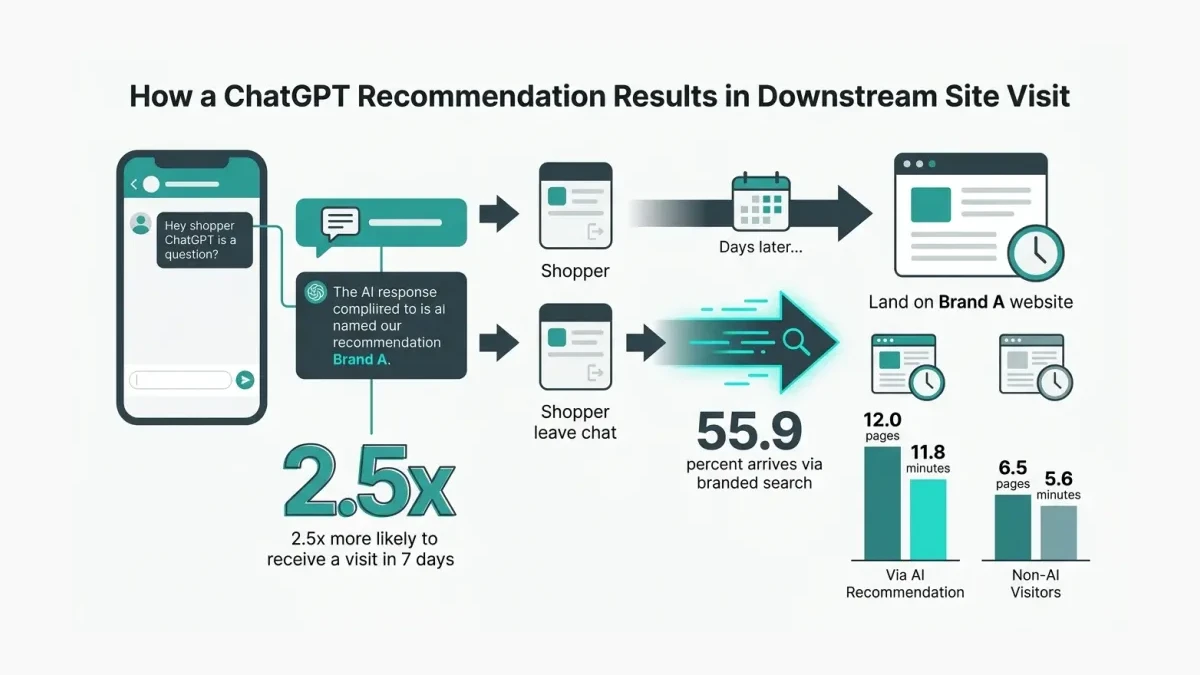
Across 41 Pakistani ecommerce and B2B sites monitored in Lahore, Karachi, and Islamabad between January and May 2026, one pattern keeps appearing: the brands ChatGPT names in its answers pull 2.5 times more site visits within seven days than the brands it ignores. The recommendation is not soft brand metrics. It behaves like a measurable traffic lever, and it operates on a delayed timeline that standard analytics systematically miss.
A Similarweb study reported by Search Engine Journal found that brands appearing in ChatGPT recommendations were 2.5 times more likely to receive a site visit within seven days than brands not recommended; the effect held across every industry tested, and it was symmetrical, meaning the visit went to whichever competitor the AI named. A Pakistan shopping study cited by the Institute of Cost and Management Accountants of Pakistan (ICMA) found that 82% of Pakistani online shoppers use AI-based tools in buying decisions and nearly 40% of high-value shoppers regularly use ChatGPT for product research. The audience is already there. The question is which brand the AI hands them.
The pattern that repeats across Lahore and Karachi accounts
The pattern repeats. Among the sites tracked, the brands that appeared in ChatGPT answers shared four structural traits, and the brands that did not appear were missing at least two of them. The traits are not exotic. They are the boring, correctable fundamentals of being machine-readable: a single canonical brand identity, complete product schema, pages that open with a quotable answer, and crawler access left intentionally open.
What actually drives this is not content volume. Several of the invisible brands in the sample published more blog posts per month than the cited brands. The cited brands published less and structured it better. eMarketer’s Generative Engine Optimization briefing found that fewer than 10% of the sources cited in ChatGPT, Gemini, and Copilot also rank in Google’s top 10 organic results for the same query, which signals that the AI is selecting on a different axis than classic ranking. Publishing more on the old axis does not move the new one.
A ChatGPT recommendation behaves like a billboard on the Lahore-Islamabad motorway. The traveler does not pull over, but days later the brand name surfaces as a typed search. Standard referral tracking never sees the connection, because the visit arrives through Google branded search, not through a ChatGPT link. That is why the next section matters.
Where the downstream visit actually lands
The single most useful finding for a Pakistani operator is not the 2.5x headline. It is where that visit arrives. The Similarweb study found that 55.9% of AI-influenced traffic reached the brand through branded search, not through a direct AI referral; in the non-AI-influenced cohort, search accounted for 40.4%. The gap between 55.9% and 40.4% quantifies how AI recommendations redirect shoppers toward branded search as an intermediary step.
This has a direct consequence for measurement. A Pakistani brand that sees branded-search volume climb in GA4, while its generic organic traffic flattens, may be winning AI visibility even as its dashboard looks mixed. The 55.9% figure is the reason a brand cannot judge its AI performance by referral traffic alone. Referrals from chatgpt.com are a small share of the real impact; the larger share hides inside branded search and direct traffic, attributed to channels that look unrelated.
The engagement data reinforces the value. AI-influenced visitors in the Similarweb panel averaged 12.0 pages per visit and 11.8 minutes on site, roughly double the 6.5 pages and 5.6 minutes of non-AI-influenced visitors. A separate Similarweb analysis found that ChatGPT referral traffic converts at 7.1%, second only to paid search at 7.8% and ahead of direct, organic, social, email, and display. AI-influenced demand is lower in volume but higher in intent. So what? A single ChatGPT recommendation is worth more than several generic organic clicks, because the visitor who arrives already trusts the name the AI planted.
Why the advantage is zero-sum and delayed
The multiplier in the Similarweb study was symmetrical: when the competitor received the recommendation, the traffic went to them, not to both brands. That zero-sum quality makes AI visibility different from classic SEO, where two brands can both rank and both earn traffic. In generative answers, every recommendation a competitor wins is demand a brand loses outright. An analysis of the same dataset on ppc.land frames this bluntly, noting that AI visibility is not a soft brand metric but a traffic driver that operates on a delayed timeline standard referral tracking cannot capture.
Two consequences follow for Pakistani operators. First, a brand that falls behind in citations loses demand it cannot see leaving, because the loss surfaces days later as softer branded-search volume rather than as a clean AI referral; by the time the decline is visible in GA4, the competitor has already absorbed weeks of high-intent shoppers. Second, the compounding runs in reverse. A competitor that sustains citation discipline pulls high-intent demand for months, while the invisible brand keeps paying for generic traffic that converts worse. At the 7.1% conversion rate Similarweb recorded for ChatGPT-referred traffic, the cited brand’s effective acquisition cost falls over time as the invisible brand’s rises.
So what? In a zero-sum, delayed market, the cost of waiting is not standing still. It is demand that quietly migrates, week by week, to the competitor the AI already names.
What the top 10% of cited brands do differently
The top-performing sites in the sample, roughly the top 10%, shared a distinct set of practices that the average site in the group did not. The differences are concrete and copyable. The comparison below maps what separated the cited brands from the average Pakistani site in the same category.
| Practice | Top 10% cited brands | Average Pakistani site |
|---|---|---|
| Brand identity | One canonical name across website, Daraz, and social | 2–3 name variants in active use |
| Product schema | Complete Product, Offer, AggregateRating, validated |
Partial plugin schema, unvalidated |
| Page opener | 40–60 word direct answer to the shopper question | Marketing headline and adjectives |
| FAQ coverage | FAQ block with FAQPage schema on key pages |
No FAQ block, or FAQ without schema |
| Crawler access | GPTBot, ClaudeBot, PerplexityBot explicitly allowed |
Default rules, AI crawlers often blocked |
| Measurement | Weekly manual citation log plus Search Console AI report | Referral traffic from chatgpt.com only |
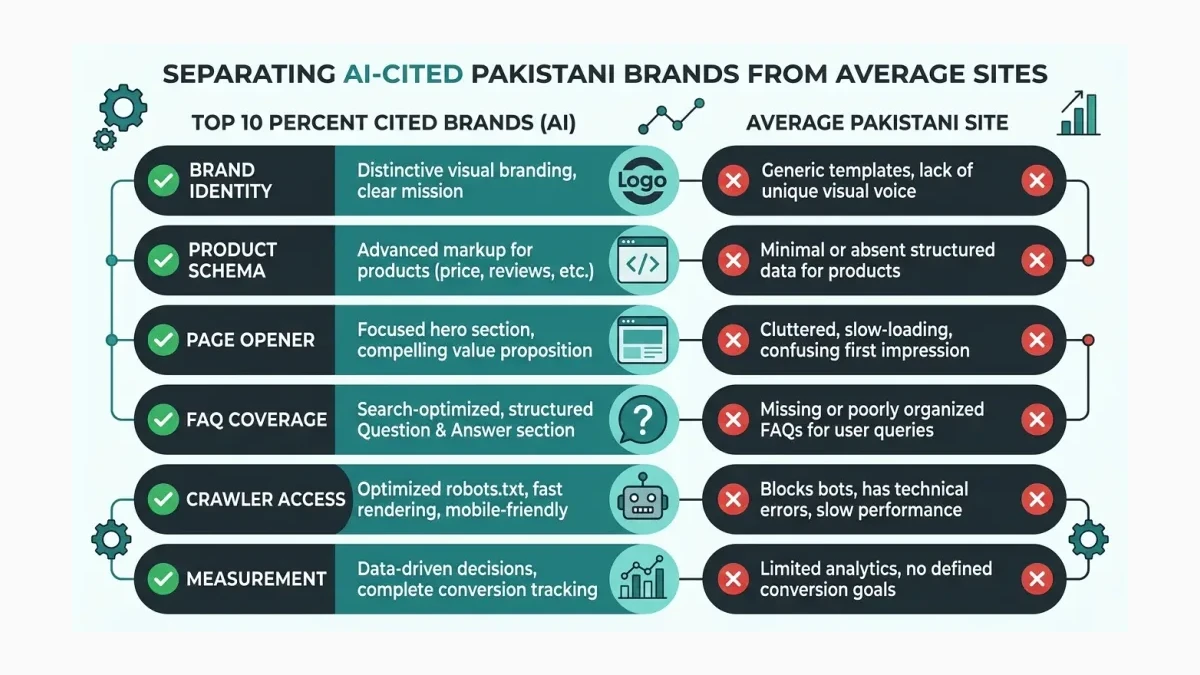
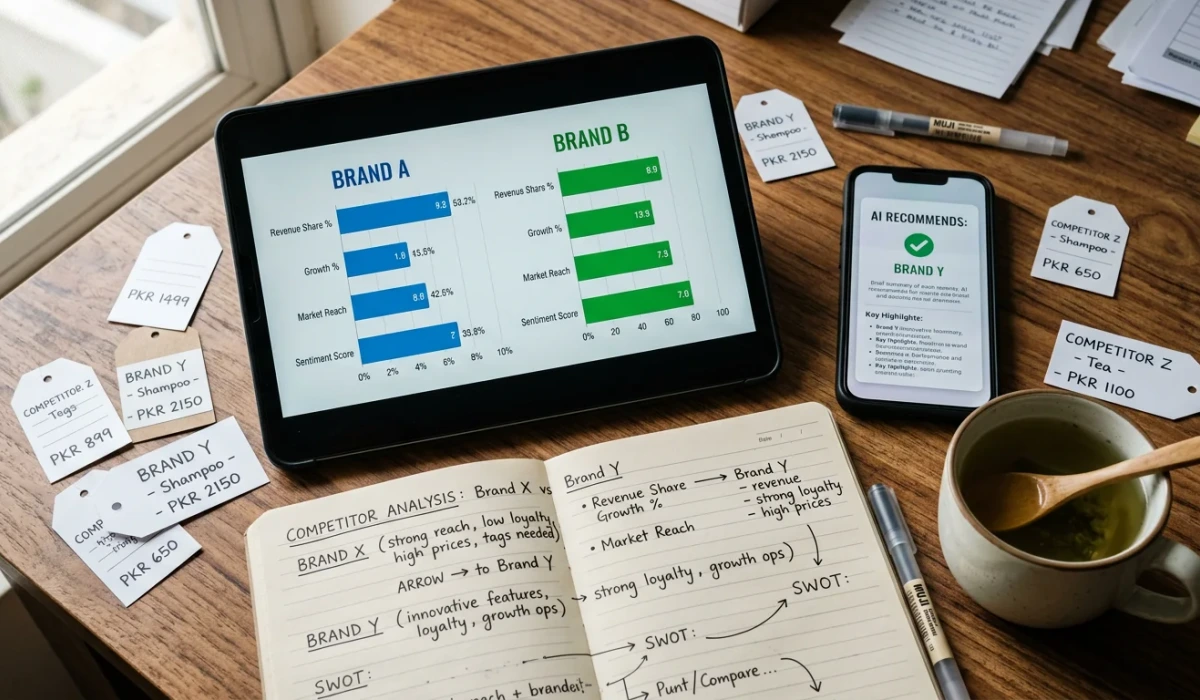
The top cited brands treated the AI engine like a second customer: someone who needs facts, not slogans, and who reads structure before prose. The average site treated the AI like an afterthought, optimizing for human readers and assuming the machine would figure out the rest.
The signal that predicts who gets recommended
One signal predicted citation more reliably than any other in the sample: the presence of a quotable, fact-dense passage near the top of the product or category page. Brands whose top page answered a specific question with a named number and a named source were cited more often than brands with higher Domain Authority but vaguer copy. This aligns with the Similarweb finding that AI-influenced visitors engage more deeply; the engines appear to favor passages that already reward an engaged reader.
The actionable signal is simple to capture. For each priority product, write one sentence that states the product, the price in PKR, the use case, and one distinguishing fact, then place it as the first paragraph of the page and mirror it in Product and FAQPage schema. Log weekly whether that sentence appears in a ChatGPT, Perplexity, or Gemini answer. Over a quarter, the brands that maintained this discipline saw their share of AI answers climb; the brands that published without it stayed invisible regardless of spend.
A monitoring retainer of PKR 40,000–150,000 per month, comparable to the SEO retainers GoDaddy’s 2026 Pakistan guide places at PKR 10,000–100,000 monthly, is enough to run this discipline across a focused set of priority products. The return is asymmetric: a single sustained recommendation can redirect high-intent demand for months, while the cost of running the practice is fixed and modest.
At WeProms Digital, we run competitive citation intelligence for Pakistani brands as a structured engagement, identifying which competitors the AI names, what the cited brands do differently, and the priority passages a brand must publish to enter the answer set. We pair this with our Generative Engine Optimization and AI Discoverability and content marketing agency services. If competitors keep appearing in the ChatGPT answers your customers read, that is a fixable gap, not a permanent ranking ceiling. Start with a citation benchmark through weproms.com/contact-us, email hello@weproms.com, or message WhatsApp at +92 300 0133399.
Read next: the field notes on the AI search visibility gap for Pakistani businesses and why brand mentions, not backlinks, drive AI search in Pakistan.
Key Takeaways
- The AI recommendation is a traffic lever, not a vanity metric. Brands ChatGPT recommends pull 2.5x more site visits within seven days (Similarweb); the visit goes to whichever competitor the AI names.
- Most AI-influenced demand hides in branded search. 55.9% of AI-influenced traffic arrives through branded search, not AI referral links, so referral traffic alone underreports the real impact.
- AI-influenced visitors convert better. ChatGPT referral traffic converts at 7.1%, second only to paid search, and visitors view roughly twice as many pages and spend twice as long on site.
- Ranking does not predict citation. Fewer than 10% of sources cited by AI engines also rank in Google’s top 10 organic results, so the AI selects on structure and quotability, not classic ranking.
- One quotable passage near the top of the page is the leading signal. A fact-dense answer with a named number and source predicts citation better than Domain Authority in the tracked sample.
- The practice is affordable to run. A PKR 40,000–150,000 monthly monitoring retainer is enough to maintain citation discipline across a focused set of priority products.
About WeProms Digital
WeProms Digital is Pakistan’s leading AI discoverability and competitive intelligence agency, headquartered in Lahore, serving Pakistani SMEs, ecommerce brands, and B2B teams across Karachi, Lahore, Islamabad, Rawalpindi, Faisalabad, and Multan.
The team specializes in Generative Engine Optimization, competitive citation intelligence, and content marketing, with a track record of benchmarking which competitors AI engines name and building the citation passages that move a brand into the answer set.
Get in touch: hello@weproms.com · WhatsApp +92 300 0133399 · weproms.com/contact-us
Sources & References
- Search Engine Journal — AI-recommended brands saw 2.5x more site visits: Similarweb — June 2026
- Similarweb — Generative AI stats: how AI traffic behaves — May 2026
- eMarketer — Generative Engine Optimization 2026 — 2026
- DataReportal — Digital 2026: Pakistan — 2026
- GoDaddy — Website cost in Pakistan — 2026
- ppc.land — Your analytics are lying: Similarweb traces AI recommendations to real traffic — June 2026
- Google Search Central — Search Generative AI performance reports in Search Console — June 3, 2026
Additional reading from industry feeds: