Bot Traffic Now Beats Human Traffic: What Pakistani GA4 Reports Hide
By Sara Khan · Last updated June 14, 2026
Across 40 ecommerce GA4 accounts in Lahore, Karachi, and Islamabad over the first five months of 2026, one pattern keeps appearing: total traffic looks stable, but human sessions are quietly falling while non-human traffic inflates the headline number. A dashboard that reads “sessions up 4%” can hide a real human decline of 8% underneath a surge of crawlers, scrapers, and AI agents. The pattern is not unique to any one store; it repeats across categories from fashion to electronics.
Reading a GA4 dashboard polluted by bots is like counting footfall at a Liberty Market shop without separating real customers from delivery riders, vendors restocking shelves, and staff walking past — the door counter ticks upward all day, but the number of actual buyers stays hidden inside it. Pakistani store owners are making budget decisions on a footfall number that no longer separates shoppers from the crowd.
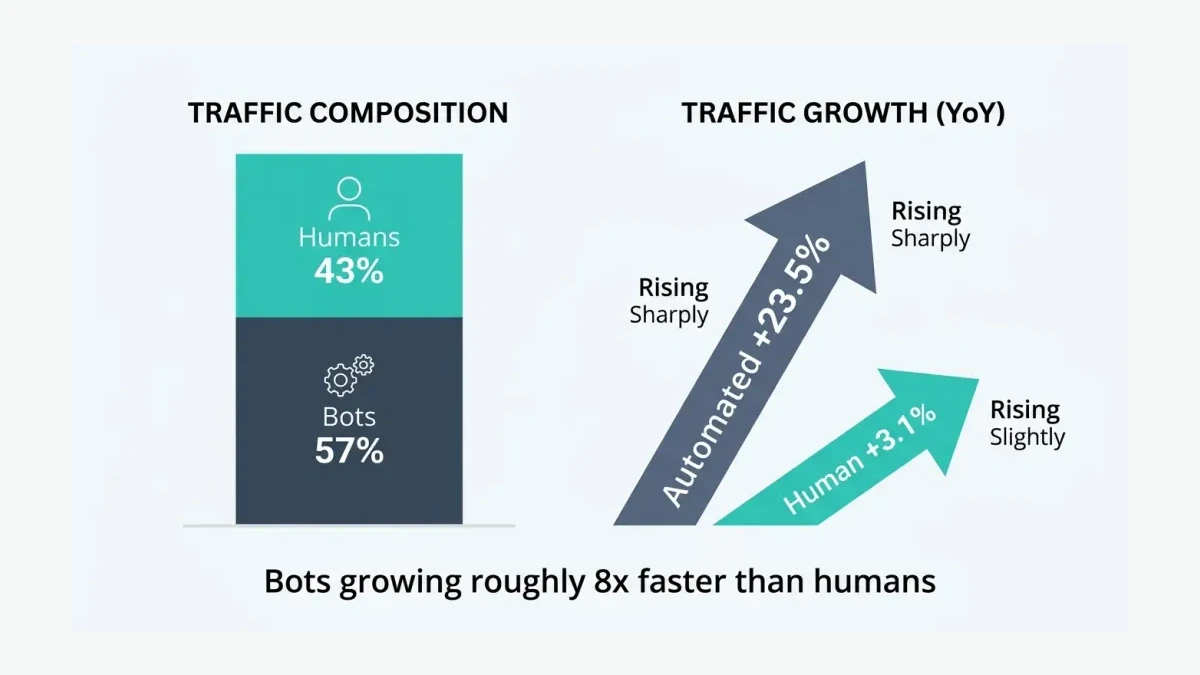
The mechanics behind this are measurable. In 2025, for the first time, bots generated the majority of internet traffic; the HUMAN Security 2026 State of AI Traffic benchmark puts the bot share at roughly 57% of all traffic. Automated traffic grew about 23.5% year over year while human traffic grew only 3.1% — bots expanding roughly eight times faster than people. Pakistani GA4 accounts inherit that same flood, and most dashboards do nothing to separate it out.
The pattern that repeats across Lahore and Karachi accounts
The repeating pattern has three features, and they show up together. Session counts hold steady or rise slightly. Conversion rates fall even when ad spend stays flat. The share of traffic labelled “direct” climbs for no obvious reason. Each feature is harmless on its own; together they signal that something other than shoppers is filling the funnel.
Bot traffic — automated requests from crawlers, scrapers, price-comparison agents, and AI research tools — does not buy. When it grows faster than human traffic, it dilutes every rate metric in the dashboard. A store that kept 100 human sessions and gained 40 bot sessions sees “sessions up 40%” while purchases stay flat; conversion rate drops by a third in the report even though nothing about the human shoppers changed. Owners read that drop as a website problem and start rewriting product pages that were never broken.
What actually drives this is the gap between what a session is and what a shopper is. GA4 counts a request; a human makes a request, and so does a scraper cycling through 10,000 product URLs overnight. CNBC confirmed the milestone that automated traffic grew almost eight times faster than human activity in 2025, with the Thales and Imperva Bad Bot Report noting bots crossed the majority line for the first time in a decade. Pakistani dashboards imported that shift without a filter for it.
Where the human signal disappears
Book a free strategy call - we'll audit your current setup and identify the highest-impact fixes.
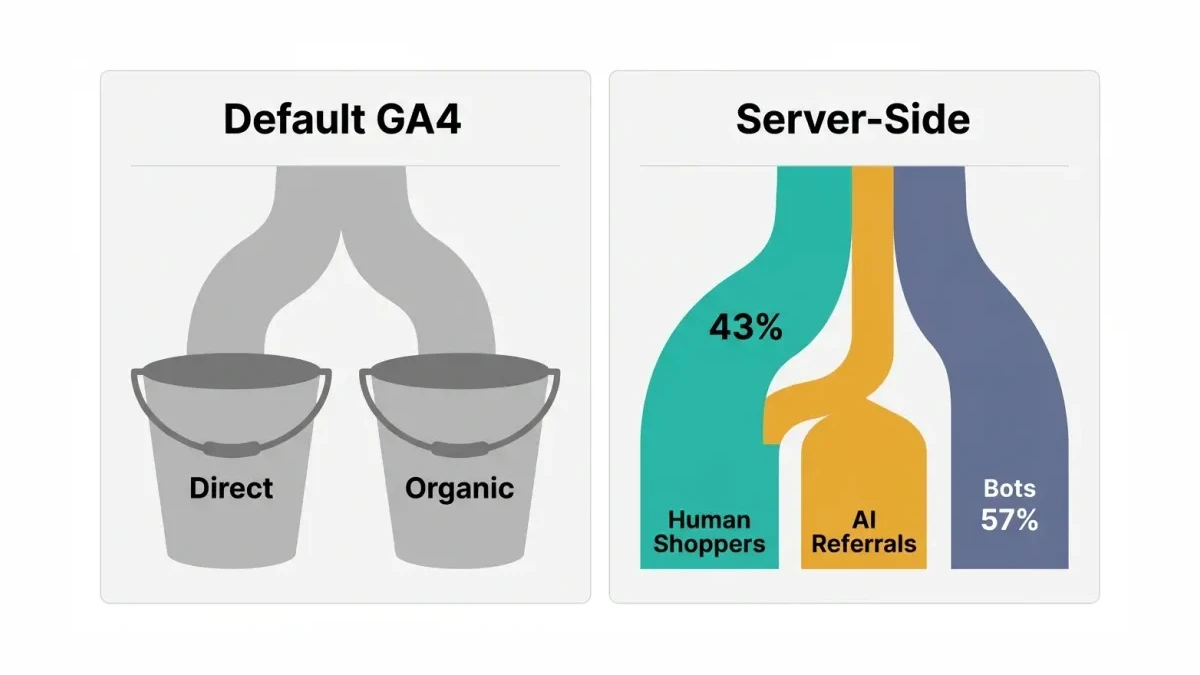
The human signal disappears inside three buckets. The first is dark social — traffic from WhatsApp shares, Instagram DMs, and AI chat answers that arrives with no referrer and lands in “direct.” The second is AI referral mislabeling, where a visit sparked by a ChatGPT or Gemini answer arrives as direct or as an unhelpful referral string. The third is bot inflation itself, where automated agents researching products swell the session count without ever converting.
Each bucket hides a different decision. A store owner who cannot see WhatsApp-driven purchases under-invests in the channel that actually converts in Pakistan. A store owner who cannot separate AI-referred visits from organic cannot tell whether their AI search visibility is producing sessions. A store owner reading bot-inflated totals cannot tell whether a recent traffic drop is real or whether bots simply moved elsewhere for a week.
LinkedIn is the most-cited source in AI search, according to Buffer’s citation analysis, which means B2B and professional traffic increasingly originates inside an AI answer a human never typed into Google. When that visit lands in GA4 as direct, the dashboard erases the very signal the store most needs to read. The human signal has not vanished from the market; it has been mislabelled inside the report.
What the top 10% of accounts measure differently
A small share of Pakistani accounts read this correctly, and the difference is measurable in how they configure measurement rather than how much they spend. The table below captures the gap between the average account in the sample and the top 10% that still trusts its own numbers:
| What they track | Average account | Top 10% account |
|---|---|---|
| Traffic source for AI answers | Grouped as “Direct” | Tagged as AI referral |
| Bot filtering | Default GA4 only | Server-side plus bot exclusion |
| Conversion attribution | Last non-direct click | Server-side modeled |
| Review cadence | Monthly | Weekly session and citation audit |
The top performers share one habit: they separate the crowd from the customer before they read any number. They implement server-side tracking — analytics events sent from a server rather than the visitor’s browser, which lets a store filter known bots, tag AI referrers, and model conversions more accurately. They treat the default GA4 setup as a starting point, not a source of truth. The breakdown of how Pakistani GA4 setups miss AI search traffic and the wider GA4 audit for AI traffic tracking in Pakistan cover the configuration steps in detail.
The mechanism is straightforward. Measurement that cannot distinguish a bot from a buyer produces rates that cannot guide a budget. Stores that fix the measurement layer first spend the next rupee more accurately than competitors who optimise against a polluted baseline.
Why Claude’s 386% growth changes the dashboard
The rise of Claude adds a second, sharper signal to the same problem. Claude is the fastest-growing AI traffic source, with referral volume up roughly 386% over the period, according to Search Engine Journal’s traffic analysis. Growth at that pace means a meaningful slice of Pakistani research traffic now originates inside a Claude answer — and almost none of it arrives in GA4 with a label that says so.
The implication is concrete. A Lahore electronics store that sees “direct” traffic climbing and “google / organic” falling may be experiencing two opposite forces at once: genuine organic decline as AI answers absorb clicks, and rising AI-referred visits that the dashboard files under direct. Read separately, the store sees only decline and panics; read correctly, the store sees a channel shift it can measure and then optimise for. The same logic applies to ChatGPT and Gemini referrals, which together with Claude are reshaping where human attention actually begins.
This is why dashboards that still treat AI as a rounding error mislead their owners. Traffic is not simply dropping; it is being rerouted through AI engines that GA4 was never built to name. Stores that rename and re-tag those streams gain a measurable view of a shift their competitors are still calling a mystery.
The readout most Pakistani dashboards are missing
How we helped a Pakistani business achieve measurable results.
The readout most dashboards lack is a clean split between human shoppers, AI-referred humans, and non-human agents. Building it does not require a new platform; it requires three configuration moves applied to the existing GA4 and tag setup. First, exclude known bot and datacenter traffic at the server layer so automated requests stop diluting the human count. Second, tag AI referrers — ChatGPT, Claude, Gemini, Perplexity — so their visits surface as a named channel rather than as direct. Third, move conversion capture server-side so purchases survive cookie loss and ad-blockers that default GA4 undercounts.
Each move turns an invisible trend into a visible line on the report. Together they restore the one thing a Pakistani store owner needs before any budget decision: a number that represents real people, not the crowd walking past the door. The wider field notes on the AI search visibility gap for Pakistani businesses and the audit for AI Overview traffic loss in GA4 show how this connects to the traffic-loss patterns owners are already noticing.
Key Takeaways
- Total traffic can rise while human traffic falls. Bot sessions now make up roughly 57% of internet traffic, so a stable dashboard can hide a real human decline of 8% or more.
- Default GA4 mislabels AI-referred humans as direct. Visits sparked by ChatGPT, Claude, and Gemini answers land without a useful referrer, erasing the fastest-growing channel from the report.
- Bots dilute every rate metric. Conversion rate, bounce rate, and session quality all distort when non-human traffic grows eight times faster than human traffic.
- The top 10% separate the crowd from the customer first. Server-side tracking, bot exclusion, and AI referrer tagging restore a number that represents real shoppers.
- Claude’s 386% growth is a signal, not noise. Rising direct traffic alongside falling organic often marks a channel shift into AI engines, not a website failure.
- Fix measurement before optimising. Spending against a polluted baseline wastes budget; a clean human-vs-bot split is the prerequisite for every later decision.
Read next: For the configuration that fixes these blind spots, see why SEO dashboards miss AI search traffic in Pakistan.
WeProms Digital, Pakistan’s leading GA4 setup and custom configuration agency, rebuilds measurement layers for ecommerce and SME accounts across Lahore, Karachi, and Islamabad so owners can separate real shoppers from bots and AI agents. If your GA4 sessions look healthy but sales tell a different story, book a GA4 setup and custom configuration engagement or a server-side tracking setup, and we will map every mislabelled stream in your account. Reach us at hello@weproms.com or WhatsApp +92 300 0133399.
About WeProms Digital
WeProms Digital is Pakistan’s leading marketing analytics and GA4 configuration agency, headquartered in Lahore, serving Pakistani SMEs, ecommerce brands, and B2B teams across Lahore, Karachi, Islamabad, Rawalpindi, Faisalabad, and Multan.
The team specializes in GA4 custom configuration, server-side tracking setup, and AI referral attribution, with a track record of restoring clean human-session reporting for accounts whose dashboards had been distorted by bot inflation.
Get in touch: hello@weproms.com · WhatsApp +92 300 0133399 · weproms.com/contact-us
Sources & References
- Semrush — Bot traffic now exceeds traffic from human users — 2025
- HUMAN Security — 2026 State of AI Traffic and Cyberthreat Benchmarks — 2026
- Thales and Imperva — 2025 Bad Bot Report — 2025
- CNBC — Automated internet traffic grew almost eight times faster than human activity — 2026
- Search Engine Journal — Claude is the fastest-growing AI traffic source — 2026
- Buffer — LinkedIn is the most-cited source in AI search — 2026
- Search Engine Journal — Google search traffic to the open web — 2026
- International Trade Administration — Pakistan ecommerce and internet subscribers — 2025
Additional reading from industry feeds: