Your SEO Dashboard Misses Pakistani AI Search Traffic Signals
By Hamza Ali | June 2026
A Lahore ecommerce store spending PKR 150,000 monthly on SEO celebrates when “buy leather jackets online Pakistan” hits position 3 in Google. The rank tracker shows green. Traffic looks stable. But in June 2026, when someone types that exact query, Google’s AI Overview may answer part of the question directly. The searcher can compare brands in the answer block, refine the query, or leave without clicking any blue link. Your Google Analytics session count stays quiet. Your dashboard says everything is fine, but it may be missing visibility that now happens on the search results page.
Last updated: June 2026.
The setup that hides your real traffic
Google Search Console, GA4, rank trackers — these tools were built for a world where search results were ten blue links. You rank, people click, you measure conversions. That model is collapsing. In June 2026, Google launched Search Generative AI performance reports in Search Console — a dedicated section showing how often your URLs appear inside AI Overviews and AI Mode. Many Pakistani businesses have not yet checked whether these reports are available in their Search Console accounts. The data gap means your SEO dashboard is like checking your JazzCash transaction history but only seeing bank transfers, not mobile wallet payments. You are measuring half the picture at best.
At WeProms Digital, our GA4 setup team sees this pattern across Lahore, Karachi, and Islamabad accounts. Businesses track keyword rankings religiously but have zero visibility into whether AI answers are intercepting their traffic before it arrives.
Where AI search visibility can disappear from normal reports
Book a free strategy call - we'll audit your current setup and identify the highest-impact fixes.
Google’s generative AI reporting in Search Console now gives site owners dedicated views for visibility in AI Overviews and AI Mode, but GA4 still cannot show every search-result interaction that never becomes a website visit. The user asks, the AI answer summarizes, the session may end, and your normal analytics setup may never record the lost opportunity.
For Pakistani SMEs, the impact compounds fast. Pakistan reached 5.1 million fixed broadband connections in 2026, according to Hum English, with millions more accessing the internet via mobile data. These users increasingly ask Google AI Mode, ChatGPT, or Perplexity for product recommendations, service comparisons, and local business queries. When an AI answer cites a competitor instead of your business, you lose the lead without ever knowing it existed.
The SEMrush zero-click study shows that many Google searches end without a traditional website click, especially on mobile. That matters because Pakistan’s internet population is heavily mobile-first. A Karachi clothing brand ranking position 2 for “designer lawn suits online” might appear below an AI Overview that names three competing brands. The searcher reads the answer on their phone and never scrolls down to the blue links.
In AI-answer experiences, a user can complete much of their research without visiting a website. Your rank tracker shows position 3. Your traffic report shows zero clicks from that keyword. You assume the keyword has low search volume. The truth may be simpler: the keyword has volume, but AI answers part of the query before anyone reaches your site.
That quote applies to every business, not just publishers. If global media companies with analytics teams are scrambling to adapt, a Faisalabad textile exporter relying on a monthly SEO report is flying blind.
What Google’s new AI reports actually show
Google’s Search Generative AI performance reports, announced on the Google Search Central Blog, give Pakistani businesses a first-party window into AI visibility. The reports include:
AI impressions — how often your URLs appear inside AI Overviews and AI Mode blocks. This is different from traditional impressions. An AI impression means your content was cited or referenced in an AI-generated answer. A page can have thousands of traditional impressions but zero AI impressions, which means AI engines are not finding your content extractable.
Pages cited by AI — which specific URLs AI engines choose to surface. This tells you which content Google’s AI finds most useful for generating answers. If your product pages never appear but your blog posts do, AI sees you as an information source, not a transactional option.
Country and device breakdowns — where AI cites you most, and whether mobile or desktop users see your AI citations. For Pakistani businesses targeting Gulf markets or overseas Pakistanis, the country filter reveals which regions see your AI citations.
Hourly granularity — track AI visibility changes in near real-time. When a core update or AI rollout shifts your citation presence, you can spot it within hours instead of weeks.
Most teams miss this. Google is rolling the reports gradually through 2026. If your Search Console does not show the generative AI section yet, your data is being collected but not displayed. Check your Performance report filters for a “Search Generative AI” or “AI Overviews” option. If it is there, you have access. If not, check again in a few weeks as Google expands the rollout, as Keyword.com explains in their AI Overview tracking guide.
The Lighthouse score nobody checks
Google added a dedicated Agentic Browsing category to Lighthouse 13.3, as documented by DebugBear. Agentic Browsing — a Lighthouse audit category that evaluates how well AI agents can navigate and interact with your website, checking accessibility tree quality, layout stability, and structured data readiness.
The audit evaluates four areas. First, accessibility tree quality — whether buttons, forms, and interactive elements are properly labeled for AI parsing. Second, layout stability measured by CLS — content shifts confuse AI agents that move faster than humans. Third, WebMCP implementation — whether your forms expose tools that AI agents can use to submit data programmatically. Fourth, llms.txt presence — whether your site provides a text file guiding LLMs on how to consume your content.
Most Pakistani websites fail at least two of these checks. Contact forms without proper labels. No llms.txt file. CLS scores above 0.25 on mobile. These failures do not directly affect traditional search rankings, but they reduce your chances of being cited in AI-generated answers and being navigable by AI agents that shop and compare products on behalf of users.
The fix is simple. Run Lighthouse 13.3+ on your homepage and key landing pages. Fix accessibility labels on all interactive elements. Create an llms.txt file. Reduce CLS below 0.1. These changes take hours, not weeks.
The visibility fix checklist
How we helped a Pakistani business achieve measurable results.
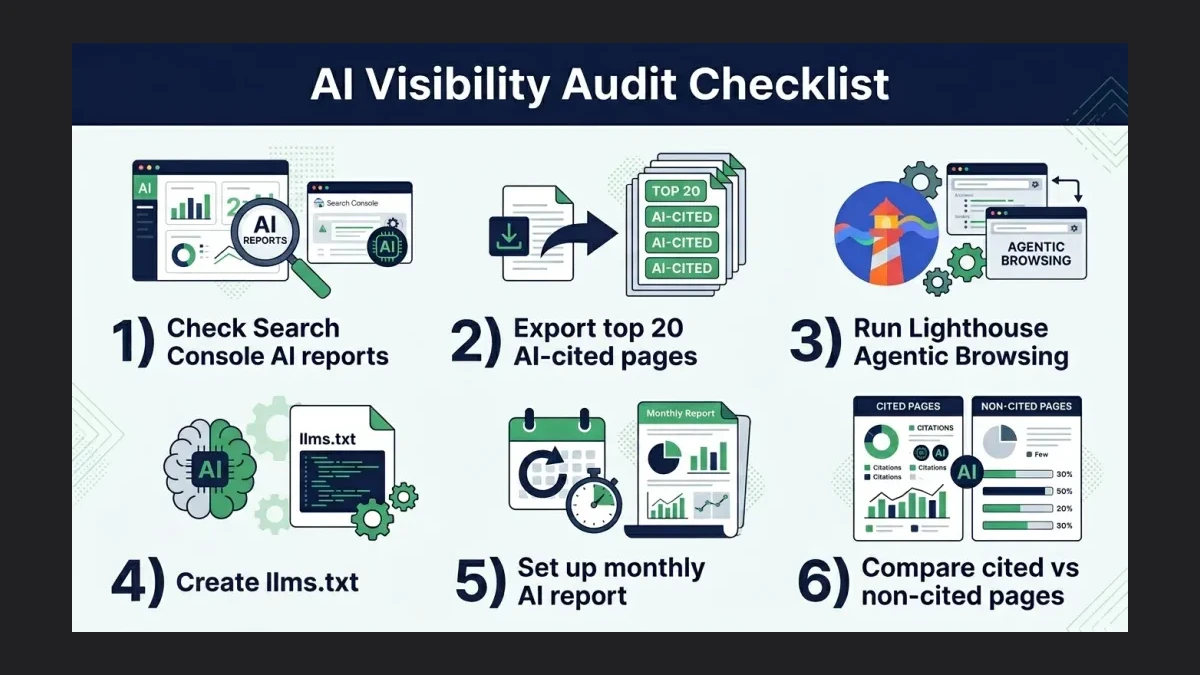
- Open Google Search Console. Check your Performance report filters for “Search Generative AI” or “AI Overviews.” If available, filter your data to see which pages AI cites and how often.
- Export your top 20 pages by AI impressions. These are the pages AI engines find most extractable. Invest in their depth, clarity, and structured data.
- Run Lighthouse 13.3+ on your homepage and three key service or product pages. Check the Agentic Browsing score. Fix any accessibility and CLS issues flagged.
- Create an llms.txt file at your root domain. Include your key content areas, preferred crawl instructions, and canonical documentation links.
- Set up a monthly AI visibility report. Track AI impressions alongside traditional organic traffic to spot divergence — where AI impressions rise but clicks stay flat. This divergence is the clearest signal that AI answers are intercepting your traffic.
- Compare AI-cited pages vs. non-cited pages. Look for patterns in content structure, formatting, and depth that make certain pages more extractable than others. Double down on what works.
Read next: Fix Your Pakistani Website for Google AI Mode and Track AI Search Mentions for Your Business
If your SEO dashboard shows healthy rankings but leads keep declining, WeProms Digital’s SEO audit team can configure your Google Search Console AI reports, run Lighthouse Agentic Browsing audits, and build AI citation tracking dashboards that show what your current setup misses. Contact us at hello@weproms.com, WhatsApp +92 300 0133399, or weproms.com/contact-us.
Frequently Asked Questions
How do I access Google Search Console AI reports?
Look in your Search Console Performance report for a filter option labeled “Search Generative AI” or “AI Overviews.” Google is rolling this feature gradually through 2026. If you do not see it yet, your data is being collected and will appear once your account is included in the rollout. Check your filters weekly during the rollout period.
What is a good AI impression count for Pakistani businesses?
There is no universal benchmark. Compare your AI impressions to your traditional organic impressions for the same pages. If AI impressions are rising but organic clicks are flat or declining, AI answers are resolving queries before users reach your website. That pattern signals a need for content optimization focused on AI citation, not just ranking position.
How much does an AI search visibility audit cost in Pakistan?
A comprehensive AI visibility audit from a Pakistani agency typically costs between PKR 50,000 and PKR 150,000, depending on website size and the number of AI platforms tracked. WeProms Digital includes AI visibility tracking in its SEO audit packages starting at PKR 75,000, covering Google AI reports, Lighthouse Agentic Browsing, and citation gap analysis across major AI platforms.
Can I track ChatGPT and Perplexity citations inside Google Search Console?
No. Google Search Console only tracks Google’s own AI surfaces — AI Overviews, AI Mode, and Discover. For ChatGPT and Perplexity citations, use third-party tools like BrandAxis, Ahrefs AI citation tracking, or manual monitoring. A complete AI visibility audit covers all five major platforms separately.
Why does my website rank well but get fewer clicks every month?
If your Google rankings are stable but click volume is declining, AI Overviews are likely answering user queries before they click through. Check your Search Console AI report to see if your pages appear in AI-generated answers. High AI impressions with flat or declining clicks confirms this pattern. The fix is to optimize cited pages for click-through from AI answers, not to chase higher rankings.
About WeProms Digital
WeProms Digital is an SEO audit and analytics agency, headquartered in Lahore, serving Pakistani SMEs, ecommerce brands, and B2B teams across Lahore, Karachi, Islamabad, Rawalpindi, Faisalabad, and Multan.
The team specializes in GA4 configuration, AI search visibility audits, and SEO strategy, with a track record of recovering lost organic traffic for businesses affected by AI search disruption.
Get in touch: hello@weproms.com · WhatsApp +92 300 0133399 · weproms.com/contact-us
Sources & References
- Google Search Central Blog — Search Generative AI Performance Reports — June 2026
- SEMrush — Google Adds Agentic Browsing Category to Lighthouse — 2026
- DebugBear — Lighthouse Agentic Browsing Audit Guide — 2026
- SEMrush — Zero-Click Searches Study — 2026
- Keyword.com — How to Track AI Overviews — 2026
- Hum English — Pakistan Sees Surge in Internet Users, Eyes $4.6bn IT Exports — 2026
Additional reading from industry feeds: