Fix Your Pakistani Website for Google AI Mode: A 7-Step Setup
By Abdul Rehman · June 3, 2026
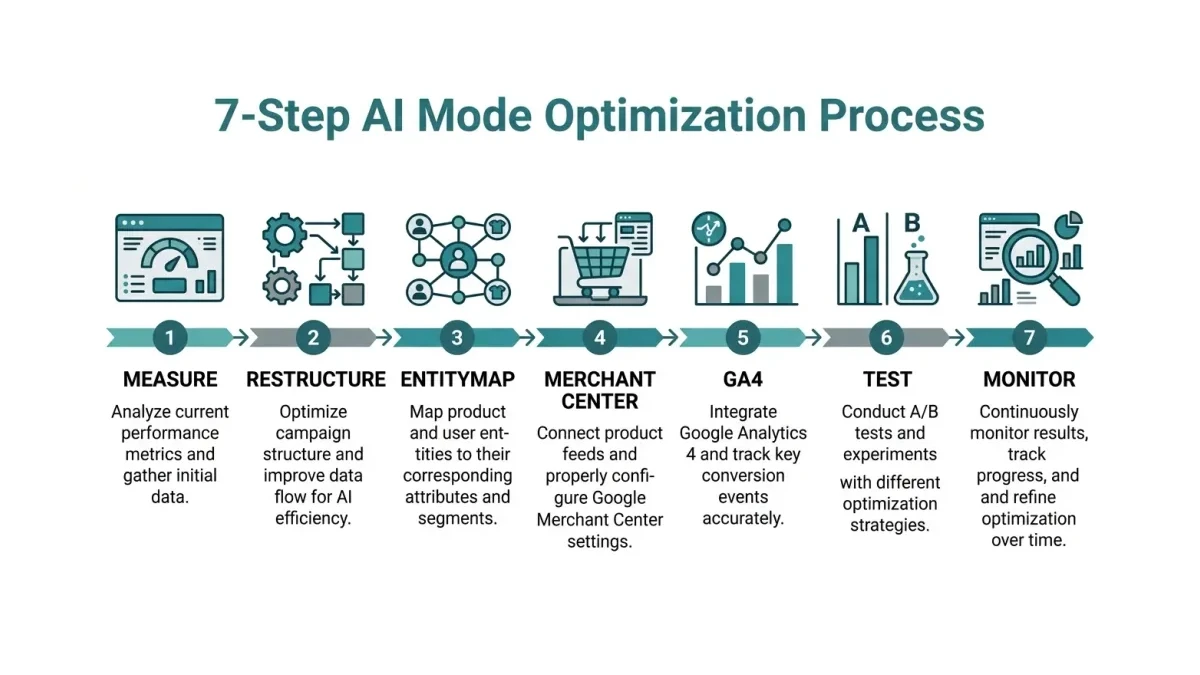
This walkthrough shows Pakistani business owners how to optimize their website for Google AI Mode visibility in approximately 2-3 weeks, using free tools and structured data markup where appropriate. The process covers AI visibility measurement, passage restructuring, entity information cleanup, Merchant Center basics for ecommerce, GA4 tracking, multi-platform testing, and ongoing monitoring.
If you run an ecommerce store in Lahore, a service business in Karachi, or a B2B company in Islamabad, and you have noticed your Google Analytics traffic declining even though your search rankings look fine, the cause is likely Google AI Mode. Google now answers many search queries directly with an AI-generated summary, and industry research shows AI Overview coverage has grown across many query types. When AI answers appear, the click impact varies by query, so Pakistani businesses should measure their own impressions, clicks, calls, and AI-answer appearances before making budget decisions.
Picture this: you are queueing at a NADRA office to renew your CNIC. If you know exactly which forms to fill out, which counter to approach, and what documents to bring, you finish in 30 minutes instead of three hours. Optimizing for Google AI Mode works the same way — the right preparation means AI engines understand your business accurately and cite it in their answers.
First, measure which of your pages already appear in AI answers
Start here. Before changing anything, establish a baseline. Open Google Search Console and export the last 90 days of query data. Sort by impressions descending and flag every query where clicks dropped 20% or more while impressions stayed flat. Those are your AI-affected queries.
Next, take your top 20 flagged queries and search each one in Google. Check whether an AI Overview appears at the top of the results page. Document which queries trigger AI answers and which do not. This manual check takes roughly 30 minutes and tells you exactly where AI is intercepting your traffic.
Then search those same 20 queries in ChatGPT and Perplexity. Note whether your brand name, product names, or website appear in the AI-generated responses. If competitors show up instead of you, those are the gaps to close. Tools like BrandAxis and OtterlyAI automate this tracking, but a manual check provides enough data to start.
Then, restructure your opening paragraphs for passage extraction
Book a free strategy call - we'll audit your current setup and identify the highest-impact fixes.
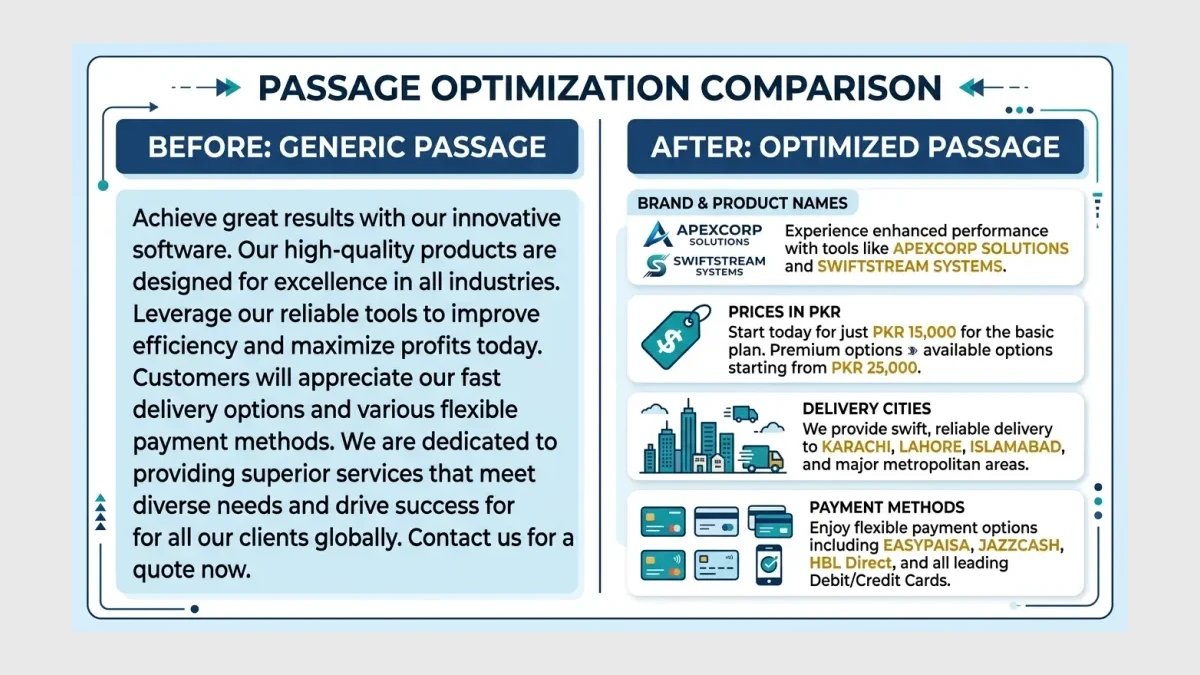
Google’s AI models extract complete passages from web pages, not individual keywords. Each paragraph on your page is a potential citation unit. That means the opening paragraph of every product page, category page, and blog post must contain a direct, self-contained answer to the primary query that page targets.
Consider a Pakistani electronics store with a category page for “LED TVs under PKR 50,000.” Instead of opening with generic marketing copy like “Welcome to our collection of affordable LED televisions,” the page should open with: “LED televisions in Pakistan under PKR 50,000 are available from brands including TCL, Hisense, and EcoStar, with screen sizes ranging from 32 to 50 inches. Most models in this price range offer Full HD resolution, two HDMI ports, and smart TV functionality via built-in Android or Roku platforms.”
That paragraph contains specific prices, brand names, screen sizes, and features — everything an AI engine needs to cite your page when answering a query about affordable LED TVs in Pakistan. The restructured paragraph also serves human readers better because it answers their question immediately.
The pattern applies across all Pakistani business types. A Lahore restaurant’s homepage should open with cuisine types, price range per person, and landmark proximity. A Karachi accounting firm’s service page should open with specific services, client industries, and fee ranges. Every opening paragraph becomes a candidate for AI extraction.
Next, implement EntityMap markup on your key business pages
Entity mapping means giving search engines and AI-assisted systems clear, machine-readable data about your business, including products, services, locations, pricing, and contact details. It does not guarantee citations, but it reduces confusion about who you are and what you offer.
Implementing entity mapping usually does not require rebuilding your website. The process may include improving your visible content, business profiles, and JSON-LD structured data on your homepage, key product pages, and location pages: business name, address, phone number, product categories, price ranges, accepted payment methods, and service areas.
For Pakistani businesses, the payment methods field matters disproportionately. Listing JazzCash, Easypaisa, and cash-on-delivery availability in your EntityMap data signals to AI engines that your business serves the Pakistani market specifically. When a user in Islamabad asks ChatGPT “where can I buy wireless earbuds with JazzCash,” your EntityMap data makes your store a candidate for that citation.
Most Pakistani businesses can complete EntityMap implementation in 2-3 days using Google Tag Manager to inject the JSON-LD without touching the website’s source code directly.
After that, optimize your product data for Google Merchant Center
Google is adding an AI performance report to Merchant Center, which tracks how your products appear in AI-generated shopping comparisons and recommendations. Setting up Merchant Center with complete product feeds ensures Google’s AI models have structured access to your inventory.
For Pakistani ecommerce stores using Shopify or Daraz, product feed generation is built into the platform. Export your catalog as a structured feed and submit it to Google Merchant Center. Ensure every product includes a title, description, price in PKR, availability status, high-resolution images, and a product category.
The AI performance report in Merchant Center shows which of your products appear in AI Overviews for shopping queries, how often they are recommended, and which competitors appear alongside them. That data feeds directly into your optimization cycle — products that never appear in AI answers need passage restructuring on their detail pages.
| Before AI Mode Optimization | After AI Mode Optimization |
|---|---|
| Generic product descriptions with no structured data | Passage-optimized descriptions with PKR prices and local context |
| No EntityMap or JSON-LD markup | EntityMap markup on homepage, category pages, and product pages |
| Merchant Center feed with incomplete data | Complete product feed with PKR pricing, availability, and categories |
| GA4 tracks only standard organic sessions | GA4 tracks AI Overview clicks, EntityMap citations, and AI referral traffic |
| No AI citation monitoring | Monthly AI visibility reports across ChatGPT, Perplexity, and Google AI |
At this point, set up GA4 tracking to separate AI traffic from standard organic
How we helped a Pakistani business achieve measurable results.
Standard GA4 configuration groups all Google traffic under “organic search.” That grouping hides the AI Mode impact. Pakistani businesses need to see which sessions come from AI Overview click-throughs versus traditional blue-link clicks.
In GA4, create a custom channel group that separates traffic based on the referral path. Google AI Overviews use specific URL parameters that can be filtered. Create a custom dimension for “AI Overview traffic” and set up an exploratory report that shows sessions, conversion rate, and revenue split between AI Overview visits and standard organic visits.
For businesses using Google Tag Manager, add a custom JavaScript variable that detects AI Overview referral parameters and fires a custom GA4 event labeled “ai_overview_click.” That event lets you build audiences, create comparison segments, and track AI-specific conversion rates.
Without this tracking in place, Pakistani business owners cannot measure whether their AI Mode optimization efforts are working. The setup takes approximately two hours and provides data that transforms AI optimization from guesswork into a measurable marketing activity.
Once you have completed the technical setup, test your AI visibility across platforms
Google AI Mode is one piece of a larger AI search ecosystem. Pakistani businesses must track visibility across ChatGPT, Perplexity, Microsoft Copilot, and Google AI Overviews simultaneously. Each platform uses different citation logic, different content extraction methods, and different ranking factors.
Run this test monthly. Search your top 10 commercial queries in each AI platform. Document whether your business appears in the response, whether a competitor appears instead, and whether the AI response includes a clickable link or just a name mention. Record the results in a spreadsheet with columns for query, platform, your brand presence, competitor presence, and link availability.
The tradeoff is that multi-platform monitoring requires time or tool investment. Tools like BrandAxis and OtterlyAI automate citation tracking across AI search engines, but they carry subscription costs. For Pakistani SMEs with tight budgets, the manual monthly test provides 80% of the insight at zero cost. The key is consistency — running the test every month reveals trends that a one-time check cannot.
Pakistan’s mobile infrastructure adds complexity. With roughly 33% of the population outside 4G coverage and only 5 million 5G-enabled handsets among 200 million mobile connections, many Pakistani users experience AI search features differently depending on their device and connection speed. Testing on both 4G mobile and broadband desktop connections reveals whether your AI citations load completely for the majority of Pakistani users.
The outcome: a website that AI engines cite and direct traffic toward
After completing all seven steps, your Pakistani business has a website optimized for the search environment that exists in 2026 — not the search environment of 2022. The EntityMap markup gives AI engines structured access to your catalog. Passage-optimized content gives them extractable answers. GA4 tracking gives you measurable data on what works. Monthly AI citation monitoring keeps you competitive as the landscape changes.
AI Mode optimization does not replace traditional SEO — it extends it. The seven steps above ensure your existing content investment works harder by making it extractable and citable by the AI engines that now sit between your business and your potential customers. Pakistani businesses that complete this setup gain a measurable advantage over competitors who continue treating declining organic traffic as a ranking problem rather than an AI visibility problem.
WeProms Digital helps Pakistani businesses implement AI Mode optimization from EntityMap markup through GA4 setup and custom configuration to monthly citation monitoring. The team provides end-to-end AI search setup packages tailored to Pakistani ecommerce stores, service businesses, and B2B companies. Get in touch: hello@weproms.com · WhatsApp +92 300 0133399 · weproms.com/contact-us
Read next: AI search visibility audit for Pakistani businesses in 2026 · AI Mode traffic audit using Google Analytics for Pakistani SMEs
Frequently Asked Questions
How long does it take to optimize a Pakistani website for Google AI Mode?
The complete seven-step process takes approximately 2-3 weeks for a typical Pakistani business website with 50-200 pages. Passage restructuring requires 3-5 days, EntityMap implementation takes 2-3 days, Merchant Center setup takes 1-2 days, and GA4 tracking configuration takes approximately 2 hours. WeProms Digital offers a managed setup service that completes the full process in 10 business days.
Does AI Mode optimization require a developer?
Most steps do not require a developer. EntityMap markup can be deployed through Google Tag Manager without touching website source code. Passage restructuring is a content editing task. GA4 custom events can be configured through the GA4 interface. The only step that may require technical support is Merchant Center product feed configuration for custom ecommerce platforms — Shopify and Daraz users can handle this through built-in integrations.
Will optimizing for AI Mode hurt my traditional Google rankings?
No. AI Mode optimization complements traditional SEO rather than replacing it. Passage restructuring improves user experience by answering questions faster. EntityMap markup adds structured data that search engines already use for rich results. Merchant Center feeds support Google Shopping ads and organic product listings. Every step in this guide either helps or has no negative impact on your existing search performance.
How much does AI Mode optimization cost for a Pakistani SME?
Self-implementation costs nothing beyond time. For Pakistani businesses that prefer professional implementation, agencies charge between PKR 100,000 and PKR 300,000 for the complete seven-step setup, depending on website size and complexity. WeProms Digital offers AI Mode optimization packages starting at PKR 120,000, which includes EntityMap implementation, passage restructuring for up to 50 pages, GA4 tracking setup, and one month of AI citation monitoring.
Which AI search engines should Pakistani businesses prioritize?
Google AI Overviews and Google AI Mode should be the first priority because Google remains the dominant search channel for most Pakistani businesses. ChatGPT is the second priority due to its growing use for product research and service discovery. Perplexity ranks third as an emerging platform with strong citation practices. Microsoft Copilot is worth monitoring but may have lower consumer usage for many Pakistani niches compared with Google and ChatGPT.